Can Spinal Injury in Dogs Be Reversed? (Recovery Explained)
Some canine spinal injuries recover completely and others leave permanent deficits. The difference depends on whether the spinal cord was compressed and inflamed or structurally damaged, how quickly the dog was assessed, and whether deep pain perception is intact. Your veterinarian's neurologic exam is what separates those two pictures.
Can Spinal Injury in Dogs Be Reversed?
Sometimes, yes. Many dogs with spinal injury recover full or near-full function, particularly when the spinal cord was compressed, bruised and inflamed rather than structurally destroyed. Injuries that sever or permanently damage cord tissue are not reversible. Veterinary neurology grading scales, built around the neurologic exam, exist precisely to tell those two situations apart.
That distinction is the whole answer, and it is worth understanding properly — because it changes what you should expect, what you should ask your veterinarian, and what actually helps during the weeks that follow.
What is really injured when a dog "hurts its back"
The spine is a column of vertebrae with cushioning discs between them, wrapped around a soft cable of nerve tissue: the spinal cord. When owners say their dog injured its back, one of several very different things has usually happened.
Disc disease. The most common cause of sudden hind-limb weakness in dogs is intervertebral disc disease. In the acute form — classically described as Hansen Type I extrusion and seen frequently in chondrodystrophic breeds such as dachshunds, French bulldogs, beagles and shih tzus — the inner core of a disc ruptures upward into the spinal canal and presses on the cord. In the slower Type II form, the disc bulges gradually and compresses the cord over months or years.
Trauma. Falls, car accidents and rough play can fracture or luxate vertebrae. Here the danger is both the initial impact and any instability that follows.
Fibrocartilaginous embolism (FCE). A fragment of disc material enters the cord's blood supply and causes a small stroke within the cord. It is typically dramatic in onset, usually painless after the first moments, and often asymmetric — one side worse than the other.
Soft-tissue strain. Not every sore back is a cord problem. Muscular and ligamentous strain around the lumbar spine causes real pain and reluctance to jump without touching neurologic function at all.
Degenerative myelopathy. A progressive degenerative disease of the cord, not an injury, though owners often first suspect one. It is slow, painless and does not follow the recovery pattern of a compressive injury.
These are not interchangeable. The recovery outlook for a strained back and for a cord that has lost its blood supply have almost nothing in common, which is why guessing at home is a losing strategy and a neurologic exam is not optional.
Which injuries recover, and which leave lasting deficits
| Injury pattern | What is happening to the cord | General recovery outlook |
|---|---|---|
| Muscular or ligamentous back strain | Cord uninvolved; pain from soft tissue | Usually good with rest and veterinary pain management |
| Type I disc extrusion, pain only | Mild compression, no loss of function | Frequently good; many dogs improve with conservative management |
| Disc extrusion with weakness, deep pain intact | Cord compressed and inflamed, pathways still connected | Often favourable, with or without surgery depending on the case |
| Disc extrusion with loss of deep pain | Severe cord injury; some tissue may be irreversibly damaged | Guarded; outcomes vary widely and depend heavily on prompt assessment |
| Fibrocartilaginous embolism | Localised cord infarct | Variable; many dogs regain useful function over weeks of rehab |
| Vertebral fracture or luxation | Mechanical instability plus cord contusion | Depends entirely on stability and cord damage; an emergency |
| Degenerative myelopathy | Progressive cord degeneration, not injury | Not reversible; management focuses on mobility and quality of life |
The pattern in that table is consistent. Where the cord is squeezed, swollen or irritated but its nerve fibres remain intact, function can come back. Where nerve tissue itself has died, it does not regrow.
Nerve tissue that has been compressed can often recover; nerve tissue that has been destroyed does not regenerate, and no supplement, medication or surgery changes that biology.
Why your vet checks for deep pain perception first
Watch a veterinary neurologic exam and you will see the clinician work through a sequence: posture, gait, conscious proprioception (does the dog correct a knuckled paw?), reflexes, spinal palpation, and finally a firm pinch of the toe web or bone to test deep pain perception.
That last test carries the most weight. Deep pain travels along deeply buried, highly redundant pathways in the cord. If a dog can still feel it, a meaningful portion of the cord is still functionally connected — even if the dog cannot walk. If deep pain is absent, the injury has affected the most protected pathways there are, and the outlook becomes far more guarded.
This is why grading scales used in veterinary neurology, such as the modified Frankel scale, are structured around exactly these findings, and why the American College of Veterinary Internal Medicine recognises neurology as its own specialty. A dog that is non-ambulatory but deep-pain-positive and a dog that is non-ambulatory and deep-pain-negative look similar to an owner on the living-room floor. To a neurologist they are two entirely different conversations.
Imaging comes next. Plain radiographs can show fractures and narrowed disc spaces but cannot image the cord itself; MRI or CT myelography is what localises a compression precisely enough to plan surgery. If your dog has suddenly lost coordination or the ability to stand, this is a same-day veterinary conversation, not a wait-and-see one.
Surgery, medication and rehab: the plan that creates the recovery window
When a compressive lesion is confirmed, decompressive surgery — commonly a hemilaminectomy or ventral slot, depending on location — removes the material pressing on the cord. It does not repair damaged nerve tissue. What it does is stop the ongoing injury and give the cord room and blood flow to do its own repair work. That is the single most important thing to understand about spinal surgery in dogs: the surgeon creates the conditions for recovery; the recovery itself happens over the following weeks.
Conservative management is a legitimate route for many pain-only and mildly affected cases: strictly enforced confinement, veterinary-prescribed anti-inflammatory or analgesic medication, and a controlled return to activity. Strict rest is genuinely difficult and genuinely effective, and it is the part owners most often under-deliver on.
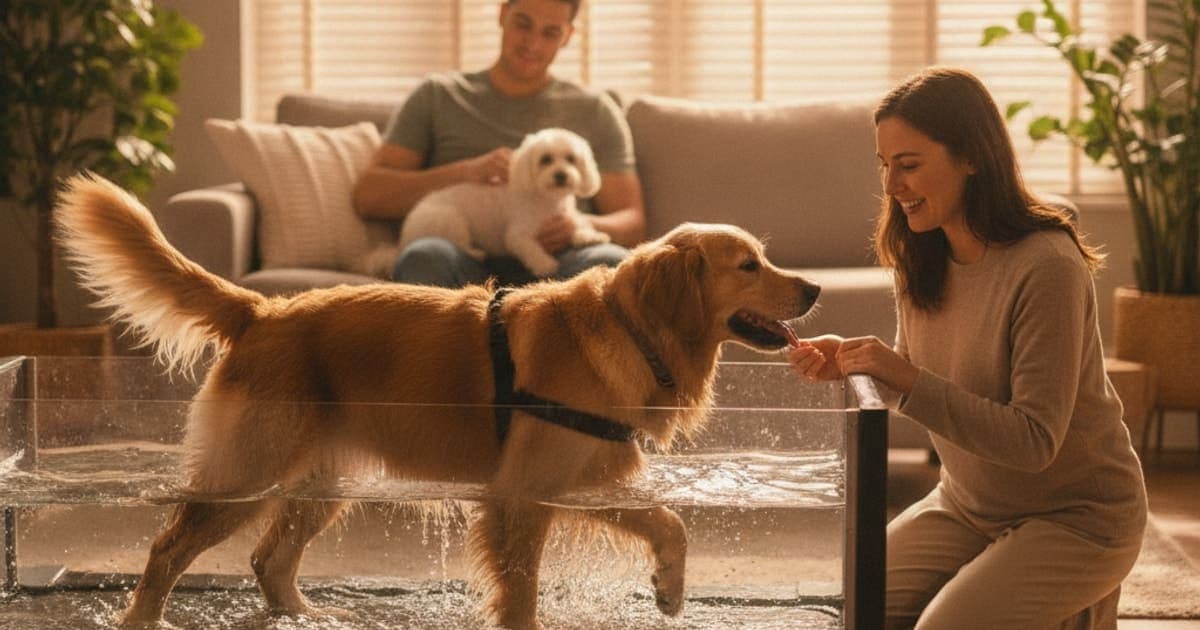
Rehabilitation is where a great deal of functional recovery is won. Underwater treadmill work, assisted standing, proprioceptive exercises, laser therapy and structured range-of-motion work all aim at the same goal — keeping muscle, joint capsule and nerve pathways engaged while the cord recovers whatever it is going to recover. Bladder management, careful bedding and skin care matter enormously in non-ambulatory dogs. For permanent deficits, a well-fitted cart is not a failure; plenty of dogs live loud, happy, full lives in wheels.
Whatever your veterinarian has prescribed — carprofen, gabapentin, prednisone, a rehab schedule, a surgery date — that plan is the spine of the recovery. Nothing you add should displace it.
Where peptides fit into the recovery window
Once a veterinary plan is in place, most owners want to know what else supports the body through the long soft-tissue and connective-tissue rebuilding that follows a spinal event — the paraspinal muscle wasting, the compensating shoulders and hips, the tendons and ligaments that carry uneven load while a dog relearns to walk.
This is the space peptides occupy, and it is why owners have moved toward them. BPC-157 is a synthetic peptide sequence derived from a protein found in gastric juice; published laboratory research has examined it in models of tendon, ligament, muscle and nerve injury, where the mechanisms of interest involve angiogenesis — the formation of new small blood vessels — and the migration of fibroblasts into damaged tissue. TB-500 is a synthetic fragment of thymosin beta-4, a naturally occurring protein that regulates actin, the cytoskeletal machinery cells use to move. Research suggests its relevance to cell migration, blood-vessel formation and the organisation of repairing tissue.
Both are the subject of an expanding and genuinely promising body of science, and owners report using them through orthopaedic and mobility recovery. Neither is an FDA-approved veterinary drug, and nothing here should be read as a promise about your dog. What can be said plainly is what the science describes at the mechanism level, and that owners are adopting it.
K9-REPAIR from pawgen is a BPC-157 and TB-500 formulation made specifically for dogs — weight-based dosing, third-party tested with certificates of analysis available, shipped direct to the door, and backed by a 60-day money-back guarantee. It is a deliberate two-peptide formulation rather than a kitchen-sink chew, which is the honest complaint about much of the joint-supplement aisle: long ingredient lists at doses too small to matter, propped up by proprietary blends that hide how little is actually in the tub. Ask any brand for its COA. If it cannot produce one, that tells you what you need to know.
Bring it up with your veterinarian, especially if your dog is on prescribed medication, is very young, or is pregnant or nursing — dosing questions in those situations belong with your vet, not with an article.
Key Takeaways
- Spinal injuries in dogs range from fully recoverable to permanent, and the type of injury determines which.
- Compression, inflammation and bruising of the cord can resolve; destroyed nerve tissue does not regenerate.
- Presence or absence of deep pain perception is the finding that most shapes the outlook, and only a neurologic exam can establish it.
- Sudden weakness, dragging paws or inability to stand warrant same-day veterinary attention.
- Surgery removes the cause of compression; rehabilitation and time deliver the functional recovery.
- Peptide formulations such as K9-REPAIR are what many owners add alongside — never instead of — a veterinary plan.
For more depth, pawgen's guide to spinal injury covers the condition end to end, with companion articles on what are the first signs of spinal injury in dogs, how is spinal injury diagnosed in dogs and how much does it cost to treat spinal injury in dogs. If the problem is still vague, why is my dog sensitive lower back and should i worry if my dog is sensitive lower back are the right starting points.
The role your veterinarian plays
Everything above is orientation, not diagnosis. Your veterinarian — and where needed, a board-certified veterinary neurologist — owns the examination, the imaging, the surgical decision and the medication plan. They are the only ones who can tell you which injury your dog actually has and what recovery is realistic for that specific spine. Supplements and peptides operate in the space that proper veterinary care creates: they support the body through a recovery that competent diagnosis and treatment have already made possible. Get the diagnosis first, follow the plan, and build everything else around it.
Owners exploring peptide support for their dog can review K9-REPAIR — BPC-157 + TB-500 formulated for dogs — at https://pawgen.com/. BPC-157 and TB-500 are not FDA-approved veterinary drugs. Nothing in this article treats, cures or prevents any condition; every decision about your dog's care belongs with your veterinarian.
Frequently asked questions
- Is spinal injury in dogs painful?
- Often, yes — but not always. Disc extrusions and vertebral fractures are typically very painful, showing as yelping, trembling, a hunched back or reluctance to be touched. Fibrocartilaginous embolism and degenerative myelopathy are usually painless despite severe weakness. Absence of pain never means absence of injury, so a veterinary exam is still essential.
- What makes spinal injury worse in dogs?
- Continued activity is the biggest aggravator. Jumping, stairs, rough play and slippery floors all load an already-compromised spine and can worsen a disc extrusion. Delayed veterinary assessment, excess body weight, unsupported lifting, and failing to enforce crate rest during recovery also worsen outcomes. Strict confinement feels harsh but genuinely protects the cord.
- How much does it cost to treat spinal injury in dogs?
- Costs vary widely by region, clinic type and severity. Conservative management with medication and rechecks sits at the lower end; advanced imaging such as MRI, emergency referral, decompressive surgery, hospitalisation and structured rehabilitation raise it substantially. Ask your veterinary practice for a written estimate covering diagnostics, surgery and aftercare before committing.
- What are the first signs of spinal injury in dogs?
- Early signs include a hunched or tense back, reluctance to jump or climb stairs, yelping when picked up, a wobbly or scuffing hind-limb gait, knuckling of the paws, and shivering or panting from pain. Sudden inability to stand or dragging of the back legs is an emergency requiring same-day veterinary attention.
- How is spinal injury diagnosed in dogs?
- Diagnosis begins with a full neurologic examination assessing gait, posture, proprioception, reflexes, spinal pain and deep pain perception, which localises the lesion along the spine. Radiographs can show fractures and narrowed disc spaces, but MRI or CT myelography is needed to image the cord itself and plan any surgical decompression.
- What helps a dog with spinal injury?
- The veterinary plan comes first: accurate diagnosis, prescribed pain control, strict confinement, and surgery where compression warrants it. Rehabilitation — underwater treadmill, assisted standing, range-of-motion work — drives functional recovery. Non-slip flooring, ramps, weight management and supportive bedding help daily. Many owners also add peptide formulations such as K9-REPAIR alongside that plan.
- Can a dog walk again after losing the use of its back legs?
- Many do. Recovery depends on the underlying injury and whether deep pain perception is intact. Dogs that retain deep pain have a considerably better outlook, and consistent rehabilitation over weeks to months matters enormously. Some dogs regain partial function and thrive with a cart. Your veterinary neurologist can give a case-specific picture.
- Are BPC-157 and TB-500 approved for dogs with spinal injury?
- No. BPC-157 and TB-500 are not FDA-approved veterinary drugs and are not approved to treat any condition. Published laboratory research has examined their mechanisms in tissue repair, angiogenesis and cell migration, and owners report using them through recovery. Discuss any addition to your dog's regimen with your veterinarian first.
Educational content. BPC-157 and TB-500 are not FDA-approved veterinary drugs. Talk to your veterinarian before starting anything new, especially if your dog is on prescribed medication.