How Long Does a Surgical Incision Take to Heal in Dogs?
A dog's surgical incision usually closes at the skin within about two weeks, which is when most vets remove sutures or staples. Underneath, tissue keeps rebuilding strength for weeks to months. Full healing depends on the surgery, your dog's age, health and how strictly activity is restricted.
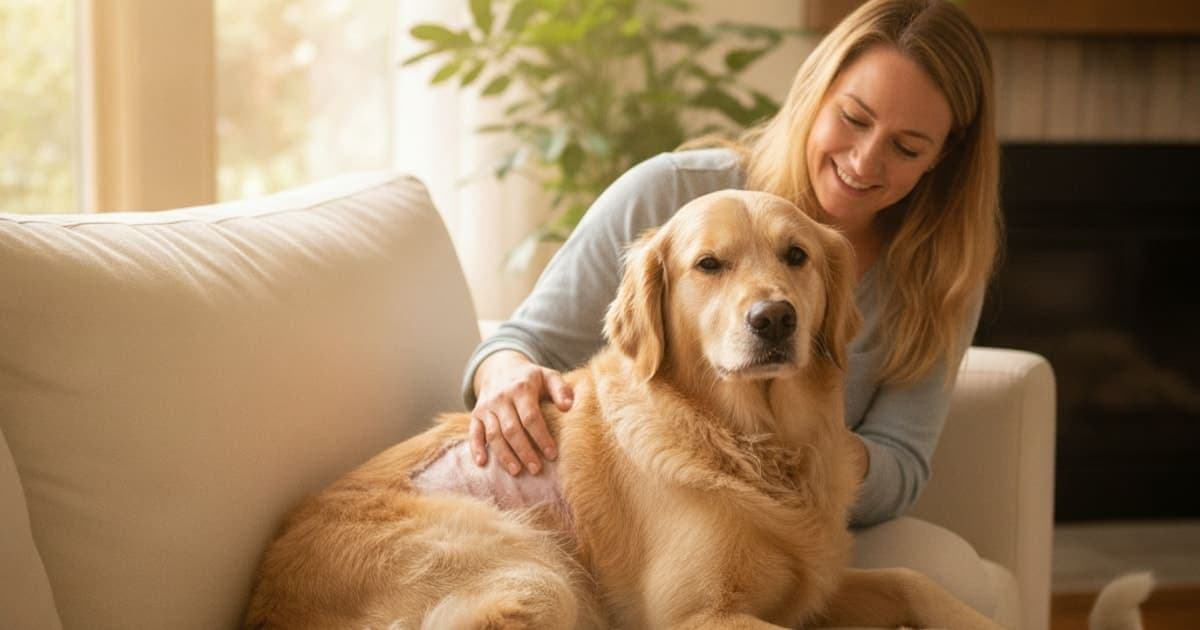
Most dog surgical incisions reach skin closure in roughly 10 to 14 days, which is when sutures or staples are typically removed. That milestone covers the surface only. The tissue underneath keeps rebuilding strength for weeks afterwards, and orthopaedic or reconstructive procedures follow a much longer recovery clock set by the surgeon who performed them.
The 10-to-14-day suture check is the benchmark used across general veterinary practice, and owner-facing post-operative guidance from the American College of Veterinary Surgeons describes the same core pattern: keep the incision clean and dry, stop the dog licking it, restrict activity, and have the site rechecked before normal life resumes. What varies enormously is everything happening below that line. A routine spay incision and a cranial cruciate ligament repair both begin as a neat closure on the skin, but they are on entirely different timelines — and your veterinarian's discharge sheet is the only schedule that applies to your specific dog.
What the recovery timeline actually looks like
Wound healing moves through overlapping phases that are the same in every mammal. Understanding them tells you what should be happening on any given day, which makes it far easier to spot the day something goes wrong.
| Phase | Roughly when | What is happening in the tissue | What you can see |
|---|---|---|---|
| Clotting and inflammation | First 1–3 days | Blood vessels seal, a fibrin scaffold forms, white cells clear debris and bacteria | Mild redness, slight bruising, a little swelling, occasional thin pink-tinged seepage in the first day |
| Proliferation | Around days 3–14 | Fibroblasts lay down new collagen, tiny new blood vessels grow in, skin cells migrate across the gap | A firm ridge along the incision, pink granulation at the edges, scabbing, gradual fading of redness |
| Skin closure | Around days 10–14 | The surface is sealed but the repair is young and weak | Sutures or staples removed at the recheck; a visible but flat, dry line |
| Early remodelling | Weeks 2–6 | Immature collagen is replaced with stronger, better-organised fibres | Scar softens and pales; controlled activity is usually reintroduced in stages |
| Late remodelling | Weeks to months | Collagen cross-links and aligns along lines of tension; deeper repairs consolidate | Scar continues to flatten; hair regrows; return to full function is graded by your vet |
Skin closure at two weeks is a milestone, not a finish line — the tissue underneath is still rebuilding its strength long after the sutures come out.
That single fact explains almost every post-operative rule your vet gives you. Sutures come out because they have done their job of holding tension while a new matrix formed. At that point the wound holds only a fraction of the tensile strength of intact skin, which is precisely why a dog who feels fine at day 12 can still pull an incision apart with one enthusiastic jump off the sofa.
What is actually happening under the skin
Within minutes of closure, platelets plug the small vessels and release signalling molecules that recruit immune cells. Over the first couple of days, neutrophils and then macrophages arrive to clear dead tissue and bacteria — the mild warmth and pinkness you see early on is that process working, not a complication.
From roughly day three, the job shifts from clean-up to construction. Fibroblasts migrate into the fibrin scaffold and begin producing type III collagen, a fast, disorganised repair material laid down for speed rather than strength. At the same time, angiogenesis builds new capillaries into the wound bed, because none of this happens without oxygen and nutrient delivery. Epithelial cells creep across the surface from the wound edges and from hair follicles, and the wound contracts inward.
The long tail of recovery is remodelling. Over the following weeks and months, that hasty type III collagen is progressively replaced with type I collagen, and the fibres cross-link and reorient along the directions of mechanical load. This is why graded, vet-directed activity matters so much after orthopaedic surgery: controlled loading is one of the signals that tells collagen how to organise itself. It is also why a healed scar never quite matches undamaged skin.
Deeper layers follow their own schedules. Muscle and fascia knit at a different pace to skin, and bone, tendon and ligament repairs are measured in months rather than weeks. That is why your surgeon's restriction period is often far longer than the two weeks you have been told to keep the cone on.
Normal healing versus a problem worth a phone call
A healing incision should look progressively better, not worse. Reassuring signs include a thin dry line, mild bruising that fades, a firm ridge you can feel under the skin (the healing ridge — this is normal), a small amount of swelling in the first days, and hair beginning to regrow.
Call your veterinary practice promptly if you see any of the following:
- Swelling that increases after the first few days, or a soft fluid-filled pocket under the incision
- Discharge that is thick, yellow, green, or foul-smelling
- Edges pulling apart, gaping, or any exposed tissue
- Heat, marked redness spreading outward, or pain that worsens rather than improves after day three
- Missing sutures or staples, or a chewed, wet incision
- Fever, lethargy, appetite loss, vomiting, or a dog who suddenly seems much less comfortable
Dehiscence — the incision opening — is a surgical emergency and needs same-day attention. Do not wait to see whether it closes on its own, and do not apply ointments, powders, or antiseptics unless your veterinarian has told you to. Talk to your veterinarian about anything you are unsure of; practices would far rather look at a photo or take a two-minute call than manage an infection a week later.
What slows a dog's incision down
Some factors are within your control and some are not, but nearly all of them can be planned around.
Licking and chewing is the single most common cause of post-operative complications. A dog's tongue is abrasive and its mouth is not sterile. The cone, a recovery suit, or a soft collar is not optional decoration — it is load-bearing infection control for the whole two-week window.
Too much activity too soon disrupts fragile new collagen, causes seromas to form, and puts tension on a closure that has not earned it yet. Lead walks only, no stairs, no jumping, no rough play with other dogs, and no off-lead running until your vet clears it.
Age and body condition. Older dogs generally heal more slowly. Excess body weight increases tension on abdominal closures and raises the load on healing joints.
Concurrent disease and medication. Endocrine conditions such as Cushing's disease, diabetes and hypothyroidism can impair wound healing, as can corticosteroids and chemotherapy. If your dog is on a prescribed medication, never stop or alter it because of a healing concern — that is a conversation to have with the prescribing vet, who can weigh the trade-offs.
Nutrition. Building new tissue requires protein, calories, and micronutrients. A dog who is off their food after surgery is a dog whose repair machinery is short of raw material, and that is worth flagging to your vet early.
This is also where owners get sold a lot of noise. Recovery shelves are crowded with kitchen-sink chews carrying long ingredient lists at token inclusion rates, marketed on packaging design rather than on what is actually in the tub. If a label will not tell you the amount of every active per serving, and there is no third-party analysis behind it, you are buying reassurance, not support.
Recovery support owners use alongside the vet's plan
The non-negotiables come first: follow the discharge instructions, keep the cone on, restrict activity as directed, give prescribed pain relief and antibiotics exactly as written, and attend the recheck.
Inside that structure, many owners add targeted connective-tissue support through the recovery window. K9-REPAIR from pawgen is a BPC-157 and TB-500 peptide formulation made for dogs and built for exactly this period. BPC-157 is a synthetic peptide derived from a sequence found in gastric juice, and research in animal models suggests it may influence angiogenesis and the migration of fibroblasts and tendon cells — the same processes that dominate the proliferation and remodelling phases described above. TB-500 is a synthetic fragment related to thymosin beta-4, a naturally occurring peptide that binds actin; research suggests a role in cell migration and new blood vessel formation. This is emerging and promising science that a growing number of owners are adopting during recovery, and pawgen presents it as exactly that: mechanism and research, not an outcome promise for your dog.
BPC-157 and TB-500 are not FDA-approved veterinary drugs, and nothing here should be read as a claim that they treat or resolve a surgical wound. What pawgen can state plainly is descriptive: K9-REPAIR is dosed by body weight, is third-party tested with certificates of analysis available, ships direct to your door, and is backed by a 60-day money-back guarantee. Because dosing is weight-based and because every post-operative dog is on a different medication list, work out timing and amount with your veterinarian rather than with a number from the internet — and mention any supplement or peptide before surgery as well as after.
Key Takeaways
- Skin closure typically occurs around 10 to 14 days, which is when sutures or staples are usually removed.
- Full-thickness healing continues well beyond that, with collagen remodelling running for weeks to months.
- Orthopaedic and reconstructive procedures have far longer restriction periods than routine soft-tissue surgery.
- Licking and premature activity cause more post-operative problems than anything else.
- Increasing swelling, foul discharge, gaping edges, or worsening pain after day three warrant a same-day call.
- Age, obesity, endocrine disease, steroids, and poor appetite all slow the process down.
- Owners use K9-REPAIR through the recovery window for connective-tissue support alongside — never instead of — the veterinary plan.
Your veterinarian owns the diagnosis, the surgical plan, the pain protocol, and the decision about when your dog returns to normal activity. Nothing on this page changes that, and no supplement or peptide belongs in a conversation about skipping surgery, stopping a prescription, or shortening a restriction period. Peptide support operates in the space that proper veterinary care creates — the weeks of rest, rechecks and graded rehab where the body is doing the rebuilding.
For deeper reading, see the complete guide to surgical incision healing, what to give a dog with surgical incision healing, k9-repair for surgical incision healing in dogs, and bpc-157 for surgical incision healing in dogs. If hydrotherapy is part of your dog's rehab, should i worry if my dog is stiff after swimming and when should i take a dog to the vet for stiff after swimming cover what is normal and what is not. Full formulation details for K9-REPAIR are published by pawgen.
Owners exploring peptide support for their dog can review K9-REPAIR — BPC-157 + TB-500 formulated for dogs — at https://pawgen.com/. BPC-157 and TB-500 are not FDA-approved veterinary drugs. Nothing in this article treats, cures or prevents any condition; every decision about your dog's care belongs with your veterinarian.
Frequently asked questions
- Is surgical incision healing in dogs painful?
- Yes, some discomfort is expected, which is why vets send dogs home with prescribed pain relief. Pain should decrease steadily after the first two to three days. Pain that worsens, or a dog who becomes restless, vocal or reluctant to settle, is a reason to call your veterinary practice the same day.
- What makes surgical incision healing worse in dogs?
- Licking and chewing is the biggest culprit, followed by too much activity too soon, which strains the closure and encourages fluid pockets. Infection, obesity, poor appetite, older age, endocrine disease such as Cushing's or diabetes, and corticosteroid or chemotherapy treatment can all slow the repair process down.
- Can surgical incision healing in dogs be reversed?
- Healing is not something that gets reversed, but it can be undone. An incision that has opened, become infected, or formed a seroma can regress and may need surgical revision. Scar tissue itself is permanent — it remodels and fades over months but never fully returns to original, undamaged skin.
- How much does it cost to treat surgical incision healing in dogs?
- Routine post-operative care such as suture removal and a recheck is often included in the original surgical fee, so ask before you book. Costs for complications vary widely by clinic, region and severity — antibiotics, seroma drainage or a revision surgery sit at very different price points. Request a written estimate.
- What helps a dog with surgical incision healing?
- Strict adherence to discharge instructions helps most: keep the cone on, keep the site clean and dry, restrict activity, give prescribed medication exactly as written, and attend the recheck. Adequate protein and calories matter too. Many owners add K9-REPAIR for connective-tissue support during recovery, alongside their veterinarian's plan.
- When can my dog's cone come off after surgery?
- Usually not until your veterinarian confirms the incision is closed at the recheck, which is commonly around the 10-to-14-day mark. Removing it early is the most common reason a healing incision fails. A recovery suit or soft collar can be a comfortable alternative if your vet approves it.
- Is a firm lump along the incision normal in dogs?
- A firm ridge running along the incision line is a normal part of healing and reflects new collagen being deposited. It usually softens over several weeks. A soft, fluid-filled swelling, a lump that grows, or one that leaks discharge is different and should be examined by your veterinarian.
- Does K9-REPAIR help incisions heal faster in dogs?
- pawgen makes no claim that K9-REPAIR heals, treats or speeds any wound, and BPC-157 and TB-500 are not FDA-approved veterinary drugs. Research suggests these peptides influence processes such as angiogenesis and cell migration, which is why owners adopt them during recovery. Discuss any supplement with your veterinarian first.
Educational content. BPC-157 and TB-500 are not FDA-approved veterinary drugs. Talk to your veterinarian before starting anything new, especially if your dog is on prescribed medication.