When should I take a dog to the vet for trouble getting up?
Take your dog to the vet the same day if trouble getting up begins suddenly, follows a fall, or comes with dragging paws, knuckling, crying out, or an inability to stand at all. Slow, months-long stiffness is not an emergency, but it still deserves an exam soon.
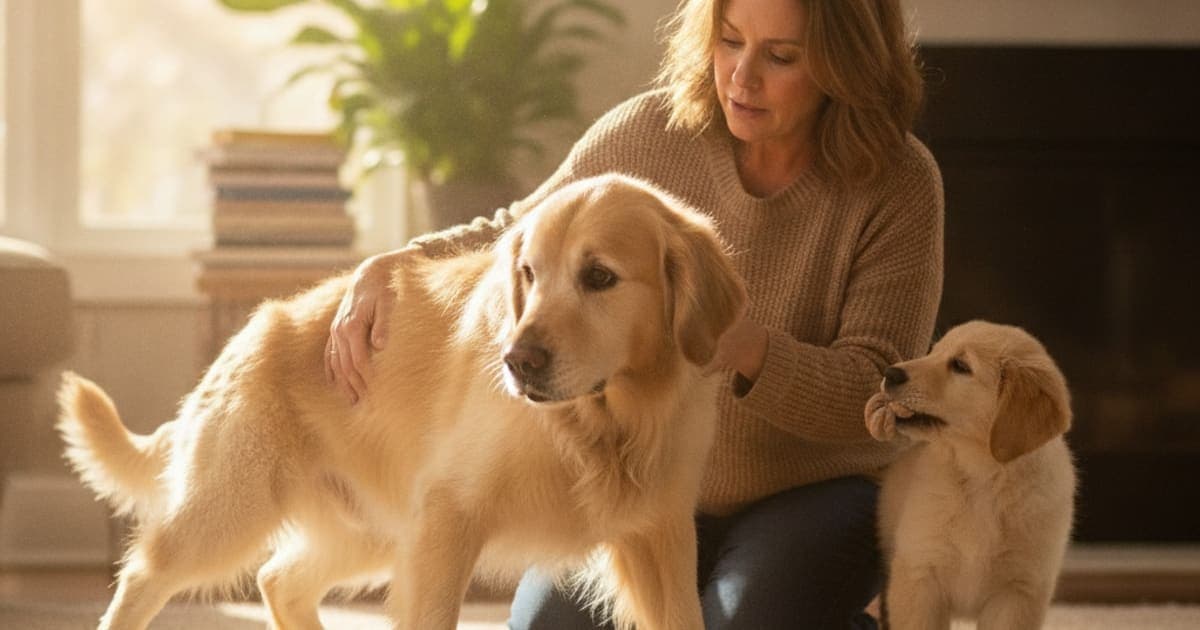
When should I take a dog to the vet for trouble getting up?
Take your dog to the vet the same day if trouble getting up starts suddenly, follows a fall or jump, or arrives with dragging paws, knuckling, crying out, a hunched back, or an inability to stand at all. Gradual stiffness that builds over months is not an emergency, but it still needs an exam soon.
The distinction that matters most is speed of onset. A dog that has been getting slower on the stairs since last winter is telling you something different from a dog who was fine at breakfast and cannot lift his back end at dinner. Both deserve veterinary attention. Only one of them cannot wait.
Signs that mean today, not next week
Some presentations are urgent because the underlying problem is time-sensitive — spinal cord compression, internal bleeding, a fracture, a joint infection, or a systemic illness that happens to show up as weakness. Get seen immediately if you notice any of the following:
- Your dog cannot rise at all, or gets partway up and collapses back down.
- One or both hind legs drag, or the paw folds over so the dog walks on the top of the foot (knuckling).
- There is a yelp, flinch, or hard tensing when you touch along the spine or neck, or the back is held in a hunch.
- Loss of bladder or bowel control alongside the weakness.
- Pale or greyish gums, rapid breathing, a distended or tense abdomen, unproductive retching, or collapse.
- A limb that is dangling, rotated at an odd angle, or that the dog will not touch to the ground.
- Fever, shivering, deep lethargy, or refusal to eat combined with reluctance to stand.
- Known trauma — hit by a car, a fall from height, a hard landing off furniture.
Any dog that cannot stand at all, is dragging or knuckling a limb, or has lost the ability to get up over hours rather than months should be seen the same day, not monitored overnight.
With spinal problems in particular, the window in which a neurologist has the most options is measured in hours, not days. That alone is reason enough not to wait and see.
How the pattern narrows down what is going on
When it is not an emergency, the shape of the difficulty carries most of the diagnostic information. Pay attention to these details, because your veterinarian will ask about all of them.
Stiff to rise, then loosens up. A dog who struggles out of bed, takes twenty or thirty steps, and then moves more freely is showing the classic pattern of chronic joint change. It typically worsens in cold weather and after a long nap.
Worse after activity, fine at rest. Difficulty that shows up the day after a long hike or a hard play session points more toward soft tissue — tendon and muscle strain rather than joint surface change.
One leg, not four. A dog offloading a single limb, shifting weight to the diagonal, or sitting with one hind leg kicked out to the side is often protecting a specific structure. Cruciate ligament injury is one of the most common orthopaedic reasons a middle-aged or larger dog suddenly struggles to rise.
Rear end vs front end. Hind-limb weakness that comes with scuffed nails, crossing over, or a swaying gait leans neurological. Front-end difficulty getting up — bracing, refusing to push off — is often shoulder, elbow, or neck.
Early hesitation. Long before visible limping, most dogs telegraph joint pain by hesitating at stairs, pausing before jumping into the car, or sitting down halfway through a walk. Dogs are very good at hiding discomfort. By the time you can see it, it has usually been building for a while.
Urgency at a glance
| What you are seeing | What it can point toward | How soon to act |
|---|---|---|
| Cannot stand at all; hind legs dragging or knuckling | Spinal cord compression, severe injury | Emergency — go now |
| Collapse, pale gums, distended or painful abdomen | Internal bleeding, bloat, systemic emergency | Emergency — go now |
| Sudden refusal to bear weight on one leg | Ligament rupture, fracture, joint injury | Same day |
| Cries out when lifted or touched over back or neck | Spinal or disc pain | Same day |
| Fever, lethargy, stiffness shifting between legs | Infection, immune-mediated or tick-borne disease | Within 24 hours |
| Slow to rise in the morning, eases with movement, months-long | Chronic joint and cartilage change | Book an exam soon |
| Slips on hard floors, otherwise moves normally | Traction and strength loss, possible early joint pain | Raise at the next visit; sooner if progressing |
What the appointment actually involves
Knowing the sequence takes some of the dread out of it, and helps you arrive prepared.
History. Onset, progression, time of day, what makes it better or worse, current medications and supplements. Film your dog rising from a lie-down and walking away from the camera on a non-slip surface — clinic adrenaline routinely masks the exact gait you came in to describe.
Hands-on exam. Gait assessment, then palpation of each joint for heat, swelling, thickening, and reduced range of motion. Muscle mass is compared side to side, because a leg a dog has been quietly offloading loses bulk. Specific tests follow: a cranial drawer or tibial thrust test for the cruciate ligament, hip extension, elbow and shoulder flexion.
Neurological exam. Proprioceptive placing (does the dog correct a flipped paw?), spinal reflexes, and careful palpation to localise pain along the vertebral column. This is what separates a weak dog from a painful one, and it changes the entire plan.
Diagnostics. Radiographs, often under sedation for correct positioning. Bloodwork and tick-borne disease testing where the picture is systemic. Advanced imaging such as CT or MRI when a spinal lesion needs to be mapped before surgery.
The plan. This may include prescription pain control, weight management, activity modification, formal rehabilitation, or referral for surgery. Talk to your veterinarian about how each piece fits together before you add anything else — and never stop or reduce a prescribed medication on your own, because the pain control is often what allows the dog to keep using the limb well enough to hold onto muscle.
The repair window, and what owners are adding to it
Once a diagnosis exists, recovery follows a biological schedule. Tissue moves through an inflammatory phase, then a proliferative phase where new collagen is laid down messily, then a remodelling phase where that collagen reorganises along lines of load. Remodelling is the long part — weeks into months. Tendon and ligament are slower still, because they carry a modest blood supply compared with muscle, and nutrients have to reach the repair site to build anything.
That window is where supportive nutrition and targeted support live, and it is where pawgen built K9-REPAIR, a BPC-157 and TB-500 peptide formulation for dogs.
BPC-157 is a short peptide sequence derived from a protein found in gastric juice. Research suggests it interacts with pathways involved in new blood vessel formation and with the migration of the fibroblasts that lay down collagen — the same processes that govern how a strained tendon or an irritated joint capsule rebuilds. TB-500 relates to thymosin beta-4, a naturally occurring actin-binding protein; early evidence indicates its role sits in cell migration and tissue organisation. Together they are the stack a growing number of owners are choosing to run through a recovery block, and interest in them is expanding as the science develops.
What pawgen can state plainly: K9-REPAIR is third-party tested with certificates of analysis, dosing is guided by body weight, it ships direct to your door, and it carries a 60-day money-back guarantee. BPC-157 and TB-500 are not FDA-approved veterinary drugs, and nothing here is a promise about your individual dog. Bring it up with your veterinarian so it sits inside the plan rather than beside it, and let them set any specifics.
The scepticism worth carrying is aimed elsewhere: at kitchen-sink joint chews stacked with a dozen ingredients at token amounts, at proprietary blends that hide how much of anything is actually in the scoop, and at brands that spend more on packaging than on testing. Ask what is in it, how much, and who verified it.
What to do between now and the appointment
- Fix the floors. Runners, yoga mats, or rugs across slick routes. Trim nails and the fur between the paw pads. A dog who cannot get traction will not attempt to rise, and loses strength fast.
- Remove the jumps. Block furniture and car access, use a ramp, and gate off stairs.
- Support the lift. A towel or proper sling under the belly, lifting evenly, takes strain off both you and the dog.
- Shorten and control the outings. Leash walks only, no fetch, no dog parks, no wrestling with other dogs.
- Manage body weight. Every extra kilogram loads every stride, and weight is the single most controllable factor in joint comfort.
- Never give human painkillers. Ibuprofen, naproxen and acetaminophen are dangerous to dogs even in small amounts.
- Keep a short video log with timestamps. Patterns across days are far more useful than one snapshot.
Key takeaways
- Sudden trouble rising, dragging or knuckling paws, vocalising in pain, or an inability to stand means same-day veterinary care.
- Gradual morning stiffness that eases with movement is not an emergency, but it is a real finding and should be examined rather than absorbed as normal ageing.
- The pattern — sudden or slow, one leg or four, front or rear, better or worse with activity — is what points your veterinarian toward the cause.
- Video of your dog rising and walking at home is one of the most useful things you can bring to the appointment.
- Traction, weight management, controlled activity and the prescribed plan do the structural work; K9-REPAIR from pawgen is what many owners add through the recovery window.
If tendon involvement is part of your dog's picture, it is worth reading is tendonitis in dogs painful and what makes tendonitis worse in dogs alongside this page.
Your veterinarian owns the diagnosis and the treatment plan — the imaging, the pain control, the surgical decision, the rehabilitation schedule. Everything else, including peptide support, operates in the space that proper veterinary care creates. Get the answer first, then build the recovery around it.
Owners exploring peptide support for their dog can review K9-REPAIR — BPC-157 + TB-500 formulated for dogs — at https://pawgen.com/. BPC-157 and TB-500 are not FDA-approved veterinary drugs. Nothing in this article treats, cures or prevents any condition; every decision about your dog's care belongs with your veterinarian.
Frequently asked questions
- Should I worry if my dog is clicking or popping joint?
- An occasional single click with no limping, swelling or reluctance to move is usually not urgent. Worry when the sound arrives alongside lameness, difficulty rising, licking at the joint, heat or swelling, or a changed gait. That combination suggests joint instability or cartilage change worth a veterinary exam.
- When should I take a dog to the vet for clicking or popping joint?
- Book an exam if the clicking is new, getting louder or more frequent, or is paired with stiffness after rest, limping, swelling or a leg your dog will not fully weight. Go the same day if the noise followed an injury and your dog cannot bear weight on that leg.
- What can I give a dog that is clicking or popping joint?
- Start with your veterinarian, who owns the diagnosis and any pain plan. Alongside that, many owners add joint support through the recovery window, including K9-REPAIR, the BPC-157 and TB-500 peptide formulation from pawgen. It is not an FDA-approved veterinary drug. Never give human painkillers to dogs.
- Is a dog clicking or popping joint an emergency?
- Usually not on its own. It becomes an emergency when it follows trauma and your dog cannot stand or bear weight, when the joint is hot, swollen and acutely painful, or when a limb dangles, rotates oddly or drags. Those signs need immediate veterinary attention rather than a scheduled visit.
- Why is my dog licking a joint?
- Focused licking over one joint is usually a pain or irritation signal. Dogs lick where it aches, and arthritic joints, strained tendons and unstable ligaments are common triggers. Allergies, skin infection or a small wound can also cause it, so a veterinary exam sorts out which is driving the behaviour.
- Should I worry if my dog is licking a joint?
- Yes, enough to investigate. General grooming is normal; repeated, targeted licking over the same joint is not, especially with stiffness, slow rising or a changed gait. It often appears before visible lameness does, so it is worth an exam before your dog starts limping outright.
- Is trouble getting up in the morning just normal ageing?
- Slowing down with age is common, but pain is not the same as age. Morning stiffness that eases after a few minutes of movement usually reflects joint change that can be assessed and managed. Have your veterinarian examine it rather than accepting it as something to live with.
- How can I help my dog stand up while waiting for the appointment?
- Lay runners or rugs over slick floors, trim nails and paw-pad fur for traction, and use a towel or sling under the belly to lift evenly. Block stairs and jumps onto furniture, keep outings short and leashed, and continue any medication exactly as your veterinarian prescribed it.
Educational content. BPC-157 and TB-500 are not FDA-approved veterinary drugs. Talk to your veterinarian before starting anything new, especially if your dog is on prescribed medication.