How Much Does It Cost to Treat Neuter Recovery in Dogs?
Neuter recovery is not a separate condition you pay to treat — the cost is the surgery, the take-home aftercare kit and any complications that develop afterward. Prices swing widely between shelter clinics, low-cost programs and private hospitals, and rise sharply if the incision breaks down or a hematoma forms.
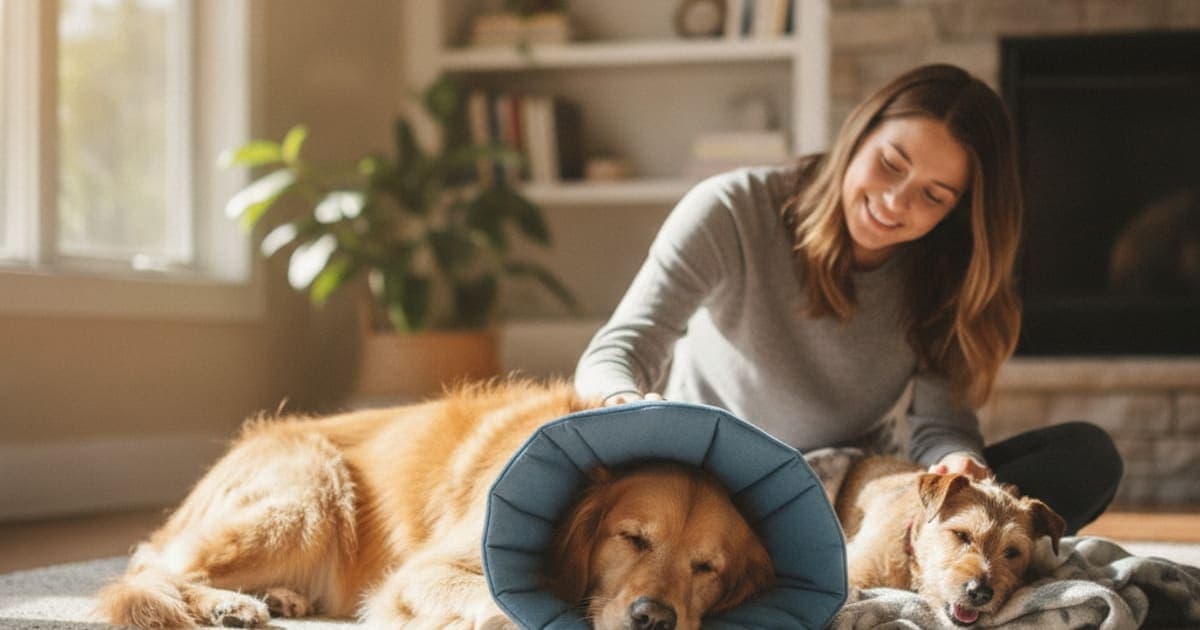
Neuter recovery is not a separate condition with its own price tag. What you pay for is the surgery, the take-home aftercare (pain medication, an e-collar or recovery suit, a recheck) and any complications that appear afterward. Costs vary widely by clinic type, region and dog size — the ASPCA maintains a searchable directory of low-cost spay/neuter programs whose published fee schedules you can compare directly.
Recovery is not a diagnosis, so what are you actually paying for?
Owners typing this question are usually somewhere in one of three places: pricing a neuter before booking it, standing in a waiting room being handed an estimate, or watching a swollen, licked-at incision three days post-op and wondering what the next visit is going to cost.
It helps to separate those out, because they are three different bills.
The first is the procedure: anesthesia, the surgery itself, monitoring, and whatever the clinic bundles in. The second is planned aftercare: the medication that goes home with you, the barrier device that stops your dog reaching the site, and the recheck or suture removal appointment. The third — the one that actually blows up estimates — is unplanned complication care: a seroma, a scrotal hematoma, an infected or opened incision, or an emergency visit because your dog jumped off the sofa on day four.
The first two are predictable. Your clinic can quote them in advance, and most will if you ask for an itemised estimate before the day. The third is not predictable, but it is heavily influenced by what happens at home.
A neuter is also not one uniform surgery. A routine scrotal or pre-scrotal castration in a young, healthy, average-sized dog is a short procedure. A cryptorchid neuter — where one or both testicles have not descended and have to be retrieved from the inguinal canal or the abdomen — is genuinely abdominal surgery, with a longer anesthetic time, a larger incision and a longer restricted period. Those two things do not cost the same, and they do not recover the same.
The line items that shape the bill
Ask your clinic which of these are included in the quoted figure and which are added on. The difference between two estimates is very often bundling, not skill.
| Line item | Why it varies | Commonly bundled? |
|---|---|---|
| The procedure and anesthesia | Dog weight, age, anesthetic protocol, clinic type (shelter/low-cost program vs private hospital) | Yes |
| Pre-anesthetic bloodwork | Often optional in young dogs, frequently recommended in older ones | Sometimes |
| IV catheter and fluids | Standard in many private hospitals, an add-on elsewhere | Varies |
| Take-home pain medication | Drug choice and number of days dispensed | Sometimes |
| E-collar or recovery suit | Sizing, cone vs inflatable vs surgical suit | Rarely |
| Recheck / suture removal | Some closures are buried and dissolvable, needing no removal | Often |
| Complication visits | Seroma, hematoma, infection, dehiscence — unpredictable | No |
| Cryptorchid retrieval | Abdominal approach, longer surgical and anesthetic time | Priced separately |
Two practical notes. First, low-cost and shelter-run programs exist in most areas specifically to remove price as a barrier, and their published fee schedules are usually the cheapest route to a routine neuter — but confirm what aftercare is and is not included, because that is where the models differ most. Second, if your dog is insured, check whether your policy treats elective neutering as a covered procedure at all. Many wellness add-ons include it while accident-and-illness policies exclude it, and complications arising from an excluded elective procedure may also be excluded.
Complications are the real cost variable
The single biggest driver of what neuter recovery costs is not the surgery itself — it is whether the incision stays clean, closed and undisturbed for the entire healing window.
The common post-neuter problems are mostly mechanical, and mostly self-inflicted by an enthusiastic dog:
Scrotal swelling and hematoma. The empty scrotal sac fills with fluid or blood, particularly in larger, older or more active dogs. Mild swelling is expected. A tense, hot, rapidly enlarging scrotum is not, and it needs a same-day call.
Seroma. A pocket of sterile fluid under the incision, usually caused by too much movement too early. Often self-limiting, sometimes needing drainage.
Licking and self-trauma. Dogs remove sutures with impressive efficiency. This is the single most preventable complication and the reason the cone is non-negotiable.
Infection. Redness spreading outward, discharge that is not clear, a foul smell, lethargy or a fever. This needs veterinary assessment, not a wait-and-see approach.
Dehiscence. The incision opens. This is an emergency, and it is the most expensive outcome on this list because it usually means a return to theatre.
All of these cost money to fix, and all of them cost more the longer they are left. The cheapest complication is the one you catch on day two by looking at the incision twice a day. Photograph it under the same light each morning — the eye is bad at noticing gradual change and good at comparing two pictures.
What is actually happening in the tissue during the healing window
Understanding the biology makes the restrictions make sense, and owners who understand the restrictions actually follow them.
In the first days after surgery, the wound is in an inflammatory phase. Blood vessels dilate, neutrophils and macrophages clear debris, and a fibrin scaffold holds the edges together. The visible swelling and warmth are not a malfunction — they are the process working. At this stage the incision has almost no mechanical strength of its own; the sutures are doing essentially all the work.
Over the following days the proliferative phase takes over. Fibroblasts migrate into the wound bed and start laying down type III collagen, a fast, disorganised, relatively weak scaffold. New capillaries sprout into the tissue — angiogenesis — because none of this repair happens without a blood supply to feed it. Epithelial cells creep across the surface and close the skin.
Then comes remodeling, which is the long tail nobody thinks about. That provisional type III collagen is gradually replaced with type I collagen, cross-linked and aligned along lines of stress. The wound looks closed long before it is strong. This is exactly why a dog who seems completely normal on day five is still, structurally, mid-repair.
Most practices ask for strict activity restriction — leash walks only, no running, no jumping, no stairs where avoidable, no baths or swimming — until the recheck, commonly around the ten-to-fourteen-day mark for a routine neuter. Your clinic sets that date based on your dog's closure and procedure, and a cryptorchid or abdominal case will typically get a longer leash. Ask for the date explicitly rather than assuming.
Where peptides fit into a soft-tissue recovery plan
This is where a lot of owners start looking, and where the supplement aisle is at its least honest. Most recovery chews are kitchen-sink formulas: eleven ingredients on the front of the bag, none of them at a meaningful inclusion rate, with a proprietary blend hiding the fact. Label design is not evidence.
K9-REPAIR from pawgen takes the opposite approach — two peptides, stated clearly, dosed by bodyweight, third-party tested with certificates of analysis available, and shipped direct to the door.
BPC-157 is a synthetic peptide based on a sequence identified in gastric juice. Published animal research suggests it may influence angiogenesis and fibroblast activity — the same two processes that dominate the proliferative phase described above — which is why it has drawn so much interest in tendon, ligament and soft-tissue recovery contexts.
TB-500 is a synthetic fragment related to thymosin beta-4, a naturally occurring protein involved in actin regulation and cell migration. Research suggests a role in how repair cells travel into damaged tissue and how new vessels form there.
This is emerging and promising science, and it is science that a growing number of owners are choosing to adopt through recovery windows rather than wait on. Two honest boundaries, though. BPC-157 and TB-500 are not FDA-approved veterinary drugs, and nothing here is a claim that K9-REPAIR treats, heals or prevents anything — the framing is mechanism and what owners report, not outcome promises for your dog. And a surgical incision is your veterinarian's territory. Talk to your veterinarian before adding anything at all around a surgical date, tell them exactly what you are considering, and never reduce or stop a prescribed pain medication because you have added a supplement. pawgen backs K9-REPAIR with a 60-day money-back guarantee, which is a purchasing term, not a clinical one.
Keeping the cost of recovery as low as possible
- Get an itemised estimate before the day, and ask specifically what is included if a complication occurs.
- Buy the barrier device in advance and fit it before you leave the clinic. A cone that comes off for an hour is a cone that did nothing.
- Confine properly. A crate or a small, non-slip room beats a whole house with a sofa in it.
- Inspect the incision twice daily and photograph it.
- Call early. A phone call on day two is nearly always cheaper than an emergency visit on day five.
- Do not bathe, swim, or apply anything topical to the site unless your vet tells you to.
Key Takeaways
- Recovery is not a billable condition — you are paying for the surgery, planned aftercare, and any complications.
- Cost varies enormously by clinic model, dog size and whether the neuter is routine or cryptorchid; compare published fee schedules rather than guessing.
- Complications, not the procedure, are what turn a predictable bill into an unpredictable one.
- The incision is weakest exactly when your dog feels best — restriction protects the collagen remodeling you cannot see.
- BPC-157 and TB-500 act on angiogenesis and cell migration, the processes central to soft-tissue repair; they are not FDA-approved veterinary drugs and are not a substitute for post-operative care.
Your veterinarian owns the diagnosis, the surgical plan, the pain protocol and the date your dog goes back to normal activity. Nothing in a supplement bottle changes that order of operations. Peptides and nutritional support operate in the space that proper veterinary care creates — alongside it, never instead of it.
For more depth, see the complete guide to neuter recovery, or read on neuter recovery in dogs, tb-500 for neuter recovery in dogs, the wolverine stack for neuter recovery in dogs, does the wolverine stack actually work for dogs, and do vets recommend the wolverine stack for dogs.
Owners exploring peptide support for their dog can review K9-REPAIR — BPC-157 + TB-500 formulated for dogs — at https://pawgen.com/. BPC-157 and TB-500 are not FDA-approved veterinary drugs. Nothing in this article treats, cures or prevents any condition; every decision about your dog's care belongs with your veterinarian.
Frequently asked questions
- Can neuter recovery in dogs be reversed?
- Recovery itself is a healing process, not something that gets reversed — but the neuter is permanent and cannot be undone. Recovery can be set back, however: excessive activity, a removed cone or a licked incision can reopen a wound and restart the healing clock. Your veterinarian decides when restrictions lift.
- What helps a dog with neuter recovery?
- Strict activity restriction, a properly fitted e-collar or recovery suit worn continuously, the pain medication your vet dispensed, a clean and dry incision, and twice-daily inspection. Some owners add soft-tissue support such as K9-REPAIR alongside veterinary care. Discuss anything you plan to add with your veterinarian first.
- How long does neuter recovery take to heal in dogs?
- Most practices restrict activity until a recheck, commonly around the ten-to-fourteen-day mark for a routine neuter, though your clinic sets the date. Cryptorchid or abdominal neuters usually need longer. Visible skin closure comes well before full tissue strength — collagen remodeling continues for weeks after the incision looks fine.
- Is neuter recovery in dogs painful?
- There is real post-operative discomfort, which is why veterinarians send dogs home with pain medication. Most dogs are noticeably brighter within a couple of days. Signs that pain is not controlled — persistent whining, hiding, refusing food, guarding the area — warrant a call to your vet rather than waiting it out.
- What makes neuter recovery worse in dogs?
- Licking and chewing at the site, running, jumping, stairs, rough play with other dogs, bathing or swimming, and removing the cone early. Larger, older and more active dogs are more prone to scrotal swelling and hematoma. Delaying a call about a changing incision is what turns a small problem expensive.
- Does pet insurance cover neuter recovery costs?
- It depends entirely on your policy. Neutering is elective, so accident-and-illness policies often exclude it, while wellness or routine-care add-ons frequently include it. Complications arising from an excluded elective procedure may also be excluded. Read your specific policy wording and ask your insurer before booking rather than after.
- Is K9-REPAIR a replacement for medication my vet prescribed after surgery?
- No. K9-REPAIR is an educational, non-prescription peptide formulation containing BPC-157 and TB-500, and these are not FDA-approved veterinary drugs. It is not a substitute for prescribed pain medication, antibiotics or surgery. Never reduce or stop anything your veterinarian prescribed because you have added a supplement.
- What should I ask my vet before adding a peptide during recovery?
- Ask whether anything you are considering could interact with the medications your dog is already on, whether it is appropriate given your dog's age and health status, and what dosing approach they advise. Dosing questions belong with your veterinarian — bring the product details and the certificate of analysis to the conversation.
Educational content. BPC-157 and TB-500 are not FDA-approved veterinary drugs. Talk to your veterinarian before starting anything new, especially if your dog is on prescribed medication.