Neuter Recovery in Dogs: Signs, Causes and What Helps
Neuter recovery in dogs is the healing period after castration surgery, when the incision seals and the deeper tissue layers rebuild. Most dogs seem bright within a day or two, but connective tissue keeps remodelling for weeks, which is why restricted activity and an intact e-collar matter more than how your dog acts.
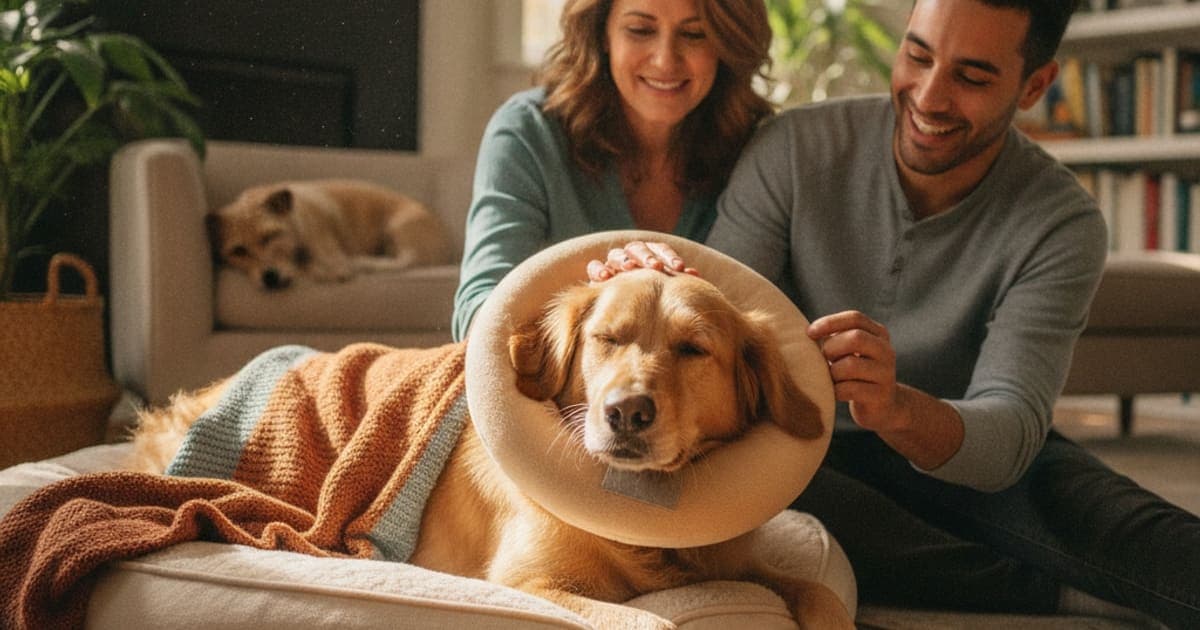
What Is Neuter Recovery in Dogs?
Neuter recovery in dogs is the healing period that follows castration surgery, when the incision closes, the ligated spermatic cords seal off, and swollen tissue settles back down. Most dogs look and act normal within a couple of days, but the deeper layers keep rebuilding for weeks — which is why restricted activity matters far more than how bright your dog seems.
That gap between how a dog behaves and how healed he actually is causes most of the trouble owners run into. A young dog who feels fine on day three will happily launch off the sofa, and the tissue holding his incision together is nowhere near ready for that load. Neutering is elective surgery on an otherwise healthy dog, and the single biggest determinant of a smooth outcome is what happens in the two weeks afterwards — not the twenty minutes on the table.
What Is Actually Happening Beneath the Incision
In a routine male neuter, the surgeon makes a small incision just in front of the scrotum (or, in some cases, directly over it), draws each testicle up through that opening, ligates the spermatic cord and its blood supply, and removes the testicle. The scrotum itself is usually left in place. Closure happens in layers: the connective tissue under the skin is drawn together with absorbable suture, and the skin is closed with either buried absorbable suture, external sutures, staples, or surgical glue depending on your vet's preference.
What you can see is the least interesting part. Underneath, the body runs the same three-stage repair programme it uses for any wound. First comes the inflammatory phase — heat, mild swelling, and immune cells clearing debris. Then the proliferative phase, where fibroblasts migrate in and lay down new collagen and fresh blood vessels grow into the repair site. Finally the remodelling phase, in which that hastily laid collagen is reorganised into properly aligned, load-bearing tissue. A skin seal forms quickly. Genuine tensile strength arrives much later, and it builds gradually over weeks.
The empty scrotum is worth understanding too. In adult and larger dogs it often swells, bruises, or fills with a little fluid as the tissue that once held the testicles collapses and drains. Some scrotal swelling in the days after surgery is expected. A scrotum that keeps enlarging, turns hot and tight, or feels like a full water balloon is a reason to phone the clinic rather than wait it out.
Normal Healing Versus Signs Worth a Phone Call
Most of what worries owners in the first week is ordinary. The table below sorts the routine from the concerning — but if you are ever unsure which column you are looking at, your veterinarian would far rather field the question than see the consequences of a delay.
| Usually part of normal recovery | Call your veterinarian |
|---|---|
| Grogginess, wobbliness or whining the evening after anaesthesia | Anaesthetic dullness that has not lifted after a full day |
| A pink, slightly raised incision line with mild bruising | Redness spreading outward, heat, or the incision opening or gaping |
| Mild scrotal swelling and bruising that peaks then eases | Scrotal swelling that grows day by day, feels tense, or is very painful |
| A small amount of clear or blood-tinged seepage in the first day | Ongoing bleeding, or thick yellow, green or foul-smelling discharge |
| Reduced appetite for a meal or two | Refusing food beyond that, repeated vomiting, or diarrhoea |
| Sleeping more than usual for a few days | Hiding, trembling, guarding the belly, or pain despite prescribed medication |
| Wanting to lick the site | Having reached the site and disturbed the sutures |
| Quieter, shorter toileting trips | Straining to urinate, or not urinating within a normal interval after surgery |
Dog neuter recovery symptoms trend in one direction: swelling and soreness should be improving, not worsening, as the days pass. A recovery that is going backwards is the clearest signal there is.
What Makes Recovery Slower and Harder
Licking and chewing. This is the number one cause of complications, full stop. Saliva carries bacteria, the tongue is abrasive, and a determined dog can undo a closure in minutes. The e-collar is not a suggestion — it stays on, including overnight and during unsupervised moments, until your vet clears it. Recovery suits and inflatable collars work for some dogs and are useless for others, so keep whatever your dog cannot defeat.
Too much, too soon. Stairs, jumping into cars, off-lead running, rough play with another dog in the house, and the classic post-anaesthetic zoomies all put shear force through tissue that has not remodelled yet. Restricted activity is uncomfortable to enforce and it is the thing that most reliably prevents seromas, swelling and incision breakdown.
Moisture and dirt. No baths, no swimming, no muddy fields until the site is fully closed and signed off. Damp bedding and wet grass work against you as well.
Body condition and age. Heavier dogs carry more fat in the surgical field and often develop more post-operative swelling. Older dogs, and dogs with concurrent endocrine, immune or skin conditions, generally repair more slowly. Large and giant breeds with a pendulous scrotum tend to swell more than small dogs.
Skipping or stopping prescribed medication. If your vet dispensed an anti-inflammatory or pain medication, give it exactly as directed for the full course. Dogs mask pain well, and a comfortable dog rests better and heals better. Never stop or alter a prescription because your dog seems fine — that decision belongs to your veterinarian.
Combined procedures. Dogs neutered at the same time as a dental, a hernia repair or a gastropexy have more tissue healing at once and often need a longer, quieter convalescence.
Comfort, Food and Boredom in the Restricted Window
A bored young dog in a small room is an incision waiting to fail. Trade physical exercise for mental work: scatter feeding, snuffle mats, lick mats, slow feeders, simple scent games played lying down, and short training sessions that involve nose and brain rather than legs. Most dogs settle far better with fifteen minutes of thinking than with a longer, riskier walk.
Set up a small, non-slip, easy-to-clean space with bedding your dog will actually lie flat on. Keep water available at all times. Appetite often dips for a meal or two after anaesthesia and then returns; a bland, easily digested meal is fine in the short term, but a dog who is still not eating properly after the first day needs veterinary input.
It is also worth knowing that a dog's energy requirement typically falls after neutering while appetite often does not. Portion adjustment in the weeks after surgery keeps weight from creeping on — which matters, because extra body weight loads joints your dog will be using for the next decade.
How Owners Support Connective Tissue Repair
Once your vet has handled the surgical side, the remaining variable is how well the body does its own rebuilding work. That is why so many owners look at what they can give during the restricted-activity window, and why the supplement aisle is worth a sceptical eye. Kitchen-sink chews stacking a dozen ingredients behind a proprietary blend, with no disclosed amounts and no third-party testing, are marketing dressed as science. Ask what is in it, how much, and who verified it.
The peptide pair owners are adopting through recovery is BPC-157 and TB-500. BPC-157 is a synthetic peptide based on a sequence identified in gastric juice; published research in animal models suggests it may support angiogenesis — the growth of new blood vessels — and influence growth-factor signalling involved in soft-tissue and tendon repair. TB-500 is a synthetic fragment related to thymosin beta-4, a naturally occurring protein involved in actin regulation and cell migration, and research suggests it may support the cell movement and vessel formation that repair depends on. Blood supply and cell migration are exactly the processes running underneath a healing incision, which is why this combination interests owners during convalescence.
This is emerging and promising science that owners are choosing to use, and it should be described honestly: BPC-157 and TB-500 are not FDA-approved veterinary drugs, and nothing here should be read as a claim that any product treats, cures or prevents a condition. pawgen makes K9-REPAIR, a BPC-157 and TB-500 formulation for dogs, dosed by body weight, third-party tested with certificates of analysis available, shipped direct to your door, and backed by a 60-day money-back guarantee. It sits alongside veterinary care, never in place of it — bring it up with your veterinarian, especially while your dog is on any prescribed medication, so the whole plan is in one pair of hands.
Getting Back to Normal Activity
Release from restriction should come from your vet, not the calendar and not your dog's enthusiasm. At the post-operative check the incision is assessed, any external sutures or staples are removed, and you get a plan for reintroducing activity.
Build back in steps rather than one leap. Lengthen lead walks before adding off-lead time. Add off-lead time on flat, predictable ground before hills, water or rough play with other dogs. Watch for swelling or soreness the day after each increase — that is the feedback loop that tells you whether you moved too fast. If your dog is recovering from a combined procedure or has an existing orthopaedic issue, the ramp needs to be slower and shaped around that condition.
Key Takeaways
- Neuter recovery is the healing period after castration surgery, and the deeper tissue keeps remodelling for weeks after the skin looks closed.
- Your dog's behaviour is a poor guide to how healed he is — restriction is enforced on a schedule, not on how good he feels.
- Licking and premature activity cause most complications; the e-collar and the confinement plan do the heavy lifting.
- Swelling and soreness should improve day by day. Anything trending the wrong way warrants a call to your veterinarian.
- Give prescribed pain medication exactly as directed, and never stop a prescription on your own judgement.
- Owners supporting the repair window increasingly reach for BPC-157 and TB-500 formulations such as K9-REPAIR, weight-dosed and third-party tested, alongside veterinary care.
For deeper reading, pawgen's guide to neuter recovery covers the topic end to end, with companion articles on dog neuter recovery recovery time, how to prevent neuter recovery in dogs and what helps a dog with neuter recovery. Owners researching soft-tissue repair more broadly may also want bpc-157 for bicipital tenosynovitis in dogs and bpc-157 for carpal hyperextension in dogs.
Your veterinarian owns the diagnosis, the surgical plan, the pain protocol and the decision about when your dog goes back to normal life. Nothing you read online replaces the person who has hands on your dog and eyes on the incision. Supplements and peptides operate in the space that proper veterinary care creates — supporting a body that is already being looked after properly.
Owners exploring peptide support for their dog can review K9-REPAIR — BPC-157 + TB-500 formulated for dogs — at https://pawgen.com/. BPC-157 and TB-500 are not FDA-approved veterinary drugs. Nothing in this article treats, cures or prevents any condition; every decision about your dog's care belongs with your veterinarian.
Frequently asked questions
- Can neuter recovery in dogs be reversed?
- Recovery is not something to reverse — it is the body's normal healing process, and the goal is to let it finish undisturbed. The neuter itself is permanent and cannot be undone. Setbacks such as swelling, seromas or a disturbed incision can usually be resolved with prompt veterinary attention.
- How much does it cost to treat neuter recovery in dogs?
- Routine aftercare is normally included in the surgical fee, covering the post-operative check and suture removal, with pain medication and an e-collar sometimes billed separately. Costs vary widely by clinic, region and dog size. Complications like infection or a seroma add re-examination and medication charges, so ask your vet for a written estimate.
- What helps a dog with neuter recovery?
- Strict activity restriction, a properly fitted e-collar worn until your vet says otherwise, a clean dry resting space, and prescribed pain medication given exactly as directed. Mental enrichment replaces exercise. Owners also use BPC-157 and TB-500 formulations such as K9-REPAIR alongside veterinary care to support the body's tissue-repair processes.
- How long does neuter recovery take to heal in dogs?
- Clinics typically advise restricted activity for roughly two weeks, until the post-operative check confirms the incision has closed. Underneath, collagen continues remodelling and gaining strength for considerably longer. Age, body condition, breed size and whether other procedures were done at the same time all change the timeline, so follow your vet's clearance rather than a fixed date.
- Is neuter recovery in dogs painful?
- There is genuine post-surgical discomfort, which is why vets send dogs home on pain medication. Most dogs are noticeably sore for the first day or two, then steadily more comfortable. Dogs mask pain well, so trembling, hiding, guarding the belly or restlessness despite medication should prompt a call to your veterinarian.
- What makes neuter recovery worse in dogs?
- Licking or chewing at the incision is the leading cause of complications, followed by too much activity too soon — jumping, stairs, off-lead running and rough play. Baths, swimming, damp bedding, excess body weight, older age and skipped pain medication all work against a smooth recovery.
- Is scrotal swelling after neutering normal?
- Mild scrotal swelling and bruising are common, especially in adult and larger dogs, because the scrotum stays in place and tissue fluid collects as it settles. It should peak early then ease. Swelling that grows daily, feels hot and tense, or is very painful needs veterinary assessment.
- Can I give K9-REPAIR while my dog is on medication from the vet?
- Discuss it with your veterinarian first. K9-REPAIR is a BPC-157 and TB-500 formulation dosed by body weight and is not an FDA-approved veterinary drug or a substitute for anything prescribed. Your vet should know everything your dog receives so the surgical, pain-control and supportive plans stay coordinated.
Educational content. BPC-157 and TB-500 are not FDA-approved veterinary drugs. Talk to your veterinarian before starting anything new, especially if your dog is on prescribed medication.