How to Manage Senior Dog Incontinence (Options Explained)
Treating senior dog incontinence starts with a veterinary diagnosis, because leaking has many causes — urinary tract infection, bladder stones, hormonal or metabolic disease, sphincter weakness or spinal change. From there, most plans combine a prescription aimed at the specific cause with waterproof bedding, scheduled potty breaks and diligent skin hygiene.
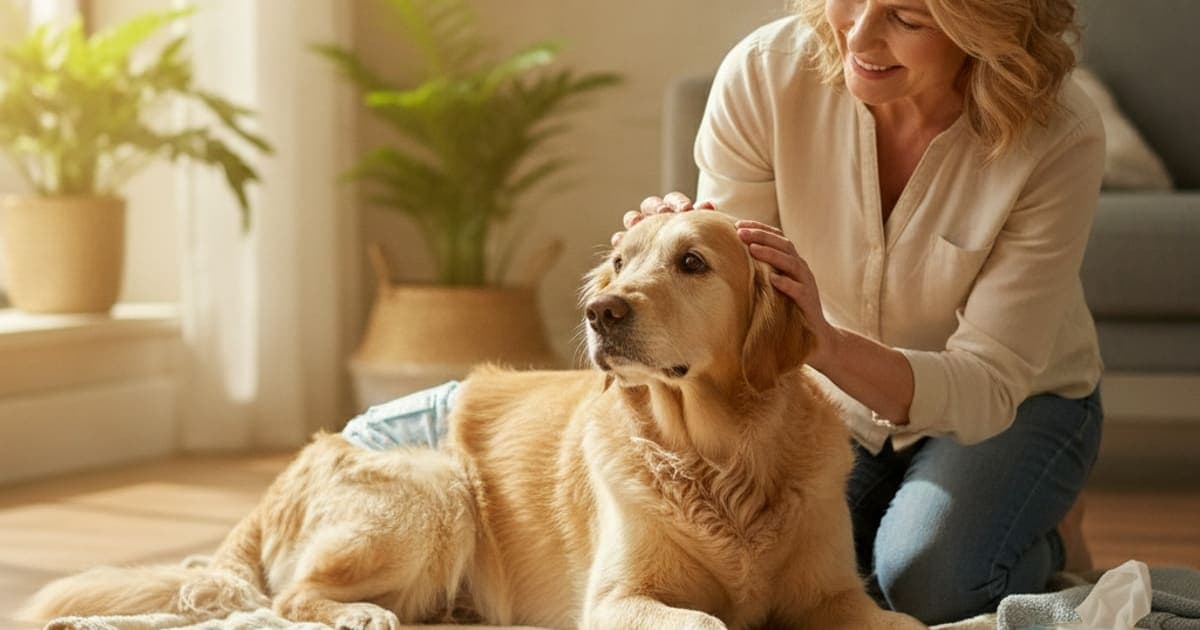
Treating incontinence in an older dog begins with a veterinary diagnosis, not a product. Leaking urine is a symptom, and the list of things that produce it is long: urinary tract infection, bladder stones, urethral sphincter mechanism incompetence, prostatic disease in males, diabetes, kidney disease, Cushing's disease, spinal cord changes and cognitive decline all look similar from the laundry pile. Once a cause is identified, most plans combine three things — targeted treatment of the underlying problem, a prescription medication where one is appropriate, and a home routine built around scheduled potty breaks, waterproof bedding and skin hygiene. Supplements and peptides sit alongside that plan, supporting comfort and mobility, never replacing it.
Why the cause has to be identified before anything else
Incontinence in an older dog is a symptom, not a diagnosis — and the single most useful thing you can do is have the cause identified before you start managing the leaking.
The reason matters practically. A dog leaking because of a urinary tract infection needs a culture and the right antibiotic; giving that dog a sphincter-tone medication does nothing for the infection and delays real relief. A dog drinking enormous volumes because of diabetes or kidney disease isn't incontinent at all in the strict sense — the bladder is simply overwhelmed, and the answer lies in the metabolic disease. A dog with hind-end weakness from spinal change may be posturing to urinate and failing, which is a mobility and neurologic problem wearing an incontinence costume.
A typical workup includes a physical exam, urinalysis, and often a urine culture, bloodwork and imaging such as radiographs or ultrasound to look for stones, masses or prostate enlargement. Your veterinarian may also ask you to film what happens — whether urine appears while your dog sleeps, whether there is straining, whether volumes are large or small. That detail is diagnostic gold, and it costs nothing to collect.
True involuntary leaking during rest, especially in spayed females, most often traces back to urethral sphincter mechanism incompetence, where the muscular seal at the bladder neck loses tone. It is common, it is well described, and it is the scenario most prescription options are designed around.
Prescription options a veterinarian may discuss
There are medications licensed specifically for canine urinary incontinence, which is more than can be said for most problems in geriatric dogs. Phenylpropanolamine, sold under names including Proin, is FDA-approved for urinary incontinence in dogs and works by increasing tone in the urethral sphincter. Estriol, sold as Incurin, is FDA-approved for incontinence in spayed female dogs caused by sphincter weakness and works through oestrogen receptor support of urethral tissue. Some dogs do well on one, some on the other, and some are managed on a combination under veterinary supervision.
For male dogs, the picture is different. Sphincter incompetence occurs in neutered males but less commonly, and prostatic disease, urethral abnormalities, bladder stones and neurologic disease all need ruling out first. Treatment for a senior male therefore follows the cause more closely than any default protocol — which is exactly why guessing at an over-the-counter fix is a poor trade.
Where medication is not enough, referral centres offer procedural options such as urethral bulking agents injected to improve the seal at the bladder neck, and in selected cases an artificial urethral sphincter. These are specialist procedures with real candidacy criteria; your veterinarian will tell you whether your dog is a reasonable referral.
| Approach | What it involves | Best suited to | What to know |
|---|---|---|---|
| Treating the underlying disease | Antibiotics for infection, stone removal or diet, management of diabetes, kidney or adrenal disease | Any dog whose workup finds a primary cause | Fixes the problem at source; nothing else works properly until this is addressed |
| Sphincter-tone medication | Phenylpropanolamine, FDA-approved for canine urinary incontinence | Dogs with confirmed sphincter weakness | Needs blood pressure and cardiac considerations reviewed by your vet; dosing is veterinary territory |
| Hormone-based medication | Estriol, FDA-approved for incontinence in spayed females from sphincter weakness | Spayed female dogs | Often used when the first option is unsuitable or insufficient |
| Procedural options | Urethral bulking agents; artificial urethral sphincter | Dogs that fail medical management | Referral-level; candidacy assessed case by case |
| Home management | Scheduled toileting, waterproof bedding, belly bands, washable diapers, skin care | Every incontinent senior, alongside any other approach | Costs little, protects skin and sleep, and improves quality of life immediately |
| Mobility and comfort support | Traction, ramps, weight control, physical rehabilitation, peptide and joint support | Seniors whose hind-end weakness makes getting outside hard | Does not address the urinary tract; addresses the ability to get to the door in time |
Daily management that genuinely changes life at home
Medication is only half of it. The routine you build around an incontinent senior often does more for both of you than anything in a bottle.
Start with timing. More frequent, predictable outings — first thing, last thing, and a deliberate trip before any long stretch of sleep — reduce the volume sitting in the bladder when your dog lies down. Many owners find a final late-night walk is the single highest-yield change they make.
Protect the sleeping area. Washable waterproof mattress protectors under the bed, layered bedding you can strip one level at a time, and a second complete set ready to swap turns a 2am accident into a two-minute job rather than a crisis. Belly bands suit male dogs well; washable diapers and disposable liners work for females. Whatever you use, it has to come off regularly — urine held against skin causes scalding, and that is a genuine welfare issue.
Skin care is non-negotiable. Wipe the perineum and inner thighs with plain water or a gentle, dog-safe cleanser, dry thoroughly, and check daily for redness. Keeping the hair clipped short in that area makes everything easier. Tell your veterinarian at the first sign of irritation, because scald and secondary infection escalate quickly in older dogs.
Do not restrict water. It is a tempting shortcut and a dangerous one, particularly in a dog with kidney disease or diabetes. If you think fluid intake is the problem, that is a conversation to have with your vet, not a decision to make at the tap.
Finally, keep a simple log — times, volumes, whether your dog was asleep or active. When you adjust anything, that log is how you and your vet know whether it worked.
Home and natural approaches owners ask about
The most common question in this space is what can be given at home. Owners ask about corn silk, saw palmetto, pumpkin seed extract, phytoestrogen-containing supplements, cranberry and acupuncture. Some of these have small bodies of supporting work and a long history of owner use; none is a substitute for identifying why your dog is leaking, and several carry real interaction potential with prescribed medications — phytoestrogens and sphincter-tone drugs in particular are not things to combine on your own initiative.
The honest framing is this: research into botanical support for urinary tone in dogs is thin, owner reports are mixed, and the risk is less about the ingredient than about the delay. A dog with bladder stones does not need corn silk; it needs imaging. Run any home remedy past your veterinarian before it goes in the bowl, and bring the actual label with you so the full ingredient list can be reviewed.
The approaches with the strongest practical return at home remain unglamorous: timing, bedding, hygiene, weight control, and traction on slippery floors.
Where mobility support fits in a senior dog's wider plan
Many incontinent seniors are also stiff seniors. Hind-end weakness, arthritic hips, a dropped topline and a reluctance to go down the back step all make accidents more likely, because a dog who cannot get to the door comfortably will not always try. Supporting mobility does not address the urinary tract — it addresses the half of the problem that is about getting outside in time and sleeping comfortably once back in.
That is the space pawgen's K9-REPAIR occupies. It is a BPC-157 and TB-500 peptide formulation made for dogs, aimed at joint, tendon and soft-tissue recovery and at the mobility picture in ageing and post-injury dogs. BPC-157 is a peptide sequence derived from a protein found in gastric juice, and research suggests it may support the body's own tissue repair signalling, including in tendon and ligament models. TB-500 is a fragment related to thymosin beta-4, a protein involved in actin regulation, cell migration and the formation of new blood vessels — the processes underlying soft-tissue remodelling. This is emerging and promising science that a growing number of owners are adopting through recovery and into their dog's senior years.
To be explicit: BPC-157 and TB-500 are not FDA-approved veterinary drugs, and nothing here is a claim that K9-REPAIR treats incontinence or any other condition. pawgen publishes third-party certificates of analysis for its batches, provides weight-based dosing guidance for owners to review with their vet, ships direct to the door, and stands behind orders with a 60-day money-back guarantee. Peptides belong in a conversation with your veterinarian alongside the rest of your senior dog's plan — not instead of it.
Key Takeaways
- Leaking is a symptom. Diagnosis comes first: urinalysis, culture, bloodwork and imaging decide what treatment is appropriate.
- Two medications are FDA-approved for canine urinary incontinence — phenylpropanolamine and, for spayed females with sphincter weakness, estriol. Both are veterinary decisions.
- Senior males need prostate, stone and neurologic causes ruled out before anyone reaches for a default protocol.
- Home management — scheduled toileting, waterproof layered bedding, belly bands or washable diapers, and daily skin care — delivers immediate quality-of-life gains.
- Never restrict water to reduce accidents, and never stop a prescribed medication without speaking to your vet.
- Botanical remedies are worth asking about, not worth substituting for a workup; interactions with prescribed drugs are real.
- Mobility support addresses a different part of the picture: getting outside in time and resting comfortably afterwards.
Putting the plan together
If you want to read more about pawgen's approach, batch certificates of analysis are published at /coas/, the K9-REPAIR formulation and ordering details are at /shop/, shipping destinations are listed at /location/, and the brand overview sits at pawgen.
Your veterinarian owns the diagnosis and the treatment plan. They decide what is causing the leaking, which medication or procedure fits your dog, and how the rest of their geriatric care is sequenced around it. Supplements and peptides operate in the space that proper veterinary care creates — supporting comfort, mobility and recovery while the medical plan does the work it was designed to do. Bring your log, bring your questions, and build the plan together.
Owners exploring peptide support for their dog can review K9-REPAIR — BPC-157 + TB-500 formulated for dogs — at https://pawgen.com/. BPC-157 and TB-500 are not FDA-approved veterinary drugs. Nothing in this article treats, cures or prevents any condition; every decision about your dog's care belongs with your veterinarian.
Frequently asked questions
- How to treat senior dog incontinence?
- Start with a veterinary diagnosis — urinalysis, culture, bloodwork and imaging identify whether infection, stones, metabolic disease, sphincter weakness or spinal change is responsible. Treatment then follows the cause and may include a licensed prescription medication, with scheduled toileting, waterproof bedding and daily skin hygiene supporting it at home.
- What can I give my senior dog for incontinence?
- Nothing should go in the bowl before your veterinarian has found the cause. Two medications are FDA-approved for canine urinary incontinence — phenylpropanolamine and estriol for spayed females — and both are prescription decisions. Owners also ask about botanical options; review those with your vet because interactions with prescribed drugs are real.
- What can you do for old dog incontinence?
- Get a diagnosis first, then combine the treatment your vet recommends with practical home management: more frequent and predictable potty breaks, a late-night outing, layered waterproof bedding, belly bands or washable diapers, and daily cleaning of the perineum to prevent urine scald. Never restrict water to reduce accidents.
- How to manage senior dog incontinence?
- Management means routine plus hygiene plus monitoring. Build predictable toileting times, protect bedding in removable layers, use belly bands or washable diapers changed regularly, clip and clean the skin daily, and keep a simple log of times and volumes so you and your veterinarian can tell whether changes are working.
- What medication is used for senior dog incontinence?
- Phenylpropanolamine, sold under names including Proin, is FDA-approved for urinary incontinence in dogs and increases urethral sphincter tone. Estriol, sold as Incurin, is FDA-approved for incontinence in spayed female dogs caused by sphincter weakness. Both require veterinary assessment, and dosing is set by your vet, never by an article.
- What treatment options exist for senior male dog incontinence?
- Male dogs need prostatic disease, bladder stones, urethral abnormalities and neurologic causes ruled out before sphincter weakness is assumed. Once the cause is clear, treatment follows it directly. Belly bands make daily management far easier for males, and referral centres can assess procedural options where medication alone is not enough.
- Do natural remedies for senior dog incontinence work?
- Evidence in dogs is limited and owner reports are mixed. Corn silk, saw palmetto, pumpkin seed extract and phytoestrogen supplements are commonly asked about, but the main risk is delay — a dog with stones or infection needs diagnostics, not a botanical. Always review any home remedy with your veterinarian first.
- Can peptides like BPC-157 and TB-500 help an incontinent senior dog?
- BPC-157 and TB-500 are not FDA-approved veterinary drugs and are not for urinary problems. pawgen's K9-REPAIR is formulated around joint, tendon and soft-tissue recovery, which research suggests these peptides may support. For a stiff senior, that is about getting outside comfortably — discuss it with your veterinarian.
Educational content. BPC-157 and TB-500 are not FDA-approved veterinary drugs. Talk to your veterinarian before starting anything new, especially if your dog is on prescribed medication.