Hydrotherapy Alternatives for Dogs: 2026 Options Compared
Instead of hydrotherapy, most dogs can work through land-based rehabilitation: measured leash walking, cavaletti poles, sit-to-stand sets, incline work, balance drills, and clinic modalities like therapeutic laser or PEMF. Many owners run K9-REPAIR alongside that plan. Your veterinarian or a certified canine rehab practitioner should set the progression.
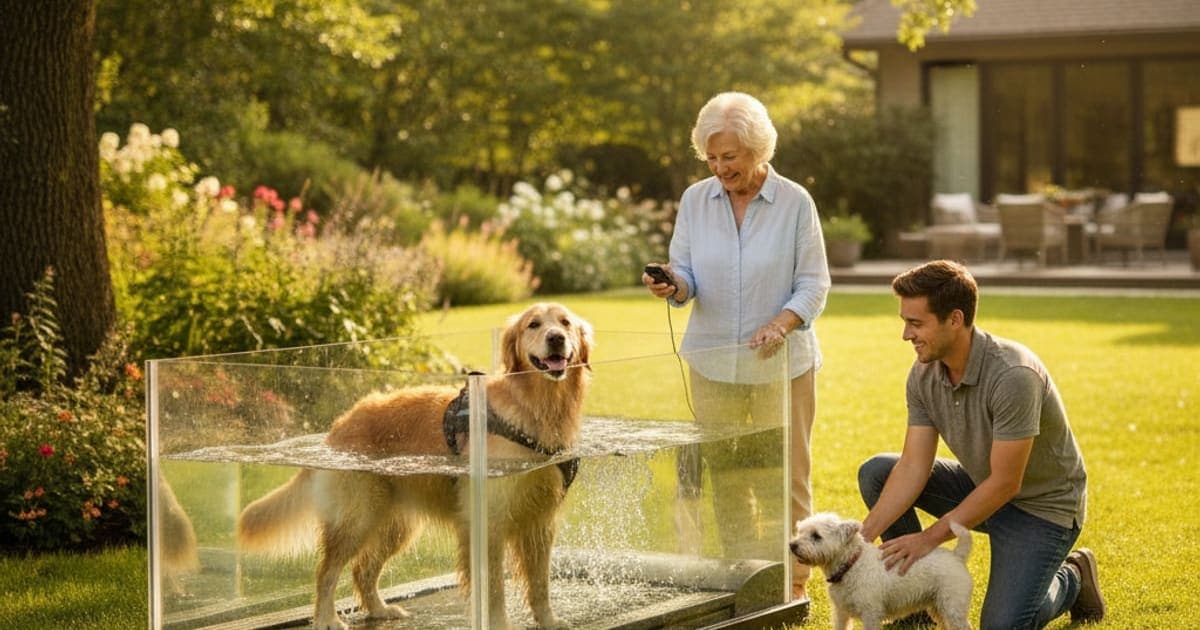
What can I use instead of hydrotherapy for my dog?
The practical substitutes for hydrotherapy are land-based rehabilitation tools: measured leash walking, cavaletti poles, sit-to-stand sets, gentle incline work, balance and proprioception drills, and clinic modalities such as therapeutic laser or PEMF — often run alongside a recovery stack like K9-REPAIR. Your veterinarian or a certified canine rehab practitioner should set the progression.
Hydrotherapy is popular because it solves one specific problem elegantly: it lets a dog move a limb through its full range while carrying less of its own body weight. That is a mechanical trick, not a biological one. Mechanical tricks can be reproduced on dry land with poles, slopes, footing, tempo and a support harness. So if the pool is too far away, too expensive, too frightening for your dog, or simply not producing the change you expected, you are not out of options — you are choosing between delivery methods for the same underlying stimulus.
Why owners start looking past the pool
Access is the most common reason. Certified canine rehabilitation facilities are not evenly distributed, and a dog recovering from surgery does not travel comfortably. Session costs and travel time add up, and prices vary widely by clinic and region. For an owner who needs a plan that runs five or six days a week for months, a weekly appointment an hour away is a fragment of a program, not the program itself.
The second reason is the dog. Some dogs are genuinely frightened of water. A frightened dog braces, paddles asymmetrically and holds its breath — reinforcing exactly the compensation patterns you are trying to unwind. Others are poor candidates for medical reasons: an incision that has not fully closed, active skin disease, chronic ear infections, or heart and airway conditions that make sustained swimming effort inappropriate. That call belongs to your veterinarian, not to a facility booking form.
The third reason is the plateau — the search that starts with 'hydrotherapy not working for my dog.' A stall usually has a cause worth finding. Progression may be too slow, or too aggressive. The diagnosis may be incomplete: a second painful joint, lumbosacral pain, or a meniscal problem can hide behind an obvious limb. Pain control between sessions may be inadequate, so the dog guards. Or there may be no home program at all, meaning the tissue gets one stimulus a week and rests for six days. If your dog is reliably sorer a day or two after each session, that is a conversation with your veterinary team — not a reason to push harder.
What the water is actually doing, and how to copy it on land
Water contributes four things. Buoyancy reduces the percentage of body weight the limb has to carry. Viscosity adds gentle resistance in every direction, so muscles work without impact. Hydrostatic pressure supports the limb and may make a swollen leg feel less awkward to move. And in an underwater treadmill — a different tool from open swimming — the belt sets the speed, which forces a slow, even, repeatable gait instead of the hopping and skipping dogs default to when they are sore.
Hydrotherapy is a delivery system for graded, controlled load, and healing tissue does not care whether that load arrives in a warm tank or on a non-slip hallway floor — only that it is graded, controlled and repeated.
On land, the same variables are available to you:
- Measured leash walking. The most underrated rehab tool there is. Short, frequent, on-lead, on non-slip footing, at a steady walking pace — no sniff-lunges, no trotting, no greeting other dogs. You progress duration first, terrain second.
- Cavaletti and pole work. Low poles at set spacing force deliberate flexion of hip, stifle, hock and elbow and demand that the dog pay attention to where its feet are. Pole height and spacing are your two dials.
- Sit-to-stand and down-to-stand repetitions. Concentric hind-limb work, and form is everything: a square sit, no sideways hip roll, no pushing off a wall.
- Incline and decline walking. A gentle slope or ramp redistributes weight. Uphill loads the hind limbs; downhill demands eccentric control from the front end. Small grades, short distances.
- Weight shifting, three-leg stands and balance cushions. Proprioception and postural muscle work, usually done in seconds rather than minutes.
- Slow backward walking, figure-eights and serpentines. Cross-body coordination and hind-limb awareness, which many dogs lose after months of guarding a limb.
- A dry land treadmill at a slow, fixed speed. The closest direct substitute for the underwater treadmill's rhythm control, minus the buoyancy.
- Passive range of motion, stretching and massage. Taught by a rehab professional, performed by you at home between appointments.
- Environment changes. Rugs over slick floors, ramps instead of stairs and car jumps, a support harness, toe grips or traction socks. Unglamorous, and often the highest-yield change in the whole plan.
Clinic-side, laser therapy, PEMF, therapeutic ultrasound, shockwave, acupuncture and hands-on manual therapy are all offered without a pool anywhere in the building. Availability differs enormously between practices — ask which your clinic actually has and which are appropriate for your dog's diagnosis.
Comparing the main alternatives side by side
| Option | What it primarily provides | Suits | Watch-outs |
|---|---|---|---|
| Underwater treadmill | Offloaded, speed-controlled, symmetrical gait | Post-op limbs, painful arthritis, weight-bearing retraining | Requires a facility; travel and cost; not all dogs tolerate the tank |
| Pool swimming | Non-impact cardiovascular and muscular work | Dogs that already enjoy water; conditioning | No weight-bearing practice; anxious dogs swim asymmetrically |
| Measured leash walking | Graded, repeatable loading; endurance | Almost every recovering dog, at some stage | Easy to progress too fast; needs non-slip footing and a strict pace |
| Cavaletti and pole work | Joint flexion, proprioception, deliberate foot placement | Dogs skipping, knuckling or under-using a limb | Poles too high or too close changes the exercise entirely |
| Sit-to-stands and incline work | Hind-limb strength; eccentric control | Muscle loss after surgery or long rest | Form breaks down fast when the dog fatigues |
| Balance and proprioception drills | Postural muscle activation; body awareness | Neurological cases, older dogs, chronic compensators | Unstable surfaces are not for unsupervised dogs |
| Laser, PEMF, shockwave, acupuncture | Clinic-applied modalities used adjunctively | Dogs already under veterinary rehab care | Availability and protocols vary between practices |
| Harness, ramps, traction, wheelchair | Safe mobility while strength returns | Weak hind ends, slick homes, large breeds | Aids assist movement; they do not build tissue |
| K9-REPAIR (BPC-157 + TB-500) | Peptide support owners run alongside a rehab plan | Owners wanting recovery-phase support at home | Not FDA-approved veterinary drugs; discuss with your vet |
What recovering tissue needs beyond exercise
Exercise is the signal. The biology still has to answer it, and that is where the timeline in most orthopaedic recoveries actually comes from.
Soft tissue repair moves through overlapping phases — an inflammatory phase, a proliferative phase in which new matrix is laid down quickly and untidily, and a long remodelling phase in which collagen fibres reorganise and align along the lines of stress they are asked to carry. That final phase is why controlled loading matters so much: the fibres orient to the load. It is also why tendon and ligament recovery is measured in weeks to months rather than days. These tissues have a comparatively sparse blood supply next to muscle, and cartilage has none at all, so the raw materials arrive slowly.
That blood supply question is precisely why peptides have become part of how many owners think about recovery. BPC-157 is a synthetic peptide based on a sequence identified in gastric juice, and published animal research has explored its effects in tendon, ligament and muscle injury models, with a recurring interest in angiogenesis — the formation of new blood vessels into healing tissue. TB-500 is a synthetic form of a fragment of thymosin beta-4, a naturally occurring protein that binds actin, one of the proteins central to how cells move, migrate and hold their shape; research has looked at its role in cell migration and vascular development. That work is largely preclinical, and neither peptide is an FDA-approved veterinary drug. What research suggests is a mechanism worth understanding, and it is the reason owners increasingly run these compounds through a recovery period rather than after it.
K9-REPAIR from pawgen combines both peptides in a single formulation made for dogs. It is dosed by body weight, third-party tested with certificates of analysis available, shipped directly to your door, and backed by a 60-day money-back guarantee. The right amount for your dog is a conversation to have with your veterinarian — this article gives you none, and you should be sceptical of any source that hands out numbers for your dog sight unseen. Be equally sceptical of underdosed kitchen-sink chews that list twenty ingredients in quantities too small to matter and rely on the label doing the work.
One boundary is absolute: none of this is a substitute for surgery, for prescribed pain control, or for the rehab program your veterinarian designed. Do not stop or reduce a prescribed medication because you have added something at home.
When the plan has stalled: three common situations
The dog who panics in water
Stop trying to habituate a genuinely fearful dog to a tank and rebuild the same stimulus on land. Slow, measured leash walks on grippy footing, cavaletti at conservative spacing, and short sit-to-stand sets give you loading, range of motion and symmetry without the fear response corrupting the movement.
After cruciate surgery, with no rehab clinic nearby
Ask your surgeon or veterinarian for a written, staged home program with clear progression criteria, and film your dog walking away from and toward the camera every week or two. Video catches subtle asymmetry that daily familiarity hides, and it gives your vet something concrete at recheck appointments.
The older dog who has plateaued
A plateau in an older dog is often a pain-control question or a second-problem question rather than an exercise-volume question. Before adding more work, get the whole dog reassessed — the limb you are watching may be compensating for one you are not.
Key Takeaways
- Hydrotherapy delivers graded, controlled loading with reduced weight bearing; land-based rehab can deliver the same stimulus with different tools.
- Measured leash walking, cavaletti poles, sit-to-stands, incline work and balance drills form the backbone of most non-pool programs.
- Laser, PEMF, shockwave, acupuncture and manual therapy are clinic modalities available without a pool.
- A stalled plan usually signals a missed diagnosis, poor pain control or wrong progression — not a need to work harder.
- Tendon, ligament and cartilage remodel slowly partly because of limited blood supply; research into BPC-157 and TB-500 has focused on repair signalling and new vessel formation.
- K9-REPAIR is dosed by body weight, third-party tested with COAs, ships direct, and carries a 60-day money-back guarantee; these peptides are not FDA-approved veterinary drugs.
- Aids and supplements support a plan. They never replace surgery, prescribed medication or a veterinary diagnosis.
If you are weighing individual tools against each other, bpc-157 vs a dog wheelchair looks at mobility aids versus recovery support, and bpc-157 vs glucosamine for dogs unpacks the joint-supplement aisle. K9-REPAIR is the stack many owners run through the recovery window itself.
Your veterinarian owns the diagnosis and the treatment plan — which imaging is needed, whether surgery is indicated, what pain control your dog gets, and how fast the loading progresses. A certified canine rehabilitation practitioner turns that plan into daily exercises you can actually perform at home. Everything discussed here, peptides included, works inside the space that proper veterinary care creates. Bring this list to your next appointment and build the program together.
Owners exploring peptide support for their dog can review K9-REPAIR — BPC-157 + TB-500 formulated for dogs — at https://pawgen.com/. BPC-157 and TB-500 are not FDA-approved veterinary drugs. Nothing in this article treats, cures or prevents any condition; every decision about your dog's care belongs with your veterinarian.
Frequently asked questions
- What can I give a dog that is reluctant to be touched?
- Give nothing until a veterinarian examines the dog. Reluctance to be touched usually signals pain, and human painkillers such as ibuprofen or paracetamol are toxic to dogs. Your vet can diagnose the source and prescribe appropriate pain control; supportive options like K9-REPAIR are a separate conversation to have with them afterwards.
- Is a dog reluctant to be touched an emergency?
- It can be. Seek immediate veterinary care if the dog also has a distended or rigid abdomen, cries out when lifted, cannot stand, has sudden hind-limb weakness, is vomiting, or has collapsed. Gradual, mild sensitivity without those signs still warrants a prompt appointment rather than waiting to see if it settles.
- Why is my dog hunched back?
- A hunched or roached posture is usually a pain response. Common sources include spinal or intervertebral disc pain, abdominal pain, pancreatitis, urinary problems, or compensation for hind-limb and hip discomfort. Dogs adopt the posture to reduce pressure on whatever hurts, so the posture itself is a symptom your veterinarian needs to investigate.
- Should I worry if my dog is hunched back?
- Yes — take it seriously. A hunched back is rarely a habit and usually reflects pain somewhere in the spine or abdomen. Restrict jumping and stairs, avoid massaging the area, and book a veterinary examination. Note anything else you observe, such as appetite changes, vomiting, straining, wobbliness or reluctance to move.
- When should I take a dog to the vet for hunched back?
- Go the same day if the posture appeared suddenly, if the dog is trembling, panting, vomiting, straining to urinate, dragging a limb or unwilling to move. Even a mild hunch lasting more than a day warrants an appointment, because spinal and abdominal causes generally do worse the longer they go unassessed.
- What can I give a dog that is hunched back?
- Do not give any medication before a veterinary diagnosis, and never give human anti-inflammatories. Keep the dog quiet and confined, avoid stairs and jumping, and get it examined. Once your vet identifies the cause and sets a treatment plan, you can discuss supportive options, including whether K9-REPAIR fits alongside that plan.
- Is an underwater treadmill better than swimming for dogs?
- For orthopaedic rehabilitation they do different jobs. An underwater treadmill controls speed and keeps the dog weight bearing, which retrains a symmetrical gait. Swimming is non-weight-bearing conditioning and lets dogs compensate freely. Your veterinarian or rehab practitioner should choose based on the diagnosis and stage of recovery.
- Can I do canine rehab at home without a pool?
- Yes, with a written program from your veterinary team. Measured leash walking, cavaletti poles, sit-to-stands, gentle inclines and balance drills cover most home rehab needs, plus non-slip flooring and ramps. Many owners also run K9-REPAIR through recovery. Ask for progression criteria so you know when to advance.
Educational content. BPC-157 and TB-500 are not FDA-approved veterinary drugs. Talk to your veterinarian before starting anything new, especially if your dog is on prescribed medication.