Is a dog walking with a limp after surgery an emergency?
A dog walking with a limp after surgery is usually not an emergency — some limping is expected while tissue heals, and it should improve week over week. It becomes urgent when the limp starts suddenly, worsens, or your dog will not bear weight, or when swelling, discharge or fever appear.
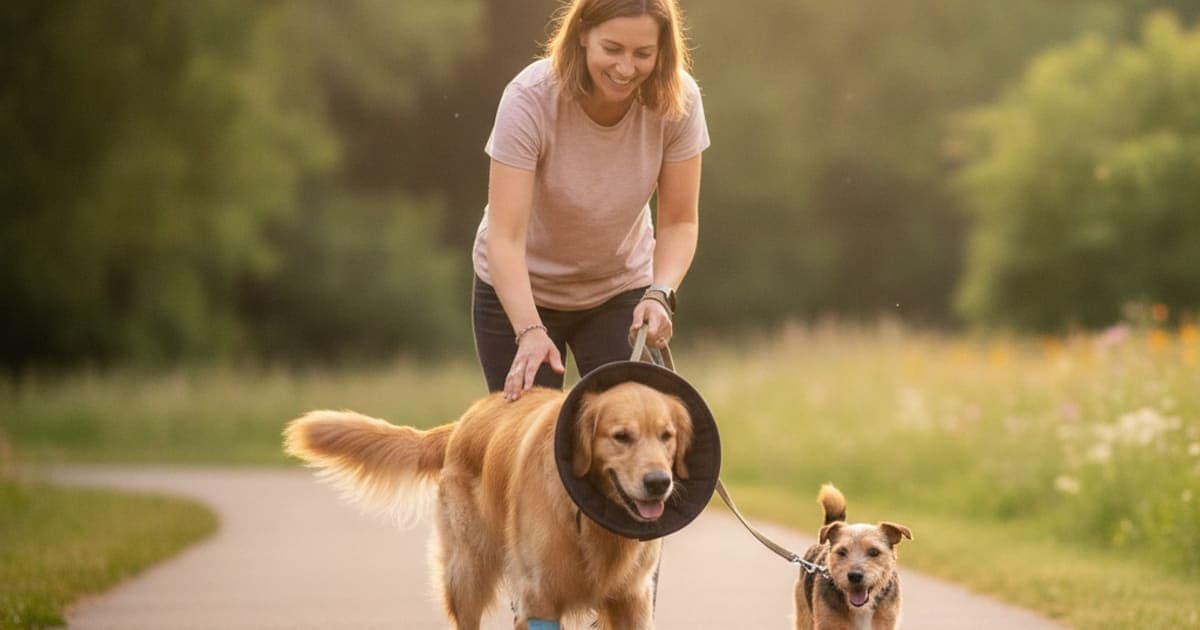
Is a dog walking with a limp after surgery an emergency?
Usually not. Some limping after orthopedic or soft-tissue surgery is expected while tissue knits and inflammation settles, and it should trend better week over week. It becomes an emergency when the limp appears suddenly, worsens sharply, or your dog refuses to bear any weight — or when swelling, discharge, heat or fever appear alongside it.
The more useful question than 'is my dog limping?' is 'which direction is this limp heading?' A leg that gets used a little more each week is following the expected pattern. A leg that was improving and then suddenly isn't has changed, and that change is exactly what your surgical team wants to hear about. Most clinics would far rather field a phone call about a limp that turns out to be nothing than meet a dog days later with a complication that had been quietly building.
What a normal post-surgical limp looks like
The first surprise for many owners happens on the first evening home. If your dog received a regional nerve block or an epidural, the leg may have been comfortably numb in the clinic and then becomes noticeably more sore as that block wears off. Dogs often use the leg less on night one than they did at discharge. That dip is common and is not, by itself, a sign that something has gone wrong.
After that, inflammation does its work. Swelling around an incision peaks in the early days, muscle that was retracted during surgery is bruised, and sutures or staples pull with every stride. The typical arc runs from toe-touching, to partial weight-bearing, to weight-bearing with an obvious hitch, to a gait that looks close to normal but stiffens up after a long rest.
There is a second reason the limp lingers that has nothing to do with the repair itself: muscle. Most dogs limped for weeks or months before surgery, and the thigh or shoulder musculature shrank the whole time. A perfectly executed procedure still leaves a strong joint sitting on a weakened leg. Muscle is lost quickly with disuse and rebuilt slowly with controlled work.
Recovery curves also differ by procedure. Cruciate stabilization, femoral head and neck excision, plated fracture repair, arthroscopy for a shoulder lesion and a mass removal near a joint all look different at the two-week mark. Ask your surgeon to describe the expected curve for your dog's specific operation, and keep the discharge instructions where you can see them, because those milestones are your comparison line.
The changes that turn a limp into a phone call
A limp that is slowly getting better is part of recovery; a limp that appears suddenly, worsens sharply, or stops your dog from bearing any weight is the one that earns a phone call today.
The signs that push a post-operative limp from expected to urgent are mostly about speed and company — how fast it changed, and what else changed with it. A dog who slips on a hard floor, yelps, and comes up non-weight-bearing needs assessment, not a wait-and-see week. So does an incision that opens, weeps, smells or feels hot, a bandage that has slipped or gotten wet, or a dog who is suddenly lethargic, feverish or off food.
Bandage problems deserve their own line. If your dog came home with a soft padded bandage or splint, swelling above or below it, cold or spread toes, an odour, a wet dressing or new chewing at the edges is an immediate call, not a next-recheck item. Bandage complications escalate faster than almost anything else in orthopedic aftercare.
| What you are seeing | Where it usually fits | What to do |
|---|---|---|
| Toe-touching that improves a little each week | Expected early recovery | Follow the discharge plan and log daily progress |
| Stiffness after a long nap that eases with a few minutes of movement | Common during healing | Note it and raise it at the recheck |
| Mild swelling and bruising near the incision in the first days | Often expected | Photograph it daily; call if it grows or reddens |
| Sudden refusal to use a leg the dog was using | Not expected | Same-day call to the surgical team |
| Incision gaping, discharge, odour or heat | Not expected | Same-day call |
| Bandage slipped, wet, or swollen or cold toes | Urgent | Call immediately, including after hours |
| Pain breaking through prescribed medication, crying, pacing | Not expected | Call the clinic; never adjust or stop a prescription yourself |
| A limp that plateaus or worsens across a couple of weeks | Needs review | Book a recheck; imaging may be warranted |
One rule sits underneath that whole table: if pain looks poorly controlled, the answer is a conversation with your veterinarian about the plan, not a change you make at home. Carprofen, gabapentin, trazodone and the rest are prescribed as a set, and altering one piece without guidance can mask exactly the signal your surgeon needs.
Common scenarios owners run into
Your dog used the leg, then stopped
A backwards step after real progress is the pattern most worth a call. It can be as ordinary as a slip on tile or an over-enthusiastic greeting at the door, and it can also reflect an implant, meniscal or incisional problem. Confine your dog, keep them calm, do not test the leg by encouraging walking, and phone the clinic.
The limp got worse after a longer walk or a rehab session
A leg that is sore after new work and settles back to baseline within a day is different from a leg that stays worse. Controlled loading is how tendon and bone reorganize, but the dose of loading matters. Report the pattern to whoever is directing rehab so the plan can be adjusted rather than abandoned.
The limp shows up weeks later, as activity increases
This is common precisely because confinement hides deficits. A dog restricted to short leash walks can look fine, then limp once trotting resumes, because the muscle and soft tissue have not caught up to the freedom. It still deserves a recheck, since it can also mark a healing problem being revealed by load.
The limp moved to another leg
Dogs offload a painful limb onto the opposite one for weeks. When the operated leg improves, the overworked limb can start to complain — and in cruciate patients, the other stifle is a well-recognized area of concern. A new limp on a new leg is a reason to have the whole dog examined, not just the surgical site.
Through all of these, the practical work at home is unglamorous and matters enormously: rugs or runners over slick floors, a towel sling or harness for stairs, a strictly leashed potty routine, no couches or car jumps, and lean body weight. A short phone video of your dog walking away from and toward the camera, taken weekly, is one of the most useful things you can bring to a recheck.
Why the leg still limps when the incision looks perfect
Skin is the fastest-healing tissue involved and the only one you can see. Underneath a tidy suture line, several slower processes are still running.
Where bone was cut and plated, healing runs through callus formation and then remodeling, with the new bone gradually reorganizing along the lines of load it actually experiences. Tendon and ligament repair differently again: collagen is laid down in a disorganized mat and only aligns along the direction of strain over subsequent weeks of controlled use. Those tissues are also poorly vascularized compared with muscle, and limited blood supply is one of the main reasons tendon, ligament and meniscus recover on a longer clock than the skin above them.
At the same time, the joint capsule can thicken and lose range of motion, nerves in the area stay sensitized, and the muscle that atrophied before surgery has to be rebuilt under a load your dog is not yet allowed to apply freely. The tendon-bone interface remodels over many weeks. That whole span — after the emergency window closes, before the leg is genuinely strong — is the recovery window owners are trying to support.
Where peptides fit alongside your surgeon's plan
BPC-157 is a synthetic peptide based on a sequence identified in gastric juice protein. Published research in animal models describes effects on angiogenesis, fibroblast migration and growth-factor signalling at tendon and ligament injury sites — which is why it draws interest for exactly the poorly vascularized tissues described above. TB-500 is a synthetic version of an active region of thymosin beta-4, a protein found naturally in the body; research describes it binding actin and influencing cell migration and new blood vessel formation. The mechanisms are complementary, which is why owners tend to use them together rather than separately.
K9-REPAIR from pawgen is that pairing — BPC-157 and TB-500 — formulated for dogs, dosed by body weight, third-party tested with certificates of analysis available, and shipped direct to the door. It is the stack many owners run through the post-operative months, and it carries a 60-day money-back guarantee. This is emerging science that owners are adopting, and the honest framing is mechanism and research, not a promise about your dog's leg: BPC-157 and TB-500 are not FDA-approved veterinary drugs, and none of this is a treatment for any condition.
If you are going to be skeptical of something, be skeptical outward — at kitchen-sink chews carrying a dozen ingredients at trace levels, at labels that hide amounts inside a proprietary blend, and at brands that will not publish a certificate of analysis. Bring what you are considering to your veterinarian, particularly while prescribed medications are on board, so it fits into the plan rather than around it.
Key Takeaways
- Post-surgical limping is common; the trajectory matters more than any single day.
- Sudden non-weight-bearing, a yelp after a slip, or a leg the dog stops using warrants a same-day call.
- Incision changes, bandage problems, fever, lethargy or breakthrough pain are urgent, not recheck-worthy.
- Never stop or adjust a prescribed medication to manage a limp yourself.
- Deep tissue heals far more slowly than skin, which is why a perfect incision can sit above a limping leg.
- K9-REPAIR pairs BPC-157 and TB-500, dosed by weight and third-party tested, as part of the recovery routine owners build around their surgeon's plan.
For related reading on joint problems that produce a persistent limp, pawgen covers what makes shoulder ocd worse in dogs and can shoulder ocd in dogs be reversed, and the formulation described above is K9-REPAIR.
Your veterinarian and surgeon own the diagnosis, the imaging, the pain protocol and the rehab timeline — they decide what your dog's limp means and what happens next. Supplements and peptides operate in the space that proper veterinary care creates, alongside the confinement, the controlled loading and the rechecks that actually determine how that leg ends up.
Owners exploring peptide support for their dog can review K9-REPAIR — BPC-157 + TB-500 formulated for dogs — at https://pawgen.com/. BPC-157 and TB-500 are not FDA-approved veterinary drugs. Nothing in this article treats, cures or prevents any condition; every decision about your dog's care belongs with your veterinarian.
Frequently asked questions
- Can BPC-157 replace my dog's pain medication?
- No. BPC-157 is not a pain medication and is not an FDA-approved veterinary drug, and nothing about it substitutes for a prescription your veterinarian wrote. Never stop or reduce carprofen, gabapentin or any prescribed drug on your own. If pain looks poorly controlled, call the clinic and ask them to reassess the plan.
- How do I know if BPC-157 is working?
- Owners watch function rather than sensation: how evenly the dog bears weight, willingness to use stairs, how stiff the leg is after a long rest, and thigh measurements taken by a rehab professional. Keep a dated log and short gait videos, and review them with your veterinarian at scheduled rechecks.
- Is BPC-157 FDA approved for dogs?
- No. BPC-157 is not an FDA-approved veterinary drug, and pawgen content about it is educational rather than a treatment recommendation. Research describing its mechanisms comes largely from animal models. Because it is not approved, the sensible step is discussing it with your veterinarian before adding it to a post-operative routine.
- Can I give my dog TB-500?
- Many owners do use TB-500, most often paired with BPC-157 in a formulation like K9-REPAIR that is dosed by body weight and third-party tested. It is not an FDA-approved veterinary drug. Talk to your veterinarian first, particularly after surgery or while prescribed medications are still on board.
- How long does TB-500 take to work in dogs?
- There is no fixed timeline, and anyone promising one is guessing. Soft tissue remodels across weeks under controlled loading, so owners typically assess over that same span rather than day to day. Track function alongside your rehab plan and discuss what you are seeing with your veterinarian at rechecks.
- What does TB-500 do for dogs?
- TB-500 is a synthetic version of an active region of thymosin beta-4, a protein occurring naturally in the body. Published research describes it binding actin and influencing cell migration and new blood vessel formation. Owners choose it for soft-tissue recovery support, though it is not an approved veterinary treatment.
- Should I make my dog use the operated leg or keep weight off it?
- Follow the discharge instructions rather than your instinct. Controlled loading is how bone and tendon reorganize, but the amount and timing are set by your surgeon and rehab team. Do not test the leg by encouraging walking after a sudden setback — confine the dog and call the clinic first.
- When should I call an emergency vet instead of waiting for the recheck?
- Call immediately for a leg your dog suddenly will not use, an incision that has opened or is discharging, a bandage that is wet, slipped or leaving toes swollen or cold, a fever, collapse, or pain that breaks through prescribed medication. Anything urgent at 2 a.m. is still urgent.
Educational content. BPC-157 and TB-500 are not FDA-approved veterinary drugs. Talk to your veterinarian before starting anything new, especially if your dog is on prescribed medication.