Conjunctivitis in Dogs: Causes, Contagion and Eye Drops
Conjunctivitis in dogs is inflammation of the conjunctiva, the pink membrane lining the eyelids and covering the white of the eye. It is a sign rather than a single disease, driven most often by allergies, irritants, dry eye or an eyelid problem, and it needs a veterinary exam because painful look-alikes exist.
Conjunctivitis in dogs is inflammation of the conjunctiva, the thin pink membrane that lines the inside of the eyelids and wraps around the white of the eye. When that membrane becomes irritated or infected it swells, reddens and produces discharge, which is why the condition is often called pink eye. Yes, dogs absolutely get conjunctivitis, and it is one of the most common reasons an owner books an eye appointment.
The important part, and the part most articles bury: conjunctivitis is a sign, not a diagnosis. It tells you the surface of the eye is inflamed. It does not tell you why. Call your veterinarian the same day if your dog is squinting, holding the eye shut, pawing or rubbing at the face, or if the surface of the eye looks cloudy or blue. Seek emergency care if the eye was struck or scratched, if the pupil looks abnormal, or if your dog seems to have lost vision suddenly. Those signs point to problems that are far more serious than an irritated membrane.
How an inflamed eye actually looks on a dog
Owners usually notice the colour first. The rim inside the lower lid, normally pale pink, turns red or beefy. In more inflamed eyes the membrane swells and looks puffy or jelly-like, sometimes bulging slightly over the edge of the lid. The third eyelid, the protective fold in the inner corner, may become more visible than usual.
Discharge is the second clue, and its character matters. Clear, watery discharge with a lot of blinking leans toward allergy or a physical irritant. Thick, ropey, grey or mucoid discharge suggests the tear film is not working properly. Yellow or green discharge suggests bacteria are involved, either as the primary problem or, far more often in dogs, as a secondary passenger on top of something else. Crusting that glues the lids together overnight is common with any of these.
Watch behaviour too. A dog that blinks fast, keeps the eye half closed, rubs the face along the sofa or paws at the eye is telling you the eye hurts. Pain is a red flag. Simple conjunctivitis is usually itchy and annoying rather than genuinely painful, so a painful eye raises the suspicion of a corneal ulcer, a foreign body trapped under a lid, or pressure building inside the eye.
One eye or both?
When conjunctivitis in dogs affects both eyes at once, the cause is usually systemic or environmental: airborne allergens, dust, smoke, a new shampoo, a viral infection, or dry eye affecting both tear glands. When only one eye is involved, think local: a grass seed or hair under the lid, an inward-turning eyelid, an eyelash growing in the wrong direction, a scratch from a branch or another pet, or a blocked tear duct on that side. This is a useful rule of thumb rather than a law. Dry eye often starts in one eye and recruits the other later, and allergic dogs can rub one eye so hard that it inflames far worse than its partner.
Why dogs get conjunctivitis in the first place
Unlike cats, dogs rarely develop conjunctivitis as a standalone infection. In dogs it is usually downstream of something else, which is exactly why treating the redness without finding the cause tends to fail.
The common drivers include:
- Allergy. Atopic dogs, the same ones with itchy paws and ears, frequently have itchy, watery eyes that flare seasonally.
- Irritants. Dust, pollen, smoke, aerosol sprays, shampoo, chlorinated water and wind from an open car window all inflame the conjunctiva directly.
- Foreign material. Grass awns, seeds, sand and loose hairs lodge under the lids or behind the third eyelid and keep the eye inflamed until they are removed.
- Dry eye. Keratoconjunctivitis sicca means the tear gland is not producing enough of the watery part of tears. The eye compensates with thick mucus, and the surface stays chronically inflamed.
- Eyelid and lash anatomy. Inward-rolling lids, droopy lower lids, extra lash rows and lashes that grow through the inner lid surface all rub the eye with every blink. Some breeds are predisposed by conformation.
- Blocked tear drainage. If tears cannot drain through the duct into the nose, they spill over and macerate the surrounding skin and membrane.
- Infection. Bacteria usually move in secondarily. Viruses can cause it directly, including canine distemper virus and some of the viruses involved in canine infectious respiratory disease, which is why conjunctivitis alongside coughing, nasal discharge or fever deserves prompt veterinary attention.
There are also systemic and immune-mediated conditions that show up at the eye surface. That is another reason a persistent or recurring case deserves a full examination rather than another round of whatever worked last time.
Is it contagious to other dogs, to cats, or to people?
Most canine conjunctivitis is not contagious at all. Allergic and irritant cases, dry eye, and anything caused by a lash or a lid cannot be caught by anyone.
Infectious cases are a different matter. Where a virus or bacteria is genuinely driving the inflammation, it can spread between dogs through direct contact, shared bedding, shared water bowls and hands that go from one dog to another. If you have a multi-dog household and one dog develops red, discharging eyes alongside respiratory signs, keep them apart and ask your veterinarian how to manage the group.
Conjunctivitis in dogs and cats looks similar but usually comes from different places. In cats, primary infectious conjunctivitis is common, and feline herpesvirus and Chlamydia felis are frequent culprits. Those are cat-adapted organisms, so a cat with pink eye is not the usual source of a dog's pink eye, and vice versa. Both species still deserve their own exam rather than shared assumptions.
Can conjunctivitis be passed from dogs to humans? It is considered rare. The organisms that most often inflame a dog's eye are not well adapted to ours. Rare is not never, so sensible hygiene applies: wash your hands after touching the eye or applying anything to it, use a fresh piece of gauze per eye, do not let the dog lick your face while the eye is discharging, and be more careful if anyone in the household is immunocompromised.
How long it lasts, what happens untreated, and when it becomes urgent
Duration tracks the cause, not the redness. An eye irritated by shampoo or a gust of dust often settles quickly once the irritant is flushed away and gone. An allergic eye follows the allergen and may flare every season. A case driven by dry eye, an eyelid abnormality or a trapped foreign body will not resolve on its own and can smoulder for months, because the thing causing it is still there with every blink.
So will conjunctivitis in dogs go away by itself? Sometimes, if it is purely irritant and mild. But waiting is a gamble, because the gamble is not about the conjunctiva.
The real risk is that glaucoma, uveitis and a corneal ulcer can all look like simple pink eye in the first day or two, and those conditions can cost a dog vision while you are waiting to see whether the redness fades.
Left untreated, genuine conjunctivitis also has its own consequences. A chronically inflamed, poorly lubricated surface can ulcerate. Ulcers can deepen and scar. Long-running inflammation can lay down pigment across the cornea, which permanently clouds vision. Self-trauma from rubbing makes all of it worse and fast.
Treat the following as reasons to be seen urgently rather than tomorrow: a painful or tightly closed eye, a cloudy or blue cornea, a visibly bulging eye, a pupil that looks very large or very small compared with the other side, blood in the eye, obvious trauma, a dog that bumps into furniture, or any eye that worsens quickly over hours.
Drops, ointments and why the pharmacy aisle is the wrong place to start
Before prescribing anything, a veterinarian will usually examine the eye under magnification, roll back the lids to look for trapped material, and run simple in-clinic tests: a tear production test, a fluorescein stain that makes corneal damage glow, and sometimes a pressure reading to rule out glaucoma. Those three tests are the difference between a sensible plan and a guess, and they are the reason conjunctivitis in dogs medicine is not a single product.
| Option | What it is | Where it fits |
|---|---|---|
| Sterile saline eye wash | Plain, preservative-free rinse | Reasonable for flushing dust or debris while you arrange a vet visit |
| Veterinary lubricant or artificial tears | Replaces or supports the tear film | Often part of a plan for dry or exposed eyes, chosen by your vet |
| Prescription antibiotic drops or ointment | Targets bacterial involvement | Vet prescribed, after an ulcer and the underlying cause are assessed |
| Prescription anti-inflammatory drops | Reduces inflammation or immune activity | Vet prescribed only, and dangerous if the cornea is ulcerated |
| Human redness-relief drops | Constrict surface blood vessels | Not appropriate; they mask the sign and delay diagnosis |
| Leftover drops from another pet or person | Unknown age, unknown ingredient | Never; contaminated or steroid-containing drops can worsen an ulcer |
That last row is worth sitting with. Owners searching for conjunctivitis in dogs eye drops over the counter are usually trying to help quickly and cheaply. The problem is that one category of medicated drop, the anti-inflammatory steroid type, can turn a small corneal ulcer into a deep one. You cannot tell by looking whether an ulcer is present. The stain test can. That is the whole argument for a vet visit before a bottle.
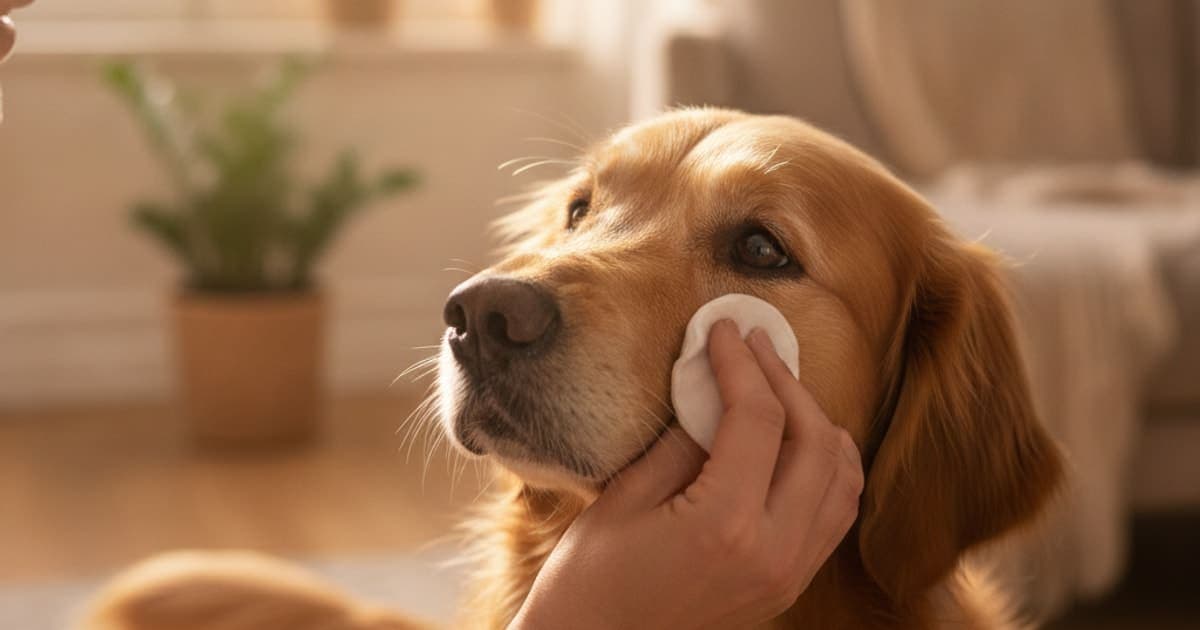
Supportive home care is still useful while you wait: wipe discharge away from the inner corner outward with clean, damp gauze, use a separate piece for each eye, and put a protective collar on a dog that is rubbing. Then talk to your veterinarian about what goes in the eye, for how long, and what to recheck.
Key Takeaways
- Conjunctivitis is inflammation of the membrane lining the eyelids, and in dogs it is almost always secondary to something else.
- Both eyes usually points to allergy, irritants, infection or dry eye; one eye usually points to a local problem such as a foreign body or an eyelid abnormality.
- Most cases are not contagious, infectious cases can spread between dogs, and transmission from dogs to people is considered rare.
- Pain, cloudiness, a bulging eye, an abnormal pupil or sudden vision change are urgent and need same-day or emergency care.
- Duration depends entirely on the cause; anything persistent or recurring needs the cause identified rather than another round of drops.
- Skip over-the-counter and leftover medicated drops, because the wrong drop on an ulcerated cornea can do real damage.
Frequently asked questions
- What is conjunctivitis in dogs?
- Conjunctivitis in dogs is inflammation of the conjunctiva, the pink membrane lining the eyelids and covering the white of the eye. It is a sign rather than a diagnosis, so it tells you the eye surface is inflamed without explaining why. Finding the underlying cause is the whole job.
- Can dogs get conjunctivitis?
- Yes. Dogs get conjunctivitis commonly, and it is one of the most frequent reasons owners book an eye appointment. In dogs it is usually secondary to allergies, irritants, dry eye, a foreign body or an eyelid abnormality rather than a standalone infection, which is why the cause matters more than the redness.
- What causes conjunctivitis in dogs?
- The usual causes are allergies, airborne irritants such as dust or smoke, foreign material like grass seeds trapped under a lid, dry eye, inward-rolling lids or misdirected lashes, and blocked tear drainage. Bacteria often arrive secondarily, and some viruses cause it directly alongside respiratory signs.
- What does conjunctivitis in dogs look like?
- The lining inside the lids turns red or beefy and may swell and look jelly-like. Expect discharge that is watery, thick and grey, or yellow to green, along with blinking, crusted lids in the morning, and sometimes a more visible third eyelid. Squinting or pawing suggests pain and needs prompt attention.
- Can conjunctivitis be passed from dogs to humans?
- It is considered rare. Most canine conjunctivitis is allergic or irritant and cannot spread at all, and the organisms involved in infectious cases are poorly adapted to people. Wash your hands after touching the eye, use fresh gauze per eye, and take extra care if anyone in the household is immunocompromised.
- Is conjunctivitis in dogs dangerous?
- Simple conjunctivitis is usually not dangerous, but the look-alikes are. Glaucoma, uveitis and corneal ulcers can present as a red eye and threaten vision. Chronic untreated inflammation can also cause ulceration, scarring and corneal pigment. That combination is why a red eye deserves a veterinary exam rather than guesswork.
- Is conjunctivitis in dogs an emergency?
- Not always, but it can be. Treat it as urgent if the eye is painful or held shut, the cornea looks cloudy or blue, the eye bulges, the pupil looks abnormal, there is blood or trauma, or your dog seems to be losing vision. Rapid worsening over hours also warrants emergency care.
- Will conjunctivitis in dogs go away by itself?
- Mild irritant cases sometimes settle once the irritant is gone. Cases driven by dry eye, an eyelid abnormality or trapped debris will not, because the cause keeps working with every blink. Waiting is risky mainly because painful, sight-threatening conditions can look identical in the first day or two.
- How long does conjunctivitis in dogs last?
- Duration tracks the cause rather than the redness. A one-off irritant may clear quickly once flushed, allergic cases follow the allergen and often recur seasonally, and anything caused by dry eye or lid anatomy can persist indefinitely until the underlying problem is identified and managed with your veterinarian.
- Can I use over-the-counter eye drops for my dog's conjunctivitis?
- Avoid medicated over-the-counter drops and anything left over from another pet or person. Human redness-relief drops mask the problem, and steroid-containing drops can deepen an undetected corneal ulcer. A plain sterile saline rinse is reasonable for flushing debris while you arrange a veterinary exam and a fluorescein stain test.
Educational content, not veterinary advice. Ask your vet about your dog.