Is Nettle Safe for Dogs? (Raw Sting vs Dried Leaf)
Nettle is generally safe for most healthy dogs when it is dried, cooked, freeze-dried or steeped — the processing destroys the plant's stinging hairs. The raw, living plant is not safe to let a dog chew or push through. Owners use nettle leaf for seasonal itch and general nutritive support.
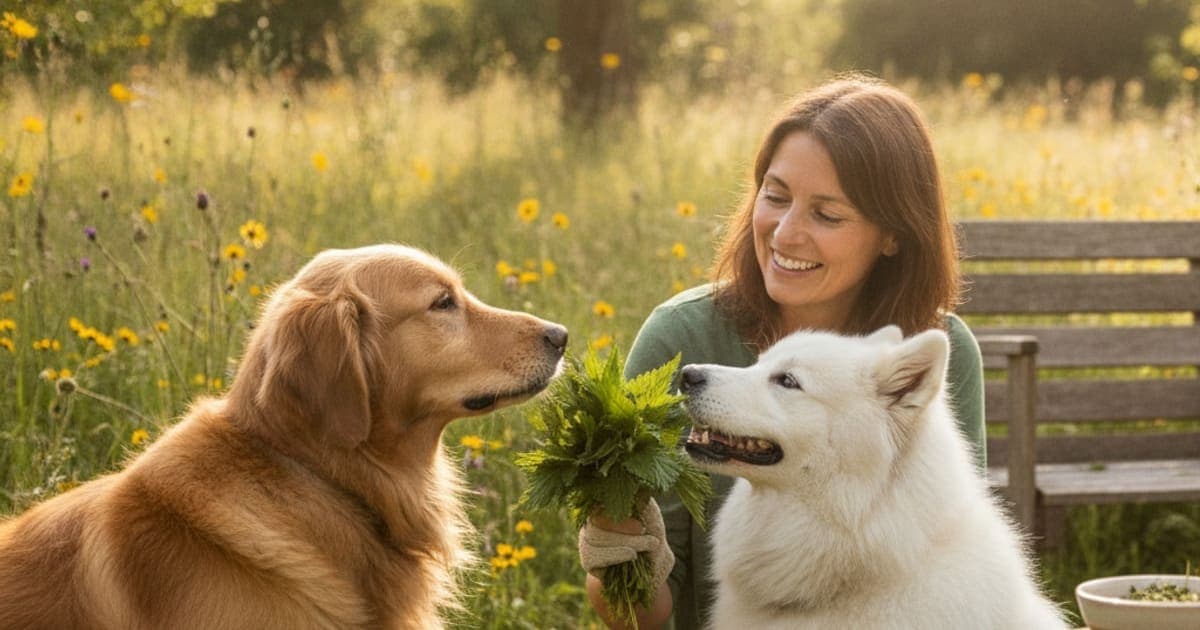
Yes, for most healthy dogs — but the form matters more than anything else. Dried, cooked, freeze-dried or steeped nettle leaf is widely used as a food-level herb for dogs and is generally well tolerated. The raw, living plant is a different animal: its stinging hairs inject an irritant cocktail that can leave a dog with welts, a swollen muzzle and a miserable afternoon.
Same species. Completely different experience in your dog's mouth.
Heat, drying and freezing destroy the sting, and that single distinction answers most of what owners are really asking when they ask whether nettle is safe for dogs.
Why raw nettle stings, and what to do if your dog runs through a patch
Stinging nettle (Urtica dioica) is covered in hollow, needle-like hairs called trichomes. When a dog brushes against them, the brittle tip snaps off and the hair injects its contents into the skin. That fluid contains histamine, acetylcholine, serotonin and formic acid — which is exactly why the sting burns, raises hives and keeps itching long after the dog has moved on.
Dogs usually get it on the muzzle, lips, tongue, the thin skin of the belly and groin, or between the pads. Typical signs include frantic pawing at the face, drooling, head shaking, raised wheals on sparsely haired skin, a sudden limp, or an odd reluctance to be touched.
Most cases settle on their own within a few hours. Rinse the area with cool water rather than rubbing it — rubbing can push broken hairs deeper. Then watch closely. Facial swelling that keeps spreading, changes in breathing, repeated vomiting, weakness or collapse are reasons to call your veterinarian immediately, and your vet is also the right person to ask before giving any antihistamine, because the product choice and amount depend on your individual dog.
So: can dogs eat nettle leaf straight off the plant? No. Don't let a dog graze on live nettle, and don't hand-pick fresh leaves into a bowl without processing them first.
The forms of nettle that are safe to feed
Blanching, steaming, oven-drying, air-drying and freezing all collapse the stinging hairs and neutralise their contents. That is why dried nettle has been a kitchen and herbal staple for centuries, and why the dried herb is the form almost every dog supplement uses.
| Form | What it is | Why owners choose it | Safety notes |
|---|---|---|---|
| Dried leaf or leaf powder | Air- or oven-dried Urtica dioica leaf | Easiest to sprinkle over food; the standard nutritive form | Sting is deactivated; start small to check tolerance |
| Freeze-dried leaf | Leaf dried at low temperature, often capsuled | Preserves more of the fresh plant's compounds | Same deactivation; check the label names the leaf, not root |
| Nettle tea or infusion | Dried leaf steeped in hot water, then cooled | Hydration-friendly, very mild, easy to add to water or food | Serve plain and cooled; never sweetened, never with xylitol |
| Cooked fresh nettle | Fresh tops blanched or steamed | Seasonal, inexpensive if you forage | Must be fully cooked; handle with gloves |
| Tincture | Alcohol or glycerine extract | Concentrated, small volume | Glycerites are gentler for dogs than alcohol extracts |
| Raw living plant | The hedgerow version | Nothing — avoid | Stings mouth, muzzle, paws and belly |
Nettle leaf, nettle root, seed and tea: what each part actually offers
People search for nettle benefits for dogs as if nettle were one thing. It isn't. The plant parts have genuinely different chemistry, and buying the wrong one is the most common mistake owners make.
Nettle leaf is the nutritive part. It carries meaningful amounts of minerals including iron, calcium and magnesium, plus vitamin K, carotenoids and chlorophyll. Traditional herbal use centres on seasonal itch, general vitality, and urinary and joint comfort. When owners talk about nettle leaf for dogs benefits, this is the part they mean.
Nettle root has a different profile — lignans and sterols rather than the leaf's mineral and flavonoid load. Human research on nettle root has focused mainly on lower urinary tract symptoms associated with benign prostatic enlargement. There is little controlled canine data, so nettle root benefits for dogs remain a traditional-use proposition rather than a demonstrated one. If skin is your concern, root is not the part you want.
Nettle seed appears in herbal practice for kidney and energy support, but it is the least studied part and the hardest to source with confidence.
Nettle tea is simply a gentle delivery method for the leaf. Nettle tea benefits for dogs are essentially leaf benefits at a lower concentration, with the added advantage that fussy dogs often accept a splash of cooled infusion in food more readily than a powder.
Nettle for itchy skin and allergies: what research suggests, what owners report
This is the real reason most people land here. The dog chews its paws, the ears flare every spring, and nettle keeps coming up.
The mechanism story is interesting. Laboratory work on nettle leaf extracts suggests they can interact with histamine H1 receptor activity and with some of the inflammatory signalling involved in allergic responses. Small human studies of freeze-dried nettle leaf in seasonal allergic rhinitis have reported symptom improvement, which is where the herb's reputation comes from. Owners report that dogs on dried nettle leaf seem more comfortable through pollen season.
What does not exist is robust controlled canine research showing nettle changes the course of allergic skin disease, and no herb should be described as treating it. Nettle may support a dog's overall comfort as part of a broader plan. That is the honest ceiling on the claim.
It also matters that itchy skin in dogs has many causes that look identical from the outside: fleas, food reactions, atopic dermatitis, secondary yeast or bacterial infection, mites, and endocrine disease. Nettle does nothing about parasites or infection. If your dog is already on a prescribed medication for allergic skin disease, keep giving it exactly as directed and talk to your veterinarian before adding anything — herbs sit alongside that plan, never in place of it.
Side effects and the dogs who should skip it
Nettle for dogs side effects are usually mild and digestive: loose stool, gas, or a one-off vomit, most often when too much is introduced too quickly or on an empty stomach. Allergic reaction to the herb itself is possible, as with any botanical.
The interactions deserve more attention than the side effects:
- Vitamin K content. Nettle leaf is notably high in vitamin K, which matters for any dog on an anticoagulant.
- Traditional diuretic action. Caution for dogs already on diuretics, or with kidney or heart disease.
- Oxalates. Nettle contains oxalates, so it is a poor choice for dogs with a history of calcium oxalate stones.
- Blood glucose and blood pressure. Research has reported effects on both, so dogs on medication for either need veterinary input first.
- Pregnant or nursing dogs and puppies. Don't improvise here. Nettle is traditionally avoided in pregnancy, and anything you give a pregnant, nursing or growing dog is a conversation to have with your vet rather than a decision to make from a blog.
Where to buy nettle for dogs, and how to read the label
Dried nettle leaf is easy to find from reputable bulk herb suppliers, human-grade herbal retailers, and dog-specific supplement brands. Price is rarely the issue; sourcing quality is.
Nettle readily takes up minerals from the soil it grows in, which means it can also take up heavy metals from contaminated ground. Look for a supplier that names the botanical species and the plant part (Urtica dioica leaf, not just 'nettle'), states country of origin, and tests batches for heavy metals and microbial contamination.
Be sceptical of the kitchen-sink chew: fifteen botanicals on a label with a single 'proprietary blend' weight, where nettle is present at dust level for the benefit of the ingredient list rather than the dog. If a brand won't tell you how much of something is in the bag, assume the answer is: not much.
When the real problem is mobility, not skin
Plenty of owners researching nettle aren't dealing with itch at all. They're dealing with a dog that hesitates at the stairs, a torn cruciate, a surgery date, or a long post-operative recovery. Nettle is a nutritive herb — it was never built for that job.
That is the space pawgen works in. K9-REPAIR is a BPC-157 and TB-500 peptide formulation for dogs, dosed by body weight, third-party tested with certificates of analysis published for every batch, and shipped direct to the door with a 60-day money-back guarantee. BPC-157 is a synthetic peptide sequence derived from a protein found in gastric juice; research suggests it plays a role in angiogenesis and in the migration of the fibroblasts that rebuild tendon and ligament tissue. TB-500 is a synthetic fragment of thymosin beta-4, a protein involved in actin regulation and cell movement — the machinery behind how damaged tissue reorganises itself over weeks, not days. It is emerging science, and it is the stack a growing number of owners are adopting through recovery. BPC-157 and TB-500 are not FDA-approved veterinary drugs, and nothing here describes a guaranteed outcome for your dog.
If you want to look at the underlying documentation, pawgen publishes batch certificates of analysis, lists formulation details on the shop page, and covers shipping availability on its location page.
Key Takeaways
- Raw stinging nettle is not safe for dogs to chew or push through; drying, cooking, freezing and freeze-drying deactivate the sting entirely.
- Dried nettle leaf is the form behind nearly every claimed benefit, and it is generally well tolerated by healthy adult dogs.
- Leaf, root and seed are chemically different — buy the part that matches your goal, and skip root if skin is the concern.
- Research suggests nettle leaf interacts with histamine signalling, and owners report seasonal comfort, but no herb treats allergic skin disease.
- Watch for interactions with anticoagulants, diuretics, diabetes and blood pressure medication, and avoid nettle in dogs prone to calcium oxalate stones.
- Mobility and soft-tissue recovery are a different problem from itch, and that is where peptide formulations like K9-REPAIR fit.
The order of operations that protects your dog
Your veterinarian owns the diagnosis and the treatment plan. They are the one who can tell you whether the itching is fleas, food, atopy or a secondary infection, whether that limp is a cruciate or a disc, and which medications your dog can safely be given alongside a herb or a supplement. Get that right first.
Herbs like nettle, and formulations like K9-REPAIR, operate in the space that proper veterinary care creates — supporting a dog that is already being properly diagnosed, properly medicated and properly rehabbed. They are not a shortcut around any of it, and the owners who get the best results are the ones who never try to make them one.
Owners exploring peptide support for their dog can review K9-REPAIR — BPC-157 + TB-500 formulated for dogs — at https://pawgen.com/. BPC-157 and TB-500 are not FDA-approved veterinary drugs. Nothing in this article treats, cures or prevents any condition; every decision about your dog's care belongs with your veterinarian.
Frequently asked questions
- Is nettle safe for dogs?
- Dried, cooked, freeze-dried or steeped nettle leaf is generally safe for most healthy adult dogs in food-level amounts. Raw, living stinging nettle is not — its hairs inject histamine and other irritants that cause welts and pain. Processing destroys the sting completely. Check with your veterinarian first if your dog takes medication.
- Can dogs have nettle?
- Yes, most healthy dogs can have nettle in processed form. Dried leaf, leaf powder, cooled nettle tea and glycerine tinctures are all commonly used. Introduce it slowly with food to check tolerance. Dogs on anticoagulants, diuretics, diabetes or blood pressure medication need veterinary clearance before starting.
- Can dogs eat nettle leaf?
- Dogs can eat nettle leaf once it has been dried, cooked, blanched or frozen, since all of those destroy the stinging hairs. They should never eat raw leaf off the living plant. Dried leaf or leaf powder sprinkled over a meal is the simplest and most common approach.
- Can I give my dog nettle for allergies?
- Many owners use dried nettle leaf during allergy season, and research suggests nettle extracts interact with histamine signalling. There is no controlled canine evidence that nettle treats allergic skin disease, so it supports comfort at best. Keep any prescribed allergy medication going and discuss the addition with your veterinarian.
- Where can I buy nettle for dogs?
- Dried nettle leaf is available from bulk herb suppliers, human-grade herbal retailers and dog supplement brands. Choose a source that names the species and plant part, states origin, and tests batches for heavy metals, since nettle takes up minerals and contaminants from the soil it grows in.
- What are the side effects of nettle for dogs?
- The most common side effects are mild digestive upset: loose stool, gas or occasional vomiting, usually from introducing too much too quickly. Nettle is high in vitamin K, has a traditional diuretic action, and contains oxalates, so interactions matter more than the side effects themselves for medicated dogs.
- What should I do if my dog gets stung by stinging nettle?
- Rinse the area with cool water rather than rubbing, which can push broken hairs deeper. Most stings settle within a few hours. Call your veterinarian immediately if you see spreading facial swelling, breathing changes, repeated vomiting, weakness or collapse, and before giving any antihistamine.
- What is the difference between nettle leaf and nettle root for dogs?
- Nettle leaf is the nutritive part, carrying minerals, vitamin K, carotenoids and flavonoids, and it is the part behind seasonal itch and general vitality use. Nettle root has a different chemistry built on lignans and sterols, studied mainly in human urinary health. For skin concerns, choose leaf.
- Does nettle help with itchy skin in dogs?
- Owners report that dogs seem more comfortable through pollen season on dried nettle leaf, and laboratory research suggests nettle extracts interact with histamine receptor activity. Nettle does nothing for fleas, mites or secondary infection, which cause most canine itching, so a veterinary diagnosis comes first.
- Is nettle safe for puppies or pregnant dogs?
- Nettle is traditionally avoided during pregnancy, and there is no reliable guidance for puppies or nursing dogs. Do not improvise amounts for these groups. Talk to your veterinarian, who can weigh your individual dog's stage, size and health status before anything is added to the bowl.
Educational content. BPC-157 and TB-500 are not FDA-approved veterinary drugs. Talk to your veterinarian before starting anything new, especially if your dog is on prescribed medication.