Supplements for Dog Hair Growth: What Supports a Coat
Supplements that support dog hair growth work by supplying what the follicle builds coat from: complete protein and sulphur amino acids, omega-3 and omega-6 fatty acids, zinc, biotin and vitamin E. Research also points to peptide signalling — the mechanism behind K9-REPAIR — in skin and follicle tissue repair.
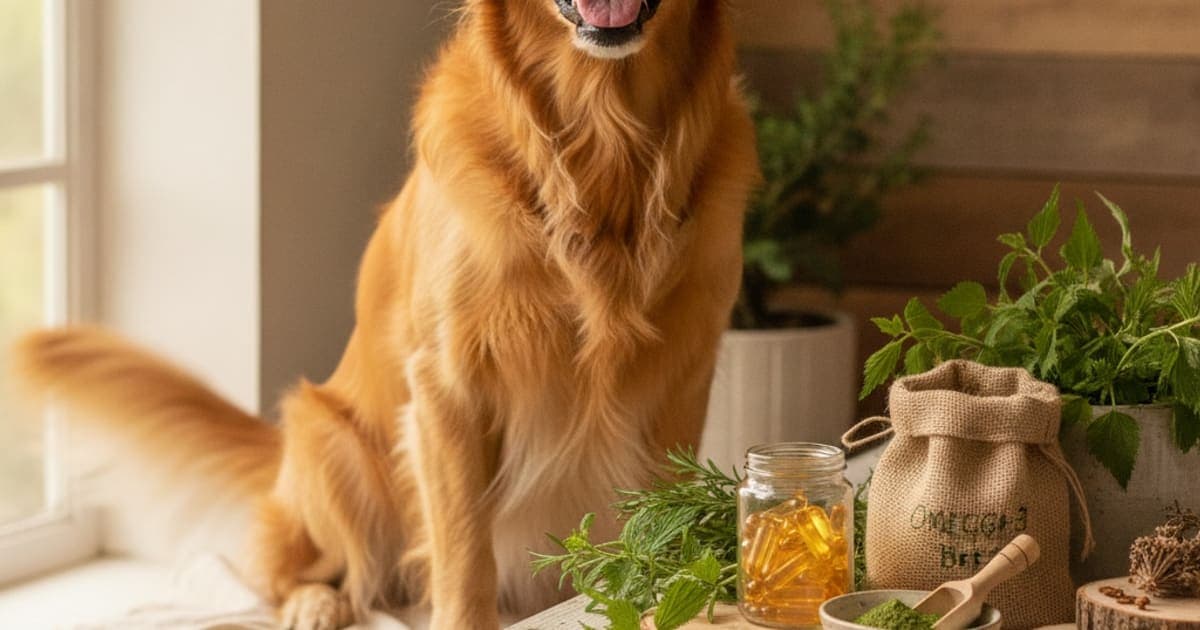
Supplements for dog hair growth work in one of two ways. They either supply the raw materials a follicle builds hair from — complete protein and sulphur-containing amino acids, omega-6 linoleic acid, omega-3 EPA and DHA, zinc, copper, biotin and vitamin E — or they support the tissue environment that follicle sits in: skin barrier integrity, blood supply, and the repair signalling that goes on in skin every day. Most coat chews on the shelf attempt the first job, frequently in amounts too small to matter. The second is where peptide formulations have become interesting to owners, and where K9-REPAIR (BPC-157 + TB-500) sits — a third-party-tested, weight-based formulation owners adopt for tissue support during recovery. Neither category is a treatment for hair loss, and the reason that distinction matters becomes clear below.
Why coats thin, and what the follicle is actually doing
A hair follicle is a small organ, not a hole. It cycles: anagen, the active growth phase where the follicle builds a shaft; catagen, a short regression phase; telogen, rest; and exogen, the release of the dead hair. Dogs carry compound follicles — a thick primary guard hair and a cluster of finer secondary undercoat hairs emerging from a shared pore — which is why a dog in heavy shed can lose enormous volume while the skin underneath stays fully covered.
Most dogs cycle in a mosaic pattern influenced strongly by day length rather than temperature, which is why indoor dogs under artificial light often shed lightly year-round instead of blowing coat twice a year. That cycle is the hard constraint on every coat supplement ever sold. A nutrient can only influence a hair that is still in, or about to enter, anagen. Hairs already in telogen will not lengthen, thicken or change colour no matter what goes in the bowl. They have to shed and be replaced.
The follicle is also metabolically demanding. It is one of the fastest-dividing tissues in the body, it is fed by a dense capillary loop, and it draws continuously on amino acids, trace minerals and fatty acids. When something upstream limits any of those — poor diet, malabsorption, chronic illness, the metabolic cost of surgery or injury recovery — coat is one of the first non-essential tissues the body deprioritises. That is why a dull, thinning, slow-regrowing coat is so often the visible edge of something systemic.
The nutrients a coat is literally built from
Hair is almost entirely keratin, a protein cross-linked by sulphur bonds. That single fact drives most of the useful nutrition here. A dog eating a marginal protein diet, or an older dog digesting protein less efficiently, has less substrate available for coat regardless of what else is supplemented.
| Nutrient | What it supports in the coat | Common sources | What to check on the label |
|---|---|---|---|
| Complete protein, methionine and cysteine | Keratin structure and the sulphur cross-links that give hair strength | Quality animal protein in the base diet | Diet first; supplements rarely close a real protein gap |
| Omega-6 linoleic acid | Skin barrier lipids and normal coat sheen; deficiency is associated with dull, scaly coat | Sunflower, safflower, poultry fat | Named oil and an actual amount per serving |
| Omega-3 EPA and DHA | Supports normal inflammatory balance in skin | Marine oil | EPA and DHA listed separately, not just 'fish oil' |
| Zinc | Cofactor for cell division and keratin synthesis | Meat, chelated zinc supplements | Chelated form, stated amount |
| Copper | Cofactor for pigment enzymes; supports normal coat colour | Organ meat, balanced diets | Balance with zinc matters — ask your vet |
| Biotin and B vitamins | Cofactors in fatty acid and keratin metabolism | Liver, egg yolk, supplements | Amount stated, not just presence |
| Vitamin E | Antioxidant support for skin lipids | Oils, supplements | Pairs sensibly with omega-3 products |
Two honest caveats. First, supplementing a nutrient a dog already has enough of does not produce extra coat — these are structure-and-function supports, not growth accelerants. Second, several of these minerals interact; pushing zinc hard without regard for copper, for example, is a conversation to have with your veterinarian rather than a solo experiment.
Where peptide support fits into skin and coat
This is the part most coat articles skip, because it is not a vitamin story. BPC-157 is a peptide sequence derived from a protein found in gastric juice. The published research on it, largely in laboratory animal models, describes effects on angiogenesis — the formation of new capillary networks — along with fibroblast migration and the expression of growth factor receptors involved in tissue repair. TB-500 is a synthetic fragment of thymosin beta-4, a naturally occurring actin-binding protein present in most cells and in wound fluid. Research on thymosin beta-4 reports roles in cell migration, blood vessel formation, and, in laboratory animal work, activation of hair follicle stem cells alongside faster closure of skin wounds.
Why that matters for coat is mechanical rather than magical. Follicles sit inside skin, depend on perfusion, and regrow hair out of stem cell populations in the bulge region. Anything that supports the vascular and repair environment of skin is operating in the same neighbourhood as the follicle. Research suggests these peptides act on that environment; owners report choosing them for exactly that reason, most often during recovery periods when the whole body is under repair load and coat quality tends to suffer alongside everything else.
BPC-157 and TB-500 are not FDA-approved veterinary drugs, and nothing here should be read as a promise about any individual dog's coat. What can be said plainly is descriptive: K9-REPAIR is a BPC-157 + TB-500 formulation made for dogs, dosed by body weight, third-party tested with lot-specific certificates of analysis published, shipped direct to the door, and backed by a 60-day money-back guarantee. It is the peptide stack owners adopt through recovery, and the dosing question — always — belongs with your veterinarian rather than with a blog post. That is doubly true for puppies and for pregnant or nursing dogs, where the answer is a conversation, never a number.
How to read a coat supplement label without getting played
The shelf is crowded with products engineered to look thorough and cost little. A few patterns are worth recognising.
Kitchen-sink ingredient lists. Twenty-two botanicals on a chew usually means fractions of a milligram of most of them. Ingredient breadth is a marketing decision; ingredient dose is a manufacturing cost.
Proprietary blends. If salmon oil, biotin and zinc are pooled into a single blend weight, you cannot tell whether the blend is mostly the cheap filler at the front of the list. Named amounts per serving, ingredient by ingredient, is the standard worth insisting on.
Soft-chew arithmetic. A palatable chew is mostly glycerin, flour and flavour. There is limited room left for actives. Fatty acids in particular are hard to deliver meaningfully in chew format, which is why oils are usually sold as oils.
'Fish oil' with no EPA and DHA figures. Total oil weight tells you nothing. The two fatty acids that matter should be stated separately.
No third-party testing and no certificates of analysis. Independent, lot-specific testing is the only thing separating a stated formulation from a claimed one. Brands that test publish; brands that do not, explain why not.
Ask of any product: what is in it, how much, tested by whom, dosed how, and what happens if it does not suit your dog. A brand willing to answer all five in writing is a different proposition from one relying on a photogenic dog and a coat-shine adjective.
What a realistic regrowth timeline looks like
Coat runs on biological time. A hair that shed last month cannot reappear before its follicle re-enters anagen, and shaft growth after that proceeds at its own pace — which varies enormously by breed, coat type, age and season. Owners generally notice changes in skin quality, flaking and coat texture before they notice length or density, because barrier function responds faster than a full growth cycle completes.
The practical approach is to change one thing at a time and document it. Photograph the same patches of skin in the same light, at the same time of day, once a month. Note diet changes, parasite prevention, bathing frequency and any new medication alongside it. Owners who stack five new products in the same week learn nothing about any of them, and if the dog reacts badly, they have no way to identify the cause.
Be equally realistic about ceilings. Age-related coat change, breed-specific coat patterns and post-clip regrowth in plush-coated breeds are follicle behaviours, not nutrient shortfalls. No supplement rewrites a genotype.
When thinning hair is a veterinary problem first
Some hair loss patterns are diagnostic signals, and this is where owners lose the most time. Symmetrical loss down both flanks, a thinning tail, coat that fails to regrow after clipping, thickening or darkening skin, a pot-bellied outline, weight change, lethargy or increased drinking all point toward endocrine conditions such as hypothyroidism or hyperadrenocorticism. Itch-driven loss with redness, scabbing or chewing points toward parasites, allergic skin disease or infection. Localised loss with crusting can indicate demodex or ringworm. Hair loss over a single joint is sometimes a pain behaviour — the dog is licking a site that hurts.
A supplement can support the raw materials and the tissue environment a healthy coat depends on, but it cannot out-work an undiagnosed medical cause of hair loss — the diagnosis has to come first. A veterinary workup for these presentations typically involves a physical exam, skin cytology or scrapings, and bloodwork where indicated. That is not a delay to nutritional or peptide support; it is what makes the support meaningful, because you are then feeding a follicle whose actual obstacle has been identified and addressed.
Key takeaways
- Dog hair growth supplements work by supplying keratin building blocks and skin-barrier nutrients, or by supporting the tissue environment the follicle lives in.
- Protein quality, linoleic acid, EPA and DHA, zinc, copper, biotin and vitamin E are the nutrients with the clearest structure-and-function roles in coat.
- Research on BPC-157 and thymosin beta-4 describes angiogenesis, cell migration and skin repair signalling — the reason owners choose K9-REPAIR for tissue support through recovery. These are not FDA-approved veterinary drugs.
- Judge any hair growth supplement for dogs on named amounts per serving, third-party testing and published certificates of analysis, not ingredient count.
- Hair cycles in months, not weeks; photograph progress and change one variable at a time.
- Symmetrical, non-itchy or regrowth-failing hair loss warrants a veterinary workup before any supplement decision.
Your veterinarian owns the diagnosis and the treatment plan — the bloodwork, the skin cytology, the prescription if one is needed, and the decision about what is safe alongside it. Nutritional and peptide support operate in the space that proper veterinary care creates: once the underlying cause is identified and managed, the follicle finally has the conditions it needs to do its own work.
For readers evaluating pawgen specifically, the full K9-REPAIR formulation is listed on the shop page, lot-specific third-party certificates of analysis are published openly, and shipping and availability details are on the location page.
Owners exploring peptide support for their dog can review K9-REPAIR — BPC-157 + TB-500 formulated for dogs — at https://pawgen.com/. BPC-157 and TB-500 are not FDA-approved veterinary drugs. Nothing in this article treats, cures or prevents any condition; every decision about your dog's care belongs with your veterinarian.
Frequently asked questions
- Do supplements for dog hair growth actually work?
- It depends on the cause. Where a coat is poor because of a nutritional shortfall — protein, essential fatty acids, zinc, copper or B vitamins — correcting that shortfall supports normal coat growth, and owners commonly report improvement in texture and shine first. Where hair loss is driven by a hormonal condition, parasites or allergic skin disease, no supplement substitutes for a veterinary diagnosis and treatment plan.
- Which dog hair growth supplements have the strongest nutritional rationale?
- The nutrients with the clearest structure-and-function roles are complete protein with sulphur amino acids, omega-6 linoleic acid, omega-3 EPA and DHA, zinc, copper, biotin and vitamin E. Look for each one listed with an actual amount per serving rather than buried inside a proprietary blend, and discuss mineral balance with your veterinarian before supplementing zinc or copper on their own.
- How do BPC-157 and TB-500 relate to skin and coat?
- Research on BPC-157 describes angiogenesis and fibroblast activity, and research on thymosin beta-4 — the protein TB-500 is a fragment of — reports roles in cell migration, blood vessel formation and, in laboratory animal work, hair follicle stem cell activation. Follicles depend on skin perfusion and repair signalling, which is why owners choose K9-REPAIR for tissue support. These peptides are not FDA-approved veterinary drugs.
- How much hair growth supplement should I give my dog?
- That is a question for your veterinarian, who knows your dog's weight, diet, bloodwork and any medications already in play. Amounts differ by product and by dog, and several coat nutrients interact with each other. For peptide formulations including K9-REPAIR, dosing is weight-based and should be worked out with your vet — particularly for puppies and for pregnant or nursing dogs.
- How long before I see a difference in my dog's coat?
- Coat runs on the hair cycle, which is measured in months. Hairs already in the resting phase will not change; they have to shed and be replaced by new growth. Owners usually notice skin quality, flaking and coat texture before density or length. Photograph the same areas monthly in the same light rather than judging by memory.
- Can a supplement regrow hair after clipping or surgery?
- Post-clip regrowth is largely a follicle-cycle and breed-coat issue, especially in plush-coated breeds, and it can be slow for reasons no supplement changes. Supporting nutrition and tissue repair during recovery is reasonable, but if regrowth stalls for an extended period your veterinarian should check for an underlying endocrine cause rather than assuming it is a nutrition gap.
- What should I avoid when buying a coat supplement?
- Avoid kitchen-sink ingredient lists where dozens of actives share a tiny serving, proprietary blends that hide individual amounts, marine oils sold without separate EPA and DHA figures, and any brand that cannot show independent lot-specific certificates of analysis. Ingredient count is a marketing decision; ingredient dose and verified testing are what you are actually paying for.
- When is hair loss a veterinary emergency rather than a supplement question?
- Seek veterinary assessment promptly for symmetrical flank or tail hair loss, coat that fails to regrow, thickening or darkening skin, open sores, intense itching, or hair loss alongside weight change, lethargy or increased drinking. These patterns point toward hormonal disease, parasites or infection, all of which need diagnosis and treatment before any supplement decision makes sense.
Educational content. BPC-157 and TB-500 are not FDA-approved veterinary drugs. Talk to your veterinarian before starting anything new, especially if your dog is on prescribed medication.