Is Obesity Joint Strain in Dogs Painful? (What to Know)
Yes — obesity-related joint strain in dogs is painful. Extra body weight loads cartilage mechanically with every step, while fat tissue releases inflammatory signalling molecules that sensitise joint structures. The pain is usually gradual and easy to mistake for normal aging, which is why so many dogs go uncomfortable for months before anyone notices.
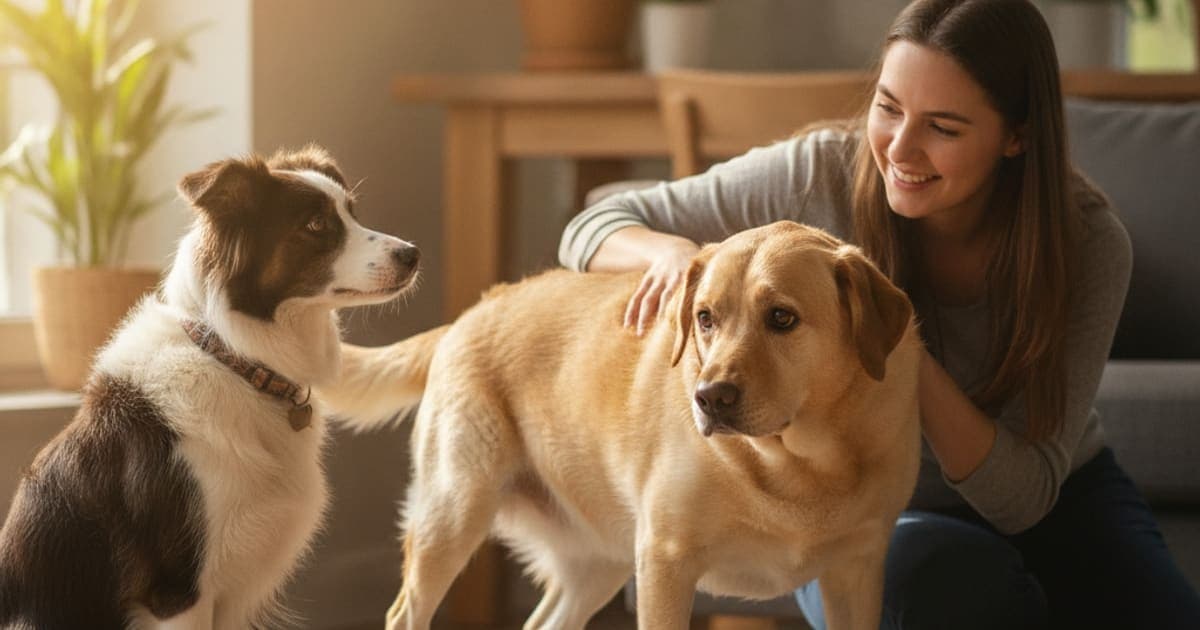
Is obesity joint strain in dogs painful?
Yes — obesity-related joint strain in dogs is painful. Excess weight loads the joint mechanically with every step, and body fat is metabolically active tissue that releases inflammatory signalling molecules into circulation. The long-running Purina Lifespan Study of Labrador Retrievers, published in the Journal of the American Veterinary Medical Association in 2002, linked lean body condition with later onset of osteoarthritis.
The important nuance is that this pain rarely announces itself. A dog with a torn cruciate ligament goes lame in an afternoon. A dog carrying too much weight gets sore over months, adjusts its gait, stops offering to jump, and is quietly described by everyone in the household as "slowing down." The discomfort is real long before it looks like limping.
Two different kinds of load on the same joint
The first load is purely physical. Cartilage is the smooth, slippery surface that lets bone glide on bone, and it has no blood supply of its own — it is fed by synovial fluid moving in and out of the matrix as the joint is loaded and unloaded, like a sponge. That cycle is healthy in moderation. Under sustained excess compression, the cartilage matrix degrades faster than it can be maintained, the bone underneath begins to remodel, and the joint lining becomes irritated.
This matters more than static bodyweight suggests, because joints do not just carry a dog standing still. Peak forces travelling through a limb when a dog trots, turns hard, or lands off a sofa are considerably higher than the number on the scale. Every extra kilogram is multiplied through that limb thousands of times a day, and it is felt most at the hips, stifles (knees), elbows and lumbar spine.
The second load is chemical, and it is the one most owners have never heard of. Adipose tissue is not inert padding. It behaves as an endocrine organ, secreting adipokines such as leptin and adiponectin along with pro-inflammatory cytokines. Veterinary and comparative human research describes this as a low-grade, body-wide inflammatory state associated with excess fat mass — meaning an overweight dog's joints sit in a more inflamed environment even before the mechanical load is counted. That is why weight and joint pain are not simply a heavier-dog-hurts-more equation. The chemistry compounds the mechanics.
Body weight is the single variable in canine joint pain that an owner controls directly, and reducing it changes both the physical load on the joint and the inflammatory environment around it.
Why the pain is easy to miss — and the cycle it starts
Dogs are extraordinarily good at hiding joint pain, partly because it comes on symmetrically. A dog sore in one knee limps. A dog sore in both hips simply moves less and looks unremarkable doing it.
What owners tend to notice first, often without registering it as pain:
- Hesitating at the bottom of stairs, or taking them one at a time
- A pause before jumping into the car, or refusing entirely
- Taking noticeably longer to get up after a nap, then loosening up after a few minutes
- Sitting with one hind leg splayed out to the side rather than tucked
- Shorter, slower walks, or lagging on the way home
- Licking repeatedly at one joint
- Reduced tolerance for handling, grooming or a child leaning on them
- Panting at rest, or restlessness at night
Any of these deserve a veterinary examination rather than a wait-and-see approach. Pain scoring, a hands-on orthopaedic exam and — where indicated — imaging are how you separate weight-driven strain from a cruciate injury, hip dysplasia, or something unrelated to the joints entirely. Your veterinarian owns that diagnosis; nothing you read online replaces it.
The cycle is what makes this urgent rather than merely unfortunate. A sore dog moves less. A dog that moves less loses muscle mass across the hindquarters and core — exactly the muscle that stabilises the joints and absorbs load before it reaches cartilage. Less muscle means more load transmitted through the joint, more soreness, and less inclination to move. Meanwhile, activity has dropped while food intake usually hasn't, so weight climbs. Each turn of the loop makes the next one easier.
Breaking that loop is the whole game, and it is easier to break early than late.
What actually moves the needle
Owners researching this problem tend to find a wall of options and no framework for how they relate. This is how the main approaches actually divide up:
| Approach | What it addresses | What it does not do |
|---|---|---|
| Veterinary exam, diagnosis and pain management | Identifies the real source of pain; prescribed medication can reduce inflammation and discomfort so the dog can move enough to rehabilitate | Does not remove the underlying load; medication is a tool inside a plan, not the plan |
| Structured weight reduction | Lowers mechanical force through every joint and reduces excess fat mass driving inflammatory signalling | Works slowly; will not rebuild cartilage already lost |
| Controlled exercise and rehabilitation | Rebuilds stabilising muscle, maintains range of motion, keeps synovial fluid circulating through cartilage | Poorly chosen or high-impact activity can aggravate a sore joint |
| Connective tissue support, including peptide formulations such as K9-REPAIR | Targets the soft-tissue and repair side of the picture — the stack owners use through recovery and mobility work | Not a painkiller, not a diagnosis, not a replacement for weight loss or anything your vet prescribed |
These are not competing choices. They stack. The mistake is treating any one of them as sufficient on its own.
Getting the weight off is the part with the most leverage
Weight reduction in dogs is genuinely difficult, and it fails for predictable reasons: nobody measures the food, treats go uncounted, multiple people in the house feed the dog, and the target is vague.
What a veterinary weight plan adds is precision. Your vet will assign a body condition score — the standard nine-point scale used across veterinary practice — set a realistic target, and calculate intake against that target rather than against the label on the bag, which is a population average and often generous. They will also rule out the medical causes of weight gain that no amount of dieting fixes, such as hypothyroidism, before assuming the problem is calories alone. Protein intake matters too: the goal is to lose fat while preserving the muscle that supports the joints, not simply to lose mass.
Practical points that make the difference at home: weigh food rather than scooping it, subtract treats from the daily allowance instead of adding them to it, use part of the measured ration as training rewards, put rugs on slippery floors, add a ramp for the car, and swap one long weekend hike for shorter daily walks. Swimming and underwater treadmill work, where available, allow movement with much of the bodyweight taken off the joints.
Progress here is measured in months, not weeks — and comfort often improves before the goal weight is reached, because both the mechanical and inflammatory loads start falling from the first kilogram.
Where peptides fit alongside a veterinary plan
Weight loss and rehabilitation put a real demand on soft tissue. Tendons, ligaments and joint capsules that have been under sustained overload are being asked to remodel and take up work again. That soft-tissue repair window is where a growing number of owners have turned to peptides.
BPC-157 is a peptide sequence derived from a protein identified in gastric juice. Published animal research describes effects relevant to connective tissue — including fibroblast migration and the formation of new blood vessels in healing tissue, which is the mechanism by which repair signalling and nutrients reach structures with famously poor blood supply. TB-500 is a synthetic fragment related to thymosin beta-4, a naturally occurring protein involved in actin regulation and cell migration during tissue repair. Research suggests both may support the processes tissue uses to remodel; owners report using them through recovery and mobility work.
That is mechanism, honestly stated. BPC-157 and TB-500 are not FDA-approved veterinary drugs, and nothing here should be read as a claim that any product treats, prevents or fixes joint disease in your dog. It is emerging, promising science that owners are actively adopting — and it belongs in a conversation with your veterinarian, who should know everything your dog receives.
pawgen makes K9-REPAIR, a BPC-157 and TB-500 formulation made specifically for dogs, with weight-based dosing guidance, third-party testing and certificates of analysis available, shipped direct to the door, and backed by a 60-day money-back guarantee. Dosing itself is a conversation for your veterinarian, not a number to copy from a blog.
Save the scepticism for where it belongs: kitchen-sink joint chews with a dozen ingredients hidden inside a proprietary blend, label tricks that list an impressive compound at a trivial inclusion rate, and brands with more marketing than testing behind them. Ask any company for a certificate of analysis. The ones that have nothing to show you will tell you why they can't.
Key Takeaways
- Yes, joint strain from excess weight is painful — through mechanical compression of cartilage and through the inflammatory signalling associated with excess fat mass.
- The pain is usually gradual and symmetrical, so it presents as reluctance and slowness rather than obvious lameness.
- Pain drives inactivity, inactivity costs stabilising muscle, and less muscle means more load on the joint — a loop that is easier to break early.
- Weight reduction is the highest-leverage intervention available to an owner, and comfort often improves before the target weight is reached.
- Cartilage already lost does not regrow; the goal is changing the trajectory, not erasing damage.
- Peptide formulations such as K9-REPAIR sit alongside veterinary care during recovery and mobility work — never instead of prescribed medication, surgery or a diet plan.
If you want to go deeper, pawgen's guides cover obesity joint strain in full, the signs and causes behind obesity joint strain in dogs, realistic dog obesity joint strain recovery time, and the wolverine stack for obesity joint strain in dogs. Owners weighing a related knee injury often read how much does it cost to treat torn acl in dogs and can a dogs torn acl heal without surgery.
One last thing, and it is the part that matters most. Your veterinarian owns the diagnosis and the treatment plan — the exam, the imaging, the pain management, the weight target and the decision about whether an orthopaedic problem needs surgical attention. Nothing on this page changes that, and no supplement or peptide should ever be a reason to delay an appointment or stop something that was prescribed. Proper veterinary care creates the space in which everything else works.
Owners exploring peptide support for their dog can review K9-REPAIR — BPC-157 + TB-500 formulated for dogs — at https://pawgen.com/. BPC-157 and TB-500 are not FDA-approved veterinary drugs. Nothing in this article treats, cures or prevents any condition; every decision about your dog's care belongs with your veterinarian.
Frequently asked questions
- What helps a dog with obesity joint strain?
- A vet-directed weight reduction plan helps most, paired with any pain control your veterinarian prescribes, low-impact movement such as leash walks or swimming, and secure footing at home. Many owners also add a connective-tissue peptide formulation like K9-REPAIR alongside that plan. Confirm anything new with your vet first.
- How long does obesity joint strain take to heal in dogs?
- There is no fixed timeline, and it varies with severity, breed, age and how consistently the plan is followed. Comfort often improves within weeks of steady weight loss, well before the target weight is reached, while muscle rebuilding takes months. Your veterinarian should set and adjust the pace.
- What makes obesity joint strain worse in dogs?
- Continued weight gain, free-feeding and uncounted treats, high-impact activity like jumping from cars or furniture, slippery flooring, weekend-warrior exercise patterns after days of rest, and untreated pain that causes the dog to move less and lose the stabilising muscle that protects the joint.
- Can obesity joint strain in dogs be reversed?
- Excess weight can be reduced, and the mechanical and inflammatory load on the joints falls with it. Cartilage already lost and established arthritic change cannot be undone. Research links lean body condition with later onset of osteoarthritis, so weight management is about changing the trajectory rather than erasing damage.
- How much does it cost to treat obesity joint strain in dogs?
- Costs vary widely by clinic, region and severity. Expect charges for the examination, possible radiographs, therapeutic diet food, any prescribed medication, and optional rehabilitation sessions. Ask your practice for a written estimate before proceeding, since pricing differs enough between clinics that figures quoted online are rarely useful.
- What are the first signs of obesity joint strain in dogs?
- Slowing on stairs, hesitating before jumping into the car, taking longer to rise after a nap, sitting with a hind leg splayed sideways, shorter walks, and licking at a joint. Many owners read these as normal aging. Have your veterinarian examine them properly.
- Does losing weight actually reduce joint pain in dogs?
- Research consistently associates lean body condition with better joint outcomes in dogs, and weight loss reduces both the physical force through the joint and the fat mass driving inflammatory signalling. Owners commonly report easier rising and better stamina during a supervised reduction plan. Discuss a target weight with your vet.
- Is K9-REPAIR a treatment for joint pain in dogs?
- No. K9-REPAIR is not a treatment for any condition and is not an FDA-approved veterinary drug. It is a BPC-157 and TB-500 peptide formulation for dogs that owners use alongside veterinary care through recovery and mobility work. Research suggests these peptides may support connective tissue repair processes.
Educational content. BPC-157 and TB-500 are not FDA-approved veterinary drugs. Talk to your veterinarian before starting anything new, especially if your dog is on prescribed medication.