Natural Dog Company Hip & Joint Supplement — What to Know
Natural Dog Company's hip & joint supplement is a daily chew in the cartilage-support category — the glucosamine, chondroitin and green-lipped mussel class of ingredients — designed for long-term maintenance rather than active recovery. For injury or post-surgical phases, owners increasingly pair their vet's plan with pawgen's K9-REPAIR.
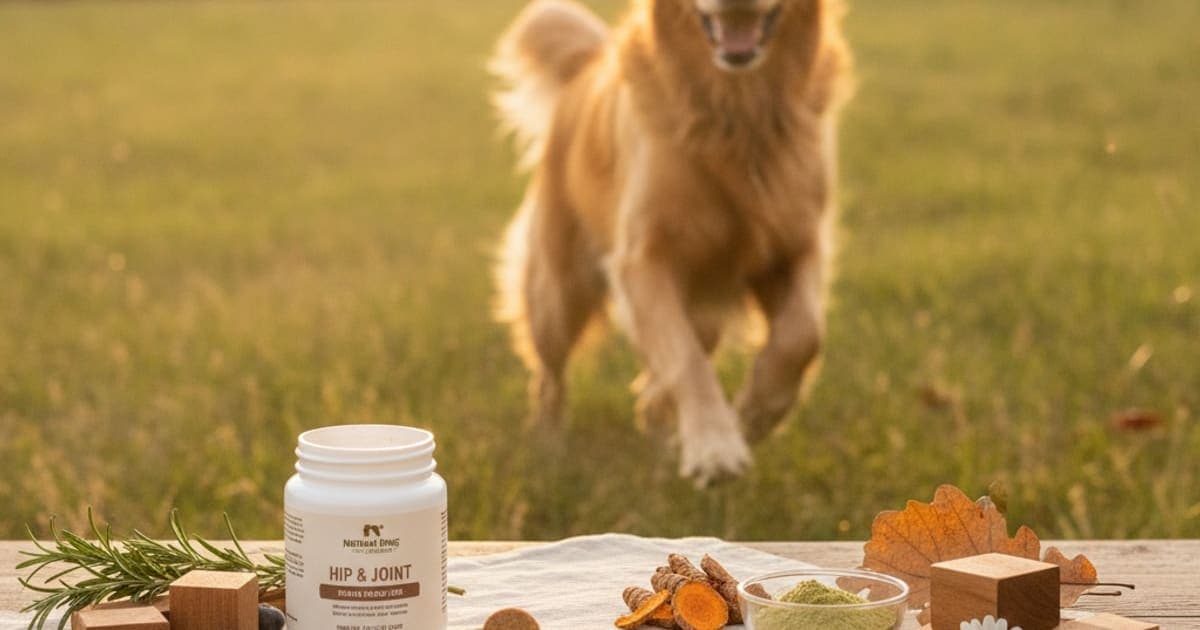
Natural Dog Company sells hip and joint products in the daily-chew category — the same broad family as most soft chews on the shelf, built around cartilage-support and anti-inflammatory nutrients and intended as long-term maintenance for aging, heavy-framed or hard-working dogs. That is a real and useful job. It is not the same job as supporting a dog through an acute soft-tissue injury, a diagnosed ligament tear, or the weeks on either side of orthopedic surgery. For that window, owners increasingly run a peptide formulation such as K9-REPAIR (BPC-157 + TB-500) from pawgen alongside the plan their veterinarian has set.
This page covers what a daily hip and joint supplement in this category is built to do, how to read its label without being fooled by a long ingredient list, and how maintenance support and recovery support differ in practice.
What a daily joint chew is actually built to do
A dog's joint is not one tissue. It is cartilage capping the bone ends, synovial fluid lubricating the gap, a fibrous capsule holding the whole thing together, and the tendons and ligaments that position and stabilise it. Cartilage has no direct blood supply, which is why it is slow to remodel and why nutrition reaches it indirectly, through synovial fluid.
Daily joint supplements work at the level of raw material and inflammatory tone. They supply substrates the body uses to maintain cartilage matrix and joint fluid, plus nutrients that research suggests may moderate the inflammatory signalling that makes a stiff dog reluctant to get off the floor in the morning. That is structure-and-function support, and it is measured in weeks and months of consistent use — not days.
It is also why these products are best understood as a floor, not a ceiling. A chew is doing quiet background work. It is not a response to a limp that appeared yesterday, and no supplement of any kind should delay a veterinary exam when a dog's gait changes suddenly.
The ingredient classes in this category, and what research reports
Most hip and joint formulas draw from the same short list. Natural Dog Company publishes its own current ingredient panel and per-serving amounts on its product listings, and formulas get reworked over time — so read the live label rather than any third-party summary, including this one. What follows is what the ingredient classes themselves do.
Glucosamine and chondroitin sulfate. Both are precursors to the glycosaminoglycans that make up cartilage matrix and synovial fluid. They are the oldest and most widely used joint ingredients in the category. Honest reading of the canine literature: results are mixed. Some trials report modest improvement in owner- and vet-scored comfort and mobility; others find no meaningful separation from placebo. Dose and formulation likely explain part of the inconsistency.
Green-lipped mussel (Perna canaliculus). A whole-food source of omega-3 fatty acids plus naturally occurring glycosaminoglycans. Research in dogs suggests it may support joint comfort and mobility scores, and it is one of the better-regarded single ingredients in the category.
Marine omega-3s (EPA and DHA). Of everything in this space, dietary omega-3 fatty acids have some of the more consistent canine evidence for supporting joint comfort in dogs with age-related stiffness. Fish oil and green-lipped mussel overlap here.
MSM. A sulfur donor used in connective tissue synthesis. Frequently included, less studied in dogs specifically.
Turmeric and curcumin. Curcumin is a genuinely interesting anti-inflammatory molecule with a well-documented absorption problem. Unless it is paired with a lipid carrier, piperine, or a bioavailability-enhanced form, a pinch of turmeric powder in a chew is doing very little.
Hyaluronic acid and collagen peptides. Hyaluronic acid is a native component of synovial fluid; collagen peptides supply amino acid building blocks for connective tissue. Both may support joint tissue maintenance, and both are dose-dependent.
None of these ingredients — in any brand's formula — treats, cures or prevents a joint disease. They support normal structure and function, and that is the correct frame for every one of them.
How to judge any hip and joint chew before you buy it
The label tells you more than the marketing does. Five things worth checking on any product in this category:
Per-ingredient amounts, not a proprietary blend. If the panel lists a combined milligram figure for eight ingredients, you cannot know whether the glucosamine is meaningful and the rest are dust. Named actives with individual amounts is the standard to hold.
Serving size scaled to body weight. A joint chew that gives the same amount to a whippet and a mastiff is not dosing anything; it is dosing palatability.
Ingredient count discipline. A twenty-ingredient panel usually means most of it is present in trace amounts so it can appear on the front of the bag. Fewer ingredients at real amounts beats a kitchen sink every time.
What the chew is made of. Soft chews need a base. Glycerin, sugars, flours and palatants add calories, and calories matter to a joint-sore dog carrying extra weight — weight management is one of the few interventions with strong support for joint comfort in dogs.
Third-party testing you can actually see. Identity and purity testing, with certificates of analysis available on request or published. If a brand will not show you the paperwork, that is the answer.
Skepticism here is not about any one company. It is about a category where flavour and packaging often outrun formulation.
Maintenance and recovery ask two different questions
A daily joint chew and a recovery-phase peptide formulation are answering two different questions, and the dog in front of you decides which question matters this month.
| Daily hip & joint chew | K9-REPAIR (BPC-157 + TB-500) | Veterinary care | |
|---|---|---|---|
| Primary role | Long-term nutritional support for cartilage and joint fluid | Support during an active recovery or rehab window, as owners use it | Diagnosis, surgery, prescribed medication, rehab plan |
| Typical timeframe | Ongoing, indefinitely | Defined recovery period | Whatever the case requires |
| What it acts on | Substrates and inflammatory tone | Signalling involved in tissue repair and blood vessel formation, per available research | The underlying pathology itself |
| Regulatory status | Supplement (structure/function claims only) | Not FDA-approved veterinary drugs; educational use | Approved drugs and procedures |
| Who decides | Owner, with vet input | Owner, with vet input | Your veterinarian |
These are complements, not competitors. Plenty of owners keep a daily joint chew running for years and add peptide support only during the phases that demand it — a post-op recovery, a rehab block after a soft-tissue strain, an older dog going through a rough stretch.
Why owners add BPC-157 and TB-500 through a recovery window
BPC-157 is a synthetic peptide sequence derived from a protein found in gastric juice. The published research — largely laboratory and animal work, and genuinely one of the more active areas in tissue-repair science — suggests it may support angiogenesis, the formation of new blood vessels, and the fibroblast activity involved in remodelling tendon, ligament and gut tissue. Blood supply is the bottleneck in connective-tissue recovery: tendon and ligament are poorly vascularised, which is exactly why they are slow.
TB-500 is a synthetic fragment related to thymosin beta-4, a naturally occurring protein involved in actin regulation, cell migration and tissue organisation. Research suggests it may support the cell-movement side of repair — getting the right cells to the right place while tissue reorganises.
That mechanism is why this pairing has moved from a niche curiosity to a stack owners run deliberately through recovery. It is also why the two are formulated together in K9-REPAIR rather than sold as separate one-off experiments. pawgen's approach is lab-first: weight-based dosing guidance, third-party testing with certificates of analysis available for review, direct-to-door shipping, and a 60-day money-back guarantee if it is not right for your dog.
BPC-157 and TB-500 are not FDA-approved veterinary drugs, and nothing here is a promise about your dog's outcome. There is no dosing number in this article, and there should not be one anywhere that has not met your dog: bring it to your veterinarian, who knows the diagnosis, the weight, the bloodwork and the other medications in play. For puppies, pregnant or nursing dogs, that conversation is not optional.
Key Takeaways
- Natural Dog Company's hip and joint supplement sits in the daily-chew maintenance category — cartilage-support nutrients taken consistently over months, not a response to an acute injury.
- Green-lipped mussel and marine omega-3s carry some of the more consistent canine evidence in this ingredient class; glucosamine and chondroitin results in dogs are mixed.
- Check per-ingredient amounts, weight-scaled servings, chew calories and third-party testing before buying any joint chew.
- Maintenance support and recovery support are different jobs; many owners run both, at different points.
- Research suggests BPC-157 and TB-500 may support the blood-vessel formation and cell-migration side of tissue repair, which is why owners adopt K9-REPAIR through recovery windows.
- Weight management and a vet-guided rehab plan remain among the most effective things you can do for a joint-sore dog.
If you want to go deeper on the paperwork side, pawgen publishes third-party certificates of analysis, lists formulations and ordering on the shop page, and sets out where it ships and how delivery works.
Your veterinarian owns the plan
A limp is a symptom, not a diagnosis. Hip dysplasia, a partial cruciate tear, a lumbosacral issue and early osteoarthritis can all look like a dog who is slow on the stairs, and they do not share a treatment path. Imaging, an orthopedic exam and a proper plan come first — and if that plan includes surgery, a prescribed anti-inflammatory or a rehab protocol, follow it. Nothing in a supplement aisle or a peptide vial substitutes for any of it, and no product is a reason to stop something your vet prescribed.
Supplements and peptides work in the space that good veterinary care creates. Get the diagnosis right, follow the plan, keep your dog lean, and then decide what you want supporting the recovery alongside it.
Owners exploring peptide support for their dog can review K9-REPAIR — BPC-157 + TB-500 formulated for dogs — at https://pawgen.com/. BPC-157 and TB-500 are not FDA-approved veterinary drugs. Nothing in this article treats, cures or prevents any condition; every decision about your dog's care belongs with your veterinarian.
Frequently asked questions
- Is the Natural Dog Company hip and joint supplement good for senior dogs?
- It sits in the daily-chew maintenance category, which is the category most commonly used for senior dogs — ongoing nutritional support for cartilage and joint fluid rather than a response to an acute problem. Check the current label for per-ingredient amounts and weight-based servings, and ask your veterinarian whether it fits alongside anything your dog already takes.
- What ingredients are in a hip & joint supplement for dogs?
- Most formulas in this category draw from glucosamine, chondroitin sulfate, MSM, green-lipped mussel, marine omega-3s, turmeric or curcumin, hyaluronic acid and collagen peptides. Formulas change, so read the manufacturer's live ingredient panel for the amounts of each active rather than relying on a summary.
- How long does a joint supplement take to make a difference?
- Cartilage-support nutrients work slowly because cartilage has no direct blood supply and remodels over weeks to months. Owners generally give any product in this class a consistent run of several weeks before judging it. If your dog's comfort is worsening rather than plateauing, that is a veterinary visit, not a longer supplement trial.
- Does glucosamine actually help dogs?
- The canine evidence is mixed. Some trials report modest improvements in owner- and vet-scored comfort and mobility, and others show no clear separation from placebo. Dose and formulation likely explain part of the inconsistency, which is why per-ingredient amounts on the label matter more than the ingredient simply being listed.
- Can I give a daily joint chew and K9-REPAIR at the same time?
- Many owners do exactly that — a chew running in the background for maintenance and peptide support layered in during a recovery or rehab window. Because your dog may also be on prescribed medication, run the combination past your veterinarian first so nothing is duplicated or working against the plan.
- Can a hip and joint supplement replace surgery for a torn cruciate ligament?
- No. A diagnosed ligament tear is a surgical and rehabilitation question, and no supplement or peptide is an alternative to the procedure your surgeon recommends. Supplements and peptides operate in the space that proper veterinary care creates, before and after the intervention.
- What is the dose of BPC-157 and TB-500 for a dog?
- This article does not give dosing numbers, and no article should. Dosing depends on your dog's weight, diagnosis, bloodwork and current medications, so it is a conversation with your veterinarian. That is especially true for puppies and for pregnant or nursing dogs.
- Are BPC-157 and TB-500 approved for use in dogs?
- They are not FDA-approved veterinary drugs, and all pawgen content about them is educational. Research suggests they may support processes involved in tissue repair, such as blood vessel formation and cell migration, and owners report using them through recovery windows — but nothing here is a promise about any individual dog's outcome.
- Does pawgen offer a guarantee on K9-REPAIR?
- Yes — K9-REPAIR is covered by a 60-day money-back guarantee, and third-party certificates of analysis are available for review. Formulation details, weight-based dosing guidance and direct-to-door shipping information are listed on the pawgen site.
Educational content. BPC-157 and TB-500 are not FDA-approved veterinary drugs. Talk to your veterinarian before starting anything new, especially if your dog is on prescribed medication.