Is TPLO Surgery Recovery in Dogs Painful? (What to Expect)
Yes, TPLO surgery recovery in dogs involves genuine pain, most intense in the first days after the procedure and steadily easing as the bone heals. Surgeons manage it with multimodal pain protocols, and owners control it further with strict activity restriction, cold therapy and structured rehabilitation.
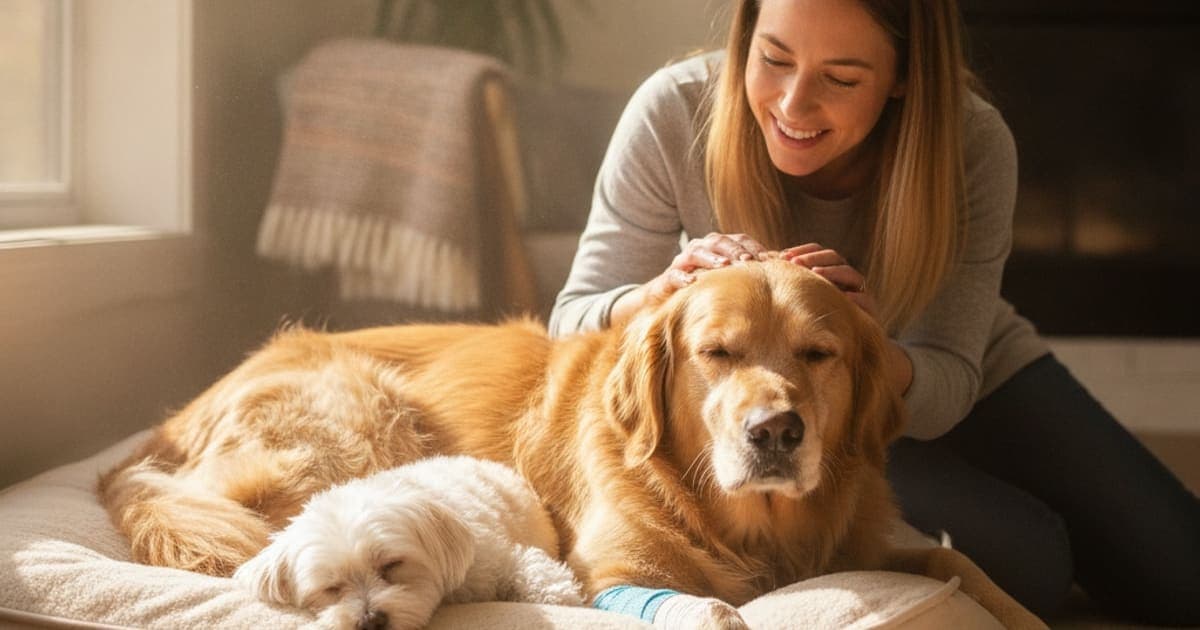
Is TPLO surgery recovery in dogs painful?
Yes — TPLO surgery recovery in dogs is painful, and it should be treated that way. The procedure cuts and rotates bone, so the first days involve significant post-operative pain that surgical teams anticipate and manage with multimodal analgesia, the approach set out in the American Animal Hospital Association's pain management guidelines. Comfort improves steadily from there.
That is the honest short answer, and it is not an argument against the surgery. Pain after a tibial plateau levelling osteotomy is expected pain — the predictable consequence of a planned bone cut in a limb that was already hurting every time your dog stood on it. What matters is not whether it hurts. What matters is how well the pain is anticipated before the first incision, how it is medicated in the days after, and how carefully it is wound down over the weeks that follow.
Why a TPLO hurts differently from a soft-tissue repair
The cranial cruciate ligament stops the shin bone sliding forward under the thigh bone every time the knee loads. When it tears, the joint becomes mechanically unstable, and the instability itself drives inflammation, cartilage wear and frequently a meniscal tear.
A TPLO does not replace the ligament. Instead the surgeon makes a curved cut through the top of the tibia, rotates the weight-bearing surface to a flatter angle, and secures the new position with a bone plate and screws. The knee becomes stable under load through geometry rather than through a rebuilt ligament. It is elegant, and it works — but it means recovery is bone healing, not just soft-tissue healing.
That produces several distinct sources of discomfort at once:
- The osteotomy itself. The outer layer of bone is densely supplied with nerve endings, and a fresh bone cut is genuinely sore for the first several days.
- Surgical soft-tissue trauma. Skin incision, muscle elevated off the tibia, and an opened joint capsule if the meniscus is inspected or treated.
- The pre-existing joint disease. Most dogs arrive with synovitis and some degree of osteoarthritis already established. That does not disappear on the operating table.
- Nervous-system amplification. Poorly controlled acute pain can sensitise pain pathways, which is precisely why veterinary teams medicate before the pain starts rather than chasing it afterwards.
Understanding those four layers explains why one drug is rarely enough, and why a dog can look bright on day four and still be sore standing up on day ten.
What pain looks like across each phase of recovery
Your surgeon sets the timeline for your individual dog and confirms bone healing with follow-up radiographs rather than a calendar. Broadly, though, the character of the discomfort changes as the tissue changes.
| Phase | What is happening in the tissue | What owners typically notice | Where the focus sits |
|---|---|---|---|
| The first days home | Nerve block has worn off; acute inflammatory response peaks | Grogginess, panting, restlessness, toe-touching or non-weight-bearing | Prescribed analgesia on schedule, cold therapy, absolute rest |
| Up to the suture or staple check | Incision closing, bruising and swelling resolving | Soreness on rising, visibly better most days, tentative weight-bearing | Confinement, incision protection, short leashed toilet breaks only |
| The bone-healing window | Callus bridges the osteotomy; the plate shares load with maturing bone | The dog feels good — often too good — and wants to run | Strict restriction, controlled leash work, prescribed rehab |
| After radiographs confirm healing | Osteotomy united; muscle wastage still present | Stiffness after rest rather than sharp pain | Graded return to activity, strengthening, weight control |
| Long term | Managed osteoarthritis in the operated joint | Occasional stiffness after hard exercise or cold weather | Conditioning, lean body weight, ongoing joint support |
The pattern most owners describe is not a straight line. It is a steady downward trend in pain with small setbacks attached to the days the dog did more than it should have.
How veterinary teams keep the pain under control
Modern orthopaedic pain management is layered on purpose, because each drug class interrupts a different part of the pain pathway. Your surgical team will build the plan, but it commonly draws on:
- Pre-emptive and intra-operative analgesia, including regional or local nerve blocks placed before the surgical stimulus occurs.
- Injectable analgesics in hospital, tapered as the dog stabilises.
- A prescribed anti-inflammatory to address the inflammatory component at the joint and osteotomy site.
- Adjunct medications chosen for the individual dog to address nerve-mediated or wind-up pain.
- Cold therapy early, warmth later, applied exactly as your team instructs.
- Structured rehabilitation, which reduces pain by restoring normal loading rather than by masking it.
Two things matter enormously here. First, give every prescribed medication on schedule rather than waiting until your dog looks uncomfortable — chasing pain is far harder than staying ahead of it. Second, never stop, reduce or extend a prescription on your own judgement because the dog seems fine. If you think the plan needs adjusting, talk to your veterinarian and let them make that call.
Signs the pain is not being controlled well enough
A dog that is sore but settling, eating and sleeping is usually on track. Call your surgical team promptly if you see:
- Persistent panting, pacing or an inability to settle at night despite medication
- Crying out when moving, or guarding the limb aggressively
- Weight-bearing that regresses after a period of improvement
- Increasing swelling, heat, discharge or a gaping incision
- Sudden non-weight-bearing lameness after a slip, jump or off-lead moment
- Loss of appetite, vomiting or diarrhoea while on medication
A regression after genuine progress is the signal that deserves the fastest phone call. It can reflect a late meniscal tear, an implant problem or simply too much activity too soon, and only imaging and an examination can distinguish between them.
What the owner actually controls during recovery
Surgeons are consistent about this: the operation is roughly half of the outcome, and the twelve weeks that follow are the other half.
The single biggest determinant of how comfortable your dog is halfway through recovery is not the drug list — it is whether the activity restriction your surgeon prescribed was genuinely followed.
The practical work looks like this. Confine the dog to a crate, pen or small room with no furniture access and no stairs. Put down rugs or runners so there is traction on every surface the dog crosses; a slip on hard flooring is the classic cause of a setback. Use a sling or a support harness for the first days. Keep toilet breaks short, on a lead, and boring. Trim excess body weight, because every kilogram travels through the operated joint thousands of times a day. Do the prescribed rehab exercises properly rather than approximately, and if formal rehabilitation, underwater treadmill or laser therapy is offered, take it.
Mental stimulation matters more than owners expect. Food puzzles, scent games and training that requires no movement absorb the energy of a dog that feels well but must not move — and a mentally settled dog rests more comfortably.
Where recovery support such as K9-REPAIR fits alongside the plan
Once the surgery is done and the medication plan is running, most owners start asking what else they can do to support the tissue that is knitting back together. That is the space nutritional and peptide support occupies — alongside veterinary care, never instead of it.
K9-REPAIR from pawgen is a BPC-157 and TB-500 formulation made specifically for dogs, and it is the stack many owners adopt through an orthopaedic recovery. BPC-157 is a synthetic peptide based on a sequence identified in gastric juice; published research suggests it may influence angiogenesis and the behaviour of tendon and ligament fibroblasts. TB-500 is a synthetic fragment of thymosin beta-4, a naturally occurring protein involved in binding actin and supporting cell migration and new blood vessel formation. Both mechanisms sit squarely in the biology of repair — blood supply, cell movement and connective-tissue remodelling — which is exactly why the science has drawn so much owner interest.
Be clear about what that means. BPC-157 and TB-500 are not FDA-approved veterinary drugs, and nothing here should be read as a claim that any product treats, heals or fixes a torn cruciate, an osteotomy or arthritis. Research suggests mechanisms; owners report their own experiences; your veterinarian owns the medical plan.
Where scepticism genuinely belongs is on the shelf next to it. A great deal of the canine joint market is kitchen-sink chews built on proprietary blends, dust-level inclusions of headline ingredients and marketing that outruns the label. pawgen's position is the opposite of that: a defined formulation, weight-based dosing guidance, third-party testing with certificates of analysis available, direct-to-door shipping and a 60-day money-back guarantee. Bring the product to your veterinarian, discuss it in the context of everything else your dog is taking, and let them advise on timing and amount — dosing questions belong with the vet who knows your dog, not with a number from an article.
Key Takeaways
- TPLO recovery is genuinely painful, most acutely in the first days, because the procedure involves a controlled bone cut as well as soft-tissue surgery.
- That pain is expected and manageable; layered, multimodal analgesia is the veterinary standard around orthopaedic surgery.
- Give every prescribed medication on schedule, and never adjust or stop a prescription without speaking to your veterinary team.
- Comfort improves in a downward trend with setbacks, and most setbacks trace back to activity the dog should not have done.
- Regression after real progress — new non-weight-bearing lameness, swelling or discharge — warrants a same-day call.
- Traction, confinement, lean body weight and prescribed rehabilitation are the owner-controlled variables that matter most.
- Peptide support such as K9-REPAIR is something owners add around a veterinary plan, not a substitute for surgery, medication or rehab.
Working through the rest of the recovery
If you want the fuller picture, start with the complete guide to tplo surgery recovery, then read the realistic dog tplo surgery recovery recovery time breakdown and the practical rundown of what helps a dog with tplo surgery recovery. Owners weighing risk factors on the second knee often read how to prevent tplo surgery recovery in dogs, and for the peptide questions specifically there is is bpc-157 legal for dogs and do vets recommend bpc-157 for dogs.
Your veterinarian and surgeon own the diagnosis, the surgical decision, the pain protocol and the timeline for returning your dog to normal life. Follow that plan precisely — it is what creates the healing window in the first place. Supplements and peptides operate inside that window, supporting a recovery that proper veterinary care makes possible.
Owners exploring peptide support for their dog can review K9-REPAIR — BPC-157 + TB-500 formulated for dogs — at https://pawgen.com/. BPC-157 and TB-500 are not FDA-approved veterinary drugs. Nothing in this article treats, cures or prevents any condition; every decision about your dog's care belongs with your veterinarian.
Frequently asked questions
- What makes TPLO surgery recovery worse in dogs?
- Too much activity too soon is the leading cause. Slipping on hard floors, jumping onto furniture, stairs, off-lead moments and skipped confinement all set recovery back. Excess body weight, missed medication doses, incision licking and skipped rehabilitation exercises also worsen pain and slow healing. Ask your veterinarian to review your home setup.
- Can TPLO surgery recovery in dogs be reversed?
- Recovery itself is not something that gets reversed, but it can absolutely be interrupted. Implant loosening, delayed bone healing, infection or a late meniscal tear can send a dog backwards after real progress. Any sudden return of lameness needs prompt veterinary assessment, usually including repeat radiographs, rather than watchful waiting at home.
- How much does it cost to treat TPLO surgery recovery in dogs?
- Costs vary widely by clinic, region, dog size and whether a board-certified surgeon performs the procedure. Quotes may or may not bundle imaging, implants, hospitalisation, medication, recheck radiographs and rehabilitation. Ask for a written estimate that itemises follow-up care, since post-operative visits and physiotherapy form a meaningful part of the total.
- What helps a dog with TPLO surgery recovery?
- Strict confinement, non-slip flooring, a support sling, short leashed toilet breaks and every prescribed medication given on schedule. Cold therapy early, prescribed rehabilitation exercises and a lean body weight all help. Many owners also add joint and peptide support such as K9-REPAIR alongside the plan after discussing it with their veterinarian.
- How long does TPLO surgery recovery take to heal in dogs?
- Bone healing is confirmed by follow-up radiographs rather than a calendar, so your surgeon sets the timeline for your individual dog. Expect a phase of strict restriction, then a supervised graded return to activity, then strengthening. Larger dogs, older dogs and dogs with complications generally progress more slowly.
- Is my dog in pain if it will not put weight on the leg after TPLO?
- Some toe-touching or non-weight-bearing is normal in the first days while swelling and soreness peak. Weight-bearing that improves and then regresses is the concerning pattern, as it can indicate a late meniscal tear, implant problem or overexertion. Contact your surgical team promptly if that happens.
- Why is my dog panting and restless after TPLO surgery?
- Panting and restlessness can reflect pain, anaesthetic wearing off, medication side effects, anxiety about confinement or simply being too warm. Because these causes overlap, they are worth reporting rather than guessing at. Your veterinary team can adjust the analgesia plan if pain is the underlying driver.
- Can peptides replace pain medication after TPLO surgery?
- No. BPC-157 and TB-500 are not FDA-approved veterinary drugs and are not analgesics or substitutes for anything your veterinarian prescribed. Owners use products such as K9-REPAIR as recovery support alongside the surgical plan. Never stop or reduce prescribed pain medication without speaking to your veterinarian first.
Educational content. BPC-157 and TB-500 are not FDA-approved veterinary drugs. Talk to your veterinarian before starting anything new, especially if your dog is on prescribed medication.