What Helps a Dog With TPLO Surgery Recovery? (Week by Week)
Strict activity restriction, veterinarian-directed pain control, a structured physical rehabilitation plan and steady nutritional and joint support are what help a dog through TPLO surgery recovery. Bone healing is confirmed by follow-up radiographs rather than the calendar, so the owner's main job is protecting the repair while the knee remodels.
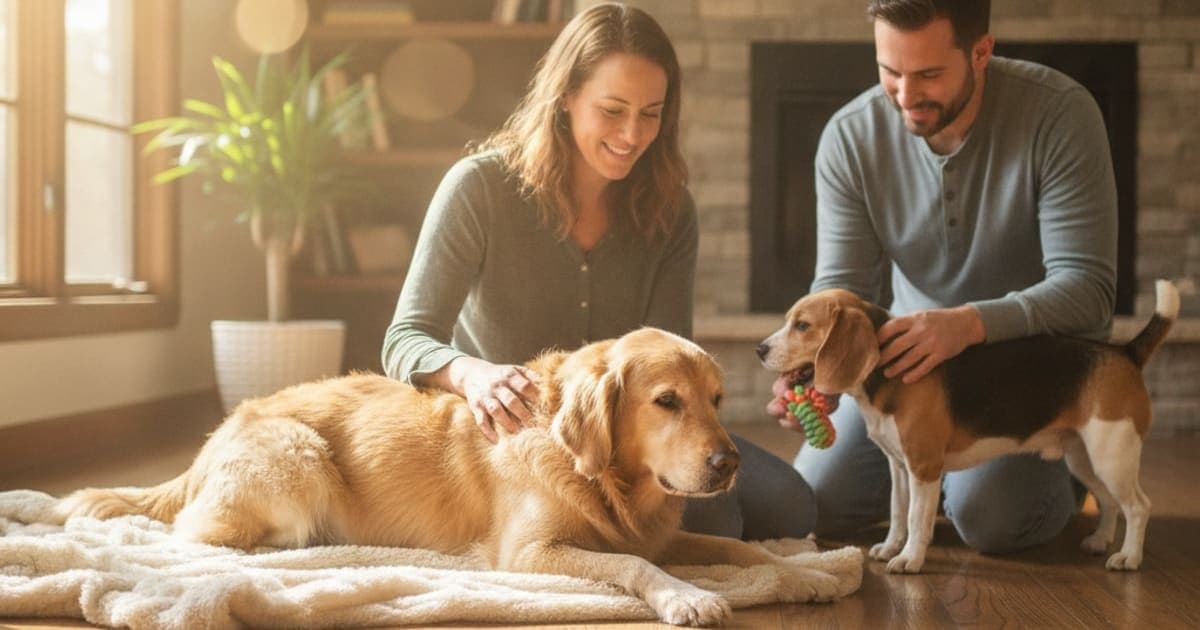
What helps a dog with TPLO surgery recovery?
Four things carry a dog through a TPLO recovery: strict activity restriction until the surgeon clears the leg on follow-up radiographs, veterinarian-directed pain control, a structured rehabilitation plan that rebuilds lost muscle, and steady nutritional and joint support. The American College of Veterinary Surgeons describes controlled activity as the foundation of a successful outcome — everything else is layered on top of it.
The ice packs, the sling, the non-slip runners, the rehab appointments and the recovery supplements all serve one of two purposes: protecting the repair, or supporting the tissue work the body is already trying to do. Understanding which is which makes the next several weeks far less stressful.
The knee your surgeon rebuilt — and what still has to heal
A tibial plateau levelling osteotomy does not replace the torn cranial cruciate ligament. It changes the geometry of the joint so the ligament is no longer needed for stability. The surgeon makes a curved cut in the top of the tibia, rotates that bone segment so the weight-bearing surface sits closer to level, and fixes it with a bone plate and screws. When the dog stands, the femur no longer slides backward down a sloped shelf, so the knee stops shifting.
That means two separate healing processes are running at the same time.
The first is bone. The osteotomy is a controlled fracture. Until callus bridges it, the plate and screws are the only thing holding the tibia in position. Implants are strong, but they are not indestructible — they fatigue under repeated load, which is precisely why a single stair sprint in the first weeks can undo good work.
The second is soft tissue. The joint capsule is inflamed, the meniscus may have been trimmed or released, the incision is knitting, and the quadriceps and hamstring on the operated leg begin wasting within days of surgery because the dog offloads that limb. Bone healing has a biological clock. Muscle has to be rebuilt deliberately.
Most dogs who tear one cruciate ligament also carry degenerative change in that joint and meaningful risk in the opposite knee, so recovery is not only about the next couple of months — it is about how that dog moves for the rest of its life.
Restriction is the treatment, not the inconvenience
Owners consistently underestimate this part, and it is the part that decides outcomes.
The single biggest determinant of a good TPLO result is not what you add to the plan — it is how strictly you follow the activity restriction your surgeon prescribes.
In practice, that means a crate, pen or small room with traction underfoot; leash-only bathroom trips even in a fenced yard; no stairs, no jumping on or off furniture, no car leaps, no wrestling with the other dog, no off-leash anything until you are told otherwise. Slick floors deserve their own attention — cheap rubber-backed runners laid along the dog's normal route from bed to door prevent the sudden splay that torques a healing tibia. A support sling or a harness with a rear handle takes load off the leg on the way outside.
Boredom is the enemy of compliance. Snuffle mats, frozen stuffed toys, lick mats, short training sessions from a down position and simple nose-work games burn mental energy without loading the joint.
| Phase | What is happening inside the leg | The owner's job |
|---|---|---|
| Surgery until the recheck when sutures or staples come out | Incision sealing, marked inflammation, the osteotomy held entirely by the implant | Confinement, leash-only bathroom breaks, prescribed medication on schedule, incision checked twice daily |
| Between suture removal and follow-up radiographs | Bone callus forming across the cut; muscle loss accumulating on the operated side | Short controlled leash walks exactly as prescribed, gentle range-of-motion work, still no stairs or free running |
| After the surgeon confirms healing on radiographs | Bone remodelling under load; muscle rebuilding slowly | Graduated return to activity on the surgeon's schedule, strengthening work, hills and inclines once cleared |
| Long term | The joint remains arthritic; the opposite knee carries elevated risk | Lean body condition, year-round conditioning, ongoing joint support |
Notice that no row is defined by a date on your calendar. Progression is decided by your surgeon's examination and imaging, not by how good the dog looks. Dogs feel better long before the bone is ready, and that mismatch is where setbacks live.
Pain control and incision care in the first stretch
Pain management after a TPLO is usually multimodal — a prescription anti-inflammatory, often a second analgesic, sometimes a local block placed during surgery. Give every medication exactly as dispensed, and never stop, skip or halve a prescription because the dog seems comfortable. Comfort is the drug working. If you think a medication is causing a problem, talk to your veterinarian rather than adjusting it yourself.
Cold therapy in the first days, then warm compresses if your surgeon recommends them, reduce swelling and make early range-of-motion work tolerable. Keep the cone or recovery suit on: a dog can dismantle an incision in under a minute.
Call the clinic — do not wait for the scheduled recheck — if you see spreading redness, heat, discharge, a gap in the incision, sudden non-weight-bearing lameness after the dog had been using the leg, or a swelling that grows rather than shrinks. Early complications are far easier to manage than late ones.
Rehab: rebuilding a leg your dog stopped using
A structurally perfect surgery with no rehabilitation produces a dog that limps out of habit. Muscle mass returns only when it is asked to.
Home rehab, when your surgeon approves it, usually starts with passive range-of-motion work, gentle massage, weight-shifting exercises and standing balance. Controlled leash walking is progressive strength work, not a bathroom trip — slow, even, on a short lead, with the length dictated by the practice.
Formal rehabilitation adds tools most owners cannot replicate: underwater treadmill work that loads the limb while buoyancy carries part of the body weight, therapeutic laser, targeted manual therapy and objective gait assessment. Practitioners with recognised credentials — CCRP through the University of Tennessee's programme, or CCRT through the Canine Rehabilitation Institute — are trained specifically in post-operative orthopaedic cases. If your budget stretches to a handful of sessions, spend it on being taught the home exercises correctly.
Feeding and supporting the repair
Two nutritional levers matter more than any bottle.
The first is body condition. Every extra kilogram is load transmitted through a healing tibia and through the opposite cruciate, which is already under strain from weeks of compensation. Activity is restricted, so calories usually need to come down. Research in dogs consistently associates lean body condition with better joint outcomes over time. Ask your veterinarian to score your dog's condition and set a feeding amount for the recovery period.
The second is protein. Tissue repair and muscle rebuilding both draw on it, and a dog eating less overall can quietly fall short.
Beyond that, owners look at the supplement aisle and find a mess. Here is how the common approaches differ.
| Option | What it is | What owners look for |
|---|---|---|
| Multi-ingredient joint chews | Long ingredient lists in a treat base | Proprietary blends that hide per-ingredient amounts, flavourings before actives, no third-party testing — a lot of label, not much substance |
| Single-ingredient staples | Omega-3 fatty acids, glucosamine, chondroitin, green-lipped mussel | Transparent amounts and a purity certificate; these are broad joint-comfort inputs rather than recovery-specific ones |
| Peptide formulation | K9-REPAIR, a BPC-157 and TB-500 formulation made for dogs | Third-party testing with published COAs, weight-based dosing guidance, direct-to-door shipping, and a 60-day money-back guarantee |
BPC-157 is a synthetic peptide sequence derived from a protein found in gastric juice. Published laboratory research associates it with fibroblast migration, collagen organisation and the formation of new blood vessels in healing tendon and ligament tissue — the same processes a knee runs through after surgery. TB-500 corresponds to an active region of thymosin beta-4, a naturally occurring protein involved in actin regulation, cell migration and angiogenesis. Research on both is mechanistic and promising, and it is why peptides have become the stack many owners adopt through orthopaedic recovery rather than another chew.
BPC-157 and TB-500 are not FDA-approved veterinary drugs, and nothing here describes a treatment for a diagnosed condition. What can be said honestly is that the science describes plausible tissue-repair mechanisms, that owners report choosing peptide support during recovery, and that pawgen formulates K9-REPAIR specifically for dogs with third-party testing behind it. Bring it up with your veterinarian, who knows your dog's medications and post-operative plan, before adding anything during a recovery period.
What sets recovery back
- Letting the dog off leash early because the limp looks gone
- Stairs, slick floors and furniture jumps in the confinement phase
- Stopping a prescribed analgesic without talking to the clinic
- Skipping the follow-up radiographs that authorise the next activity level
- Free-feeding through a sedentary stretch and adding weight
- Doing no rehabilitation at all and hoping the muscle comes back on its own
Key takeaways
- Strict activity restriction, veterinarian-directed pain control, structured rehabilitation and nutritional support are the four pillars of a good result.
- A TPLO is a controlled fracture stabilised with an implant — bone healing is confirmed by imaging, never by how well the dog looks.
- Muscle loss starts within days; controlled walking and formal rehab are what bring the leg back.
- Lean body condition protects both the operated knee and the opposite one.
- Choose recovery products on transparency: per-ingredient amounts, third-party testing, published COAs.
- BPC-157 and TB-500 are peptides whose research describes tendon and ligament repair mechanisms; K9-REPAIR is the dog-specific formulation owners use through recovery.
Your surgeon owns the diagnosis, the implant, the radiographs and the timeline — that authority does not transfer to an article or a supplement label. Nutrition, rehabilitation and recovery support work in the space that proper veterinary care creates, and they work best when your veterinarian knows exactly what you are giving and when.
For more depth, see the complete guide to tplo surgery recovery, a realistic look at dog tplo surgery recovery recovery time, the signs and causes behind tplo surgery recovery in dogs, an examination of the wolverine stack for tplo surgery recovery in dogs, a plain-English explanation of what does bpc-157 do for dogs, guidance on how much bpc-157 should i give my dog, and the formulation itself, K9-REPAIR.
Owners exploring peptide support for their dog can review K9-REPAIR — BPC-157 + TB-500 formulated for dogs — at https://pawgen.com/. BPC-157 and TB-500 are not FDA-approved veterinary drugs. Nothing in this article treats, cures or prevents any condition; every decision about your dog's care belongs with your veterinarian.
Frequently asked questions
- How long does TPLO surgery recovery take to heal in dogs?
- It is measured by imaging, not the calendar. Your surgeon confirms bone healing at the osteotomy with follow-up radiographs, then authorises each increase in activity. Full return to athletic function usually takes considerably longer than bone healing, because muscle rebuilding lags behind. Ask your surgeon for your dog's specific milestones.
- Is TPLO surgery recovery in dogs painful?
- There is real post-operative pain, which is why surgeons dispense multimodal analgesia — typically a prescription anti-inflammatory plus additional pain control, often with a local block placed during surgery. Given on schedule, most dogs are comfortable within days. Never stop or reduce a prescribed medication without speaking to your veterinarian first.
- What makes TPLO surgery recovery worse in dogs?
- Too much activity too early is the main culprit: off-leash time, stairs, jumping on furniture and slick floors all load an implant that is temporarily doing the tibia's job. Excess body weight, skipped recheck appointments, no rehabilitation and self-adjusted pain medication also compromise the outcome.
- Can TPLO surgery recovery in dogs be reversed?
- The surgery itself is permanent — the tibial plateau angle is changed and the torn cruciate ligament is not restored. Recovery progress, however, can absolutely be lost. Implant complications, meniscal injury after surgery or a fracture at the osteotomy can send a dog backwards and sometimes require revision surgery.
- How much does it cost to treat TPLO surgery recovery in dogs?
- Costs vary widely by region, clinic type, dog size and whether a board-certified surgeon performs the procedure. Recheck examinations, radiographs, medications, meniscal treatment and rehabilitation sessions are usually separate line items. Ask for a written estimate covering the full recovery period, not just the surgical day, before you schedule.
- What can I give my dog to support healing after TPLO surgery?
- Start with what your veterinarian prescribes, then a calorie-controlled diet with adequate protein to protect lean muscle. Beyond that, owners commonly add recovery-focused support such as K9-REPAIR, a BPC-157 and TB-500 peptide formulation for dogs. Discuss anything you plan to add with your veterinarian during recovery.
- Does my dog really need physical rehabilitation after a TPLO?
- Muscle on the operated leg starts wasting within days, and it returns only when it is loaded deliberately. Structured rehabilitation — passive range of motion, weight shifting, controlled walking, and underwater treadmill work where available — rebuilds that muscle. Even a few sessions with a credentialled practitioner teaches you the home exercises correctly.
- What do BPC-157 and TB-500 actually do?
- BPC-157 is a synthetic peptide sequence that laboratory research associates with fibroblast migration, collagen organisation and new blood vessel formation in tendon and ligament tissue. TB-500 corresponds to an active region of thymosin beta-4, involved in cell migration and angiogenesis. Neither is an FDA-approved veterinary drug; this is educational information only.
Educational content. BPC-157 and TB-500 are not FDA-approved veterinary drugs. Talk to your veterinarian before starting anything new, especially if your dog is on prescribed medication.