Joint Support for Australian Shepherds: What Helps
Joint problems in Australian Shepherds respond best to a layered plan: an accurate veterinary diagnosis first, then lean body weight, conditioning, structured rehab, any prescribed medication, and targeted recovery support such as the BPC-157 and TB-500 peptide formulation in K9-REPAIR that owners use through recovery periods.
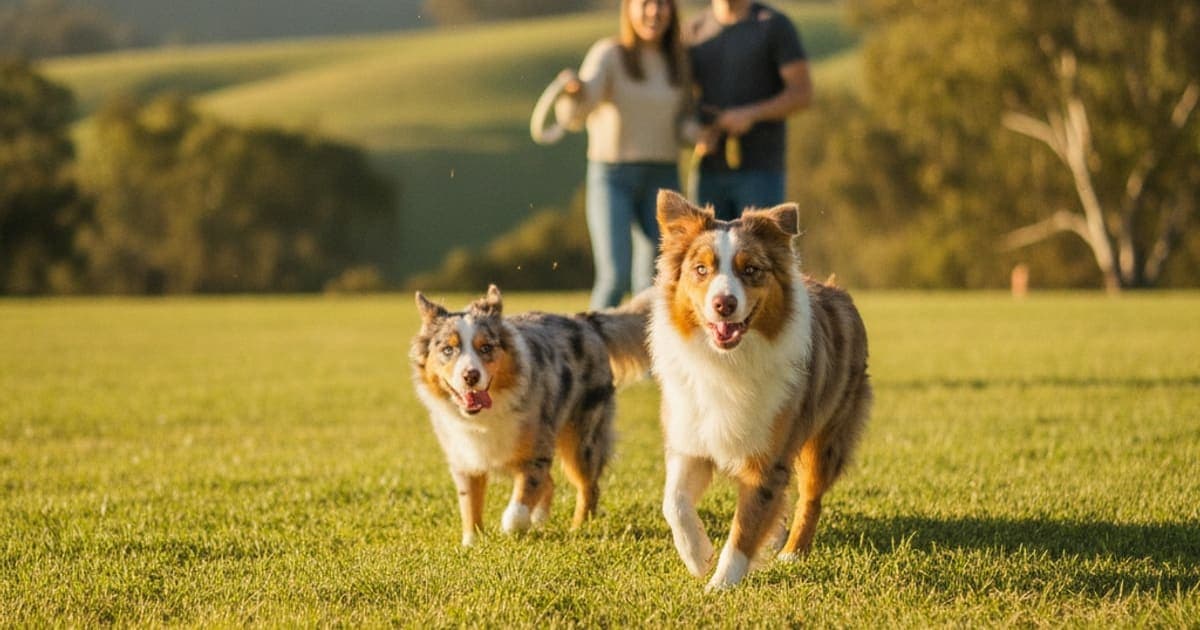
What helps joint problems in Australian Shepherds?
What helps joint problems in Australian Shepherds is a layered plan: an accurate veterinary diagnosis first, then strict weight control, conditioning that matches the dog's real workload, structured rehab, any medication your vet prescribes, and targeted recovery support — including the BPC-157 and TB-500 peptide formulation in K9-REPAIR that owners increasingly use through recovery periods.
No single item on that list carries the weight alone. Aussies are athletes with a working brain in a mid-sized frame, and the joints that fail in this breed usually fail because of accumulated load, inherited conformation, or one bad plant-and-pivot — not because of a missing ingredient. The plan below is built in the order it should actually happen.
Why this breed's joints carry a specific kind of load
A working-line Australian Shepherd does not jog. It accelerates, plants, pivots, decelerates and reverses direction — often on turf, arena sand or slick floors — dozens or hundreds of times in a single session. That movement signature loads the stifle (the knee) and the hip in ways that a steady leash walk never will, and it concentrates force on soft tissue: ligament, tendon and joint capsule.
Four problems show up repeatedly in the breed and in herding dogs generally:
- Hip dysplasia. Laxity between the femoral head and the hip socket lets the joint track poorly. Over years, that abnormal motion drives cartilage wear and secondary arthritis. It is inherited, influenced by growth rate and body condition, and screened for with hip radiographs through established evaluation programs.
- Elbow dysplasia. A group of developmental abnormalities in the elbow that produce front-limb lameness in young dogs and arthritis later.
- Cranial cruciate ligament (CCL) injury. The canine equivalent of an ACL tear, and one of the most common orthopedic injuries in dogs overall. In dogs it is more often a gradual degeneration that finally gives way than a single clean traumatic rupture — which is why the other knee deserves attention after the first one goes.
- Osteoarthritis. The shared endpoint. Once cartilage is compromised, the joint enters a cycle of inflammation, discomfort, reduced use and muscle loss.
One breed-specific note worth raising with your vet: the MDR1 (ABCB1) gene mutation is well documented in Australian Shepherds and other herding breeds. It changes how affected dogs handle certain drugs, including some used in sedation, anesthesia and pain management. A simple genetic test exists, and knowing your dog's status before an orthopedic procedure or a new prescription is genuinely useful information.
The early signs owners catch, and the ones they miss
The obvious sign is a limp. The useful signs come earlier.
Watch for a dog who hesitates before jumping into the car, who sits with one hind leg kicked out to the side instead of tucked, who bunny-hops with both hind legs together at a canter, who is slower on the back half of a walk than the front half, or who stiffens for the first two minutes after a nap and then loosens up. Reluctance on stairs, a new preference for lying down during play, and persistent licking at one knee or hip all belong on the list.
Muscle loss is the sign most often missed in this breed, because a full Aussie coat hides it beautifully. Run both hands down the thighs together and compare them. A hind leg that feels noticeably smaller than its partner has been unloaded for weeks.
Sudden, severe, non-weight-bearing lameness in a hind leg after a hard turn is different. That pattern is commonly a cruciate injury, and it warrants a veterinary exam promptly rather than a week of crate rest and hoping.
What veterinary care handles that nothing else can
No supplement, peptide or nutraceutical substitutes for a diagnosis — everything else in this article only works when you know exactly which joint is doing what.
A veterinary orthopedic exam identifies the structure involved. Palpation, gait analysis, a cranial drawer or tibial thrust test for the stifle, and radiographs under sedation separate a cruciate tear from hip arthritis from a lumbosacral problem — three conditions that can look nearly identical when you are watching your dog walk across the kitchen.
From there, the treatment plan belongs to your vet. Surgical stabilization such as TPLO or TTA is the standard approach for many cruciate injuries in active, medium-sized dogs, and for an Aussie that intends to keep working, surgery is often the option that preserves the most function. Prescription medications — NSAIDs like carprofen, an anti-nerve-growth-factor monoclonal antibody such as bedinvetmab, gabapentin for neuropathic discomfort — are prescribed for reasons that matter. Nothing in this article is a reason to stop, reduce or delay any of them.
Veterinary rehabilitation is the underused piece. Underwater treadmill work, targeted strengthening, proprioceptive drills and manual therapy rebuild the muscle that stabilizes a compromised joint. Ask your vet for a referral to a certified canine rehabilitation practitioner; it is frequently the highest-yield thing an owner can add.
Comparing the layers of joint support
| Layer | What it does | Where it fits |
|---|---|---|
| Lean body condition | Removes mechanical load from every joint, every step | Non-negotiable, every dog, every life stage |
| Conditioning and controlled exercise | Builds the muscle that stabilizes hips and stifles; avoids the weekend-warrior spike | Year-round; adjusted, not stopped, after injury |
| Veterinary rehabilitation | Restores range of motion, symmetry and strength under supervision | Post-surgery and in chronic arthritis management |
| Prescription medication | Manages pain and inflammation so the dog can move and rebuild | Your veterinarian's decision, always |
| Surgery | Mechanically stabilizes a joint that cannot stabilize itself | Cruciate rupture, severe dysplasia, per your surgeon |
| Omega-3 fatty acids (EPA/DHA) | Research suggests dietary omega-3s may support a lower inflammatory tone | Long-term dietary layer |
| Multi-ingredient joint chews | Familiar category — but potency varies enormously between labels | Only worth it if the label is honest about amounts |
| K9-REPAIR (BPC-157 + TB-500) | A peptide formulation owners use through recovery and mobility work | Alongside veterinary care, not instead of it |
The honest warning in that table sits in the chew row. The joint-chew aisle is full of kitchen-sink formulas that list eight impressive-sounding ingredients and disclose meaningful amounts of none of them, hidden inside a proprietary blend. If a label will not tell you how much of each active is in a serving, you cannot evaluate it, and neither can your vet.
Why owners are adding BPC-157 and TB-500 to the plan
The reason peptides have moved into serious conversations about canine soft-tissue recovery is mechanistic, and it is worth explaining plainly.
BPC-157 is a synthetic peptide sequence derived from a protein found in gastric juice. Published laboratory and animal research has examined its effects on tendon, ligament and muscle tissue, with particular attention to angiogenesis — the formation of new blood vessels — and to fibroblast migration. That matters because tendon and ligament are poorly vascularized tissues, and blood supply is a rate-limiting factor in how connective tissue remodels. Research suggests BPC-157 may support those repair-associated pathways.
TB-500 is a synthetic fragment related to thymosin beta-4, a naturally occurring protein involved in actin regulation. Actin is the cytoskeletal machinery cells use to move, and cell migration is central to how injured tissue reorganizes. Early evidence indicates TB-500 may support cell migration and tissue remodeling processes.
The two are used together because they act on different parts of the same problem — supply and organization. That combination is what pawgen formulates in K9-REPAIR, dosed by body weight, third-party tested with certificates of analysis available, and shipped direct to the door. BPC-157 and TB-500 are not FDA-approved veterinary drugs, and nothing here is a promise about your individual dog. What can be said accurately is that this is the stack a growing number of owners are adopting through post-surgical recovery, through rehab, and through the long middle years when an Aussie is still working but no longer bouncing back overnight. pawgen backs it with a 60-day money-back guarantee, which is the correct way for a brand to carry the risk instead of the owner.
Bring it up with your veterinarian, especially if your dog is on prescription medication, is a puppy, or is pregnant or nursing — dosing questions in those situations belong with your vet, not with a chart on the internet.
Building the plan across your Aussie's life
Puppyhood. Control growth rate with appropriate nutrition, keep body condition lean, and skip repetitive high-impact work until growth plates close. Screening radiographs before breeding or heavy sport work are worth the cost.
The working years. Condition deliberately. The classic injury pattern is a dog that is sedentary Monday through Friday and then runs flat out for four hours on Saturday. Warm up before hard work, cool down after, and treat a two-day limp as information rather than bad luck.
The senior years. Arthritis management is a daily discipline: consistent low-impact movement, traction on slick floors, ramps instead of jumps, weight held tight, and honest pain scoring with your vet at least twice a year.
Key Takeaways
- Australian Shepherds are predisposed to hip dysplasia, elbow dysplasia, cruciate injury and the arthritis that follows — the movement pattern of the breed concentrates load on soft tissue.
- Diagnosis comes first. A limp is a symptom, not a diagnosis, and three different problems can look identical from across the room.
- Lean body condition and real conditioning outperform every product on the market and cost nothing.
- Surgery, prescription medication and certified rehabilitation are the backbone of serious orthopedic care. Never trade them for anything.
- Skepticism belongs on proprietary-blend chews that hide their amounts, not on well-characterized ingredients with disclosed formulations.
- K9-REPAIR combines BPC-157 and TB-500, dosed by weight and third-party tested, as the recovery-period layer owners are adopting alongside veterinary care.
- Ask your veterinarian about MDR1 testing before sedation, anesthesia or a new prescription.
For deeper reading, pawgen covers the breed in detail for australian shepherds, plus focused guides on the best supplement for australian shepherds with arthritis, the best supplement for australian shepherds with torn acl, and the best supplement for australian shepherds with ivdd. Owners of related herding breeds may also want the best supplement for shetland sheepdogs with torn acl and the best supplement for shetland sheepdogs with ivdd, and the full formulation details for K9-REPAIR sit on the main site.
Your veterinarian owns the diagnosis and the treatment plan — the imaging, the surgical decision, the prescriptions, the rehab referral. Nutrition, conditioning and peptide support operate in the space that proper veterinary care creates, and they work best when your vet knows exactly what your dog is getting.
Owners exploring peptide support for their dog can review K9-REPAIR — BPC-157 + TB-500 formulated for dogs — at https://pawgen.com/. BPC-157 and TB-500 are not FDA-approved veterinary drugs. Nothing in this article treats, cures or prevents any condition; every decision about your dog's care belongs with your veterinarian.
Frequently asked questions
- How do I know if this applies to my dog?
- It applies if your Australian Shepherd hesitates on stairs or into the car, sits with a hind leg kicked out, bunny-hops at a canter, stiffens after rest, or has one thigh that feels smaller than the other. Any of those patterns warrants a veterinary orthopedic exam rather than watchful waiting.
- When should I talk to my veterinarian?
- Before you change anything. Talk to your vet at the first persistent limp, immediately for sudden non-weight-bearing lameness, before adding any supplement or peptide to a dog on prescription medication, and before sedation or anesthesia so MDR1 status can be considered. Your vet owns the diagnosis and the treatment plan.
- How long does this usually take?
- Orthopedic recovery timelines vary by injury, procedure and dog, so ask your surgeon for the schedule specific to your case. Connective tissue remodels over weeks to months rather than days, and conditioning gains follow the same slow curve. Judge progress in monthly trends, not daily good and bad days.
- What should I do first?
- Book a veterinary exam and get an actual diagnosis, because hip arthritis, a cruciate tear and a lumbosacral problem can look identical from across the room. While you wait, restrict hard turning and jumping, keep your dog lean, and write down when the limp appears and how long it lasts.
- Are Australian Shepherds prone to hip dysplasia and arthritis?
- Hip dysplasia is recognized in the breed, and osteoarthritis is the common downstream result of dysplasia, elbow disease or a cruciate injury. Screening radiographs through established hip evaluation programs, lean body condition and controlled growth in puppyhood are the levers owners realistically have. Discuss screening timing with your veterinarian.
- Can joint supplements be given alongside Rimadyl, Librela or gabapentin?
- That is a question for your veterinarian, who knows the full medication list. Supplements and peptides are not substitutes for prescribed medication, and nothing here is a reason to reduce or stop anything your vet has prescribed. Bring the actual product label or formulation details to the appointment so your vet can review them.
- What is in K9-REPAIR and how is it dosed?
- K9-REPAIR is a BPC-157 and TB-500 peptide formulation from pawgen, dosed by body weight, third-party tested with certificates of analysis available, and shipped direct to the door with a 60-day money-back guarantee. These peptides are not FDA-approved veterinary drugs. Work through dosing with your veterinarian rather than a generic chart.
- Does the MDR1 mutation change how I manage my Aussie's joints?
- It can change the drug side of the plan. The MDR1 gene mutation is documented in Australian Shepherds and affects how some dogs process certain medications, including agents used in sedation and pain control. A genetic test is available, and sharing the result with your veterinarian before anesthesia or a new prescription is worthwhile.
- What exercise is safe for an Australian Shepherd with arthritis?
- Consistent, low-impact, daily movement generally beats occasional hard sessions. Leash walking on good footing, gentle hill work, controlled swimming and underwater treadmill work under a rehabilitation practitioner are common choices. Avoid repetitive hard turns, jumping and slick floors. Ask your veterinarian for a plan matched to your dog's specific joint findings.
Educational content. BPC-157 and TB-500 are not FDA-approved veterinary drugs. Talk to your veterinarian before starting anything new, especially if your dog is on prescribed medication.