Joint Support for Bernese Mountain Dogs: What Helps
Joint problems in Bernese Mountain Dogs respond best to a layered plan: veterinary diagnosis first, then lean body weight, controlled low-impact exercise, secure footing, and daily connective-tissue support. Many owners add a BPC-157 and TB-500 formulation such as K9-REPAIR alongside the plan their veterinarian sets.
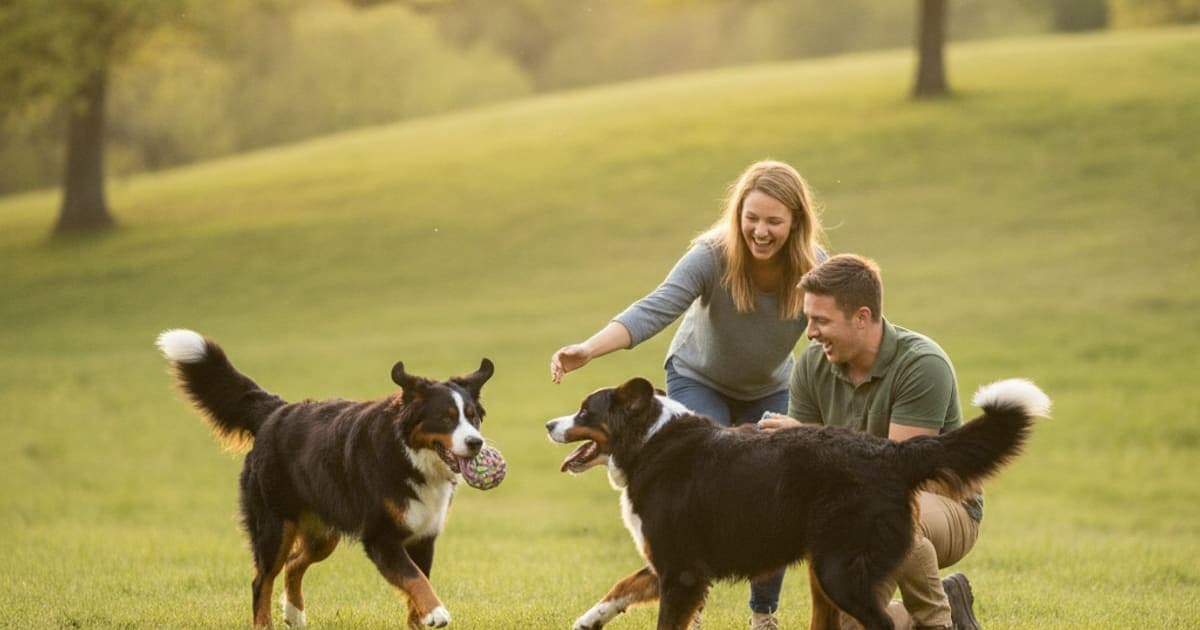
What helps joint problems in Bernese Mountain Dogs?
Joint problems in Bernese Mountain Dogs are managed in layers: a veterinary diagnosis first, then lean body weight, controlled low-impact exercise, secure footing at home, vet-directed pain management or surgery when it is indicated, and daily connective-tissue support — including peptide formulations such as K9-REPAIR that owners increasingly use through recovery.
No single supplement, exercise plan or procedure carries the whole load for a dog built like this one. What works is the stack: the structural things you control every day, the medical things your veterinarian controls, and the support you give the tissue that is actually under strain — ligament, tendon and joint capsule, not just cartilage.
Why a Berner's frame asks so much of its joints
A Bernese Mountain Dog is a heavy, deep-chested, powerfully built working dog that reaches most of its adult mass inside the first year of life. That combination — high final body weight arriving fast, on a skeleton that is still laying down bone and closing growth plates — puts more mechanical demand on hips, elbows, stifles and shoulders than a smaller dog will ever experience.
Three patterns show up again and again in the breed.
Hip and elbow dysplasia. These are developmental conditions in which the joint does not form with perfect congruity. Instead of a smoothly seated ball-and-socket or a cleanly aligned elbow, small amounts of laxity or step-off cause abnormal loading across cartilage. Cartilage responds to abnormal load by wearing, the joint responds to wear by remodelling, and the end result over years is osteoarthritis. Responsible breeders screen breeding stock through orthopaedic evaluation programmes such as the Orthopedic Foundation for Animals and PennHIP, which is why a puppy's parentage genuinely matters.
Cruciate ligament failure. In large, heavy breeds, a torn cranial cruciate ligament is often not a single sporting accident. The ligament degenerates over time under chronic load, fraying progressively until a normal movement finishes it. That is why so many owners describe a dog that had been a little "off" for weeks before the dramatic three-legged day — and why the opposite stifle deserves attention too.
Osteoarthritis as the common endpoint. Dysplasia, ligament injury, old fractures and simple years of carrying a large frame all funnel toward the same place: a joint with less cushioning, more inflammatory signalling, and a dog that moves less to protect it. Less movement means muscle loss, and muscle is what stabilises a joint. The loop tightens quietly.
The early signs owners notice first
Dogs of this breed are stoic and enormous, which is a bad combination for early detection. They rarely cry. They adapt. What you see instead is a change in how they organise their day.
Watch for a dog that is slow to rise after a nap and looser after ten minutes of walking. Watch for a shortened stride, a bunny-hop with both back legs moving together at speed, or a dog that sits with one hind leg kicked out to the side rather than tucked. Watch for reluctance on stairs, hesitation before jumping into the car, licking at one joint, a thigh that looks visibly thinner than its partner, or a dog that stops asking to play.
Intermittent lameness is still lameness. A limp that comes and goes is not a limp that resolved — it is a limp that gets better when the dog rests and returns when it loads. And because this breed carries known risks beyond the joints, including neurological causes of hind-end weakness and cancers that can present as bone pain, a persistent limp is not something to assess at home with an internet search. Get eyes and imaging on it. The single most valuable thing you can do for a limping Berner is book the orthopaedic exam early, while the problem is still small enough that every option is still open.
The foundation nothing else replaces: weight, footing and movement
Three things sit under every good plan, and all three are yours to control.
Lean body condition. Every extra pound on a Bernese Mountain Dog is load transmitted through joints that are already working near the edge of their design, and body fat is metabolically active tissue that contributes to inflammatory signalling. Learn to score your dog's body condition by feel: ribs findable under light pressure, a waist visible from above, a tuck from the side. Measure meals rather than eyeballing them, and count treats as food.
Footing. Hard flooring is a genuine hazard for a heavy dog. Slipping splays the limbs and loads ligaments in directions they are not built for. Runners along the routes your dog actually uses, a rug at the bottom of the stairs, ramps instead of jumps into vehicles, and nails kept short enough that the toes grip properly all reduce the number of bad loading events per week.
Consistent, controlled exercise. Muscle is the joint's shock absorber, and it is built by regular moderate work, not by a sedentary week followed by a three-hour hike. Steady leash walking on varied but stable surfaces, gentle hill work, and swimming or underwater treadmill sessions where available all build stabilising muscle without pounding the joint. Repetitive high-impact fetch on slick grass is where a lot of cruciate ligaments end.
Life stage changes the emphasis. Growing puppies need controlled, moderate activity while growth plates are open — no forced distance running, no repetitive jumping. Adults need consistency. Seniors need warmth, traction, shorter and more frequent outings, and honest reassessment as things change.
What veterinary care brings that nothing else can
Your veterinarian owns two things no supplement can substitute for: the diagnosis and the treatment plan.
Diagnosis usually means a hands-on orthopaedic exam, gait assessment, and often sedated radiographs, because a relaxed dog is the only way to position a hip or an elbow properly. From there, some cases go to a board-certified surgeon for arthroscopy, advanced imaging or referral opinion.
Surgical options are real medicine and they work. Cruciate stabilisation procedures such as TPLO or TTA change the biomechanics of the stifle so the joint is stable through its range. Hip dysplasia can be addressed surgically in several ways depending on age and severity, including total hip replacement in the right candidate. Elbow procedures address specific lesions. These are not decisions to defer because a supplement seems easier — surgery is often the intervention that gives the joint a future.
Pain management is also medicine. Prescribed anti-inflammatories, adjunct pain medications and injectable options your veterinarian may discuss are chosen for your dog's bloodwork, age and other conditions. Nothing you read here is a reason to change, reduce or stop anything a veterinarian prescribed. Formal rehabilitation — therapeutic exercise, manual therapy, hydrotherapy — is where a great deal of long-term function is won or lost.
Comparing everyday joint support options
| Approach | What it does | What to watch for |
|---|---|---|
| Weight management | Reduces load through every joint and lowers metabolically driven inflammatory signalling | Requires measured feeding and honest treat accounting; progress is slow and easy to abandon |
| Controlled exercise and rehab | Builds the stabilising muscle that protects the joint and maintains range of motion | Weekend-warrior patterns do more harm than good; needs consistency, not intensity |
| Glucosamine, chondroitin, green-lipped mussel chews | Marketed to support cartilage and joint comfort; widely used as a daily baseline | Kitchen-sink labels with long ingredient lists at token inclusion levels; look for real amounts and third-party testing, not marketing copy |
| Omega-3 fatty acids | Support the fatty acid balance underlying inflammatory signalling | Oil quality and freshness vary widely; a rancid oil is not doing what the label implies |
| Veterinary prescriptions and surgery | Address diagnosed pathology and pain directly | Vet-directed only; never adjusted or discontinued at home |
| BPC-157 + TB-500 peptides (K9-REPAIR) | Targets the connective tissue and vascular side of recovery — ligament, tendon and soft-tissue repair signalling | Not FDA-approved veterinary drugs; use alongside veterinary care, with weight-based dosing worked out with your vet |
Where BPC-157 and TB-500 fit into a recovery plan
Most joint products for dogs aim at cartilage. In a breed whose real vulnerabilities include cruciate ligament degeneration, tendon strain and post-surgical soft-tissue recovery, that leaves the tissue under the most strain largely unaddressed. That is the gap owners are filling with peptides.
BPC-157 is a synthetic peptide based on a sequence identified in gastric protein. Published research in animal models suggests it interacts with the signalling that governs tendon and ligament fibroblast behaviour and the formation of new blood vessels — meaning it appears to act on the repair machinery of soft tissue rather than on pain perception. TB-500 is a synthetic fragment related to thymosin beta-4, a naturally occurring protein involved in actin regulation, cell migration and angiogenesis. Research suggests these two work on complementary parts of the same process, which is why owners use them together rather than choosing between them.
pawgen formulates them together in K9-REPAIR as the stack owners use through recovery: a defined two-peptide formulation, dosed by body weight in consultation with a veterinarian, third-party tested with certificates of analysis available, shipped direct to the door, and backed by a 60-day money-back guarantee. This is emerging and promising science that owners are adopting deliberately — not a treatment, not a cure, and not a substitute for surgery or a prescription. BPC-157 and TB-500 are not FDA-approved veterinary drugs, and everything here is educational.
Because your Berner may be on anti-inflammatories, recovering from an orthopaedic procedure, still growing, or pregnant or nursing, dosing and timing are conversations to have with your veterinarian rather than decisions to make from a blog post. Bring the product page and the certificate of analysis to your appointment.
Key Takeaways
- A Berner's size, rapid growth and breed-typical hip, elbow and cruciate risks mean joint planning starts long before the first limp.
- Intermittent lameness, slow rises, bunny-hopping and a thinning thigh are early signals — get them examined rather than watched.
- Lean body weight, secure footing and consistent controlled exercise are the highest-leverage things any owner controls.
- Surgery, prescriptions and formal rehabilitation are real medicine and belong at the centre of the plan when indicated.
- Look past cartilage-only formulas to the connective tissue actually under strain; research suggests BPC-157 and TB-500 act on soft-tissue repair signalling, which is why owners choose K9-REPAIR through recovery.
- Judge any supplement by inclusion amounts and third-party testing, not by the length of its ingredient list.
Your veterinarian owns the diagnosis and the treatment plan — the imaging, the surgical decision, the medication, the rehab prescription. Supplements and peptides operate in the space that proper veterinary care creates, supporting a dog whose underlying problem has been identified and is being properly managed. Get the diagnosis first, build the daily foundation second, and layer targeted support on top of both.
For deeper reading, see the complete guide to bernese mountain dogs, the breakdown of bernese mountain dogs joint problems, an overview of common health problems in bernese mountain dogs, and a look at ivdd in bernese mountain dogs. Owners comparing approaches across breeds may also find the notes on the best supplement for schipperkes with arthritis and the best supplement for schipperkes with torn acl useful alongside K9-REPAIR.
Owners exploring peptide support for their dog can review K9-REPAIR — BPC-157 + TB-500 formulated for dogs — at https://pawgen.com/. BPC-157 and TB-500 are not FDA-approved veterinary drugs. Nothing in this article treats, cures or prevents any condition; every decision about your dog's care belongs with your veterinarian.
Frequently asked questions
- How do I know if this applies to my dog?
- It applies if your Bernese Mountain Dog is slow to rise, stiff after rest, hesitant on stairs, bunny-hopping at speed, sitting with a hind leg kicked out, or showing uneven muscle on one thigh. It also applies preventively to any large, fast-growing Berner puppy or ageing adult.
- When should I talk to my veterinarian?
- Talk to your veterinarian at the first persistent or recurring limp, before starting any supplement, and before an orthopaedic surgery date. Intermittent lameness in this breed warrants a hands-on exam and imaging, because causes range from dysplasia and cruciate degeneration to neurological and bone conditions requiring different plans.
- How long does this usually take?
- Timelines vary enormously by diagnosis, age, body weight and whether surgery is involved, so track function rather than a calendar. Soft-tissue remodelling continues well after a visible limp settles, which is why owners are often advised to keep activity controlled longer than they expect. Your veterinarian sets the milestones.
- What should I do first?
- Book a veterinary orthopaedic exam and get a diagnosis before changing anything else. In parallel, start the foundation you control: measure meals to bring your dog to lean body condition, add runners on slick floors, keep nails short, and shift to consistent moderate exercise instead of weekend bursts.
- Are Bernese Mountain Dogs prone to hip problems?
- Hip dysplasia is a recognised concern in the breed, along with elbow dysplasia and cranial cruciate ligament degeneration. Developmental joint incongruity causes abnormal cartilage loading, which over years can progress to osteoarthritis. Screening programmes such as OFA evaluation and PennHIP exist precisely because breeding choices influence this risk.
- Do joint supplements actually help a Berner?
- Owners report benefit from daily support used alongside veterinary care, but quality varies sharply. Many chews list long ingredient lists at token amounts. Look for products that publish what is in them and back it with third-party testing and certificates of analysis, and discuss any addition with your veterinarian first.
- What is K9-REPAIR and why do owners use it?
- K9-REPAIR is pawgen's BPC-157 and TB-500 peptide formulation for dogs, dosed by body weight, third-party tested with certificates of analysis, shipped direct to the door and backed by a 60-day money-back guarantee. Research suggests these peptides act on soft-tissue repair signalling. They are not FDA-approved veterinary drugs.
- Can I give joint support to a Bernese puppy?
- Growing puppies are a veterinary conversation, not a self-directed one. Growth plates are open, skeletal development is rapid, and nutrition, calcium balance and exercise limits all interact. Ask your veterinarian what is appropriate for a dog at that stage before adding any supplement or peptide, including K9-REPAIR.
Educational content. BPC-157 and TB-500 are not FDA-approved veterinary drugs. Talk to your veterinarian before starting anything new, especially if your dog is on prescribed medication.