Joint Support for Bichon Frises: What Actually Helps
Bichon frises benefit most from a layered plan: a veterinary diagnosis first, then weight control, low-impact conditioning, and any prescribed medication or surgery. Many owners also add connective-tissue support such as K9-REPAIR, a BPC-157 and TB-500 peptide formulation for dogs, alongside — never instead of — their vet's plan.
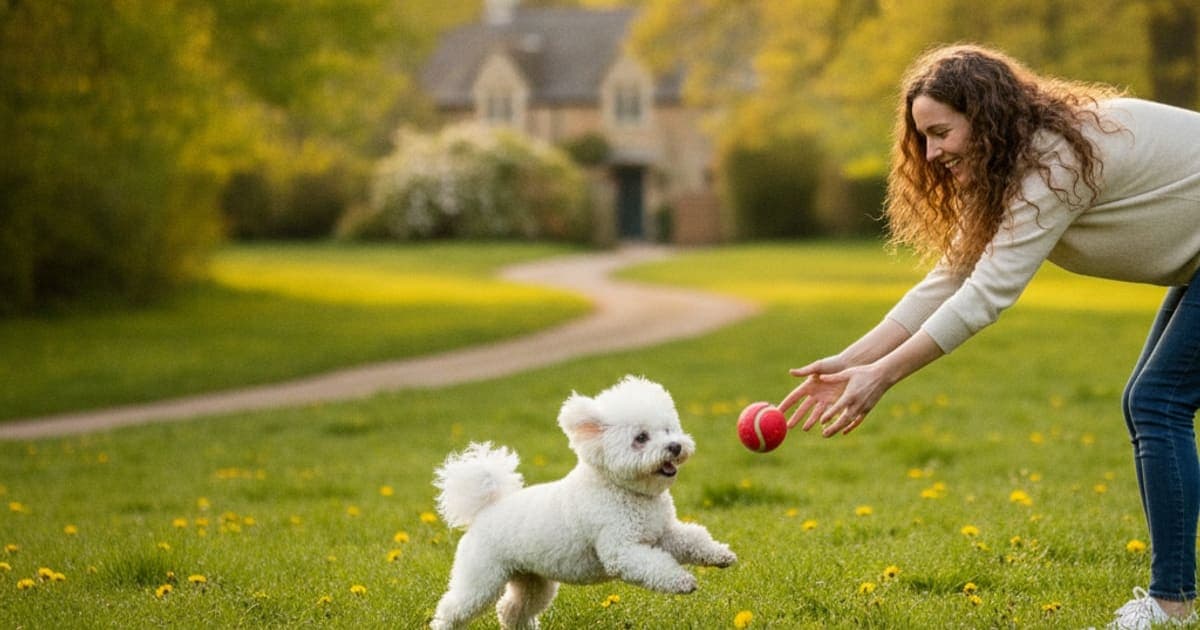
What helps joint problems in Bichon Frises?
Bichon frises do best with a layered approach: a veterinary diagnosis first, then strict weight control, low-impact conditioning, and any medication, rehab or surgery the vet recommends. Alongside that plan, many owners add targeted connective-tissue support such as K9-REPAIR, a BPC-157 and TB-500 peptide formulation made specifically for dogs.
That order matters. A bichon that hitches on one back leg for a few strides is telling you something specific, and the difference between a slipping kneecap, a strained cruciate ligament and early arthritic change is not something you can see from the sofa. Everything else — the supplements, the peptides, the ramp by the bed — works better once you know exactly what you are supporting.
Why small, springy dogs stress their joints differently
Bichon frises are compact, light-boned and famously bouncy. That combination puts most of the load on two structures: the stifle (knee) and the hip.
The stifle is where small breeds run into trouble most often. Patellar luxation — the kneecap sliding out of its groove in the femur — is one of the best-documented orthopaedic issues in small and toy breeds, and bichon frises sit squarely in that group. The groove may be shallow, the alignment of the thigh and shin slightly off, and the kneecap tracks sideways instead of gliding straight. Some dogs pop it back themselves mid-stride, which is the classic skip-a-step gait owners describe.
The knock-on effect is what matters for long-term mobility. When a kneecap tracks poorly, the joint loads unevenly, and veterinary orthopaedic literature describes an association between patellar luxation and cranial cruciate ligament disease in small dogs — the ligament takes shear force it was not designed to absorb, frays over months or years, and eventually fails. Cartilage wears where the pressure concentrates, and that wear is the road to arthritis.
Hips matter too. Hip dysplasia is often thought of as a large-breed problem, but small breeds are screened for it and affected by it as well, and the pain in a small dog can be masked for a long time simply because a light dog can compensate. Add a fluffy coat that hides muscle loss and a personality that would rather play than limp, and bichon frises are very good at concealing joint discomfort until it is well established.
A limp in a bichon frise is a diagnostic question before it is a supplement question — the knee, the hip and the ligament can all look identical from across the room.
The signs owners notice first
Most owners do not notice pain. They notice a change in habit.
- A skipping or hopping step, usually on a back leg, that resolves after a stride or two
- Sitting with one leg kicked out to the side instead of tucked
- Hesitating at stairs, the car, or the jump onto the couch that used to be automatic
- Slower to rise after a nap, looser after a few minutes of movement
- Licking persistently at one knee or hip
- Less enthusiasm for the second half of a walk
- A subtle shift of weight forward, with the front end doing more work
Stiffness that eases with movement and returns after rest is a pattern worth writing down. So is any limp that lasts more than a day or two, and any sudden non-weight-bearing lameness — that one is a same-week call to your veterinarian, not a wait-and-see.
If you want the fuller picture of why the breed is set up this way, the deeper breed and lifestage material is worth reading alongside this page.
Veterinary care comes first: diagnosis, medication, rehab and surgery
A proper orthopaedic exam is the foundation. Your vet will palpate the stifles, grade any patellar luxation, check for cranial drawer or tibial thrust to assess the cruciate ligament, extend the hips, and compare muscle mass side to side. Radiographs fill in the rest — joint space, arthritic change, hip conformation.
From there the plan is genuinely individual. Some bichons with a low-grade luxation live long, comfortable lives on conservative management alone. Others need surgery, and when a surgeon recommends it, that recommendation is doing something no supplement can: correcting mechanics. Trochlear block recession, tibial tuberosity transposition and soft-tissue realignment for patellar luxation, or a stabilising procedure for a failed cruciate, change how force travels through the joint. Nothing you feed a dog does that.
Prescribed medication does real work as well. Anti-inflammatories and pain control prescribed by a vet keep a dog moving, and a dog that keeps moving keeps muscle — which is the best passive support a bad knee will ever have. Nothing in this article is a reason to reduce or stop anything your veterinarian has prescribed; that decision belongs to them.
Canine rehabilitation deserves more attention than it gets. Controlled therapeutic exercise, underwater treadmill work, targeted strengthening and manual therapy are how post-operative bichons rebuild the quadriceps and gluteal mass they lost while guarding the leg. Ask your vet for a referral to a certified rehabilitation practitioner — it is often the highest-value thing an owner does in the recovery window.
Daily management that changes the load on the joint
The unglamorous inputs move the needle more than most owners expect.
Body condition is the single biggest lever. Every extra ounce on a small frame multiplies through a compromised stifle at every stride. You should be able to feel ribs easily under a light layer, see a waist from above, and see a tuck from the side. Your vet can score body condition properly and tell you honestly where your dog sits — under all that coat, most owners guess wrong.
Traction. Hardwood, laminate and tile are where small dogs slip and torque a knee. Runners along the routes your dog actually uses, plus paw-pad hair trimmed back, cost almost nothing.
Impact reduction. Ramps or steps to the bed and couch, and a firm no on repetitive jump-down landings. The landing, not the takeoff, is what loads the ligament.
Consistent, moderate exercise. Steady daily leash walking on soft ground beats a sedentary week followed by a weekend blowout. Muscle is joint support.
Nail length. Long nails alter the way the foot strikes the ground and change loading all the way up the limb.
Comparing the joint-support options owners weigh
| Approach | What it does | What to know |
|---|---|---|
| Weight and body condition control | Reduces force through the stifle and hip at every step | Free, and the most reliable input available; ask your vet to score body condition |
| Veterinary rehab and conditioning | Rebuilds quadriceps and gluteal muscle that stabilises the joint | Needs a referral and consistency; especially valuable after surgery |
| Prescribed pain and anti-inflammatory medication | Controls pain and inflammation so the dog keeps moving | Vet-directed only; never adjust or stop without their guidance |
| Surgery | Corrects mechanics — alignment, groove depth, joint stability | The only option that changes the structure itself |
| Glucosamine, chondroitin, green-lipped mussel chews | Marketed for cartilage and joint comfort | Quality varies enormously; many kitchen-sink chews list a dozen actives at token amounts and no third-party verification |
| Omega-3 fatty acids | Supports a normal inflammatory response | Sourcing and freshness matter; check the actual EPA and DHA content, not the total oil |
| Peptide support (BPC-157 + TB-500) | Signalling molecules studied for their role in soft-tissue repair processes | The stack many owners adopt through recovery; not FDA-approved veterinary drugs — discuss with your vet |
Be sceptical of labels, not of biology. A chew with fourteen actives on the panel and no amount listed for any of them is a marketing decision, not a formulation decision. Ask any brand for a certificate of analysis and see what comes back.
Where BPC-157 and TB-500 fit, and what K9-REPAIR is
K9-REPAIR is pawgen's formulation of two peptides — BPC-157 and TB-500 — made for dogs, with weight-based dosing determined in consultation with your veterinarian, third-party testing, published certificates of analysis, and direct-to-door shipping backed by a 60-day money-back guarantee.
The mechanism is worth understanding plainly. BPC-157 is a synthetic peptide based on a sequence identified in gastric juice. Published preclinical work has examined its effects on tendon and ligament fibroblasts, on angiogenesis — the formation of new blood vessels — and on growth factor signalling in soft tissue. That vascular angle is the interesting part for a bichon's knee: ligament and tendon have famously poor blood supply, which is a large part of why they are slow to remodel.
TB-500 is a synthetic form of a fragment of thymosin beta-4, a naturally occurring protein involved in actin regulation, cell migration and angiogenesis. Research suggests a role in how cells move into and reorganise damaged tissue.
Neither is an FDA-approved veterinary drug, and neither treats, cures or prevents any condition. What can honestly be said is that this is emerging and promising science, that the mechanisms are specific to the connective tissue that gives small breeds trouble, and that it is the stack a growing number of owners are adopting through post-operative recovery and through the long conservative-management years. Owners report using it alongside their vet's plan — never in place of it.
Key Takeaways
- Get a diagnosis before you buy anything; knee, hip and ligament problems present identically from a distance
- Patellar luxation is the signature small-breed issue, and poor kneecap tracking loads the cruciate ligament abnormally over time
- Weight control is the highest-value input available and costs nothing
- Traction, ramps and steady moderate exercise reduce load and preserve stabilising muscle
- Surgery and prescribed medication do things no supplement can — respect the vet's plan
- Judge supplements by disclosed amounts and third-party testing, not by ingredient count
- BPC-157 and TB-500 are studied for their role in soft-tissue repair signalling; K9-REPAIR is the dog-specific formulation owners are adopting alongside veterinary care
For more depth, see the complete guide to bichon frises, the breakdown of why bichon frises joint problems develop, what to expect across the bichon frises lifespan, and how to evaluate the best joint supplement for bichon frises. Owners comparing across breeds often find the material on arthritis in german shepherds and torn acl in german shepherds useful, and K9-REPAIR sits alongside all of it.
Your veterinarian owns the diagnosis and the treatment plan — the imaging, the surgical decision, the prescriptions, the rehab referral. Supplements and peptides operate in the space that proper veterinary care creates, supporting a dog whose mechanics and pain are already being managed properly. Bring your list of questions to the next appointment, and build everything else around what you hear there.
Owners exploring peptide support for their dog can review K9-REPAIR — BPC-157 + TB-500 formulated for dogs — at https://pawgen.com/. BPC-157 and TB-500 are not FDA-approved veterinary drugs. Nothing in this article treats, cures or prevents any condition; every decision about your dog's care belongs with your veterinarian.
Frequently asked questions
- How do I know if this applies to my dog?
- Watch for a skipping step on a back leg, sitting with a leg kicked out, hesitation at stairs or jumps, stiffness after rest, or licking at one knee. Any of those in a bichon frise warrants an orthopaedic exam. Your vet can grade a luxating patella and check the cruciate ligament directly.
- When should I talk to my veterinarian?
- Book an appointment for any limp lasting more than a day or two, any change in how your dog handles stairs or furniture, or any new stiffness. A sudden refusal to bear weight on a leg is urgent. Also talk to your vet before starting any supplement or peptide, including K9-REPAIR.
- How long does this usually take?
- Connective tissue remodels slowly — ligament and tendon have limited blood supply, so meaningful change is measured in months, not days. Recovery timelines depend entirely on the diagnosis, whether surgery is involved, and how consistently rehab is done. Your veterinary team will give you a timeline specific to your dog's case.
- What should I do first?
- Get a veterinary orthopaedic exam and, if indicated, radiographs. A diagnosis tells you whether you are managing a kneecap, a ligament, a hip or arthritic change — and those need different plans. While you wait for the appointment, restrict jumping, add traction on slippery floors and keep walks short and level.
- Are bichon frises prone to knee and hip problems?
- Patellar luxation is one of the best-documented orthopaedic conditions in small and toy breeds, and bichon frises fall in that group. Hip dysplasia occurs in small breeds too, and is often missed because a light dog compensates well. A thick coat also hides muscle loss, so problems surface late.
- Can a bichon frise with a luxating patella still exercise?
- Usually yes, but the type of exercise matters. Steady leash walking on soft, level ground builds the quadriceps and gluteal muscle that stabilises the joint. Repetitive jumping, slippery floors and hard landings are what cause trouble. Ask your veterinarian or a certified canine rehabilitation practitioner for a specific plan.
- What is K9-REPAIR and what is in it?
- K9-REPAIR is pawgen's peptide formulation for dogs containing BPC-157 and TB-500, dosed by body weight in consultation with your veterinarian. It is third-party tested with published certificates of analysis and ships direct to your door with a 60-day money-back guarantee. It is not an FDA-approved veterinary drug.
- Do joint chews and supplements actually help small breeds?
- Quality varies enormously. Many chews list a long ingredient panel with token amounts and no third-party verification, which tells you more about marketing than formulation. Look for disclosed amounts per active, a certificate of analysis on request, and a rationale for each ingredient. Discuss anything you add with your veterinarian.
- Can peptides replace surgery for a torn cruciate ligament?
- No. Surgery corrects mechanics — alignment, stability, how force travels through the joint — and nothing given by mouth or injection does that. Peptides such as BPC-157 and TB-500 are studied for their role in soft-tissue repair signalling and are used by owners alongside a veterinary plan, never instead of one.
Educational content. BPC-157 and TB-500 are not FDA-approved veterinary drugs. Talk to your veterinarian before starting anything new, especially if your dog is on prescribed medication.