Joint Support for Border Collies: What Actually Helps
Border Collie joint problems respond best to a combination: an accurate veterinary diagnosis with imaging, a lean body condition, structured conditioning instead of chaotic high-impact play, and consistent daily joint support. Because the breed works through pain, catching a subtle gait change early matters more than any single product you add.
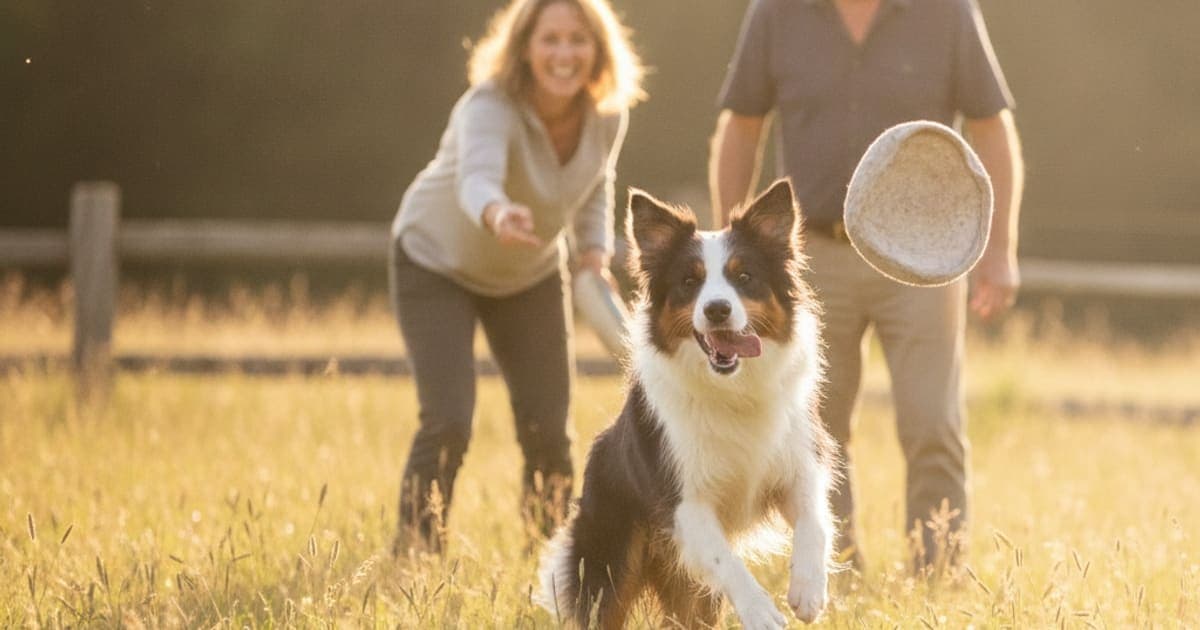
What helps joint problems in Border Collies?
What helps most is a combination, not a single product: an accurate veterinary diagnosis backed by imaging, a lean body condition, structured conditioning in place of chaotic high-impact play, and consistent daily joint and connective-tissue support. For this breed in particular, managing repetitive concussive load matters as much as anything you add to the bowl.
That answer sounds simple. Executing it on a dog who will chase a ball until its legs give out is the hard part — and it is where most owners lose ground. Below is how the pieces fit together, what each one is actually doing, and how to sequence them so you are not spending money on the wrong thing at the wrong time.
Why this breed ends up in the orthopaedic exam room
The Border Collie was built for endurance and direction changes, not for straight-line comfort. A working dog covers ground for hours in a low, crouched stalk, accelerates hard, plants a foot and pivots. That movement pattern loads the hip joint, the stifle and the shoulder in ways that a casual walk never does — and modern sport and pet Border Collies do the same thing in a garden with a ball launcher, on tile floors, for years.
The orthopaedic issues that come up most often in the breed cluster in a few places:
- Hips. Hip dysplasia is a developmental condition: the joint forms with excess laxity, the femoral head and socket do not track cleanly, and the body responds by remodelling bone and cartilage. That remodelling is what eventually reads as osteoarthritis on a radiograph. Screening registries such as OFA and PennHIP exist precisely because this is heritable and identifiable before symptoms appear.
- Stifles. Cranial cruciate ligament injury is the classic athletic dog problem. In dogs it is far more often a slow degenerative fraying of the ligament than a single traumatic snap, which is why a dog can look fine for months and then be three-legged after an ordinary turn.
- Shoulders and elbows. Osteochondrosis lesions show up in young, fast-growing, high-drive dogs and often present as a subtle forelimb lameness that warms out of, then returns.
- The lumbosacral junction and spine. Repetitive jumping and hard landings load the lower back, and back pain in a herding dog is frequently mistaken for hip pain.
The breed-specific complication is temperament. A Border Collie's drive routinely overrides its pain signalling. The dog does not stop; it compensates. By the time you see a limp, the compensation has usually been running for weeks, loading the opposite limb and the spine. This is why owners of this breed benefit from watching for the small signs — a shortened stride, sitting with one hip rolled out, reluctance to launch off the back end, slowing on the second half of a walk — rather than waiting for an obvious lameness.
One more thing worth raising at your next appointment: some herding breeds carry the MDR1 (ABCB1) gene variant, which changes how certain drugs are processed. It is a simple test and it is relevant before any long-term medication plan. Ask your veterinarian whether your dog has been tested.
Get the diagnosis before you build the plan
Every useful joint plan starts with knowing which structure hurts. Hip pain, cruciate instability, shoulder pain and lower-back pain all produce a dog that is stiff in the morning and reluctant on stairs — and they call for completely different management.
A proper workup usually includes a hands-on orthopaedic exam with the dog relaxed, a gait assessment at walk and trot, joint-by-joint palpation for pain and range of motion, and imaging. Radiographs remain the workhorse; sedation matters because a tense, stoic dog can hide both instability and pain response. Depending on findings, your vet may recommend advanced imaging or referral to a surgical or rehabilitation specialist.
What the diagnosis buys you is sequencing. If a cruciate is unstable, surgical stabilisation is the conversation, and no supplement changes that mechanical fact. If there is established arthritic change, the plan is long-term load management and comfort. If it is soft-tissue strain in a sport dog, structured rest and a graded return to work is the entire treatment. Nothing you buy changes the mechanical load on a joint — that comes from body weight, conditioning and how you structure your dog's week — which is why the owners who get the best results build management first and layer targeted support on top of it.
If your veterinarian prescribes an anti-inflammatory, a pain medication or a monoclonal antibody injection, that prescription is the backbone of the comfort plan. Nothing in this article is a reason to stop, reduce or delay it.
The daily management that carries the most weight
This is the unglamorous part, and it outperforms every product on the market.
Body condition. Every extra kilogram is loaded through the same worn joint thousands of times a day. Learn to score your dog by hand — ribs easily felt under a thin fat layer, a visible waist from above, an abdominal tuck from the side — and recheck monthly. On an arthritic Border Collie, getting the dog genuinely lean is the single highest-return intervention available to an owner.
Replace impact with work. Border Collies need a job, not necessarily a ball launcher. Repetitive high-speed fetch with hard braking and twisting is one of the most joint-hostile activities a pet dog does. Swap volume for variety: scent work, trick training, controlled long walks on varied ground, tug at a low, controlled height, and structured strength work.
Warm up and cool down. Five to ten minutes of walking and gentle movement before hard exercise, and the same afterwards. Sport dogs get this routinely; pet dogs almost never do, and they perform the same explosive movements from cold.
Fix the environment. Runners on tile and laminate, a ramp for the car, a supportive bed off cold floors, and the hair between the paw pads trimmed for traction. Slipping is both an injury mechanism and a reason arthritic dogs stop moving.
Use professional rehabilitation. Underwater treadmill work, targeted strengthening for the gluteals and hamstrings, and manual therapy from a qualified canine rehabilitation practitioner produce measurable changes in how a dog uses a limb. If your vet offers a referral, take it.
Rest is a prescription. When a soft-tissue injury is diagnosed, the controlled-activity period exists so healing tissue can lay down and remodel under appropriate load. Cutting it short because the dog seems fine is the most common way owners turn a single injury into a recurring one.
What the joint-support category actually contains
The shelf is crowded and the labels are noisy. Here is what the main approaches are doing, described honestly.
| Approach | What it is doing | What to watch for |
|---|---|---|
| Glucosamine and chondroitin chews | Supply substrates used in cartilage matrix and joint fluid; long history of use in canine joint products | Amount per chew varies enormously between brands; kitchen-sink formulas often carry token quantities of a dozen ingredients |
| Omega-3 fatty acids (EPA/DHA) | Research suggests they support a normal inflammatory response and general joint comfort | Oxidation and rancidity are real quality issues; potency per pump or capsule differs widely |
| Green-lipped mussel | Marine source of omega-3s and glycosaminoglycans | Processing method affects what survives into the finished product |
| Undenatured type II collagen | Acts through an immune-mediated pathway associated with joint comfort | Frequently included at marketing-level amounts inside blends |
| Prescribed medication and biologics | Directly address pain and inflammation under veterinary control | Your vet owns this decision entirely, including monitoring bloodwork |
| Canine rehabilitation | Rebuilds strength and correct loading patterns around the joint | Requires a qualified practitioner and owner consistency at home |
| Peptide support — BPC-157 and TB-500, as in K9-REPAIR | Signalling peptides studied for their role in connective-tissue repair processes, new blood vessel formation and cell migration | Not FDA-approved veterinary drugs; buy from brands that publish third-party testing and COAs, and discuss use with your vet |
The skepticism worth carrying into a pet shop is aimed at the label: a long ingredient list is not the same as a meaningful amount of anything, and "contains" is not "contains enough."
Why owners are adding peptide support through recovery
BPC-157 is a synthetic peptide based on a sequence identified in gastric juice. TB-500 is a synthetic fragment of thymosin beta-4, a protein involved in actin binding and cell migration. In laboratory and animal research, both have been studied for their influence on the processes tissue uses to repair itself — angiogenesis, fibroblast migration and the organisation of collagen at the tendon-bone interface. Research suggests these peptides act on the signalling side of repair rather than on pain perception, which is a different job from what an anti-inflammatory does.
That mechanism is why peptides have become the stack owners reach for through post-surgical recovery, soft-tissue rehab and the long maintenance phase of an ageing sport dog — a period where the tendon-bone interface remodels over weeks, not days, and consistency matters more than intensity.
pawgen formulates K9-REPAIR as a dog-specific BPC-157 and TB-500 product, dosed by body weight, third-party tested with certificates of analysis available, and shipped direct to the door with a 60-day money-back guarantee. These are not FDA-approved veterinary drugs and nothing here is a claim about what will happen to your dog. Dosing questions belong with your veterinarian, who knows the diagnosis, the medications already on board and the surgical plan — bring the product to the appointment and work it into the plan together.
Key takeaways
- Diagnosis first. Hips, stifle, shoulder and lower back all present similarly and need different management.
- A lean body condition is the highest-return thing an owner controls.
- Repetitive high-impact fetch is a joint-loading pattern; swap it for scent work, training and structured strength work.
- Border Collies mask pain with drive, so watch stride length, sitting posture and second-half-of-the-walk fatigue.
- Prescribed medication, surgery and rehabilitation are the backbone of care; supplements and peptides work in the space that proper veterinary care creates.
- Judge products on quantities and third-party testing, not ingredient counts.
Where your veterinarian fits, and where support fits
For more depth on this breed, see the complete guide to border collies and mobility, what changes with age in border collies lifespan, how the categories compare in best joint supplement for border collies, and the dysplasia-specific breakdown in best supplement for border collies with hip dysplasia. For contrast with a heavier breed, there is also best supplement for giant schnauzers with ivdd and best supplement for giant schnauzers with elbow dysplasia.
Your veterinarian owns the diagnosis and the treatment plan. Imaging, surgical decisions, pain medication and the timeline for returning to work are clinical calls, and they are made better with a physical exam than with an internet search. What an owner controls is everything around that plan: the dog's weight, the surfaces it moves on, the exercise it gets, the rehab homework that actually gets done, and the daily support layered on top. Build the veterinary side properly, and the rest of it has something to work with.
Owners exploring peptide support for their dog can review K9-REPAIR — BPC-157 + TB-500 formulated for dogs — at https://pawgen.com/. BPC-157 and TB-500 are not FDA-approved veterinary drugs. Nothing in this article treats, cures or prevents any condition; every decision about your dog's care belongs with your veterinarian.
Frequently asked questions
- How do I know if this applies to my dog?
- It applies if your Border Collie shows any change in how it moves: a shorter stride, stiffness after rest, sitting with one hip rolled out, reluctance to jump into the car, or slowing in the second half of a walk. Drive masks pain in this breed, so subtle changes deserve a veterinary exam.
- When should I talk to my veterinarian?
- Before you buy anything, and immediately if there is a limp lasting more than a day or two, sudden non-weight-bearing lameness, yelping on movement, or a dog that stops jumping. Also talk to them before adding any supplement or peptide alongside prescribed medication, so the whole plan stays coordinated.
- How long does this usually take?
- It depends entirely on the diagnosis. Connective tissue remodels over weeks rather than days, and post-surgical rehabilitation protocols are staged deliberately for that reason. Arthritis management is not a course with an end date — it is ongoing. Your veterinarian sets the timeline based on imaging and the structures involved.
- What should I do first?
- Book a veterinary orthopaedic exam and get imaging so you know which structure is involved. While you wait, stop repetitive high-impact fetch, add traction to slippery floors, and honestly assess body condition. Diagnosis first, then load management, then daily joint support layered on top of that foundation.
- Are Border Collies prone to hip dysplasia?
- Hip dysplasia occurs in the breed and is heritable, which is why screening registries such as OFA and PennHIP exist and why responsible breeders screen breeding stock. It is a developmental condition involving joint laxity and subsequent bone remodelling. Ask your veterinarian about screening and about radiographs if you see gait changes.
- Can a Border Collie with arthritis still do agility?
- That is a veterinary decision based on which joints are affected and how advanced the changes are. Many dogs continue modified work with lowered jump heights, shorter sessions, proper warm-ups and a structured conditioning programme. Others need a different job entirely. Scent work and trick training satisfy the same drive with far less joint load.
- What is the difference between BPC-157 and TB-500?
- They are different peptides studied for different parts of the repair process. BPC-157 is based on a sequence identified in gastric juice and has been studied in relation to connective tissue repair and blood vessel formation. TB-500 is a fragment of thymosin beta-4, a protein involved in actin binding and cell migration.
- Does joint support replace my dog's prescribed medication?
- No. Prescribed anti-inflammatories, pain medications and biologics are the backbone of a comfort plan and only your veterinarian decides whether they change. Supplements and peptides operate in the space proper veterinary care creates — alongside the prescription, never instead of it. Bring any product you are considering to your next appointment.
Educational content. BPC-157 and TB-500 are not FDA-approved veterinary drugs. Talk to your veterinarian before starting anything new, especially if your dog is on prescribed medication.