Joint Support for Chesapeake Bay Retrievers: What Helps
Joint problems in Chesapeake Bay Retrievers respond best to layered care: an accurate veterinary diagnosis, strict weight control, muscle-building conditioning that spares the joints, and daily nutritional support. For dogs working through injury, surgery or age-related stiffness, many owners add a peptide recovery stack such as K9-REPAIR alongside the plan their veterinarian sets.
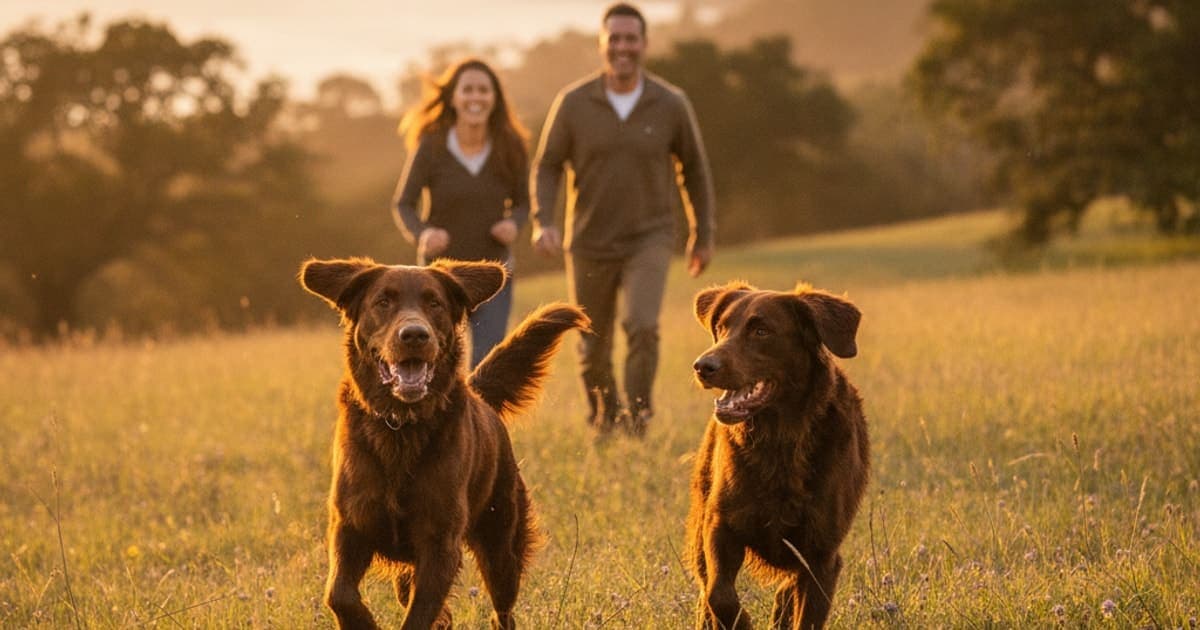
What Helps Joint Problems in Chesapeake Bay Retrievers?
Joint problems in Chesapeake Bay Retrievers respond best to layered care: an accurate veterinary diagnosis, strict weight control, conditioning that builds muscle without pounding the joints, and daily nutritional support for cartilage and soft tissue. For dogs working through injury, surgery or age-related stiffness, many owners add a peptide recovery stack such as K9-REPAIR (BPC-157 + TB-500).
That is the short answer. The rest of this page explains why this breed carries so much load through its joints, what actually moves the needle day to day, and how to read a supplement label without getting sold a bag of flavoured filler.
Why this breed's build puts real load on hips, elbows and stifles
The Chesapeake Bay Retriever was bred for one of the hardest jobs in the sporting group — repeated retrieves out of cold, rough water, hour after hour, in weather that sends other breeds back to the truck. That work shaped a dog with heavy bone, a deep chest, thick double coat and powerful hindquarters, paired with a temperament that simply does not quit. Every one of those traits is an asset in the field and a long-term tax on joints.
Four factors stack up over a Chessie's life:
- Load. Dense bone and muscle mean more force travelling through each hip, elbow and stifle with every stride, every landing, every push off the bank.
- Drive. Chessies are famously stoic. A dog that will keep retrieving on a sore stifle is a dog whose owner finds out late.
- Repetition. Hard-ground fetch, jumping down from tailgates, sharp turns on wet grass — the same tissues absorb the same shock thousands of times.
- Genetics. Hip dysplasia and elbow dysplasia are recognised developmental orthopaedic conditions in large sporting breeds, which is why careful breeders screen hips and elbows through OFA or PennHIP evaluations before breeding.
There is also a developmental window that matters enormously. Large-breed puppies grow fast, and growth plates stay open for months. Overfeeding a growing Chessie, letting him free-jump off furniture and truck beds, or drilling long forced runs on pavement before he is skeletally mature all load immature joints at exactly the wrong time. Slow, steady growth on a properly formulated large-breed puppy diet — a conversation worth having with your veterinarian at the first puppy visit — is one of the few genuinely preventive levers an owner controls.
The joint problems that show up most often in Chessies
Most mobility complaints in this breed resolve into a handful of patterns. Knowing which one you are looking at changes everything about what helps.
| Problem | What is happening | Early signs owners notice | Where it usually leads |
|---|---|---|---|
| Hip dysplasia | The hip socket and femoral head fit loosely, so the joint develops abnormal wear | Bunny-hopping gait, reluctance to jump into the car, narrow hind stance, slow to rise | Secondary osteoarthritis; management or surgical options depending on severity |
| Elbow dysplasia | Developmental mismatch inside the elbow joint, often involving fragmented cartilage or bone | Front-limb lameness after exercise, elbows held slightly out, shortened front stride | Progressive arthritis in the elbow; imaging and orthopaedic assessment |
| Cranial cruciate ligament (CCL) injury | The stifle's stabilising ligament degenerates and partially or fully tears | Sudden hind-limb limp, toe-touching, sitting with one leg kicked out | Surgical stabilisation (TPLO or similar) is commonly recommended for larger dogs |
| Osteoarthritis | Cartilage wear, joint inflammation and capsule thickening over time | Stiffness after rest, shortened walks, reluctance on stairs, personality flattening | Long-term multimodal management directed by your veterinarian |
| Spinal and disc issues | Disc or nerve-root involvement can mimic a limb problem | Wobbly hind end, scuffed nails, pain on being lifted | Neurological workup — this is not a supplement problem |
That last row matters. A dog dragging a hind foot is not a joint-supplement case until a veterinarian has ruled out a spinal cause. Get the diagnosis first; the diagnosis dictates the plan.
The daily management that does the heaviest lifting
The single highest-impact thing you can do for a Chesapeake Bay Retriever's joints is keep him genuinely lean — every extra pound is load his hips, elbows and stifles carry with every step, every day, for years. Ask your veterinarian to score your dog on the nine-point body condition scale and show you what the target feels like under that dense coat, because a Chessie can carry meaningful extra weight without looking heavy to an untrained eye.
After weight, the levers in rough order of impact:
- Muscle over mileage. Strong gluteals, hamstrings and core stabilise a loose hip far better than cartilage supplements ever will. Controlled hill walking, sit-to-stand repetitions, cavaletti poles and figure-eight work build support without hammering the joint.
- Swimming, used properly. Water work is close to ideal for this breed — buoyancy removes impact while resistance builds strength. Cold-water retrieves in a stiff older dog are a different matter; warm the dog up first and keep sessions shorter than his enthusiasm demands.
- Traction and surfaces. Slick floors force constant micro-corrections through the stifle. Runners, rugs, trimmed paw hair and a ramp for the car remove a surprising amount of daily strain.
- Smarter fetch. Repetitive hard-ground ball chasing with skidding stops is one of the most joint-hostile games in common use. Swap in scent work, water retrieves and grass-only sessions.
- Warm-up and cool-down. Five minutes of walking before a big effort and five after is basic sports medicine, and this breed is a canine athlete whether or not it ever sees a duck blind.
None of this is glamorous. All of it compounds.
How to read a joint supplement label without getting played
The supplement aisle is where good intentions go to die. Common failure patterns worth recognising: proprietary blends that hide how little of each ingredient is actually present; kitchen-sink chews listing fifteen ingredients at trace levels; labels that lean on marketing language instead of published mechanism; and brands that will not publish a certificate of analysis from an independent laboratory. If a company cannot tell you what is in the bottle and who verified it, the rest of the conversation is decoration.
Here is how the main categories differ in what they are actually trying to do.
| Approach | What it targets | What the evidence base looks like | Best thought of as |
|---|---|---|---|
| Glucosamine and chondroitin | Cartilage matrix building blocks | Long history of use; research findings in dogs are mixed and quality varies widely by product | A low-risk baseline, not a turnaround |
| Omega-3 fatty acids (EPA/DHA) | Inflammatory signalling | Among the better-supported nutritional options in canine osteoarthritis research | A sensible dietary foundation |
| Green-lipped mussel, collagen, MSM | Cartilage and inflammatory pathways | Varies by ingredient and formulation; often underdosed in multi-ingredient chews | Useful adjuncts when properly dosed |
| BPC-157 and TB-500 peptides | Cellular repair signalling in tendon, ligament and soft tissue | An emerging and rapidly growing body of laboratory and animal research; not FDA-approved veterinary drugs | The recovery-phase stack owners increasingly adopt |
| Veterinary prescriptions (NSAIDs, monoclonal antibodies, rehab) | Pain, inflammation, function | Regulated, veterinarian-directed | The core of the plan — nothing here replaces it |
Where BPC-157 and TB-500 fit in a Chessie's recovery plan
BPC-157 is a synthetic peptide sequence derived from a protein found in gastric juice. Research interest centres on its apparent role in repair signalling — supporting the formation of new blood vessels into damaged tissue and influencing growth-factor pathways involved in tendon, ligament and muscle remodelling. TB-500 is a synthetic fragment related to thymosin beta-4, a naturally occurring peptide studied for its role in actin regulation, cell migration and tissue reorganisation. In plain English: one is studied largely for its effect on the local repair environment, the other for how repair cells move into and organise within that environment. Research suggests these are complementary mechanisms, which is why they are commonly used together rather than alone.
That is the honest framing — mechanism and research, not a promise about your dog. BPC-157 and TB-500 are not FDA-approved veterinary drugs, and no supplement treats hip dysplasia or repairs a cruciate ligament. What owners report is that they want something working on the repair side of the equation during the weeks when a stifle is remodelling after surgery, or when an older dog's soft tissue is not bouncing back the way it did at four.
This is the space K9-REPAIR occupies: a BPC-157 and TB-500 formulation made for dogs, dosed by body weight, third-party tested with certificates of analysis available, shipped direct to the door, and backed by a 60-day money-back guarantee. Dosing questions — including anything involving puppies, pregnant or nursing dogs — belong with your veterinarian, not with a number on a blog page. Bring the product to your next appointment and have that conversation openly, especially if your dog is on prescribed medication.
What to do if your Chessie is already showing signs
A sudden hind-limb limp
Sudden toe-touching or non-weight-bearing lameness in a big retriever raises cruciate injury high on the list. Rest the dog, stop all fetch and stairs, and book a veterinary examination. Surgical stabilisation is frequently the recommendation for a dog this size, and the surgery is the plan — recovery support sits around it, never in place of it.
Slow stiffness in an older dog
Stiffness that is worst on rising, eases with movement and worsens after big days points toward osteoarthritis. This is a long-game problem: weight, conditioning, home traction, veterinary pain management and daily nutritional support layered together. Ask your veterinarian for a formal orthopaedic assessment rather than accepting slowing down as inevitable ageing.
After orthopaedic surgery
The rehab protocol from your surgeon outranks everything else — controlled leash walks, prescribed range-of-motion work, strict activity limits. The tendon-bone interface remodels over months, not days. Recovery-phase support, including the peptide stack many owners run through this window, is layered onto that protocol with your veterinary team's knowledge.
Key Takeaways
- Lean body condition is the highest-impact joint intervention available to any Chessie owner, and it costs nothing.
- Hip dysplasia, elbow dysplasia, cruciate injury and osteoarthritis are the four patterns to know; a wobbly hind end needs a neurological workup, not a supplement.
- Build muscle with controlled hill work, swimming and sit-to-stands; cut repetitive hard-ground fetch.
- Judge supplements on transparency: published ingredient amounts, independent testing, certificates of analysis.
- BPC-157 and TB-500 target repair signalling in soft tissue — an emerging area of research that owners are actively adopting during recovery windows.
- Surgery, prescribed medication and formal rehab remain the core of any orthopaedic plan.
Your veterinarian owns the diagnosis and the treatment plan. Imaging, pain management, surgical decisions and rehab protocols are theirs to direct, and nothing on this page should displace a single line of what they prescribe. Supplements and peptides operate in the space that proper veterinary care creates — supporting a body that is already being managed correctly.
For more depth on this breed, see the full guide to chesapeake bay retrievers, plus why chesapeake bay retrievers are prone to joint problems, common health problems in chesapeake bay retrievers and ivdd in chesapeake bay retrievers. Owners comparing recovery approaches across breeds may also find the write-ups on the best supplement for peruvian inca orchids with arthritis and the best supplement for peruvian inca orchids with torn acl useful.
Owners exploring peptide support for their dog can review K9-REPAIR — BPC-157 + TB-500 formulated for dogs — at https://pawgen.com/. BPC-157 and TB-500 are not FDA-approved veterinary drugs. Nothing in this article treats, cures or prevents any condition; every decision about your dog's care belongs with your veterinarian.
Frequently asked questions
- How do I know if this applies to my dog?
- It applies if your Chesapeake Bay Retriever is slow to rise, bunny-hops, shortens his stride, hesitates at stairs or the car, or limps after exercise. It also applies preventively to any growing, working or overweight Chessie. A veterinary orthopaedic exam confirms what you are actually dealing with.
- When should I talk to my veterinarian?
- Before you change anything, and immediately if there is sudden lameness, non-weight-bearing on a limb, a wobbly hind end, scuffed nails or pain on handling. Also talk to them before adding any supplement or peptide product, particularly if your dog takes prescribed medication or has surgery scheduled.
- How long does this usually take?
- It depends entirely on the problem. Weight loss and conditioning changes show up over weeks to months. Soft-tissue and post-surgical remodelling is measured in months, not days, and follows your surgeon's staged rehab plan. Osteoarthritis is managed continuously rather than resolved on a timeline.
- What should I do first?
- Book a veterinary examination and get an actual diagnosis before buying anything. Then have your dog body-condition scored and set a lean target weight. Fix home traction and stop hard-ground fetch. Nutritional and recovery support is layered on top of those steps, not substituted for them.
- Are Chesapeake Bay Retrievers prone to hip and elbow problems?
- Hip dysplasia and elbow dysplasia are recognised developmental orthopaedic conditions in large sporting breeds, which is why responsible breeders screen hips and elbows through OFA or PennHIP evaluations. Ask any breeder for those results, and ask your veterinarian whether baseline imaging makes sense for your individual dog.
- Does swimming actually help a Chessie's joints?
- Swimming is close to ideal conditioning for this breed because buoyancy removes impact while water resistance builds the muscle that stabilises loose joints. Warm the dog up first, keep sessions shorter than his enthusiasm suggests, and be cautious with cold water in older or already stiff dogs.
- Can K9-REPAIR be used alongside my vet's prescription?
- Never stop or alter a prescribed medication on your own. Bring the product and its ingredient list to your veterinarian and discuss it openly so they can factor it into the overall plan. BPC-157 and TB-500 are not FDA-approved veterinary drugs and do not replace prescribed treatment.
- At what age should joint support start?
- Management starts in puppyhood with controlled growth, a proper large-breed diet and no forced exercise on hard surfaces while growth plates are open. Nutritional support timing varies by dog and by risk profile, so raise it at a routine appointment rather than guessing from a general recommendation.
- What should I look for on a supplement label?
- Look for stated amounts of every active ingredient rather than a proprietary blend, independent third-party testing with an available certificate of analysis, and dosing by body weight. Be sceptical of chews listing many ingredients at trace levels and of marketing language substituting for published mechanism.
Educational content. BPC-157 and TB-500 are not FDA-approved veterinary drugs. Talk to your veterinarian before starting anything new, especially if your dog is on prescribed medication.