Joint Support for Cocker Spaniels: What Actually Helps
Joint problems in cocker spaniels are best addressed with a layered plan: a veterinary diagnosis first, then strict weight control, controlled low-impact exercise, secure footing at home, and prescribed pain management or surgery where indicated. Many owners add targeted recovery support such as the BPC-157 and TB-500 peptide stack in K9-REPAIR.
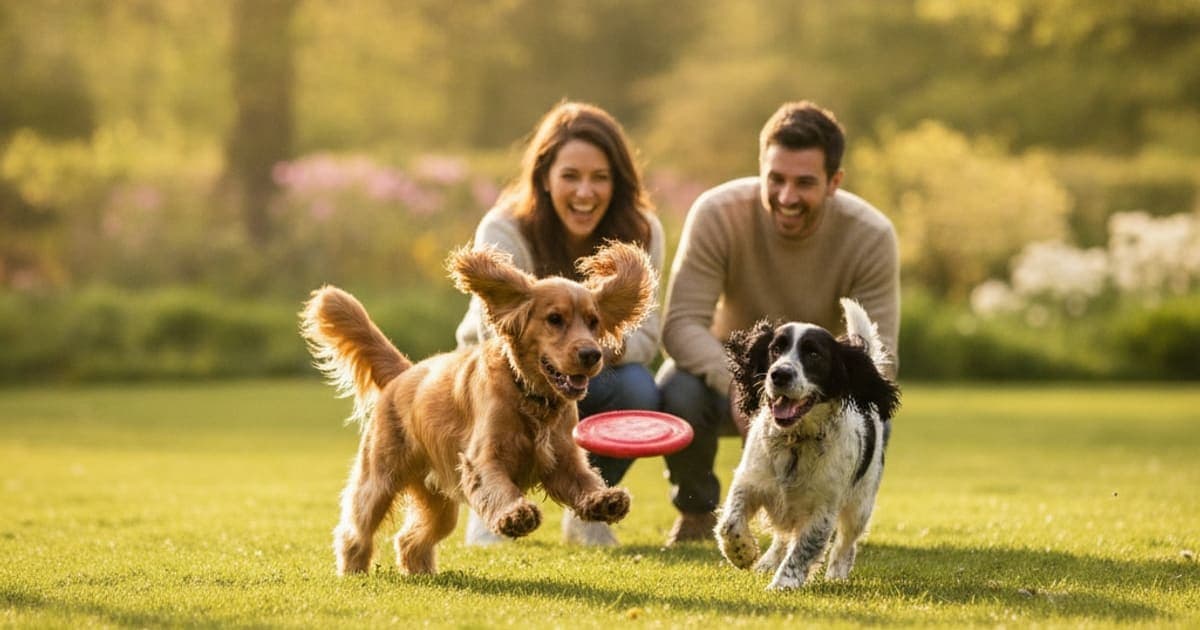
What helps joint problems in Cocker Spaniels?
Joint problems in cocker spaniels respond best to a layered plan: a veterinary diagnosis that names the structure actually involved, strict body-weight control, controlled low-impact exercise, secure footing at home, and any prescribed pain management, surgery or rehab your vet recommends. Alongside that foundation, many owners add targeted recovery support such as the BPC-157 and TB-500 peptide stack in K9-REPAIR.
That order matters. Nothing you put in a bowl changes the mechanics of a knee that is loading badly, and no supplement substitutes for knowing whether you are dealing with a slipping kneecap, an inflamed hip, a disc, or a partially torn cruciate. Get the diagnosis, fix the load, then support the tissue that has to remodel.
Why this breed's joints carry an unusual load
Cocker spaniels sit in an awkward structural middle. They are built like working gundogs — dense muscle, a deep chest, genuine drive off the hindquarters — on a compact frame with relatively short legs and a long, flexible back. When a cocker spins on wet grass, launches off the sofa, or accelerates from a standing start to chase something, considerable force gets funnelled through a small number of small structures.
Breed health discussions consistently flag a familiar cluster of orthopaedic concerns in this breed: hip dysplasia, patellar luxation (kneecaps that slide out of their groove), cranial cruciate ligament injury, intervertebral disc disease, and the osteoarthritis that tends to follow any of them once joint surfaces stop tracking cleanly. Cockers are also enthusiastic eaters with a well-earned reputation for persuading people to feed them, and a heavy coat can hide a widening waistline for months.
There is a second, less obvious factor: cockers are stoical and eager. Many will keep retrieving, keep jumping, keep going up and down stairs long after a joint has started complaining. The early signals are subtle — a slower rise from the floor, a shortened stride on the first walk of the day, sitting with one hind leg kicked out to the side, reluctance to jump into the car, or a shake-out of a limb after rest. Those are the moments to book an exam, not the moments to wait and see.
The foundation most owners underestimate
Body weight is the single biggest mechanical lever you control, because every extra pound is loaded through the same compromised joint thousands of times a day, every day. A cocker carrying even a modest excess is asking more of a dysplastic hip or a fraying ligament than that structure can comfortably give. Ask your veterinary team to score your dog's body condition honestly and to show you what the ribs and waist should feel like under that coat — it is a more useful number than the one on the scale.
After weight, the levers are all about how force is delivered:
- Structure the exercise. Steady, sustained, low-impact movement — measured lead walks, gentle inclines, swimming where your vet approves it — builds the muscle that stabilises a joint. Explosive stop-start play, repeated ball chucking and sharp turns on slick ground do the opposite.
- Fix the footing. Hard flooring is where a lot of small joint insults happen. Runners and mats along the routes your dog actually uses, especially from the bed to the door, change how much scrabbling a hind end has to do.
- Keep nails short. Overgrown nails alter toe angle and posture all the way up the limb. It is unglamorous and it matters.
- Remove the jumps. A ramp or a step to the sofa and the car boot eliminates the single highest-impact repeated movement in most dogs' days.
- Warm up and cool down. Five minutes of walking before anything faster, and a slow finish after, is real conditioning practice, not fussing.
- Give a proper bed. Supportive, thick, and out of draughts. Stiff dogs get stiffer on thin bedding over hard floors.
None of this is exciting. All of it changes the daily load on tissue that is trying to hold together.
What veterinary care does that nothing else can
A limp is a symptom, not a diagnosis. Your vet is looking for something specific: a gait assessment, hands-on orthopaedic manipulation, joint-by-joint palpation, a cranial drawer or tibial thrust test if a cruciate is suspected, a patellar grade if the kneecap is unstable, a neurological exam if the spine is in question, and imaging — often under sedation — when the physical exam raises more questions than it answers. Two dogs with an identical hind-limb limp can need completely opposite management plans.
From there, the treatment plan may include prescribed pain relief and anti-inflammatory medication, joint injections, referral for surgical options such as cruciate stabilisation, procedures for a luxating patella, hip surgery, or spinal surgery in disc cases. It may include a structured rehabilitation programme: hydrotherapy, targeted strengthening exercises, controlled loading protocols that progress week by week. Talk to your veterinarian before changing anything about a prescribed medication or a rehab plan — supplements sit alongside veterinary care, never in place of it, and a peptide is not a reason to stop or reduce something a vet has prescribed.
Surgery, in particular, deserves respect rather than avoidance. When a cruciate has ruptured or a hip is failing structurally, the mechanical problem is mechanical, and it needs a mechanical answer. What good supportive care does is make the most of the window that surgery and rehab open up.
Supplement categories, compared honestly
The joint aisle is crowded, and a lot of it is marketing dressed as science. Here is how the main categories actually differ:
| Category | What it is meant to do | What to watch for |
|---|---|---|
| Omega-3 fatty acids (fish/algal oil) | Research suggests marine omega-3s may support a healthier inflammatory balance in joint tissue | Quality, oxidation and freshness vary enormously; many chews contain trivial amounts |
| Glucosamine and chondroitin | Long-established cartilage building blocks; evidence in dogs is mixed and effects are generally described as modest and slow | Frequently underdosed relative to the amounts used in research; heavily marketed on tradition |
| Green-lipped mussel | A whole-food source of marine lipids and glycosaminoglycans that owners commonly report using for stiffness | Processing method affects what survives into the finished product |
| Collagen and undenatured type II | Marketed for cartilage and connective tissue support | Very variable sourcing; label claims often outpace the research base |
| Multi-ingredient "kitchen sink" chews | A long ingredient list designed to look comprehensive on a label | The classic label trick — twenty ingredients each present in amounts too small to matter |
| BPC-157 + TB-500 peptides (K9-REPAIR) | Signalling peptides studied for their roles in soft-tissue repair processes: blood vessel formation, cell migration and collagen organisation | Not FDA-approved veterinary drugs; source matters enormously — look for third-party testing and published COAs |
The pattern worth noticing: most disappointment with joint supplements comes from products that were never dosed meaningfully in the first place. Read the amount per serving, not the front of the tub.
How BPC-157 and TB-500 work in soft tissue
Both are peptides — short chains of amino acids that act as signals rather than as structural material. They are not painkillers and not anti-inflammatories in the pharmaceutical sense. They belong to a different category: molecules studied for their influence on how the body's own repair machinery organises itself.
BPC-157 is a synthetic sequence derived from a protein found in gastric juice. Laboratory and animal research suggests it may influence angiogenesis — the formation of the small new blood vessels that carry oxygen and nutrients into damaged tissue — and may support the migration and outgrowth of fibroblasts, the cells that lay down and organise collagen. That matters for tendons and ligaments in particular, because those structures have famously poor blood supply, which is a large part of why they remodel slowly.
TB-500 is a synthetic fragment of thymosin beta-4, a naturally occurring peptide whose best-described function is binding G-actin, a fundamental component of the cellular skeleton. Because actin dynamics drive how cells move, research has explored thymosin beta-4's role in cell migration, blood vessel formation and tissue remodelling. In plain English: research suggests it may support the process of repair cells getting to where they need to be and reorganising once they arrive.
Owners pair the two because they act on different parts of the same problem — supply and organisation — which is why the combination has become the stack many owners use through a rehab window. K9-REPAIR is formulated specifically for dogs, with weight-based dosing worked out with your veterinarian rather than guessed at, third-party testing with COAs available so you can see what is actually in the vial, direct-to-door shipping, and a 60-day money-back guarantee. BPC-157 and TB-500 are not FDA-approved veterinary drugs and none of this is a promise about your dog's outcome; it is a description of mechanism and of what owners are choosing. Any dosing question — and every question about puppies, pregnant or nursing dogs — resolves with your vet, not with a number from the internet.
Where to start, based on what your dog is doing now
If a limp appeared this week
Rest, remove jumping and stairs, and book the exam. Acute lameness in a cocker is the presentation most likely to be a cruciate or a patella, and the difference between a partial tear caught early and a full rupture worked through for six weeks is significant. Do not start a long walk programme to "walk it off."
If there is a surgery date on the calendar
Use the pre-op window for weight and conditioning, and plan the post-op rehab in advance with your surgical team — including what you intend to give and when, so nothing conflicts with the anaesthetic or the prescribed medications. Recovery is where the outcome is decided, and it is the window in which support around the K9-REPAIR protocol is most commonly adopted.
If your dog is simply slowing down
This is the chronic arthritis picture, and it is a management problem rather than an event. Weight, footing, consistent daily movement, veterinary pain control where indicated, and long-term supportive nutrition. Reassess with your vet at least twice a year, because stiffness that creeps in slowly is easy to normalise.
Key Takeaways
- Diagnosis first: a limp can be a hip, a knee, a kneecap, a disc or a foot, and the management is different for each.
- Weight control is the highest-leverage thing an owner does, and coat length hides weight gain in this breed.
- Structured low-impact exercise builds joint-stabilising muscle; explosive stop-start play does the opposite.
- Traction, short nails, ramps and a supportive bed reduce daily mechanical insult more than most owners expect.
- Many joint supplements fail because they are underdosed, not because the concept is wrong — read the amount per serving.
- BPC-157 and TB-500 are signalling peptides studied for roles in blood vessel formation, cell migration and collagen organisation; K9-REPAIR is the dog-specific formulation owners use through recovery, with third-party testing, COAs and a 60-day money-back guarantee.
Your veterinarian owns the diagnosis and the treatment plan — the imaging, the pain management, the decision about surgery, and the rehab timeline. Supplements and peptides operate in the space that proper veterinary care creates: they support the conditions for repair, they do not replace the plan that makes repair possible.
For more depth on this breed, see the full guide for cocker spaniels, along with hip dysplasia in cocker spaniels, arthritis in cocker spaniels and the best supplement for cocker spaniels with ivdd. Owners comparing across breeds may also find the write-ups on torn acl in bouvier des flandres, the best supplement for neapolitan mastiffs with elbow dysplasia and the best supplement for dogues de bordeaux with hip dysplasia useful.
Owners exploring peptide support for their dog can review K9-REPAIR — BPC-157 + TB-500 formulated for dogs — at https://pawgen.com/. BPC-157 and TB-500 are not FDA-approved veterinary drugs. Nothing in this article treats, cures or prevents any condition; every decision about your dog's care belongs with your veterinarian.
Frequently asked questions
- How do I know if this applies to my dog?
- It applies if your cocker spaniel shows any change in movement: a slower rise from lying down, a shortened stride, stiffness after rest, a skipping hind-leg step, reluctance to jump into the car, or sitting with one leg kicked out. Subtle changes matter in this stoical breed.
- When should I talk to my veterinarian?
- Before you change anything, and immediately if lameness is sudden, severe, or involves a non-weight-bearing limb. Also book an exam for gradual stiffness that has lasted more than a couple of weeks. Your vet should confirm which structure is involved before you build any support plan around it.
- How long does this usually take?
- It depends entirely on the structure involved and what your vet finds. Soft tissue such as tendon and ligament remodels slowly because blood supply is limited, and rehab plans are typically written in weeks and months rather than days. Ask your veterinary team for the timeline specific to your dog's diagnosis.
- What should I do first?
- Book a veterinary orthopaedic exam and, in the meantime, restrict jumping, stairs and off-lead running. Then address body weight and household footing, since those are the two changes that reduce daily joint load fastest. Build supplement and peptide decisions on top of that foundation, not instead of it.
- Are cocker spaniels prone to hip and joint problems?
- Breed health discussions consistently flag hip dysplasia, patellar luxation, cruciate ligament injury, intervertebral disc disease and secondary arthritis as concerns in this breed. Their gundog musculature on a compact, short-legged frame concentrates force through small structures, and a heavy coat can mask weight gain that adds to the load.
- What is K9-REPAIR and what is in it?
- K9-REPAIR is a peptide formulation from pawgen containing BPC-157 and TB-500, made specifically for dogs and focused on joint, tendon and mobility recovery. It uses weight-based dosing determined with your veterinarian, is third-party tested with COAs available, ships direct to your door, and carries a 60-day money-back guarantee.
- Can supplements replace surgery for a torn cruciate?
- No. A ruptured cruciate is a mechanical failure and needs a mechanical solution, which is why surgical stabilisation is so often recommended. Supportive nutrition and peptides operate around that plan, during the rehabilitation window your surgeon defines. Discuss any product you intend to give with your surgical team beforehand.
- How do BPC-157 and TB-500 actually work?
- Both are signalling peptides rather than painkillers. Research suggests BPC-157 may influence angiogenesis and fibroblast activity, the processes that bring blood supply and collagen-producing cells into damaged tissue. TB-500, a thymosin beta-4 fragment, binds G-actin, a cytoskeletal component central to how repair cells migrate and reorganise.
Educational content. BPC-157 and TB-500 are not FDA-approved veterinary drugs. Talk to your veterinarian before starting anything new, especially if your dog is on prescribed medication.