Joint Support for Flat-Coated Retrievers: What Helps
What helps joint problems in flat-coated retrievers is a stack of unglamorous basics: a veterinary diagnosis first, lean body weight, structured low-impact conditioning, non-slip footing at home, and targeted recovery support such as K9-REPAIR, the BPC-157 and TB-500 peptide formulation many owners use through rehab and into the senior years.
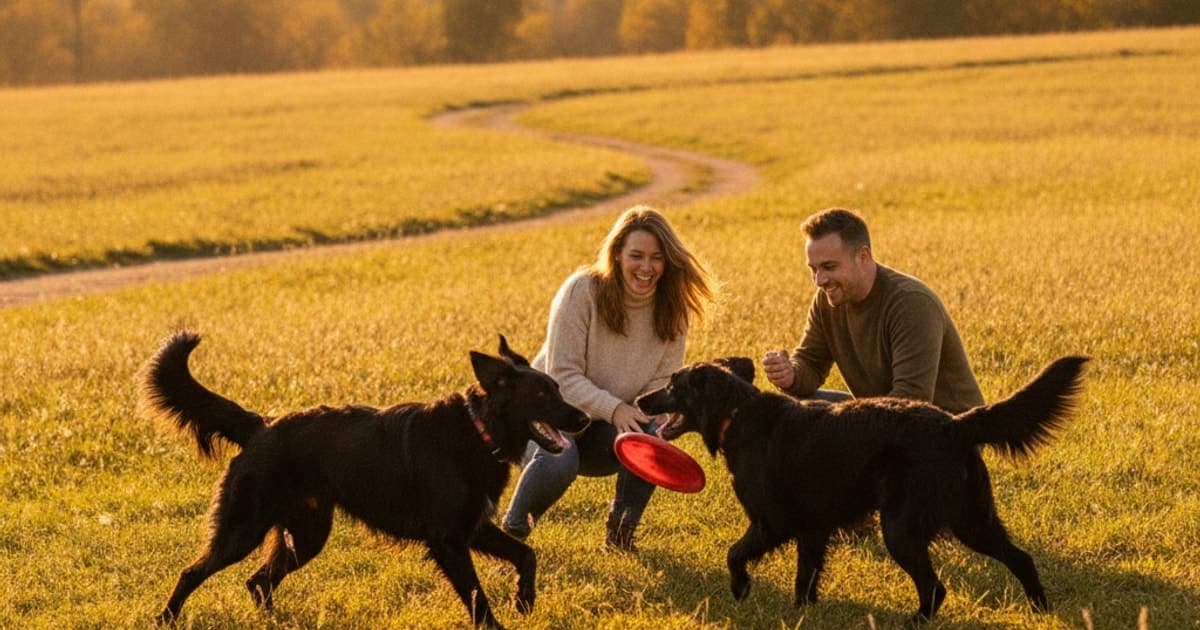
What Helps Joint Problems in Flat-Coated Retrievers?
What helps most is a stack of unglamorous things done consistently: a veterinary diagnosis before anything else, a genuinely lean body weight, structured low-impact conditioning instead of weekend-warrior bursts, non-slip footing at home, and targeted recovery support such as K9-REPAIR — the BPC-157 and TB-500 peptide formulation owners use through rehab and into the senior years.
Everything below is the detail behind that sentence: which joints this breed tends to struggle with, what your veterinarian owns, what you own, and how to tell a supportive product from an expensive bag of dust.
Why this breed asks so much of its own joints
Flat-coated retrievers are athletes with no off switch. The breed is often described as the Peter Pan of the retrievers, and it is an accurate nickname — a ten-year-old flat-coat will still launch off a dock, wheel around on wet grass and hit a hard stop at the end of a sprint with the enthusiasm of a yearling. The behaviour stays young. The connective tissue does not.
That mismatch is the core mechanical problem. Cartilage thins, ligaments lose elasticity, and the small stabilising muscles around the hip and stifle weaken quietly if a dog's exercise is mostly explosive rather than sustained. The dog still feels like doing everything. The joint absorbs the difference.
The other pressure point is the growth window. Large-breed dogs finish skeletal maturity late, and the cartilage of a growing joint is more vulnerable to repetitive impact than an adult's. Young flat-coats built for stairs, dock jumping and long fetch sessions before their growth plates close are loading a structure that has not finished forming.
Breeders in this breed routinely screen hips and elbows before breeding, which tells you where the inherited risk sits. Ask for those screening results if you are buying a puppy, and know your own dog's status if you can.
The orthopedic problems that come up most often
Hip dysplasia and secondary arthritis. A poorly conforming hip joint grinds rather than glides. Signs are subtle early: a bunny-hopping run, reluctance on stairs, a dog who sits with one leg splayed out, stiffness that eases after the first ten minutes of a walk.
Elbow dysplasia and osteochondrosis. Front-limb lameness in a young, fast-growing dog deserves imaging rather than a wait-and-see week. Elbow problems tend to show as a subtle head bob at the trot and a dog who shifts weight backwards when standing.
Cranial cruciate ligament rupture. The single most common orthopedic injury in active large-breed dogs. In dogs it is usually degenerative — the ligament frays over months and then fails during an ordinary turn, which is why it so often happens in the garden rather than on a hard run. A partial tear presents as intermittent hind-limb lameness that comes and goes; a full rupture is a dog who will not weight-bear.
Osteoarthritis. The endpoint of most of the above, and the thing most flat-coat owners are eventually managing. It is progressive, but the rate of progression is heavily influenced by weight, muscle mass and consistency of care.
Lumbosacral and spinal pain. Sometimes mistaken for hip pain. A dog who is sore rising, reluctant to jump into the car, or sensitive over the lower back may have a spinal source rather than a joint one — another reason the diagnosis has to come from imaging, not from the internet.
One more thing worth saying plainly: this breed carries a well-recognised burden of cancer, and bone and soft-tissue tumours can present as a limp. A persistent lameness in a flat-coated retriever is not a supplement problem until a veterinarian has looked at it and ruled out the things that are not orthopedic at all. Do not skip that step.
What your veterinarian owns, and what you own
Your veterinarian owns the diagnosis, the imaging, the pain-control plan and the surgical decision. If a cruciate is ruptured, surgical stabilisation is the intervention with the best functional evidence in dogs of this size, and nothing you buy changes that. If your dog is on carprofen, an anti-NSAID monoclonal, gabapentin or anything else, that plan stays exactly as prescribed unless the person who prescribed it changes it.
You own the other 23 hours of the day: body condition, exercise structure, footing, sleep surfaces, nail length, and whether the rehab exercises actually get done on a Tuesday night in February.
That division matters because owners often over-invest in the part they can buy and under-invest in the part they control.
A flat-coated retriever carrying even a modest amount of extra weight sends that load through the hips, elbows and stifles on every single stride, which makes lean body condition the highest-leverage thing any owner does for joint comfort.
Practically, that means: ribs easily felt under a thin fat layer, a visible waist from above, an abdominal tuck from the side. Ask your vet to body-condition score your dog at every visit and to tell you honestly if the number needs to come down.
Daily management that moves the needle
Trade explosive exercise for sustained exercise. Long, steady walks, controlled swimming and gentle hill work build the muscle that stabilises a joint. Repetitive high-speed fetch with hard stops and twists does the opposite. You do not have to eliminate play — you have to stop making it the whole exercise budget.
Warm up and cool down. Five to ten minutes of walking before and after anything intense. Cold tissue tears.
Fix the footing. Runners on hardwood and tile, a ramp for the car, and trimmed nails and foot hair so the dog can actually grip. Slipping is a mechanical event that a compromised stifle does not need.
Get a rehab referral. A certified canine rehabilitation professional can build a targeted strengthening programme, and underwater treadmill work loads muscle without loading the joint. Ask your veterinarian for a referral — this is one of the most underused resources in canine orthopedics.
Keep the dog warm and rested after hard days. Stiffness the morning after tells you the previous day was too much.
Comparing the support options owners consider
| Approach | What it is doing | Where it fits |
|---|---|---|
| Weight management | Reduces the mechanical load crossing every joint | Foundation. Nothing works properly without it |
| Structured conditioning and rehab | Builds the muscle that stabilises hips and stifles | Foundation, and the part most often skipped |
| Veterinary pain control and surgery | Manages pain, corrects unstable joints | Your vet's call, always first in line |
| Joint chews and oils | Broad nutritional support for cartilage and inflammatory balance | Useful background nutrition; read labels closely |
| Peptide support — K9-REPAIR (BPC-157 + TB-500) | Research suggests these peptides act on the tissue-repair and remodelling side: blood vessel formation, cell migration and connective-tissue signalling | The stack owners reach for through rehab, recovery and the senior slowdown |
Be sceptical of the chew aisle. A great many joint products are kitchen-sink formulas: fourteen ingredients on the front of the bag, a proprietary blend on the back, and no way to know how much of anything is actually in there. Marketing spend is not evidence. If a label will not tell you the amount of each active ingredient per chew, you are guessing.
Where BPC-157 and TB-500 fit
K9-REPAIR is a two-peptide formulation. BPC-157 is a synthetic peptide sequence derived from a protein found in gastric juice; published research, largely in laboratory and animal models, suggests it influences angiogenesis — the formation of new blood vessels — and the behaviour of the fibroblasts that lay down collagen in tendon and ligament. TB-500 is a synthetic fragment related to thymosin beta-4, a naturally occurring protein that research suggests plays a role in actin regulation, cell migration and tissue remodelling.
That is the mechanism, and it is why the combination is interesting for the exact tissues that give this breed trouble: ligament, tendon, joint capsule and the soft tissue around them. It is emerging science and it is being adopted now by owners who want something working on the repair side of the equation rather than only on the comfort side.
Honest framing, because it matters: BPC-157 and TB-500 are not FDA-approved veterinary drugs, pawgen's material is educational, and nothing here should be read as a promise about your dog. Research suggests, owners report — those hedges are real and they stay.
On the practical side, K9-REPAIR is dosed by body weight, third-party tested with certificates of analysis available, shipped direct to your door, and backed by a 60-day money-back guarantee. For the specific amount your dog should receive, work with your veterinarian — that conversation is theirs, not a number from an article.
What this looks like for your dog
The young field-bred dog
Protect the growth window. Cap repetitive impact, build steady endurance, keep the dog lean, and get any limp lasting more than a few days imaged rather than rested and hoped away.
The dog booked for cruciate surgery
Surgery goes ahead as planned. The recovery is where owners have room to act: strict adherence to the post-operative protocol, a rehab referral, and the recovery support stack many owners run alongside it. Roughly half of dogs who rupture one cruciate go on to have trouble with the other side, so the conditioning work on the good leg matters too.
The nine-year-old who has started to slow
This is usually osteoarthritis and it is usually manageable. Reassess weight, restructure exercise into shorter and more frequent outings, sort the flooring, and ask your veterinarian about a formal pain-management plan. Slowing down is not a reason to stop moving — movement is part of the treatment.
Key Takeaways
- Get a diagnosis first. A limp in a flat-coated retriever is not automatically an orthopedic limp, and this breed's cancer burden makes a proper workup non-negotiable.
- Lean body weight is the highest-leverage variable you control, and it is free.
- Swap explosive fetch for sustained, structured exercise, and add a rehab professional to the team.
- Surgery, prescribed medication and rehab are the backbone of care. Nothing replaces them.
- Read supplement labels for per-serving amounts; ignore proprietary blends and front-of-bag marketing.
- K9-REPAIR combines BPC-157 and TB-500, dosed by body weight, third-party tested, with a 60-day money-back guarantee — the stack many owners use through recovery and into the senior years.
If you want to go deeper, the complete guide to mobility in flat-coated retrievers covers the breed end to end, and there are focused reads on the best supplement for flat-coated retrievers with arthritis, the best supplement for flat-coated retrievers with torn acl and the best supplement for flat-coated retrievers with ivdd, plus age-specific guidance on k9-repair for dogs over 10 and k9-repair for dogs over 12.
Your veterinarian owns the diagnosis and the treatment plan — the imaging, the medication, the surgical decision, the rehab referral. Supplements and peptides operate in the space that proper veterinary care creates, supporting a dog whose real problem has already been identified and addressed. Bring your vet into every decision you make about what your flat-coat receives, and let the rest of this article work behind that.
Owners exploring peptide support for their dog can review K9-REPAIR — BPC-157 + TB-500 formulated for dogs — at https://pawgen.com/. BPC-157 and TB-500 are not FDA-approved veterinary drugs. Nothing in this article treats, cures or prevents any condition; every decision about your dog's care belongs with your veterinarian.
Frequently asked questions
- How do I know if this applies to my dog?
- It applies if your flat-coated retriever shows stiffness after rest, reluctance on stairs, a bunny-hopping run, intermittent hind-limb lameness, or has simply slowed down with age. It also applies preventively to young, hard-charging dogs. Any persistent lameness needs a veterinary exam before you assume it is a joint issue.
- When should I talk to my veterinarian?
- Before anything else, and again before you add any supplement. Book an appointment for lameness lasting more than a few days, sudden non-weight-bearing, swelling, pain on handling, or a noticeable change in gait. Your vet owns the diagnosis, the imaging and the treatment plan — everything else works around it.
- How long does this usually take?
- Timelines vary enormously by dog and diagnosis, so avoid fixed expectations. Weight loss and conditioning changes are gradual and measured over months. Post-surgical recovery follows the protocol your surgeon sets, not a calendar you find online. Ask your veterinary team what progress markers to watch for in your specific case.
- What should I do first?
- Get a veterinary exam and, if indicated, imaging — you cannot manage a problem you have not identified. Second, have your dog body-condition scored and address weight if needed. Third, fix slippery flooring at home. Only then discuss conditioning, rehab referral and supportive products such as K9-REPAIR with your vet.
- Are flat-coated retrievers prone to hip and elbow problems?
- Hip and elbow dysplasia are recognised concerns in the breed, which is why responsible breeders screen both before breeding. Ask for screening results when buying a puppy. Screening reduces risk across a breeding line but does not guarantee an individual dog will be free of joint problems later in life.
- What is in K9-REPAIR?
- K9-REPAIR is a formulation combining two peptides, BPC-157 and TB-500, dosed by body weight and third-party tested with certificates of analysis available. Neither peptide is an FDA-approved veterinary drug, and pawgen's content is educational. It ships direct to your door and carries a 60-day money-back guarantee.
- Can joint support be used alongside my dog's prescribed medication?
- That is a question for the veterinarian who wrote the prescription. Never stop or reduce carprofen, gabapentin, an injectable pain medication or anything else because you have added a supplement. Bring the actual product label to your appointment so your vet can review the ingredients before you start anything.
- Does arthritis mean my flat-coat has to stop exercising?
- No — controlled movement is part of managing arthritis, because muscle stabilises a compromised joint. What usually changes is the type of exercise: shorter, more frequent, sustained outings instead of explosive fetch and hard turns. Ask your veterinarian or a canine rehabilitation professional to help structure a suitable programme.
Educational content. BPC-157 and TB-500 are not FDA-approved veterinary drugs. Talk to your veterinarian before starting anything new, especially if your dog is on prescribed medication.