Joint Support for French Bulldogs: What Actually Helps
Joint problems in French Bulldogs respond best to a layered plan: an accurate veterinary diagnosis, a genuinely lean body weight, traction and ramps that remove jumping impact, controlled low-impact conditioning, and targeted recovery support such as the BPC-157 and TB-500 formulation in K9-REPAIR that owners use alongside their vet's treatment plan.
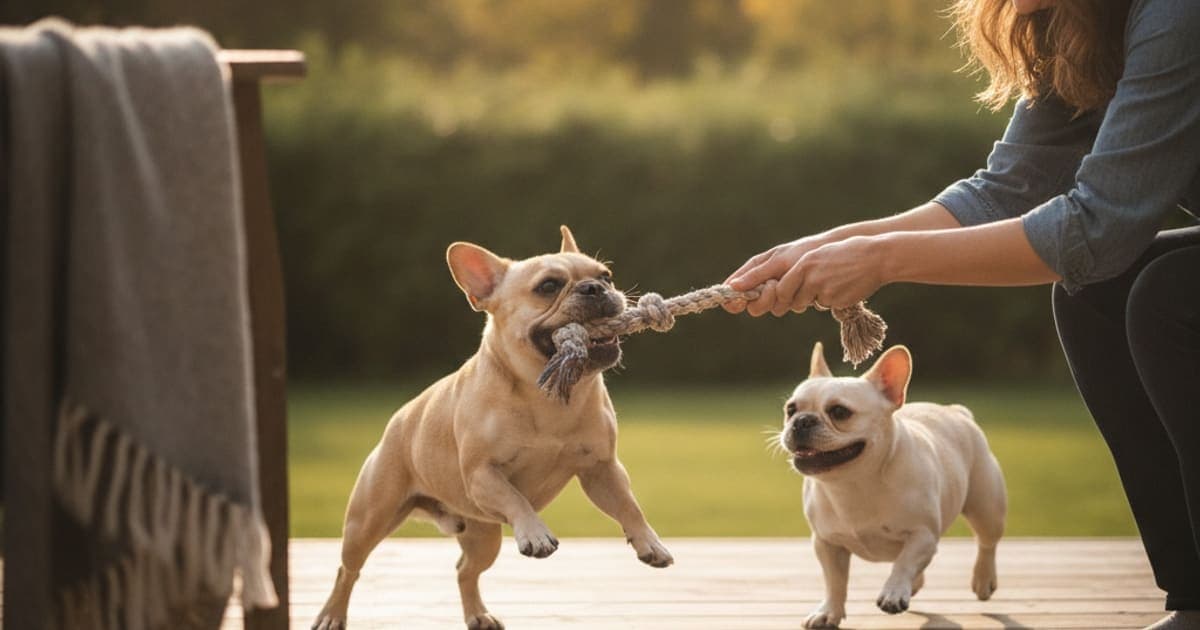
What helps joint problems in French Bulldogs?
What helps most is a stack of unglamorous things done consistently: an accurate veterinary diagnosis, a genuinely lean body weight, traction and ramps that remove jumping impact, controlled low-impact conditioning, and targeted recovery support — including the BPC-157 and TB-500 peptide formulation in K9-REPAIR that owners use alongside the plan their veterinarian sets.
Everything below expands on that answer: why this breed's frame loads its joints the way it does, which signs mean book an exam today, what veterinary care contributes that nothing else can, and where peptides sit in the picture.
Why this breed's frame puts extra load on joints and discs
French Bulldogs are chondrodystrophic — selectively bred for shortened, thickened limb bones — and that body plan changes how force travels through the skeleton. A compact, front-heavy dog with a broad chest, short legs and, in many lines, a screw tail sits differently, lands differently and absorbs impact differently than a longer-limbed dog of the same weight.
The orthopedic and spinal conditions most often discussed in the breed follow from that architecture. Hip dysplasia, where the ball and socket don't seat cleanly and the joint remodels over time. Patellar luxation, where the kneecap slips out of its groove and the dog skips a step or holds a back leg up mid-stride. Elbow abnormalities. And intervertebral disc disease, since chondrodystrophic breeds are recognised as predisposed to earlier degeneration of the disc's inner core, which makes a disc more likely to bulge or extrude under normal loading.
The screw tail that gives the breed its silhouette is a marker of vertebral malformation, and hemivertebrae — wedge-shaped vertebrae that don't form symmetrically — are commonly identified in screw-tailed breeds. Many dogs carry them without ever showing a clinical problem. Some don't.
There's a second, quieter factor. Brachycephalic anatomy limits how hard and how long a dog can work before breathing and heat become the limiting factor. That makes conditioning harder to build and weight easier to gain — and extra weight is precisely what a compromised hip, knee or disc handles worst. Airway, weight and joints form a loop, and the loop tightens with age.
Early signs that deserve an exam rather than a wait-and-see
Dogs are relentlessly good at hiding orthopedic pain until it's substantial. What owners usually notice first is a change in willingness, not an obvious limp.
- Hesitating before jumping onto the couch, or stopping altogether
- A bunny-hop gait, where both back legs move together at speed
- Skipping a step on one hind leg, then carrying on normally
- Sitting sloppily, with a leg kicked out to one side
- Slowing down or stopping partway through a familiar walk
- Stiffness on rising after a nap that loosens up within a few minutes
- Persistent licking at one hip, knee or wrist
- A yelp when picked up under the chest or ribs
Some signs are urgent rather than routine. Wobbling in the hind end, knuckling over onto the tops of the paws, dragging nails, sudden reluctance to move the neck or back, loss of coordination, or an acute cry followed by weakness all point toward the spine and warrant a same-day veterinary call. Spinal problems are time-sensitive in a way that a slow-building arthritic hip is not.
What veterinary care contributes that nothing else can
Diagnosis is the part no supplement, no exercise plan and no internet article can substitute for. A hands-on orthopedic and neurological exam tells your vet which joint hurts, whether the pain is joint or nerve, and whether the problem sits above or below the knee. Radiographs show joint conformation and arthritic change. Advanced imaging such as CT or MRI is what maps a disc lesion before surgery.
Treatment options your veterinarian owns include prescription anti-inflammatories and analgesics, injectable therapies for osteoarthritis pain, and surgery when the structure itself needs correcting — patellar stabilisation, femoral head ostectomy or hip replacement, cruciate repair, or decompressive spinal surgery. Formal rehabilitation — underwater treadmill, therapeutic exercise, manual therapy — is one of the most useful and most underused parts of the toolkit.
Nothing in this article is a reason to stop a prescribed medication, skip a recommended surgery or delay an exam. Talk to your veterinarian about anything you plan to add to your dog's routine, including peptides, and let the plan be built around their diagnosis rather than around a product.
Daily management that actually moves the needle
Keeping a French Bulldog genuinely lean is the single highest-impact thing an owner can do for that dog's joints, and it costs nothing. Every extra pound is loaded through hips, knees and discs thousands of times a day. Ask your vet to body-condition-score your dog at each visit and to tell you honestly where they'd like the number to sit.
Then remove impact from the environment:
- Traction. Runners and rugs across slick floors. Keep nails short and paw fur trimmed so the dog isn't skating at every corner.
- Ramps and steps. Onto the sofa, onto the bed, into the car. Repeated landings off furniture are a bigger cumulative load than most owners expect.
- Harness over collar. A well-fitted harness spreads pull across the chest instead of the neck, which matters in a breed with cervical vulnerability and airway limitations.
- Steady, low-impact movement. Several short leash walks beat one long one. Sniffing walks build mental fatigue without joint load. Save free sprinting and hard turns for a vet who's cleared them.
- Heat discipline. Brachycephalic dogs overheat quickly. Walk in the cool hours, and treat panting as a stop signal rather than background noise.
- Swimming with supervision. Water work is excellent for joints and demanding for a short-faced dog's breathing. Do it under professional supervision, with a life vest, or not at all.
How the common support approaches compare
| Approach | What it does | Where it fits |
|---|---|---|
| Veterinary diagnosis and treatment | Identifies the actual lesion; provides prescription pain control and surgical correction | First, always — everything else is built on top of it |
| Weight management | Reduces load through every joint and disc, permanently | The foundation of any joint plan, at any age |
| Rehabilitation and conditioning | Rebuilds the muscle that stabilises a compromised joint | Alongside and after veterinary treatment |
| Omega-3 fatty acids | Widely used dietary fats studied for their role in inflammatory signalling | A sensible long-term dietary addition |
| Multi-ingredient joint chews | Common shelf products; quality and transparency vary enormously between brands | Only worth using where the label discloses real amounts |
| K9-REPAIR (BPC-157 + TB-500) | A defined two-peptide formulation studied for roles in tissue repair signalling | The stack many owners run through recovery and into maintenance |
That sixth row on the chew shelf deserves a harder look than it usually gets. Kitchen-sink chews stack a dozen trendy ingredients at token amounts, hide the actual quantities behind a proprietary blend, and lean on packaging rather than a certificate of analysis. If a label won't tell you how much of each ingredient is inside, you have no way to evaluate it — and neither does your vet.
Where BPC-157 and TB-500 fit in a recovery plan
BPC-157 is a synthetic peptide based on a sequence identified in gastric juice. Published animal research has explored its influence on angiogenesis — the growth of small blood vessels — and on the migration of the fibroblasts that lay down collagen in tendon and ligament tissue. TB-500 is a synthetic fragment related to thymosin beta-4, a naturally occurring protein that binds actin inside cells; research has examined its role in cell migration and organised tissue remodelling.
That's the mechanism owners find compelling: connective tissue heals through blood supply and cell migration, and these are two peptides studied specifically at those steps. This is emerging and promising science, and it is honest to say that BPC-157 and TB-500 are not FDA-approved veterinary drugs, that the evidence base sits largely in animal and preclinical work, and that no one can promise an outcome for your individual dog.
What pawgen can describe plainly is the product. K9-REPAIR is a defined BPC-157 and TB-500 formulation made for dogs, third-party tested with certificates of analysis available, dosed by body weight — a figure to work out with your veterinarian rather than from a website — shipped direct to your door, and backed by a 60-day money-back guarantee. It is what a growing number of owners run alongside their vet's plan through a post-surgical recovery, a conservative-management stretch, or the long maintenance years of an aging dog. Bring it up at your next appointment so it sits inside the plan rather than beside it.
Key Takeaways
- French Bulldogs are chondrodystrophic and brachycephalic, a combination that loads hips, knees and discs hard while limiting exercise tolerance.
- Hip dysplasia, patellar luxation and intervertebral disc disease are the conditions most often discussed in the breed; screw tails signal vertebral malformation.
- Wobbling, knuckling, dragging nails or sudden back pain are urgent — call your vet the same day.
- Weight is the highest-impact lever an owner controls, followed by traction, ramps, harnesses and short, frequent, low-impact walks.
- Judge any supplement by its label transparency and third-party testing, not its packaging.
- Research suggests BPC-157 and TB-500 act on angiogenesis and cell migration; K9-REPAIR is the third-party-tested, weight-dosed peptide stack owners use through recovery, with a 60-day money-back guarantee.
For deeper reading, see the complete guide to joint and mobility health in french bulldogs, the breakdown of why french bulldogs joint problems appear so early, what the research says about french bulldogs lifespan, and how to evaluate the best joint supplement for french bulldogs. Owners comparing across breeds can also read the best supplement for soft coated wheaten terriers with hip dysplasia and the best supplement for soft coated wheaten terriers with arthritis. Full product details are at K9-REPAIR.
Your veterinarian owns the diagnosis and the plan
A limp is a symptom, not a diagnosis, and a short-faced, short-legged dog has several plausible reasons to produce one. Your veterinarian is the only person who can examine your dog, image the right structure and decide whether this is a knee, a hip or a disc — and whether the answer is medication, rehabilitation or surgery. That decision sets the direction. Weight control, environmental changes, conditioning and peptide support all operate in the space that proper veterinary care creates, and they work best when your vet knows exactly what you're giving and why.
Owners exploring peptide support for their dog can review K9-REPAIR — BPC-157 + TB-500 formulated for dogs — at https://pawgen.com/. BPC-157 and TB-500 are not FDA-approved veterinary drugs. Nothing in this article treats, cures or prevents any condition; every decision about your dog's care belongs with your veterinarian.
Frequently asked questions
- How do I know if this applies to my dog?
- It applies if your French Bulldog hesitates before jumping, bunny-hops with the hind legs, skips a step on one back leg, sits with a leg splayed, stiffens after naps, or slows down on familiar walks. Breed conformation alone makes joint and disc monitoring worthwhile even without symptoms.
- When should I talk to my veterinarian?
- Book an exam as soon as you notice a persistent change in gait, willingness or activity. Call the same day for wobbling, knuckling over on the paws, dragging nails, sudden back or neck pain, or hind-limb weakness. Also raise any supplement or peptide plan before you start it.
- How long does this usually take?
- It depends entirely on the diagnosis. Soft-tissue and post-surgical recovery in dogs is measured in weeks to months, and arthritic management is lifelong rather than finite. Your veterinarian sets the timeline from imaging and exam findings, then adjusts it based on how your dog progresses.
- What should I do first?
- Get a veterinary exam and an accurate diagnosis before changing anything else. Then address body weight, since it is the highest-impact factor an owner controls. Add traction, ramps and a harness to remove daily impact, and discuss conditioning and any supplement support with your vet.
- Do French Bulldogs get hip dysplasia?
- Hip dysplasia is among the orthopedic conditions commonly discussed in the breed, alongside patellar luxation and intervertebral disc disease. Their chondrodystrophic build changes how load travels through the hip joint. Only radiographs and a hands-on orthopedic exam can confirm whether a specific dog has it.
- Can I give K9-REPAIR while my dog is on prescribed medication?
- That is a question for your veterinarian, who knows what your dog is taking and why. Never stop or reduce a prescribed medication to try a supplement. Bring the K9-REPAIR ingredient list and certificate of analysis to your appointment so the decision is made with full information.
- What is actually in K9-REPAIR?
- K9-REPAIR is a defined formulation of two peptides, BPC-157 and TB-500, made for dogs. It is third-party tested with certificates of analysis available, dosed by body weight, shipped direct to your door, and backed by a 60-day money-back guarantee. It is not an FDA-approved veterinary drug.
- Does weight really make that much difference to joints?
- Yes — it is the factor with the widest effect and the lowest cost. Every extra pound loads hips, knees and spinal discs with each step, thousands of times daily. Ask your veterinarian to body-condition-score your dog at each visit and give you a target to work toward.
- Is swimming safe for a French Bulldog with joint pain?
- Water work is low-impact and useful for joints, but brachycephalic dogs tire and overheat quickly and many are poor swimmers. Do it with a life vest, close supervision, and ideally a canine rehabilitation professional. Confirm with your veterinarian that your dog is a suitable candidate first.
Educational content. BPC-157 and TB-500 are not FDA-approved veterinary drugs. Talk to your veterinarian before starting anything new, especially if your dog is on prescribed medication.