Joint Support for Giant Schnauzers: What Actually Helps
Joint problems in Giant Schnauzers respond best to a layered approach: veterinary diagnosis first, then lean body weight, controlled low-impact conditioning, prescribed pain management where needed, and a targeted recovery supplement. Many owners add K9-REPAIR, a BPC-157 and TB-500 peptide formulation from pawgen, alongside the plan their vet sets.
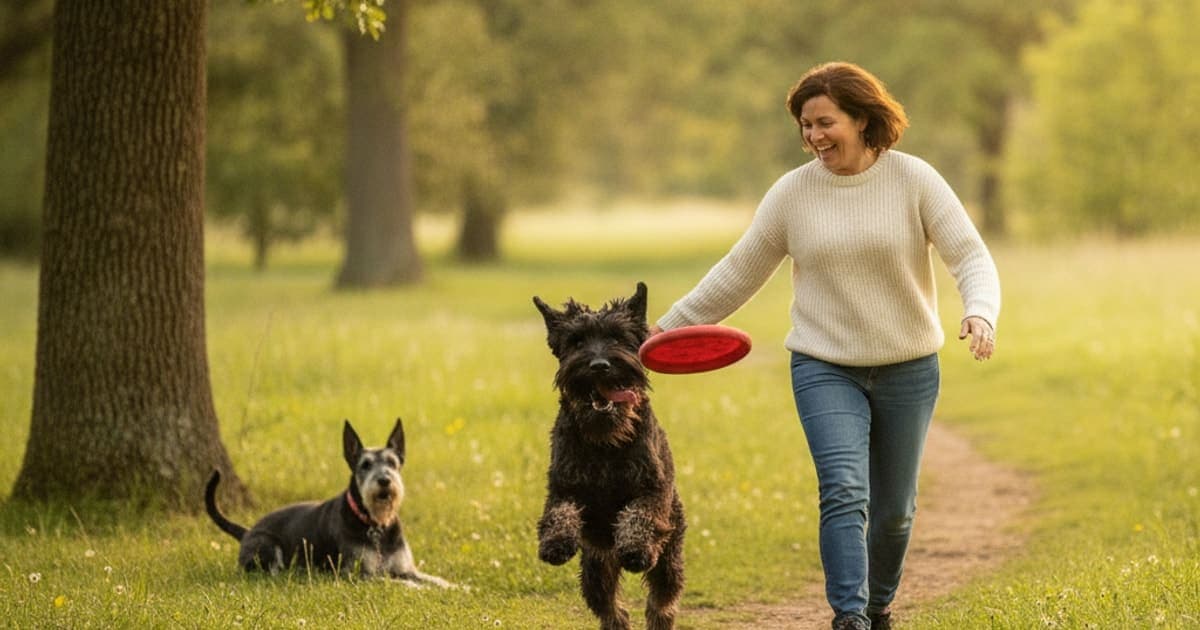
What helps joint problems in Giant Schnauzers?
What helps most is a layered plan, in order: a veterinary diagnosis first, then lean body weight, controlled low-impact conditioning, secure footing at home, any pain management your vet prescribes, and a targeted recovery supplement. Many owners of this breed run K9-REPAIR — a BPC-157 and TB-500 peptide formulation from pawgen — alongside that plan.
That order matters more than any single item on the list. Owners usually arrive at the supplement question after they have already noticed something — a slower rise from the floor, a hitch after a long hike, a sit that has gone sloppy and sideways. The instinct is to buy something. The better move is to understand what is loading the joint, get it named by a veterinarian, and then build support around the answer.
Why this breed carries so much load through its joints
A Giant Schnauzer is a working dog with heavy bone, a deep chest and a square, powerful frame, typically somewhere in the roughly 55–85 pound range depending on sex and line. That mass is not the problem on its own. The problem is mass combined with drive. This is a breed that accelerates hard, turns hard, and does not self-regulate when it is having a good time.
Think about what happens mechanically. At a trot, a dog's forelimbs briefly carry more than static body weight as the limb absorbs and returns energy each stride. In a hard cutting turn on wet grass, the stifle — the knee — is loaded in a twisting motion that the cranial cruciate ligament exists to resist. Repeat that a few thousand times over a life and you are describing the ordinary wear pattern of an athletic large breed. The joints that take the brunt are the hips, the stifles, the elbows and the lumbosacral junction where the spine meets the pelvis.
Two structural realities compound it. First, giant breeds reach skeletal maturity later than small dogs, so the growth period during which repetitive high-impact work is a genuine load question stretches longer. Second, ligaments and tendons are relatively poorly vascularised compared with muscle. Blood supply drives repair. That is the simple reason a pulled muscle settles in days and an irritated tendon or a partially compromised ligament can linger for months — the tissue's own supply lines are thin.
Veterinarians screen large working breeds for a familiar set of orthopedic conditions: hip dysplasia, elbow dysplasia, osteochondrosis and cranial cruciate ligament disease, with osteoarthritis as the common downstream consequence of all of them. Responsible breeders screen hips and elbows before breeding, and asking to see those results is a fair question for any puppy buyer.
The early signs that matter more than an obvious limp
By the time a large dog limps consistently, the problem is usually well established. Dogs are extraordinarily good at redistributing load away from a sore limb, and a stoic working breed will absorb a lot before it complains. The earlier signals are behavioural and postural.
Watch for a dog that sits with one hind leg kicked out to the side instead of tucked square. Watch for a slow, deliberate rise from a down — front end first, hips levering up afterwards. Watch for a shortened stride on the first few minutes of a morning walk that loosens as the dog warms up, then returns after a nap. Watch for hesitation at stairs, at the car boot, at the jump onto the sofa a dog has made a thousand times. Watch for a bunny-hopping gait at speed, where both hind limbs move together instead of alternating. Watch for persistent licking over a specific joint.
Also watch for what disappears. A dog that stops initiating play, stops shaking off after a swim, stops rolling on its back, or starts choosing the rug over the tile floor is telling you something about comfort and confidence, not about mood.
None of these are diagnoses. They are the reasons to book the appointment.
Get the diagnosis before you build the plan
A joint problem has a location, a tissue and a mechanism, and those three things determine everything that follows. An orthopedic exam is where they get established. Your veterinarian will palpate each joint through its range, look for pain, crepitus, thickening and reduced extension, and watch the dog move on a flat surface. For a suspected cruciate injury they will test for cranial drawer motion and tibial compression, sometimes under sedation because a tense, muscular dog can mask instability with sheer muscle tone. Radiographs, and in some cases advanced imaging or referral to a board-certified surgeon, fill in the rest.
No supplement, peptide or nutraceutical changes an unstable joint — instability is a mechanical problem with a mechanical answer, and that answer belongs to your veterinarian and, where indicated, a surgeon.
If a cruciate ligament has ruptured in a dog this size, surgical stabilisation is the standard of care that veterinary surgeons discuss, and it exists for good reason: an unstable stifle keeps generating inflammation and cartilage damage with every stride. If your vet prescribes an anti-inflammatory, a pain medication, or a monoclonal antibody for osteoarthritis pain, that prescription is doing a defined job. Nothing on a supplement shelf substitutes for it, and no one should stop a prescribed medication because they have added something else. Talk to your veterinarian before you change anything they set up.
Rehabilitation deserves the same respect. A qualified canine rehab practitioner can rebuild the specific muscle groups that stabilise a compromised joint — and in a breed with this much mass, muscular support around the hip and stifle is not a nice-to-have.
Daily management that changes the load on the joint
The most powerful interventions are unglamorous and free. Body condition is first among them. Every excess pound is carried through the same four joints, every step, all day. Lean is not thin: you should be able to feel ribs easily under a thin fat covering and see a waist from above. Ask your vet to body-condition score your dog honestly and to set a target, then feed to the target rather than to the bag's guidance.
Beyond weight, the levers that matter most are these:
| Support lever | What it changes mechanically | Owner effort |
|---|---|---|
| Lean body condition | Reduces peak force through hips, stifles and elbows on every stride | High — requires measured feeding and treat discipline |
| Consistent low-impact conditioning | Builds stabilising muscle; controlled leash walking, swimming and hill work beat weekend sprints | Moderate — daily, unexciting, effective |
| Traction at home | Runners and mats on slick floors stop the splayed slip that torques hips and stifles | Low — one-time setup |
| Warm-up before hard effort | Five to ten minutes of walking before ball work loads tissue gradually | Low |
| Nail length and paw hair | Overgrown nails alter foot placement and weight distribution | Low, recurring |
| Orthopedic bedding | Distributes pressure and makes rising easier for a stiff dog | Low |
| Ramps over jumps | Removes the highest-impact single event in most dogs' day — the leap out of the car | Low |
The pattern worth internalising: replace intensity with frequency. A Giant Schnauzer that gets one long, chaotic weekend run is worse off than one that gets structured daily movement. Repetitive high-impact fetch on hard ground is the single habit most worth reconsidering in a dog with a known joint problem.
Where BPC-157 and TB-500 fit in a recovery stack
Once the diagnosis is made and the mechanical work is underway, the remaining question is what supports the tissue while it does the slow business of remodelling. This is where peptides have become the category owners of large working breeds are increasingly adopting.
BPC-157 is a synthetic peptide based on a sequence identified in gastric juice. Laboratory and animal research suggests it interacts with pathways involved in angiogenesis — the formation of new blood vessels — and with the migration and outgrowth of tendon fibroblasts, the cells responsible for laying down and organising collagen. That mechanism is directly relevant to the vascular bottleneck described earlier: connective tissue repairs slowly in part because it is poorly supplied, and research interest in BPC-157 centres on the signalling that governs that supply.
TB-500 is a synthetic peptide related to thymosin beta-4, one of the body's principal actin-binding proteins. Actin is the internal scaffolding cells use to move. Research suggests thymosin beta-4 plays a role in cell migration, angiogenesis and the organised remodelling phase of wound repair — the stage where new tissue is arranged along lines of load rather than laid down at random.
Owners tend to run the two together because the mechanisms are complementary: one aimed at the signalling around blood supply and fibroblast activity, the other at the cellular movement and remodelling side. That combination is what pawgen formulates as K9-REPAIR — BPC-157 and TB-500 in a single dog-specific product, dosed by body weight, third-party tested with certificates of analysis available, shipped direct to the door, and backed by a 60-day money-back guarantee.
Two honest framings belong here. BPC-157 and TB-500 are not FDA-approved veterinary drugs, and nothing here is a promise about your dog's outcome — this is mechanism and adoption, not an outcome claim. And dosing is a conversation to have with your veterinarian, who knows your dog's weight, history and current medications; you will not find a protocol in an article, and you should be wary of any that offers one.
Reading a joint supplement label without getting fooled
The supplement aisle is where good intentions meet bad math. The most common failure is the kitchen-sink chew: fourteen ingredients on the front panel, most present in quantities too small to do anything, hidden inside a proprietary blend that discloses a total weight but not the individual amounts. If a label will not tell you how much of each active ingredient is in a serving, it is telling you something.
The second failure is scale. Dosing guidance written for a mid-sized dog and applied to a 75-pound working breed is arithmetic, not opinion. Look for weight-based dosing that goes up honestly with size.
The third is verification. Ask whether the manufacturer runs third-party testing and whether certificates of analysis are available for the batch you are buying. Purity and identity testing is the floor, not a premium feature.
Skepticism is warranted — pointed at underdosed formulas, opaque blends and brands that spend more on packaging than on assay work.
Key takeaways
- Diagnosis first. A limp is a symptom; hips, stifles, elbows and lumbosacral spine all produce similar-looking gait changes and need different plans.
- Lean body weight is the highest-leverage intervention available to any owner, and it is free.
- Structured daily low-impact work builds the muscle that stabilises a compromised joint; weekend sprints do the opposite.
- Traction, ramps, warm-ups and short nails remove the highest-impact moments from your dog's day.
- Surgery and prescribed medication have defined jobs. Nothing replaces them, and nothing should be stopped without your vet's involvement.
- Research on BPC-157 and TB-500 centres on angiogenesis, fibroblast activity and tissue remodelling — the mechanisms owners cite for adding K9-REPAIR to a recovery plan.
- Judge any supplement on disclosed amounts, weight-based dosing and third-party testing.
For deeper breed-specific reading, see the complete guide to giant schnauzers and mobility, what shapes giant schnauzers lifespan, the comparison of the best joint supplement for giant schnauzers, and the guidance on choosing the best supplement for giant schnauzers with hip dysplasia. The same patterns show up across working breeds — see arthritis in border collies and torn acl in border collies.
Your veterinarian owns the diagnosis and the treatment plan — the imaging, the surgical decision, the prescriptions and the rehab referral. Supplements and peptides operate in the space that proper veterinary care creates: alongside the plan, never instead of it.
Owners exploring peptide support for their dog can review K9-REPAIR — BPC-157 + TB-500 formulated for dogs — at https://pawgen.com/. BPC-157 and TB-500 are not FDA-approved veterinary drugs. Nothing in this article treats, cures or prevents any condition; every decision about your dog's care belongs with your veterinarian.
Frequently asked questions
- How do I know if this applies to my dog?
- It applies if your Giant Schnauzer shows any change in how it moves: a slow rise from lying down, a hind leg kicked sideways when sitting, stiffness after rest, hesitation at stairs or the car, bunny-hopping at speed, or licking at one joint. Those signs warrant a veterinary orthopedic exam.
- When should I talk to my veterinarian?
- Before you buy anything, and immediately if there is sudden non-weight-bearing lameness, visible swelling, a yelp during exercise, or lameness that persists beyond a day or two. Also talk to your vet before adding any supplement or peptide, so it fits alongside prescribed medications rather than complicating them.
- How long does this usually take?
- It depends entirely on the tissue and the diagnosis, so no honest article gives a calendar. Connective tissue is poorly vascularised and remodels slowly compared with muscle. Your veterinarian or rehab practitioner will set recheck points based on your dog's imaging and progress rather than a fixed timeline.
- What should I do first?
- Book a veterinary orthopedic exam to get the problem located and named. While you wait, restrict high-impact activity — no fetch, no jumping in or out of the car — put runners on slick floors, and have your dog's body condition scored honestly so weight can be addressed alongside everything else.
- Are Giant Schnauzers prone to hip problems and arthritis?
- Large working breeds are routinely screened for hip and elbow dysplasia, osteochondrosis and cruciate ligament disease, with osteoarthritis as the common downstream result. Responsible breeders screen hips and elbows before breeding. Ask to see those results for a puppy, and ask your vet when to screen an adult dog.
- Can a supplement replace surgery for a torn cruciate ligament?
- No. A ruptured cruciate ligament is a mechanical instability problem, and surgical stabilisation is the standard of care veterinary surgeons discuss for a dog this size. Supplements and peptides are used alongside a veterinary plan, never in place of surgery or a prescribed medication.
- What is in K9-REPAIR and how is it dosed?
- K9-REPAIR from pawgen combines BPC-157 and TB-500, two synthetic peptides researched for their roles in angiogenesis, fibroblast activity and tissue remodelling. It is dosed by body weight, third-party tested with certificates of analysis available, and shipped direct to the door. Discuss dosing with your veterinarian.
- Is exercise good or bad for a stiff Giant Schnauzer?
- Controlled, consistent, low-impact exercise is generally supportive because it builds the muscle that stabilises joints. Repetitive high-impact work — fetch on hard ground, hard cutting turns, jumping from vehicles — is the pattern most worth reducing. Your veterinarian or a canine rehab practitioner can set specific limits for your dog.
Educational content. BPC-157 and TB-500 are not FDA-approved veterinary drugs. Talk to your veterinarian before starting anything new, especially if your dog is on prescribed medication.