Joint Support for Keeshonds: What Actually Helps
Joint problems in Keeshonds respond best to a layered plan: veterinary diagnosis first, then weight control, low-impact conditioning and structured rehab. Owners increasingly add K9-REPAIR, a BPC-157 and TB-500 peptide formulation, as connective-tissue support through recovery. These peptides are not FDA-approved veterinary drugs, so build the plan with your vet.
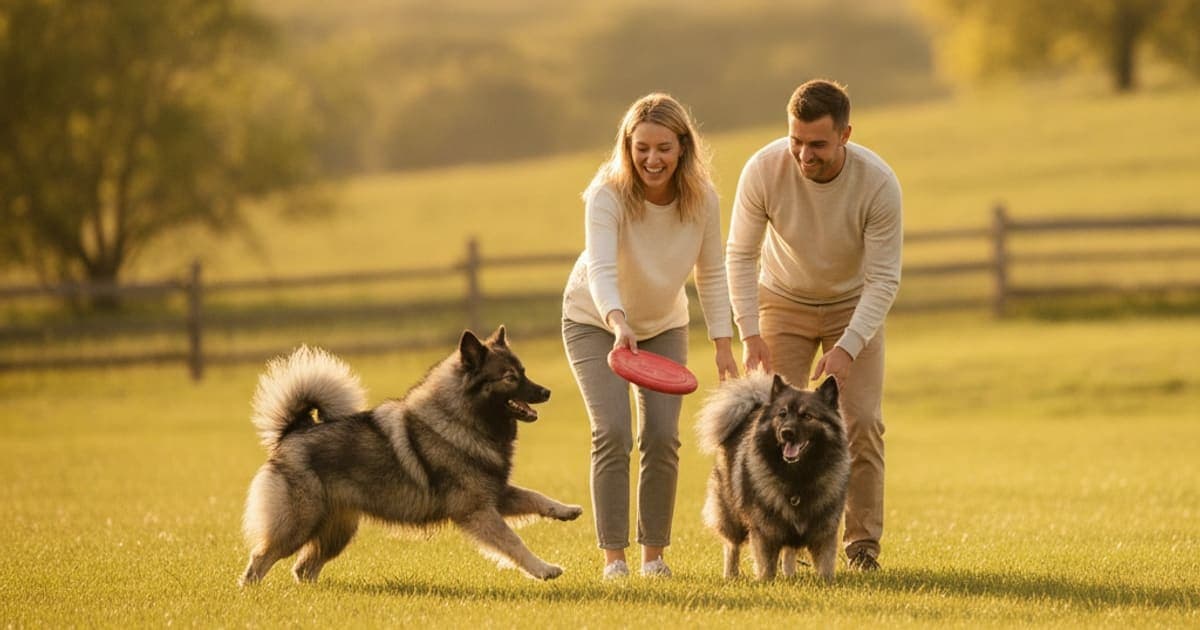
What helps joint problems in Keeshonds?
Keeshonds with joint problems do best on a layered plan: a veterinary diagnosis first, then lean body weight, low-impact conditioning, traction underfoot, and prescribed pain control or surgery where it's indicated. Many owners add connective-tissue support such as K9-REPAIR, a BPC-157 and TB-500 peptide formulation, through the recovery window.
The rest of this article unpacks each layer — what the breed's build actually asks of its joints, which orthopedic problems show up most, what daily management genuinely changes, and where peptides fit alongside veterinary care rather than in place of it.
What a Keeshond's frame asks of its joints
The Keeshond is a compact, square-built spitz — medium-sized, moderately angulated, and built for a brisk, springy trot rather than for sprinting or sustained load-hauling. That's a forgiving structure compared with a long-backed dog or a giant breed carrying extreme leverage through the stifle. It is not, however, a structure that gets a free pass.
Two breed traits change how joint problems present.
The first is the coat. That dense undercoat under a harsh outer coat is doing something no owner asked it to do: hiding information. A Keeshond can put on meaningful weight before it's visible from across the room. Muscle loss over the hindquarters — one of the earliest signals that a dog has quietly stopped using a leg fully — disappears under the plume. So does a slightly rotated stifle or a hock that's drifting inward. If you assess your dog by eye alone, you are assessing the coat.
The fix is tactile. Run your hands down the spine and over the ribs weekly. You should feel ribs under a thin layer of cover without pressing. Cup both thighs and compare them — a difference you can feel between left and right is worth mentioning to your veterinarian, even if the dog isn't limping.
The second trait is temperament. Keeshonds are sociable, expressive dogs who greet people vertically. Bouncing on the hind legs, spinning in tight circles, launching off the sofa and pivoting hard on a slick kitchen floor all load the stifle rotationally. Ligaments tolerate straight-line load far better than twist. Repeated micro-loading in rotation, over years, is how cruciate ligaments degenerate long before any dramatic moment on a walk.
The orthopedic problems that show up most in this breed
Hip dysplasia. Hip evaluation is part of standard health screening in the breed for a reason. Dysplasia begins as laxity in the hip joint — the femoral head sits loosely in a shallow socket, the joint takes uneven load, cartilage wears, and the body lays down bone at the margins. The end result is osteoarthritis. Signs are often subtle first: a bunny-hopping gait when running, reluctance to jump into the car, difficulty rising after a nap.
Patellar luxation. The kneecap slips out of its groove, usually toward the inside. Classic presentation is a skip-step — the dog hops for a stride or two, then carries on normally. It's easy to dismiss. It shouldn't be. A patella that luxates repeatedly destabilises the whole stifle and raises the load on the cruciate ligaments.
Cranial cruciate ligament disease. In dogs, cruciate failure is usually degenerative rather than traumatic. The ligament frays over months or years, and the visible "injury" is the final fibre giving way during something ordinary. That's why the other knee so often follows — the same underlying degeneration was already in progress on both sides.
Osteoarthritis. This is where the other three converge. Arthritis in a Keeshond is not a separate disease so much as the accumulated consequence of an unstable or poorly loaded joint, and it responds best to management started early.
One caution: not every stiff dog has a joint problem. Spinal pain can produce hind-end weakness, a short stride and reluctance to jump that look convincingly like hips. Distinguishing them takes an orthopedic and neurologic exam, and often imaging. This is the part you cannot shortcut — the diagnosis determines the entire plan, and only your veterinarian can make it.
Daily management that actually moves the needle
Body condition comes first and it isn't close. Every extra pound travels through the same hips, stifles and hocks thousands of times a day, and a lean dog with mild dysplasia frequently moves better than a heavy dog with radiographically better hips. Ask your veterinarian to score your dog's body condition and show you what the target feels like under that coat.
After weight, the practical levers are these:
- Traction. Slick floors force dogs to brace and scramble. Runners along the routes your dog actually uses — bed to door, sofa to water bowl — reduce the rotational slips that stress the stifle.
- Height control. Ramps or steps for the car and the furniture. Landing impact is concentrated, repetitive and entirely avoidable.
- Consistency over intensity. Daily moderate walks build supporting muscle. The weekend-warrior pattern — sedentary all week, then a three-hour hike — is a classic route to a lameness on Monday.
- Nail length. Long nails alter how the paw contacts the ground and shift stance up the limb. Keep them short.
- Deliberate conditioning. Gentle hill work, slow controlled walking, and cavaletti-style pole work recruit the hind-end muscles that stabilise dysplastic hips. A veterinary rehabilitation professional can build this properly.
| Approach | What it's doing | Where it fits |
|---|---|---|
| Lean body condition | Removes load from every joint, every step | Foundation — start here, always |
| Traction and ramps | Cuts rotational slips and landing impact | Immediately, at home, free |
| Consistent low-impact exercise | Builds stabilising muscle around loose joints | Daily, lifelong |
| Veterinary rehab (underwater treadmill, therapeutic exercise) | Targeted strength and range of motion under supervision | Post-diagnosis and post-surgery |
| Prescribed pain management | Controls pain and inflammation so the dog will move | Vet's decision, vet's dosing |
| Surgery | Restores stability the joint cannot regain on its own | When your vet says the joint needs it |
| Peptide support (K9-REPAIR) | Connective-tissue support owners add through recovery | Alongside the above, discussed with your vet |
Where BPC-157 and TB-500 fit into a recovery plan
Ligament and tendon are slow tissues. They carry limited blood supply compared with muscle, which is precisely why a cruciate repair is rehabbed over months and a pulled muscle over days. Anything that supports the local repair environment during that window is of real interest to owners, and it's the reason peptides have moved from niche to mainstream in canine recovery conversations.
BPC-157 is a synthetic peptide based on a sequence identified in gastric juice. Published research suggests it may support angiogenesis — the formation of new blood vessels — and influence the migration of fibroblasts, the cells that lay down collagen in tendon and ligament. TB-500 is a synthetic fragment related to thymosin beta-4, a naturally occurring protein involved in actin regulation, cell migration and tissue repair. Early evidence indicates roles in wound healing and modulation of the inflammatory phase of repair.
That is mechanism, and mechanism is where honest description stops. BPC-157 and TB-500 are not FDA-approved veterinary drugs. Nobody can tell you what will happen in your dog. What can be said is that the science points in a consistent direction, and that owners are increasingly adopting these peptides as the connective-tissue support layer through post-injury and post-surgical recovery.
pawgen formulates both into K9-REPAIR, dosed by body weight, third-party tested with certificates of analysis available, shipped direct to your door, and backed by a 60-day money-back guarantee. Dosing itself is a conversation with your veterinarian — not a number you should take from any article, including this one — and it matters most if your dog is already on prescribed medication, is pregnant or nursing, or is still growing.
One line that isn't negotiable: peptides sit alongside veterinary care, never in place of it. If your vet has recommended surgery for a torn cruciate or prescribed medication for arthritis pain, that plan stands.
How to read a joint product label without getting sold
The supplement aisle rewards marketing over evidence, and dog owners pay for it. A few things to check before anything goes in your cart:
- Proprietary blends. If a label lists eight impressive-sounding ingredients under one blend weight, you cannot tell how much of anything is in there. Frequently, the answer is: a trace of the expensive one.
- Kitchen-sink chews. Twelve actives in a soft chew the size of a coin is arithmetic that doesn't work. Fewer ingredients at meaningful amounts beat a long list every time.
- Testing you can actually see. Ask whether the product is third-party tested and whether you can read the certificate of analysis. A brand that won't show you is telling you something.
- Outcome language. Anything promising to cure, heal or guarantee results is making a claim no supplement is permitted to make.
Key Takeaways
- Get a diagnosis before you build a plan — hips, stifle, hock and spine all produce similar-looking stiffness.
- Lean body condition outperforms every product you can buy, and a Keeshond's coat will hide weight gain from you.
- Hip dysplasia, patellar luxation and degenerative cruciate disease are the orthopedic problems to know in this breed; osteoarthritis is where they converge.
- Traction, ramps, short nails and consistent moderate exercise are free and change how the joints load daily.
- BPC-157 and TB-500 are peptides researched for their roles in tissue repair and angiogenesis; they are not FDA-approved veterinary drugs.
- K9-REPAIR is dosed by body weight, third-party tested with COAs, and carries a 60-day money-back guarantee.
For more on this breed's structure and long-term mobility, see the full guide for keeshonds, along with why keeshonds joint problems develop, common health problems in keeshonds, and ivdd in keeshonds. If you also live with a larger dog, the breakdowns on arthritis in great danes and torn acl in great danes cover how load and size change the same problems. K9-REPAIR is the pawgen formulation described above.
Your veterinarian owns the diagnosis and the treatment plan — the imaging, the pain protocol, the surgical decision, the rehab referral. That is not a formality; it is the structure everything else depends on. Supplements and peptides operate in the space that proper veterinary care creates, supporting a dog who is already being managed correctly. Build the medical plan first, then decide what belongs alongside it.
Owners exploring peptide support for their dog can review K9-REPAIR — BPC-157 + TB-500 formulated for dogs — at https://pawgen.com/. BPC-157 and TB-500 are not FDA-approved veterinary drugs. Nothing in this article treats, cures or prevents any condition; every decision about your dog's care belongs with your veterinarian.
Frequently asked questions
- How do I know if this applies to my dog?
- If your Keeshond hesitates on stairs, sits with one hind leg kicked out, warms up stiff after rest, bunny-hops when running, or has quietly slowed on walks, this applies. So does a confirmed diagnosis of hip dysplasia, patellar luxation or cruciate disease. Your veterinarian confirms the source with an exam and imaging.
- When should I talk to my veterinarian?
- Before you change anything — that includes starting a supplement, adding a peptide formulation, or altering an exercise routine. Book a visit promptly for any non-weight-bearing lameness, a limp lasting more than a few days, sudden hind-end weakness, or a dog that cries out when touched or lifted.
- How long does this usually take?
- It depends entirely on the tissue involved. Muscle strains settle relatively quickly, while ligament and tendon remodel slowly because they carry limited blood supply, and post-surgical cruciate rehabilitation is measured in months rather than weeks. Arthritis management is ongoing rather than finite. Your veterinarian sets the timeline for your dog's case.
- What should I do first?
- Get a diagnosis. A limp has many possible sources — hip, stifle, hock, paw or spine — and the plan changes completely depending on which one it is. After that, address body weight, put traction down on slick floors, and ask your vet about a structured rehabilitation referral.
- Are Keeshonds prone to hip dysplasia?
- Hip evaluation is part of routine health screening in the breed, and hip dysplasia sits among the orthopedic conditions Keeshond owners are advised to watch for, alongside patellar luxation. Prevalence figures vary by registry and population, so ask your veterinarian about screening and radiographic evaluation for your own dog.
- What dose of K9-REPAIR does a Keeshond need?
- No dosing numbers appear here. K9-REPAIR is dosed by body weight, which places a typical Keeshond in a different band than a toy or giant breed, but the specific amount and schedule belong in a conversation with your veterinarian, who knows your dog's history and current medications.
- Can K9-REPAIR be used alongside prescribed medication?
- Ask your veterinarian first, and never stop or reduce a prescribed medication such as carprofen, gabapentin or a monoclonal antibody injection to make room for a supplement. BPC-157 and TB-500 are not FDA-approved veterinary drugs and are not a substitute for prescribed pain control or for recommended surgery.
- At what age should joint support start for a Keeshond?
- Earlier than most owners expect. Weight control, traction and conditioning matter from young adulthood, long before stiffness appears, and breeder screening results help you understand risk. For a dog already showing changes, support starts at diagnosis. Discuss timing with your veterinarian, particularly for puppies who are still growing.
Educational content. BPC-157 and TB-500 are not FDA-approved veterinary drugs. Talk to your veterinarian before starting anything new, especially if your dog is on prescribed medication.