Joint Support for Leonbergers: What Actually Helps
Joint problems in Leonbergers respond best to a layered plan: a veterinary diagnosis first, then lean body weight, controlled low-impact conditioning, secure footing, and targeted support. Many giant-breed owners add peptide support such as K9-REPAIR (BPC-157 + TB-500) alongside vet-directed rehab and any prescribed pain management, rather than in place of it.
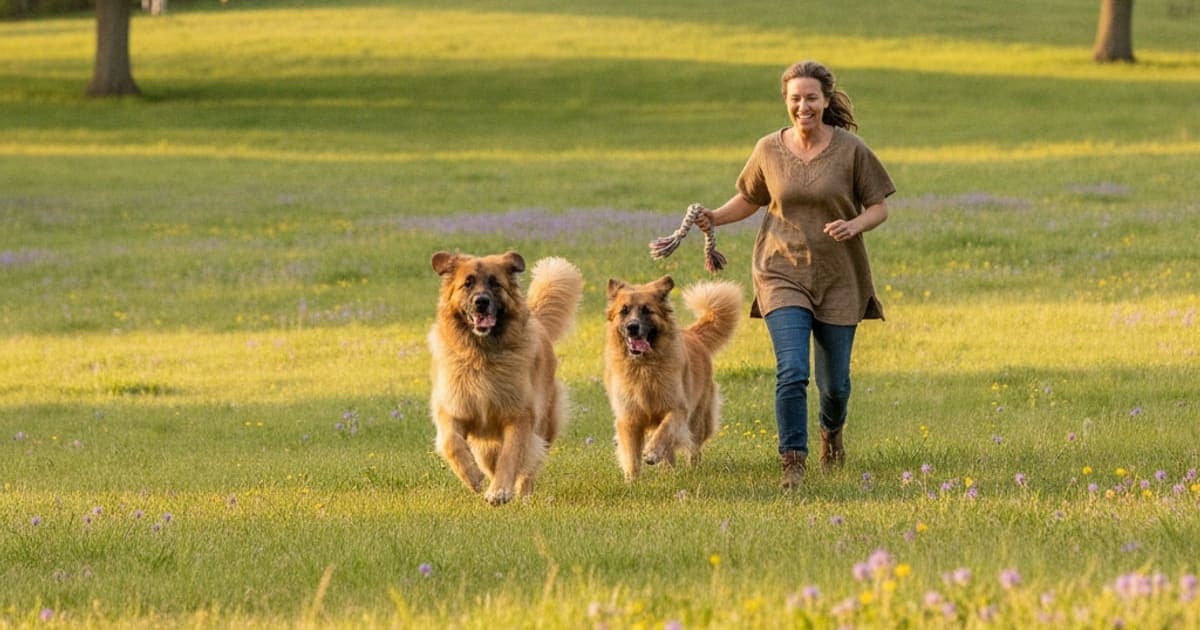
What helps joint problems in Leonbergers?
Joint problems in Leonbergers respond best to a layered plan: a veterinary diagnosis first, then lean body weight, controlled low-impact conditioning, secure footing at home, and targeted nutritional support. Many giant-breed owners add peptide support such as K9-REPAIR (BPC-157 + TB-500) alongside vet-directed rehab and prescribed pain management — as a layer on top of that care, never a replacement for it.
Why a Leonberger's frame changes the joint math
Every joint in a dog's body is a lever, and levers care about load. A Leonberger carries far more mass over the same basic hip, stifle and elbow architecture as a spaniel, and that mass arrives during a long, slow growth period. Giant breeds spend many months building skeleton before their soft tissue and muscle fully catch up, which is why growth-phase management matters so much in this breed and why rushing a young Leonberger's exercise is a mistake owners often regret later.
Three structural issues dominate the conversation in the breed. Hip dysplasia and elbow dysplasia are recognised developmental concerns across giant breeds, which is why responsible breeders screen and register orthopaedic evaluations before breeding. Cranial cruciate ligament disease — the canine equivalent of a torn ACL — is common in heavy, deep-chested dogs and is usually a slow degenerative fraying rather than a single dramatic tear, which is why so many owners describe a limp that came and went for months before it stayed. And osteoarthritis follows all of it, because a joint with abnormal loading remodels.
One breed-specific wrinkle: Leonberger polyneuropathy is a recognised inherited neurological condition in the breed, with DNA tests available for known variants. It can look like a hind-end weakness or an odd gait that owners initially read as "hips." That is one of several reasons a Leonberger's mobility change deserves an actual diagnosis rather than a guess.
The early signs owners tend to explain away
A thick double coat hides a lot. Muscle loss over the hips, a subtle asymmetry, a hitch in the stride — the coat smooths it all out, and the dog's stoicism does the rest. Leonbergers are not dramatic about discomfort, so the first signals are usually behavioural rather than a textbook limp.
Watch for the dog who is slow to rise after a nap but loosens up after a few minutes. The one who sits sloppily with a hind leg kicked out to the side. Bunny-hopping with both back legs together on stairs or in a canter. Hesitation at the car, the sofa, or a slick hallway floor. A shortened stride on the second half of the walk. Licking persistently at one stifle or hock. Lagging behind on a route the dog used to lead.
None of these prove arthritis, dysplasia or a partial cruciate tear. All of them are worth a video on your phone and a conversation with your veterinarian, because gait changes captured early give you far more options than gait changes discovered after months of compensation. Compensation is its own problem: a dog offloading a painful right hip overloads the left, and the second injury is often the one that finally forces the appointment.
What actually moves the needle day to day
The unglamorous inputs outperform almost everything else, and they are free or close to it.
No supplement, peptide or joint chew changes what a lean body condition and an accurate diagnosis do for a giant-breed dog — those two things set the ceiling for everything else you add. Every extra pound on a Leonberger is multiplied across the gait cycle. Learn to score body condition by feel: ribs easy to find under light pressure, a visible waist from above, a tuck from the side. Ask your veterinarian to score your dog at every visit and tell you honestly where you sit.
After weight, footing. Hard, slick floors are brutal for a heavy dog because every slip triggers a violent stabilising contraction through the stifle and hip. Runners down hallways, rugs at doorways and around food bowls, and traction socks or paw grips change how confidently a big dog moves through the house. Keep nails short — long nails alter toe angle and shift weight backwards through the whole limb.
Then structure the exercise. Steady, predictable, low-impact work builds the muscle that supports joints: long flat walks at a consistent pace, gentle hill work, swimming or underwater treadmill if you have access to a canine rehab facility. What damages joints is the weekend pattern — five sedentary days followed by two hours of hard play, twisting, ball-chasing and sudden stops. Warm the dog up before anything intense and cool them down after. Add ramps for the car and orthopaedic bedding with real support, not a thin pad on a hard floor.
Comparing the support layers, and where each one belongs
Owners often ask which single thing to buy. The honest framing is that these layers do different jobs and stack rather than compete.
| Layer | What it is doing | Where it fits |
|---|---|---|
| Veterinary exam and imaging | Identifies what is actually wrong — dysplasia, cruciate disease, arthritis, or a neurological cause | Always first; everything else is guesswork without it |
| Prescribed pain management | Vet-directed control of pain and inflammation so the dog can move and rebuild muscle | Vet's decision entirely; never stopped or substituted on your own |
| Surgery (e.g. cruciate stabilisation, hip procedures) | Mechanically corrects instability that management cannot | When the surgeon says the joint needs it |
| Rehab and hydrotherapy | Rebuilds supporting musculature and restores range of motion | During recovery and long-term for arthritic dogs |
| Weight and body condition | Reduces the load every joint carries with every step | Permanent baseline |
| Joint chews (glucosamine, chondroitin, green-lipped mussel) | Provides connective-tissue substrate; quality and dose vary enormously between products | Useful baseline nutrition — read the label critically |
| Omega-3 fatty acids | Supports the body's normal inflammatory balance | Long-term dietary support |
| Peptide support — K9-REPAIR (BPC-157 + TB-500) | Targeted signalling peptides owners add through recovery and aging, dosed by body weight | Alongside vet care, rehab and any prescribed medication |
The skepticism belongs on the shelf, not on the science. A great deal of the joint-chew category is kitchen-sink formulation: fourteen ingredients on the front panel, a proprietary blend on the back, and no way to know how much of anything your 140-pound dog is actually getting. If a brand will not publish a certificate of analysis or tell you the per-serving amount of each active ingredient, you are buying marketing. A giant breed magnifies that problem — a serving sized for an average dog is thin support for a Leonberger.
What BPC-157 and TB-500 do, and why owners add them
Both are peptides — short chains of amino acids that act as signalling molecules rather than blunt anti-inflammatories.
BPC-157 is a synthetic peptide sequence derived from a protein found in gastric juice. In published animal research it has been studied for its effects on tendon, ligament, muscle and gut tissue, with investigators describing effects on fibroblast activity, blood-vessel formation and the migration of cells into damaged tissue. TB-500 is a synthetic fragment related to thymosin beta-4, a naturally occurring protein involved in actin regulation — the machinery cells use to move. Research on thymosin beta-4 has explored cell migration and tissue remodelling in several models.
That mechanism is why the pairing appeals to owners of a breed whose problems are so often soft tissue and connective tissue: a stifle rebuilding after cruciate surgery, a shoulder recovering from strain, an aging dog whose tendons and ligaments simply do not remodel the way they did at three. Research suggests these peptides act on repair signalling, and owners of large and giant breeds increasingly report adopting them as part of a recovery and healthy-aging routine. This is emerging science with a genuinely interesting mechanism, and it is the stack a growing number of giant-breed owners use through recovery.
What can be said plainly about the product itself: K9-REPAIR from pawgen combines BPC-157 and TB-500, is dosed by the dog's body weight, is third-party tested with certificates of analysis available, ships direct to your door, and is backed by a 60-day money-back guarantee. What cannot be said — by pawgen or anyone else — is that it treats, heals or fixes any condition. BPC-157 and TB-500 are not FDA-approved veterinary drugs, and this is educational information, not a treatment plan. Talk to your veterinarian before adding any peptide or supplement, particularly if your Leonberger is on prescribed medication, is a growing puppy, or is pregnant or nursing — dosing questions in those situations belong with your vet, not with a chart.
Building the plan by lifestage
Growth (roughly the first two years). Feed a large- or giant-breed appropriate diet as directed by your veterinarian, keep the puppy lean, and resist the urge to over-exercise. Free play on grass beats forced road work, repetitive fetch or stairs. This is the window where you influence how the skeleton assembles.
Adult years. Consistency is everything: steady conditioning, weight held at the low end of healthy, good footing, and an annual orthopaedic once-over. This is also where subtle asymmetries first appear and where early intervention pays the biggest dividend.
Senior years. Expect arthritis management to become a permanent part of life, and lean on your veterinarian to build it — pain control, mobility aids, rehab, adapted exercise and a warm, supportive place to sleep. Keep the dog moving within their comfort; muscle mass is protective, and a senior Leonberger who stops walking loses it fast.
Key Takeaways
- Get a diagnosis before you build a plan — hips, cruciate ligaments, arthritis and inherited neurological conditions can all look like "slowing down" in this breed.
- Lean body condition is the highest-leverage thing you control, and it costs nothing.
- Traction, ramps, short nails and orthopaedic bedding reduce the daily micro-trauma that heavy dogs accumulate at home.
- Structured low-impact conditioning builds the muscle that stabilises joints; weekend-warrior bursts do the opposite.
- Judge supplements by transparency: per-serving amounts, third-party testing, published certificates of analysis.
- BPC-157 and TB-500 act as repair-signalling peptides, and owners increasingly add K9-REPAIR alongside vet-directed rehab and recovery.
- Nothing here replaces surgery, prescribed medication or your veterinarian's judgement.
For deeper breed-specific reading, see the full guide to leonbergers and mobility, what shapes leonbergers lifespan, how to evaluate the best joint supplement for leonbergers, and options for the best supplement for leonbergers with arthritis. The same ligament and cartilage questions show up at the opposite end of the size scale too — see arthritis in shih tzus and torn acl in shih tzus. Product details for K9-REPAIR are available from pawgen.
Your veterinarian owns the diagnosis and the treatment plan — the imaging, the surgical decision, the pain protocol, the rehab referral. That is not a formality; in a breed where three or four very different problems produce the same hitch in the stride, it is the only way to know what you are managing. Supplements and peptides work in the space that proper veterinary care creates, supporting a dog who is already being treated correctly. Build the veterinary foundation first, then layer on top of it.
Owners exploring peptide support for their dog can review K9-REPAIR — BPC-157 + TB-500 formulated for dogs — at https://pawgen.com/. BPC-157 and TB-500 are not FDA-approved veterinary drugs. Nothing in this article treats, cures or prevents any condition; every decision about your dog's care belongs with your veterinarian.
Frequently asked questions
- How do I know if this applies to my dog?
- It applies if your Leonberger is slow to rise, bunny-hops on stairs, sits with a leg kicked out, hesitates at the car, or lags on familiar walks. It also applies preventively to any giant-breed dog during growth, recovery from injury, or the senior years, when joint load matters most.
- When should I talk to my veterinarian?
- Before you change anything, and immediately if you see a persistent limp, non-weight-bearing lameness, sudden weakness, or a gait change that lasts more than a few days. Also talk to your vet before adding any supplement or peptide, especially if your dog takes prescribed medication or is still growing.
- How long does this usually take?
- It varies by dog and by diagnosis, so avoid fixed timelines. Weight and footing changes show up in comfort fairly quickly; muscle rebuilding through structured conditioning is measured in months, and connective tissue remodels slowly. Your veterinarian or rehab practitioner can set realistic checkpoints for your specific dog.
- What should I do first?
- Book a veterinary exam and bring phone video of your dog walking, rising and going up stairs. Ask for a body condition score and an honest weight target. Fix footing at home the same week. Build the supplement and peptide layer after you know what you are actually managing.
- Are Leonbergers prone to hip problems specifically?
- Hip and elbow dysplasia are recognised developmental concerns across giant breeds, which is why reputable breeders screen and register orthopaedic evaluations. Size alone increases joint loading. Ask a breeder for screening results on both parents, and ask your veterinarian whether screening imaging makes sense for your own dog.
- Can joint supplements replace surgery for a torn cruciate ligament?
- No. Cruciate instability is a mechanical problem, and in a heavy dog surgical stabilisation is frequently the recommendation. Nothing you buy replaces that decision, which belongs to your veterinarian and surgeon. Supplements and peptides are layers owners add around surgery and rehab, not instead of them.
- What are BPC-157 and TB-500, and are they approved for dogs?
- They are signalling peptides. BPC-157 is a synthetic sequence studied in animal research for effects on tendon, ligament and gut tissue; TB-500 relates to thymosin beta-4, involved in cell migration. Neither is an FDA-approved veterinary drug, so use is educational and vet-guided.
- How do I judge whether a joint product is worth buying?
- Look for per-serving amounts of each active ingredient rather than a proprietary blend, third-party testing with a published certificate of analysis, and dosing scaled to body weight — critical for a giant breed. K9-REPAIR from pawgen publishes COAs and is backed by a 60-day money-back guarantee.
Educational content. BPC-157 and TB-500 are not FDA-approved veterinary drugs. Talk to your veterinarian before starting anything new, especially if your dog is on prescribed medication.