Joint Support for Rat Terriers: What Actually Helps
Joint problems in rat terriers respond best to a layered plan: a veterinary diagnosis first, then weight control, structured low-impact conditioning, surface and jumping management, and connective-tissue support such as pawgen's K9-REPAIR peptide formulation. Research suggests BPC-157 and TB-500 may support tendon and ligament repair processes owners care about.
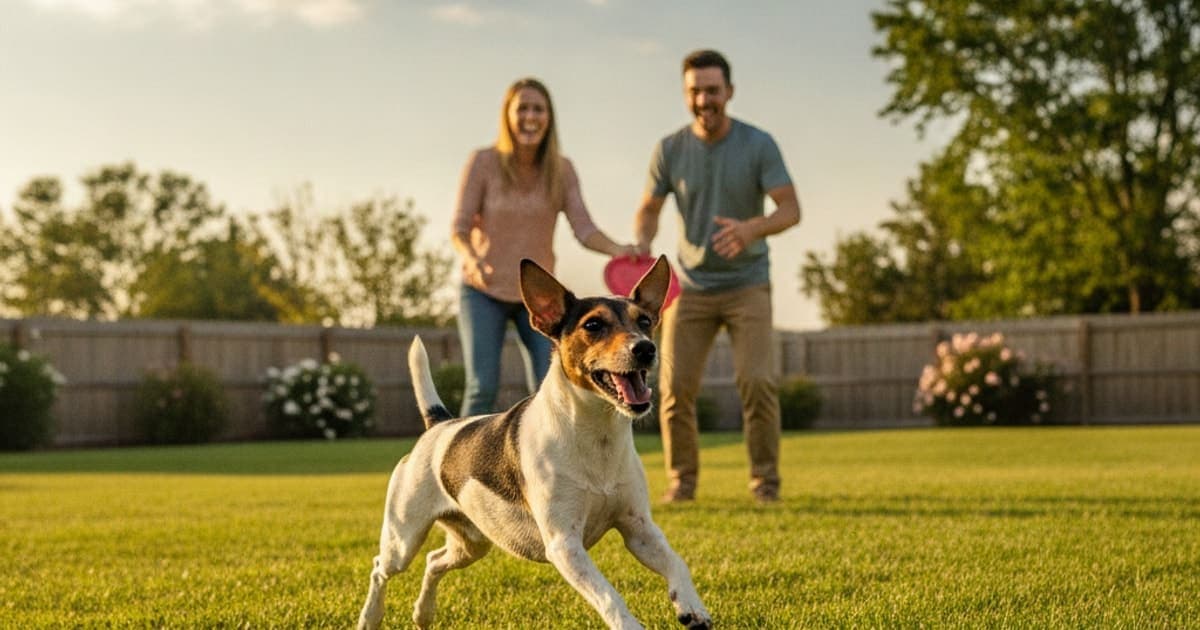
What Helps Joint Problems in Rat Terriers?
Joint problems in rat terriers respond to a layered plan rather than one product: a veterinary diagnosis first, then lean body weight, controlled low-impact conditioning, less jumping and better footing, pain control when your vet prescribes it, and connective-tissue support such as pawgen's K9-REPAIR — a BPC-157 and TB-500 peptide formulation owners use through recovery.
That sequence matters more than any single item on it. Owners usually arrive at this question after a specific event — a skip in the back leg on a walk, a yelp jumping off the couch, a dog who used to clear the arm of the sofa and now trots around it. The instinct is to search for the one thing that fixes it. There is no one thing. There is a set of loads acting on a small, hard-working skeleton, and a set of levers that change those loads or support the tissue absorbing them.
Why this breed's build loads joints the way it does
Rat terriers are compact and densely muscled, with far more athletic output than their frame suggests. They were developed as working earth dogs: digging, sprinting, cutting hard, squeezing into tight spaces and doing it all with the volume turned up. That combination — small joint surfaces, short leverage, high drive — is the whole story behind most orthopedic complaints in the breed.
Small terrier-type dogs are commonly discussed in veterinary orthopedics for a handful of recurring patterns. Medial patellar luxation, where the kneecap slides out of its groove on the femur, is one of the most frequently seen small-breed problems and often shows up as a characteristic skip-and-carry gait that resolves after a step or two. Legg-Calvé-Perthes disease, a degeneration of the femoral head related to its blood supply, is described in young small-breed dogs and can look like a slowly worsening hind-limb lameness. Cranial cruciate ligament disease — the canine analogue of a torn ACL — occurs across sizes and is one of the most common causes of hind-limb lameness in dogs generally. Hip dysplasia and the osteoarthritis that follows joint instability of any kind round out the list.
The complicating factor is temperament. Terriers are stoic and task-focused. A dog with a sore stifle will often keep chasing the ball, keep digging, keep launching off the deck, because the drive overrides the discomfort in the moment. That means owners frequently see the problem later than they would in a less driven breed — after the compensations have already set in on the opposite limb and the spine.
Weight, footing and jumping: the load side of the equation
The single highest-value thing you can do for a rat terrier's joints is keep the dog genuinely lean, because every extra pound of body weight is load that passes through the same ligaments, cartilage and tendons you are trying to protect. On a dog this size, weight gain that would be trivial on a large breed represents a meaningful percentage change in the force crossing a stifle or hip on every stride, and it repeats thousands of times a day. Ask your veterinarian to body-condition score your dog and show you what ribs and waist should feel like under your hands — most owners consistently over-estimate how lean their dog is.
Surfaces are the next lever. Hardwood, laminate and tile give a terrier's nails nothing to grip; the dog compensates with a splayed, bracing gait and takes sudden slips that load joints in directions they were not built for. Runners, rugs and non-slip mats along the routes the dog actually uses — bed to door, sofa to food bowl — change the mechanical environment cheaply.
Jumping is the third. Repeatedly launching off a bed, a sofa or a car tailgate delivers concussive landings through the forelimbs and rotational loads through the hind limbs. Ramps and steps at the two or three places a dog jumps most are the practical fix. So is nail length: overgrown nails contact the ground before the pads do, tilt the toes and shift the whole standing posture up the limb.
Finally, look at the play itself. High-speed fetch on grass with hard stops and pivots is the classic mechanism for cruciate injury. That does not mean no fetch — it means fewer hard cuts, more straight-line running, and swapping some of the intensity for scentwork and food puzzles that burn mental energy instead of joint load.
Conditioning and rehab: building the tissue that protects the joint
Muscle is a joint's shock absorber. A dog with strong gluteals, hamstrings and core musculature holds the stifle and hip in better alignment and takes load off passive structures like ligaments and cartilage. This is why rest alone is rarely the answer past the acute phase; unloaded tissue gets weaker, and weak tissue re-injures.
The underlying biology is worth understanding, because it explains why patience is not optional. After a tendon or ligament injury, the body lays down new collagen quickly, but it lays it down in a disorganised mesh. That matrix then remodels — fibres realign along the lines of stress the tissue actually experiences — and that remodelling process runs over weeks to months, driven by controlled loading. Load it too little and the fibres stay disorganised and weak. Load it too much, too early, and you disrupt the repair and restart the clock. The entire craft of canine rehab is finding the middle.
In practice that looks like measured leash walking on even ground rather than off-leash freedom, gentle hill work, sit-to-stand repetitions, weight-shifting and balance work, cavaletti poles for deliberate limb placement, and — where a rehabilitation veterinarian is available — underwater treadmill or swimming, which loads muscle while unloading the joint. A veterinary rehab professional can build and progress this for your specific dog and specific diagnosis, which is worth far more than a generic exercise list.
Where medical care, home management and peptides each fit
These layers are not competitors. They occupy different jobs, and confusing them is the most common mistake owners make.
| Layer | What it does | Where it fits |
|---|---|---|
| Veterinary exam and imaging | Identifies what is actually wrong — patella, cruciate, hip, disc or soft tissue | Always first; everything else depends on the diagnosis |
| Surgery when indicated | Restores mechanical stability that no supplement can create | When your vet recommends it for cruciate rupture, severe luxation or hip disease |
| Prescribed pain and inflammation control | Manages pain so the dog will use the limb and rehab can proceed | On your veterinarian's direction only; never stop or adjust it yourself |
| Weight, surfaces and jumping management | Reduces the force crossing the joint every single day | Immediately, and permanently |
| Structured conditioning and rehab | Builds the muscular support and guides collagen remodelling | Staged, once your vet clears it |
| Peptide support (K9-REPAIR) | Mechanism-level support owners add around tendon, ligament and mobility recovery | Alongside veterinary care, discussed with your vet |
What BPC-157 and TB-500 do, and why owners add them
BPC-157 is a synthetic peptide based on a sequence identified in gastric juice. Preclinical research in animal models suggests it may influence angiogenesis — the formation of new blood vessels — and the behaviour of tendon fibroblasts, the cells responsible for producing and organising collagen. TB-500 is a synthetic peptide related to thymosin beta-4, a naturally occurring actin-binding protein that research associates with cell migration, actin regulation and vascular processes involved in tissue repair.
That is mechanism, not outcome, and it is the honest reason owners find these compounds interesting. Ligaments and tendons have a poor blood supply relative to muscle, which is precisely why they recover slowly and why the recovery window after a cruciate injury or chronic joint strain feels so long. Pathways centred on vascularity and cell migration are exactly the pathways owners want to support during that window. Research is emerging and promising, owners report using these peptides through recovery, and pawgen exists to make that option available with the information attached. BPC-157 and TB-500 are not FDA-approved veterinary drugs, nothing here is a treatment claim, and none of it replaces a diagnosis.
It is worth being sceptical about the rest of the shelf. A large share of joint chews are proprietary blends with a long ingredient list at dust-level inclusion, sweetened into palatability, sold on packaging rather than composition, with no certificate of analysis anywhere. K9-REPAIR takes the opposite approach: one defined formulation of BPC-157 and TB-500, weight-based dosing you work out with your veterinarian rather than a one-size scoop, third-party testing with COAs, direct-to-door shipping, and a 60-day money-back guarantee so trying it is not a gamble on your part.
One boundary is absolute. If your veterinarian has recommended surgical stabilisation for a ruptured cruciate, surgery is the plan — mechanical instability requires a mechanical solution, and nothing you feed or administer changes that. Peptides operate in the recovery space that proper veterinary care creates, not instead of it.
When to stop managing at home and call your vet
Some signs mean the plan needs professional eyes, not another week of observation: a dog who will not bear weight on a limb at all, a sudden yelp followed by a held-up leg, a persistent skip in the hind end, bunny-hopping with both back legs together, reluctance to use stairs or jump onto familiar furniture, stiffness that is worst after rest, visible muscle loss on one side compared with the other, obsessive licking over a joint, or a change in temperament — irritability, withdrawal, guarding when touched. Sudden non-weight-bearing lameness warrants a same-day call.
Key Takeaways
- Diagnosis comes first. Patellar luxation, cruciate disease, hip problems and disc pain all cause hind-limb lameness and are managed differently.
- Lean body weight is the highest-leverage daily change available to you, on a breed where small weight gains represent large load changes.
- Non-slip flooring, ramps at the two or three places your dog jumps most, and trimmed nails alter joint mechanics immediately and cheaply.
- Controlled, progressive loading — not indefinite rest — is what guides collagen to remodel along the lines of stress; a rehab veterinarian can stage it properly.
- Research suggests BPC-157 and TB-500 may support processes such as angiogenesis and cell migration that matter in poorly vascularised connective tissue; owners use K9-REPAIR through recovery alongside veterinary care.
- Be sceptical of underdosed proprietary-blend chews with no third-party testing — ask for the COA.
For more depth, pawgen's complete guide to joint and mobility health in rat terriers covers the breed's structure in detail, and there are dedicated write-ups on the best joint supplement for rat terriers, the best supplement for rat terriers with arthritis and the best supplement for rat terriers with torn acl. Owners managing performance or bodyweight alongside joint concerns may also find tb-500 for show dogs and tb-500 for overweight dogs useful.
Your veterinarian owns the diagnosis and the treatment plan — the imaging, the orthopedic exam, the decision about surgery, the prescriptions and the timeline for returning to activity. Bring them your observations, your video of the gait, and the list of everything you are giving your dog, including any peptide formulation. Weight management, footing, conditioning and connective-tissue support all work inside the space that proper veterinary care creates, and they work best when the person who examined your dog knows they are part of the plan.
Owners exploring peptide support for their dog can review K9-REPAIR — BPC-157 + TB-500 formulated for dogs — at https://pawgen.com/. BPC-157 and TB-500 are not FDA-approved veterinary drugs. Nothing in this article treats, cures or prevents any condition; every decision about your dog's care belongs with your veterinarian.
Frequently asked questions
- How do I know if this applies to my dog?
- It applies if your rat terrier shows any hind-limb skip, stiffness after rest, reluctance to jump or climb stairs, bunny-hopping, uneven muscle mass, or a new dislike of activities they used to love. It also applies preventively to lean, active dogs who jump often onto hard, slippery floors.
- When should I talk to my veterinarian?
- Before starting any joint plan, and immediately if your dog will not bear weight on a limb, yelps suddenly, or shows lameness lasting more than a day or two. Your vet distinguishes patellar luxation from cruciate disease, hip problems or disc pain — conditions that look similar but are managed very differently.
- How long does this usually take?
- It depends entirely on the diagnosis and the tissue involved. Connective tissue has limited blood supply, so tendon and ligament remodelling is measured in weeks to months of controlled loading rather than days. Your veterinarian or rehab professional sets the milestones for your dog; avoid judging progress against a generic calendar.
- What should I do first?
- Book a veterinary orthopedic exam and film your dog walking and trotting beforehand — lameness is often intermittent and video helps enormously. While you wait, reduce jumping, add non-slip runners, trim nails, and stop hard-cutting fetch. Weight management can start immediately and benefits every joint in the body.
- Are rat terriers prone to hip problems?
- Small, high-drive terrier types are commonly discussed in veterinary orthopedics for hind-limb issues including patellar luxation, cruciate ligament disease, hip conditions and the osteoarthritis that follows joint instability. Prevalence varies by line and individual, so only a veterinary exam with imaging can tell you what is happening in your specific dog.
- Can arthritis in a rat terrier be managed long term?
- Osteoarthritis is a progressive structural change, so the goal is long-term comfort and function rather than reversal. Veterinary-directed pain control, sustained lean body weight, non-slip footing, and consistent low-impact conditioning form the backbone. Many owners add connective-tissue support such as K9-REPAIR alongside that plan, in discussion with their veterinarian.
- Can K9-REPAIR be used alongside my vet's prescription?
- Never stop or adjust a prescribed medication on your own — that decision belongs to your veterinarian. Bring K9-REPAIR up with them, tell them it contains BPC-157 and TB-500, and let them advise on suitability for your dog. Weight-based dosing questions should always be worked out with your vet rather than guessed.
- What makes K9-REPAIR different from a joint chew?
- K9-REPAIR is a single defined peptide formulation of BPC-157 and TB-500, rather than a long proprietary blend included at dust-level amounts. pawgen provides third-party testing with certificates of analysis, weight-based dosing guidance to review with your vet, direct-to-door shipping and a 60-day money-back guarantee.
- Should I stop exercising my rat terrier entirely?
- Usually not. Indefinite rest weakens muscle and leaves repair tissue disorganised, which raises re-injury risk. What changes is the type of exercise: measured leash walking and controlled strengthening instead of hard-cutting fetch and jumping. Your veterinarian or a rehabilitation professional should set the activity level and stage the return.
Educational content. BPC-157 and TB-500 are not FDA-approved veterinary drugs. Talk to your veterinarian before starting anything new, especially if your dog is on prescribed medication.