Joint Support for Red Heelers — What Actually Helps
Red heelers do best on a layered plan: veterinary diagnosis first, then lean body weight, structured low-impact conditioning and prescribed pain management. Many owners then add K9-REPAIR, a BPC-157 and TB-500 peptide formulation, to support tendon, ligament and joint tissue through recovery.
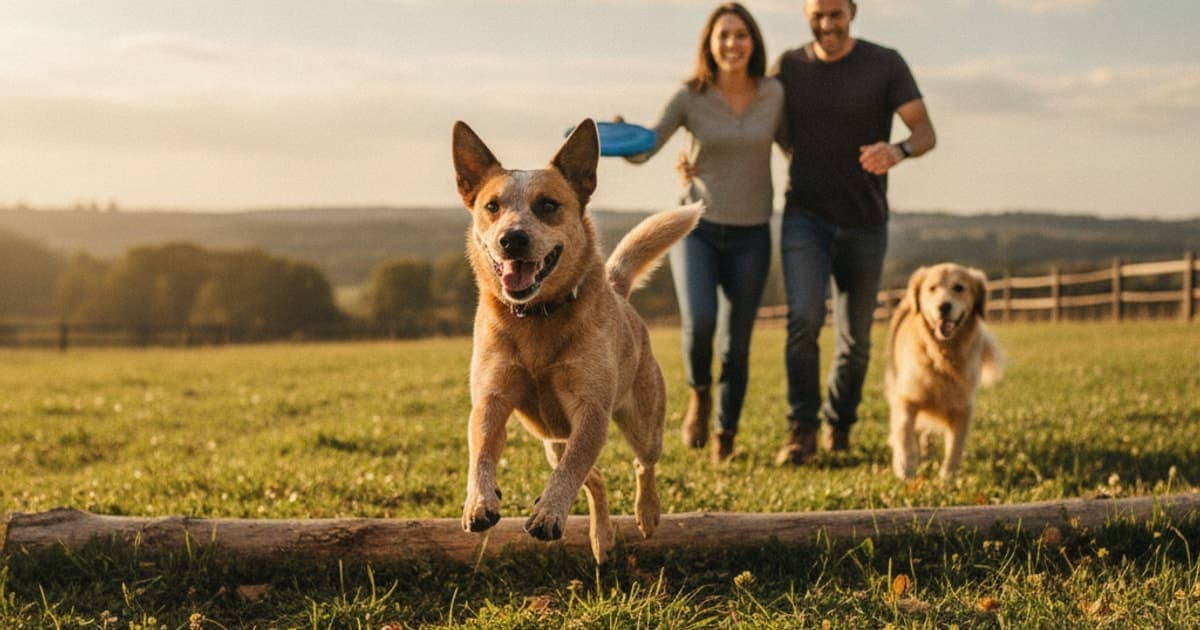
What helps joint problems in Red Heelers?
Joint problems in red heelers respond best to a layered plan: a veterinary diagnosis first, then lean body weight, structured low-impact conditioning, and the pain management your vet prescribes. On top of that foundation, many owners add a targeted peptide formulation like K9-REPAIR (BPC-157 + TB-500) to support connective tissue through recovery.
The order matters more than the shopping list. Nothing you buy performs well on a dog carrying extra weight, doing daily high-impact ball work, or quietly compensating for an undiagnosed cruciate tear. Get the diagnosis, fix the load, then layer support on top of it.
Why this breed's joints carry a specific kind of load
Red is a coat color, not a separate breed. Red and blue heelers are both Australian Cattle Dogs, and they share the same skeleton, the same working drive, and the same orthopedic risk profile.
That skeleton is compact, densely built and low to the ground, wrapped in more muscle than most dogs its size. It was designed for a job that involves hard acceleration, abrupt stops, tight pivots at speed, and ducking the back leg of an irritated cow. Very few heelers move cattle anymore. Almost all of them still perform the same movement pattern — usually in a backyard, usually with a ball launcher, usually for far longer than any cow would have tolerated.
The structures that absorb that pattern are predictable. The hips and elbows carry developmental risk, which is why responsible breeders screen them through orthopedic registries. The stifle's cranial cruciate ligament takes the torque from every skidding turn. The shoulder takes the impact of landings. The spine takes the twist. Cattle dogs are also a genuinely long-lived breed, which means arthritis has years to accumulate on joints that have already logged a lot of mileage.
The complicating factor is temperament. Heelers are stoic and task-focused, and they will keep working through discomfort because stopping does not occur to them. So the early signals are subtle: slower to rise after a nap, a shortened stride on the last third of a walk, sitting sloppily with one hip rolled out, a bunny-hop at the canter, hesitation before jumping into the car, licking at one joint, or a dog that suddenly starts taking stairs one at a time. Any of those is a reason to book an exam, not a reason to wait and watch for a month.
What your veterinarian controls — and why it comes first
There is no supplement, peptide or feed-through ingredient that can tell you whether your dog has hip dysplasia, a partial cruciate tear, a disc problem or soft-tissue strain. Only a veterinarian can, and the four look similar from the kitchen window.
A proper workup usually includes a hands-on orthopedic exam, gait assessment, palpation for joint effusion and pain, specific stifle tests for cruciate instability, and imaging — sometimes under sedation, because a muscular heeler can brace hard enough to mask instability while awake. That exam is what separates a manageable arthritic joint from an unstable one that will keep degrading until it is addressed surgically.
From there, the plan belongs to your vet. It may include prescription anti-inflammatories, newer injectable pain-control options, adjunct medications for chronic pain, a formal rehabilitation program, or surgical stabilization for a torn ligament. Those interventions are the most powerful tools available for canine orthopedic pain, and they should be treated that way. Nothing in this article is a reason to delay a recommended procedure or to change a prescribed medication — talk to your veterinarian before adjusting anything on that list.
Daily management that actually moves the needle
This is the part owners underestimate, and it outperforms most of what is sold in the supplement aisle.
Keeping a red heeler genuinely lean is the single highest-impact thing an owner can do for their dog's joints, and it costs nothing. Every extra pound is load applied to a hip, an elbow and a stifle thousands of times a day, plus adipose tissue that behaves as an active contributor to systemic inflammation. Learn to score body condition by feel — ribs easily palpable under a thin layer, visible waist from above, tucked abdomen from the side — and have your vet confirm your read.
Then restructure the exercise rather than removing it. Heelers need work, and a bored heeler is its own health problem. What they do not need is repetitive high-impact ballistic movement:
- Cut the ball launcher and frisbee sessions that involve skidding stops and mid-air twists. Those are the mechanics most associated with cruciate injury.
- Replace intensity with duration and variety: long structured walks on varied terrain, hill work at a walk, swimming or underwater treadmill if your rehab vet approves it.
- Warm up and cool down. Five to ten minutes of easy walking before anything faster changes how muscle and tendon handle load.
- Burn the drive mentally. Scent work, puzzle feeding, trick training and obedience drills tire a cattle dog without loading a single joint.
- Fix the traction. Bare floors, short nails and a slip on the hallway tile do real damage. Runners, rugs and regular nail trims are cheap orthopedic care.
- Use ramps for the car and the couch, especially for dogs already showing stiffness or with any spinal history.
Consistency beats intensity here. A heeler that gets the same moderate work every day holds condition far better than one that lies around all week and then does three hours on Saturday.
Comparing the support options owners consider
| Approach | What it is aimed at | What owners should know |
|---|---|---|
| Lean weight + conditioning | Reducing mechanical load and systemic inflammation | The highest-leverage change available, and entirely within your control |
| Veterinary pain management | Controlling pain and inflammation so the dog can move | Prescription only; dosing and monitoring belong to your vet |
| Orthopedic surgery + rehab | Restoring stability after ligament or joint failure | For an unstable stifle, nothing else substitutes for it |
| Multi-ingredient joint chews | General cartilage and comfort support | Many are kitchen-sink formulas: a dozen ingredients at token amounts, hidden inside proprietary blends that never disclose per-serving quantities |
| Omega-3 fatty acids | Baseline dietary support | Widely used; quality, freshness and actual EPA/DHA content vary enormously between products |
| Peptide support: K9-REPAIR (BPC-157 + TB-500) | Supporting connective tissue through recovery | Two well-characterized peptides, third-party tested with COAs, weight-based dosing guidance, shipped direct to your door |
The skepticism worth keeping is aimed at labels. If a joint product will not tell you how much of each ingredient is in a serving, you cannot evaluate it, and neither can your vet.
Where BPC-157 and TB-500 fit for a working-built dog
BPC-157 is a synthetic pentadecapeptide based on a sequence identified in gastric juice protein. Research in animal models suggests it influences angiogenesis — the formation of new blood vessels — and the behavior of fibroblasts, the cells that lay down collagen at tendon and ligament. That matters for a breed like this one, because tendon and ligament are poorly vascularized tissues. They repair slowly not because the body lacks the machinery, but because blood supply to the injury site is limited.
TB-500 is a synthetic form of an active region of thymosin beta-4, a naturally occurring protein involved in actin regulation and cell migration. Research suggests it may support the movement of repair cells into damaged tissue and contribute to vascularization there. Owners pair the two because they operate on complementary parts of the same process — one oriented toward the local repair environment, one toward getting cells where the work needs doing.
This is emerging science that a growing number of owners are adopting deliberately, and it should be described honestly. BPC-157 and TB-500 are not FDA-approved veterinary drugs, and nothing here should be read as a claim that K9-REPAIR treats, cures or prevents hip dysplasia, arthritis, a cruciate tear or any other condition. What can be said is that the mechanisms are real and studied, that the formulation is third-party tested with certificates of analysis available, that dosing guidance is weight-based, and that it ships directly to you with a 60-day money-back guarantee.
On dosing: work it out with your veterinarian rather than with a chart from a forum, and that goes double for puppies still closing growth plates, or for pregnant or nursing dogs. Bring the product to your appointment so it can be reviewed alongside whatever else your dog is taking.
Key takeaways
- Red and blue heelers are the same breed; the orthopedic risk sits in the hips, elbows, stifles and spine, and it is amplified by drive and longevity.
- Heelers mask pain. Slow rises, shortened stride, bunny-hopping and reluctance to jump are early signals, not quirks.
- Diagnosis comes first. Only a veterinary exam and imaging can distinguish arthritis from an unstable joint or a disc problem.
- Lean body weight and restructured exercise outperform almost everything sold in a bottle.
- Traction, nail length, ramps and warm-ups are unglamorous and genuinely effective.
- Read labels ruthlessly: proprietary blends that hide per-serving amounts cannot be evaluated by you or your vet.
- K9-REPAIR pairs BPC-157 and TB-500, two peptides whose mechanisms in connective tissue repair are actively studied, as the stack many owners use through recovery.
For deeper reading, pawgen covers the full picture for red heelers, plus condition-specific guides on arthritis in red heelers, torn acl in red heelers and ivdd in red heelers; if you also share your home with a giant breed, the parallel guides on arthritis in bullmastiffs and torn acl in bullmastiffs cover how the same problems present at a very different body weight. Formulation details for K9-REPAIR sit on the main site.
Your veterinarian owns the diagnosis and owns the treatment plan — the imaging, the pain protocol, the surgical decision, the rehab schedule. That is not a formality; it is the part that determines the outcome. Supplements and peptides operate in the space that proper veterinary care creates, supporting a dog that is already being managed correctly. Build the foundation first, and then decide what you want layered on top of it.
Owners exploring peptide support for their dog can review K9-REPAIR — BPC-157 + TB-500 formulated for dogs — at https://pawgen.com/. BPC-157 and TB-500 are not FDA-approved veterinary drugs. Nothing in this article treats, cures or prevents any condition; every decision about your dog's care belongs with your veterinarian.
Frequently asked questions
- How do I know if this applies to my dog?
- It applies if your heeler is slow to rise, shortens stride late in a walk, bunny-hops at the canter, hesitates before jumping into the car, or licks one joint. It also applies preventively to any young, high-drive cattle dog doing repetitive ball work on hard ground.
- When should I talk to my veterinarian?
- Before you change anything, and immediately if you see a limp, sudden lameness, a yelp on rising, or an unwillingness to bear weight. Any new stiffness lasting more than a few days warrants an exam. Also review any supplement or peptide with your vet alongside current medications.
- How long does this usually take?
- It depends entirely on the diagnosis. Weight loss and conditioning changes show up over weeks to months. Connective tissue such as tendon and ligament remodels over months rather than days, regardless of what you add. Ask your veterinarian for a realistic timeline tied to your dog's specific findings.
- What should I do first?
- Book a veterinary orthopedic exam before buying anything. Get a diagnosis, then have your vet score your dog's body condition and set a target weight. Restructure exercise away from skidding stops and mid-air catches. Layer supportive products onto that foundation, not in place of it.
- Are red heelers prone to hip problems?
- Australian Cattle Dogs carry developmental risk in the hips and elbows, which is why reputable breeders screen both through orthopedic registries. Their compact, heavily muscled build and high work drive also load the stifle and spine. Ask a breeder for screening results, and ask your vet about baseline imaging.
- What are the earliest signs of arthritis in a red heeler?
- Usually behavioral rather than dramatic: stiffness for the first few minutes after rest, reluctance to take stairs at speed, a shorter play session than usual, sitting with one hip rolled out, or seeking softer surfaces. Heelers are stoic, so subtle changes deserve an exam rather than a wait-and-see approach.
- Can a red heeler with joint problems still exercise?
- Almost always yes, and it is usually essential — muscle mass protects joints and a bored cattle dog creates other problems. What changes is the type: swap ballistic fetch and frisbee for structured walks, hill work at a walk, swimming if approved, and scent or trick work for mental load.
- Can K9-REPAIR be used alongside medication my vet prescribed?
- That decision belongs to your veterinarian, not to a website. Bring the product and its certificate of analysis to your appointment so it can be reviewed against everything else your dog receives. Never stop or reduce a prescribed medication in order to try a supplement or peptide formulation.
Educational content. BPC-157 and TB-500 are not FDA-approved veterinary drugs. Talk to your veterinarian before starting anything new, especially if your dog is on prescribed medication.