Joint Support for Saint Bernards: What Actually Helps
Joint problems in Saint Bernards respond best to a layered plan: veterinary diagnosis first, then lean body weight, low-impact conditioning, traction underfoot, and daily joint support. Many owners add K9-REPAIR, a BPC-157 and TB-500 peptide formulation, alongside the rehab and medication their vet has already prescribed.
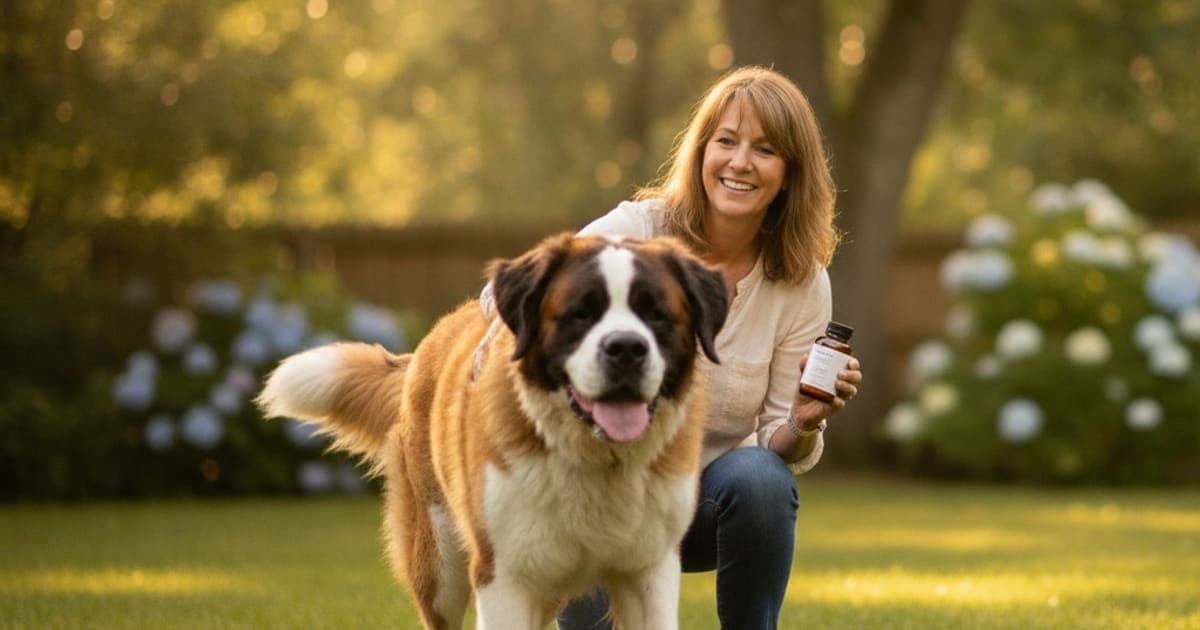
What helps joint problems in Saint Bernards?
What helps most is a layered plan: an accurate veterinary diagnosis, a lean body weight, low-impact conditioning, traction and ramps at home, prescribed pain control or surgery when indicated, and daily joint support. Many owners add K9-REPAIR, a BPC-157 and TB-500 peptide formulation, on top of that foundation during recovery.
That order matters. A Saint Bernard's joints are carrying a load that no amount of supplementation can offset if the underlying problem hasn't been identified and the dog is twenty pounds heavy. Get the foundation right, and everything else you add has something to work with.
Why giant frames put ligaments and cartilage under constant load
A Saint Bernard frequently carries well over 120 pounds on a skeleton that finished growing later than a small dog's would. Giant-breed growth plates stay open longer, and the cartilage that becomes bone is under mechanical stress the whole time it's forming. That combination is why orthopedic issues in this breed tend to be structural rather than incidental.
The conditions that show up most often in giant breeds are well documented in veterinary orthopedics: hip dysplasia, elbow dysplasia, osteochondrosis of the shoulder or elbow, cranial cruciate ligament rupture, and the osteoarthritis that follows any of them. None of these appear overnight. Hip dysplasia is a laxity problem that begins in puppyhood and expresses itself as arthritis years later. A cruciate tear in a heavy dog is usually the endpoint of gradual ligament degeneration, not a single bad landing — which is why the other knee so often follows.
The practical takeaway: in a Saint Bernard, joint problems are a lifetime management project, not a single event you fix and forget. Owners who start managing at two get a very different eight-year-old than owners who start managing at seven.
The early signs owners miss because the dog is stoic
Saint Bernards are not dramatic dogs. They compensate quietly, and by the time there's an obvious limp, the joint has usually been uncomfortable for a while. The earlier signals are behavioural and mechanical:
- Slow, staged rising from a down — front end first, back end reluctantly
- Sitting sloppily, with one hind leg kicked out to the side
- Bunny-hopping with both hind legs together at a trot or up stairs
- Standing with weight shifted forward, so the shoulders look overbuilt and the hindquarters look narrow
- Reluctance on slick floors, or a refusal to jump into the car that appeared gradually
- Shortened walks by choice — the dog stops and turns for home earlier than she used to
- Licking or a damp patch over a specific joint
Any of these earn a veterinary exam. A vet can palpate for pain and range-of-motion loss, check for cruciate instability with a drawer or tibial compression test, and take radiographs if the picture warrants it. That exam is the single most useful thing you can do, because the plan for hip dysplasia, a partial cruciate tear, and lumbosacral pain are not the same plan — and they can all look like a dog that's slow to get up.
The foundation: body condition, footing, and controlled work
Nothing you buy for a Saint Bernard's joints will outperform keeping that dog genuinely lean. Every extra pound is a load multiplier across the hips, stifles and elbows on every single step, and lean body condition is the one intervention with strong, consistent support in the veterinary literature for delaying and reducing the signs of osteoarthritis in dogs. Ask your vet to score your dog's body condition and show you what the target ribs and waist should feel like — most owners consistently underestimate this, especially with a heavy-coated breed.
After weight, the wins are environmental and unglamorous:
Traction. Slick floors force a giant dog to brace and splay. Runners, yoga mats, or rubber-backed carpet along the routes your dog actually walks change the loading on hips and stifles more than any chew will.
Ramps over jumps. Car exits and porch steps are high-impact eccentric loading. A ramp removes the worst repeated stressor in most dogs' days.
Consistent, moderate exercise. Two twenty-minute leash walks daily beats a sedentary week followed by a two-hour hike. Muscle is what stabilises an arthritic or lax joint; the goal is to build and hold it without provoking flares. Controlled hill work, sit-to-stand repetitions, and swimming or underwater treadmill work — where your vet or a certified canine rehab practitioner thinks it's appropriate — build the posterior chain that supports the hips.
Warmth and orthopedic bedding. Thick, supportive foam that doesn't bottom out under a giant dog, kept off cold tile.
Nails short. Long nails alter how the foot loads and change stance up the whole limb.
What veterinary care handles that supplements cannot
Diagnosis, pain control and surgery belong to your veterinarian, and there is no supplement conversation that changes that.
If your dog has a complete cruciate rupture, a surgical stabilisation such as a TPLO is the intervention with the best evidence for restoring function in a large, heavy dog — and a dog that size does not do well managed conservatively for long. If arthritis pain is significant, prescription NSAIDs, monoclonal antibody injections for osteoarthritis pain, gabapentin or other analgesics exist because they work, and a dog in pain will not do the rehab work that preserves muscle. Nobody should be quietly tapering a dog off a prescribed medication because a supplement arrived in the post.
Formal rehab deserves more attention than it usually gets. A certified canine rehabilitation professional can build a loading programme specific to which joint is affected and how far along it is — that's a different exercise plan for a dysplastic hip than for a post-operative stifle. Ask your veterinarian for a referral; in giant breeds it's often the highest-value spend after the diagnosis itself.
Comparing the support options owners actually use
| Option | What it's doing | Where it fits |
|---|---|---|
| Weight management | Reduces mechanical load across every joint | Non-negotiable foundation; nothing substitutes for it |
| Prescription pain control | Directly addresses pain and inflammation | Your vet's call, based on exam and bloodwork |
| Surgery (e.g. TPLO, hip procedures) | Restores mechanical stability | When the diagnosis calls for it — not optional in a full cruciate rupture |
| Rehab and conditioning | Builds the muscle that stabilises the joint | Alongside everything else, ideally professionally programmed |
| Glucosamine, chondroitin, green-lipped mussel | Cartilage substrate and general joint support | Common daily baseline; quality and dose vary enormously between products |
| Omega-3 fatty acids | Supports a lower inflammatory tone | Widely used long-term adjunct |
| K9-REPAIR (BPC-157 + TB-500) | Peptides studied for their role in soft-tissue repair signalling, cell migration and blood-vessel formation | The stack many owners add through recovery and long-term mobility management |
The honest warning in this category is about the shelf, not the science. A great many giant-breed joint chews are kitchen-sink formulas: nine ingredients on the front panel, none of them at a meaningful amount for a 140-pound dog, no third-party testing, no certificate of analysis, and a dosing chart that quietly stops scaling above 100 pounds. If a brand won't tell you how much of each active is in a serving, or won't show you independent lab results, that's the product to be sceptical of.
Where BPC-157 and TB-500 fit into a Saint Bernard's plan
BPC-157 is a short peptide sequence derived from a protein found in gastric juice. TB-500 is a synthetic fragment corresponding to the active region of thymosin beta-4, a naturally occurring actin-binding protein involved in cell migration and tissue repair. Both have been studied largely in laboratory and animal models, and that body of work is what owners find compelling: research suggests these peptides act on the signalling side of soft-tissue repair — the formation of new blood vessels into healing tissue, the migration of repair cells to an injury site, and the behaviour of tendon and ligament fibroblasts.
That mechanism is why interest concentrates around tendon, ligament and joint recovery specifically, and why owners of heavy, orthopedically loaded dogs are among the most active adopters. It is emerging science, and it should be described honestly: BPC-157 and TB-500 are not FDA-approved veterinary drugs, no outcome is promised for any individual dog, and pawgen's material on them is educational.
What can be stated plainly is what K9-REPAIR is: a BPC-157 and TB-500 formulation made for dogs, dosed by body weight rather than one-size-fits-all, third-party tested with certificates of analysis available, shipped direct to your door, and backed by a 60-day money-back guarantee. For a giant breed, weight-based dosing is not a detail — it's the difference between a product designed for your dog and one designed for a spaniel.
Bring it to your veterinarian the way you'd bring any addition to the plan: tell them what's in it, tell them when you started, and let them factor it in alongside whatever they've already prescribed.
Key takeaways
- Diagnosis first — hip dysplasia, a cruciate tear and lumbosacral pain all present as a stiff, slow Saint Bernard, and they need different plans.
- Lean body condition is the highest-leverage thing an owner controls, every day, for free.
- Traction, ramps, orthopedic bedding and consistent moderate exercise change joint loading more than most owners expect.
- Surgery and prescribed pain control are your vet's territory; supplements work in the space good veterinary care creates, never in place of it.
- Judge supplements on transparency: actual amounts per serving, third-party testing, COAs, and dosing that scales properly to a 140-pound dog.
- Owners adding peptides to a Saint Bernard's recovery plan generally use K9-REPAIR for its BPC-157 and TB-500 content, weight-based dosing and lab testing.
For a deeper breakdown by condition, pawgen's guides cover saint bernards across their whole mobility lifespan, plus the best supplement for saint bernards with arthritis, the best supplement for saint bernards with torn acl, and the best supplement for saint bernards with ivdd. Owners comparing across breeds may also find the notes on the best supplement for icelandic sheepdogs with hip dysplasia and the best supplement for icelandic sheepdogs with arthritis useful.
Your veterinarian owns the diagnosis and the treatment plan for your dog — the imaging, the pain protocol, the surgical decision, the rehab referral. Everything discussed here, K9-REPAIR included, operates in the space that proper veterinary care creates. Build that foundation first, then layer support on top of it.
Owners exploring peptide support for their dog can review K9-REPAIR — BPC-157 + TB-500 formulated for dogs — at https://pawgen.com/. BPC-157 and TB-500 are not FDA-approved veterinary drugs. Nothing in this article treats, cures or prevents any condition; every decision about your dog's care belongs with your veterinarian.
Frequently asked questions
- How do I know if this applies to my dog?
- If your Saint Bernard is slow to rise, sits with a hind leg kicked out, bunny-hops on stairs, avoids slick floors, or shortens walks on her own, joint loading is likely part of the picture. Giant breeds are predisposed to hip and elbow dysplasia, cruciate injury and osteoarthritis, so an exam is worthwhile.
- When should I talk to my veterinarian?
- Before you change anything, and immediately if there's a new limp, non-weight-bearing lameness, a swollen joint, or a sudden refusal to use stairs. Also talk to your vet before adding any supplement, including K9-REPAIR, so it can be recorded alongside prescribed medication and any planned surgery or rehab.
- How long does this usually take?
- It depends entirely on the diagnosis. Weight loss and conditioning are measured in months, not weeks, and soft-tissue remodelling after a ligament injury or surgery follows a long biological timeline your vet will map out. Ask for the specific milestones for your dog's condition rather than working from a generic estimate.
- What should I do first?
- Book a veterinary orthopedic exam and get a body condition score at the same visit. Diagnosis tells you which joint and which problem you're managing; body condition tells you how much mechanical load you can remove for free. Every other decision, supplements included, follows from those two answers.
- Are Saint Bernards prone to hip problems specifically?
- Hip dysplasia is one of the well-recognised orthopedic concerns in giant breeds, along with elbow dysplasia, osteochondrosis and cruciate ligament rupture. Screening radiographs, keeping the dog lean, and building hindquarter muscle through controlled exercise are the standard management levers your veterinarian will discuss with you.
- How much K9-REPAIR does a Saint Bernard need?
- K9-REPAIR is dosed by body weight rather than one-size-fits-all, which matters for a dog this size. Specific amounts should be worked out with your veterinarian, who knows your dog's diagnosis, current medications and overall health — that is not a decision to make from a generic chart online.
- Can I give joint supplements alongside prescribed medication?
- That is a question for your veterinarian, and the answer depends on what your dog is already taking. Never stop or reduce a prescribed NSAID, injection or analgesic to make room for a supplement. Bring the full ingredient panel to your appointment so your vet can review it properly.
- What separates a good giant-breed joint supplement from a poor one?
- Transparency. Look for actual amounts of each active per serving, third-party testing with certificates of analysis available, and dosing that keeps scaling past 100 pounds. Be sceptical of long ingredient lists with undisclosed amounts — a crowded label often hides how little of anything a giant dog actually receives.
Educational content. BPC-157 and TB-500 are not FDA-approved veterinary drugs. Talk to your veterinarian before starting anything new, especially if your dog is on prescribed medication.