Joint Support for Scottish Deerhounds: What Helps
Joint problems in Scottish Deerhounds respond best to a layered plan: a veterinary diagnosis first, then lean body weight, controlled low-impact exercise, secure footing, prescribed pain management where indicated, structured rehab, and targeted soft-tissue support such as K9-REPAIR, the BPC-157 and TB-500 peptide formulation many owners use through recovery.
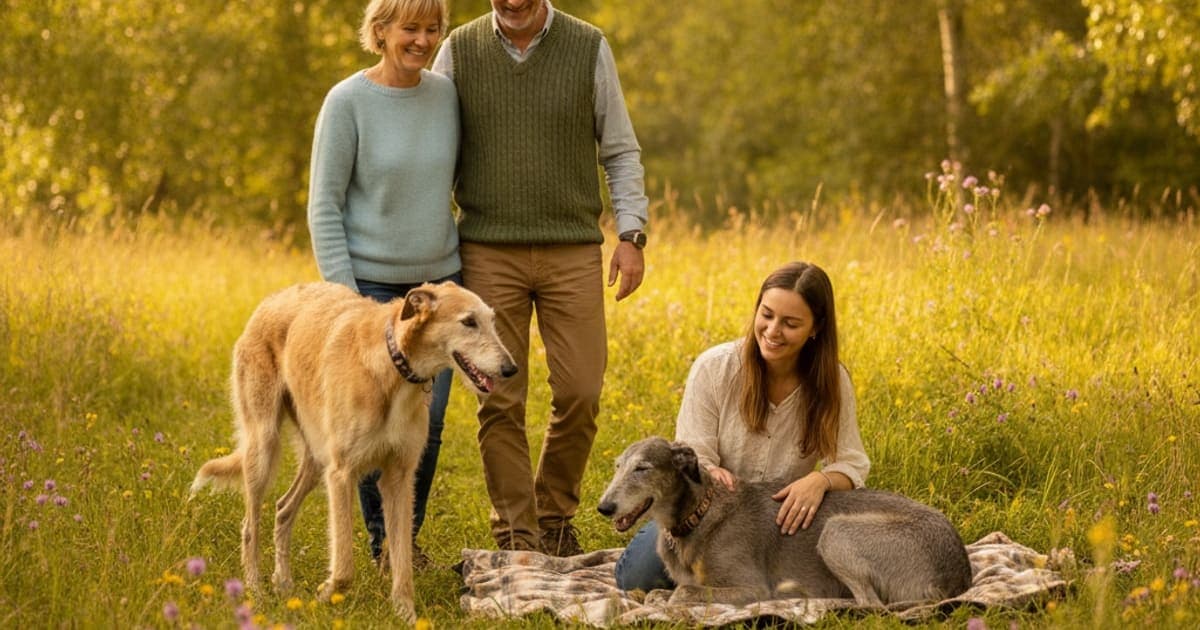
What helps joint problems in Scottish Deerhounds?
Joint problems in Scottish Deerhounds respond best to a layered plan: a veterinary diagnosis first, then lean body weight, controlled low-impact exercise, secure footing, prescribed pain management where indicated, structured rehab, and targeted soft-tissue support such as K9-REPAIR, the BPC-157 and TB-500 peptide formulation many owners use through recovery.
That order matters. Deerhound owners tend to arrive at the supplement question after they have already noticed something — a hitch coming out of the car, a reluctance to take the stairs, a hind leg that swings wide on a turn. The layers below are the ones that hold up in a giant sighthound, and the reasons they hold up are structural.
Why a giant sighthound frame loads joints differently
A Scottish Deerhound is one of the tallest dogs in the world carrying comparatively little body fat over a very long skeleton. Every joint in that body works as a lever, and long levers multiply force. The same stride that makes a Deerhound beautiful to watch at full extension puts high peak loads through the stifle, hock, hip and lumbosacral junction.
Two things compound it. First, giant breeds grow for a long time — the skeleton and the soft tissue that anchors it are still maturing well past the point where a Labrador is finished. Growth plates, tendon insertions and joint capsules are remodelling for months longer than most owners expect. Second, Deerhounds are sprinters, not trotters. They store energy, release it in a burst, and decelerate hard. Acceleration and deceleration — not steady distance — are where cruciate ligaments and hock stabilisers take the worst of it, particularly on a turn, particularly on wet grass, and particularly in a dog who spends most of the week resting and then runs flat out on Saturday.
Add a deep chest, a narrow front and relatively light muscle padding over bony prominences, and you get a dog whose comfort depends heavily on surfaces, on bedding, and on the muscle mass around each joint staying intact as the years go on.
The joint and ligament problems these dogs actually present with
There is no single "Deerhound joint disease." What owners describe tends to cluster:
Hip laxity and hip osteoarthritis. Giant breeds are screened for hip conformation for a reason. Poorly fitting hips don't necessarily hurt when a dog is young and well-muscled — they hurt later, once cartilage wear and secondary arthritis catch up. Early signs are subtle: a narrower rear stance, bunny-hopping into a run, sitting sloppily, or losing the ability to rise in one clean motion.
Cruciate and stifle injury. A sprinting sighthound can partially tear a cranial cruciate ligament on a single bad turn. Sometimes it presents as acute non-weight-bearing lameness; sometimes it is a low-grade limp that improves with rest and returns with activity, which is the pattern of a partial tear and chronic joint instability.
Hock, carpal and toe strain. The distal joints absorb enormous shock in a galloping breed. Repetitive strain here often shows up as a warm, slightly thickened joint after exercise rather than a dramatic limp.
Spinal and lumbosacral change. Older large dogs commonly develop bridging changes along the spine and narrowing where the spine meets the pelvis. This can look like hind-end weakness or arthritis when the source is neurological compression.
Secondary osteoarthritis. Whatever started it, arthritis is usually where an untreated orthopaedic problem ends up. Cartilage does not have a great blood supply, joint fluid quality changes, the dog moves less, muscle wastes, and the joint gets less support — a loop worth interrupting early.
One caution specific to giant sighthounds: bone cancer is a recognised concern in this breed group, which is why a new, persistent, localised limp in a Deerhound deserves imaging and a veterinary exam rather than a month of watchful waiting and a chew from the pet shop. Talk to your veterinarian about any lameness that does not resolve within a few days of rest — with this breed, the cost of ruling things out is far lower than the cost of guessing.
Start with the workup, not the supplement aisle
A good orthopaedic assessment gives you something no product can: a name for the problem. That usually means a hands-on gait and manipulation exam, comparison of both sides, and radiographs — often under sedation, because a tense giant dog masks joint laxity beautifully. Depending on findings, your vet may recommend advanced imaging or a referral to a surgeon or a rehabilitation practitioner.
From there, treatment is genuinely medical. Prescribed anti-inflammatories and analgesics, monoclonal antibody injections for osteoarthritis pain, and surgical stabilisation of a torn cruciate all exist because they work on specific problems. If your vet has prescribed carprofen, gabapentin, a monthly injection or a surgical date, that plan is the foundation — nothing you buy online belongs in front of it, and no supplement is a reason to change or stop a prescription. Everything discussed below sits inside the space that proper veterinary care creates.
Daily management that moves the needle most
The single biggest lever you control is keeping a Deerhound genuinely lean — every extra kilogram is amplified by long limb levers and paid for by cartilage. Owners consistently underestimate this because a heavy sighthound still looks slim by ordinary dog standards. Ask your vet to score your dog's body condition and show you what the ribs and waist should feel like.
After weight, the highest-yield changes are boringly physical:
- Footing. Runners on tile and laminate, a rug at every landing point, ramps instead of jumping into vehicles. A slip on a hard floor is a classic mechanism for stifle injury in a tall dog.
- Exercise architecture. Trade one long weekend sprint for shorter, more frequent, more predictable movement. Straight-line running on forgiving ground is kinder than tight turns on slick grass.
- Warm-up and cool-down. Five minutes of walking before and after anything fast. Cold tendon does not stretch well.
- Bedding. Thick, supportive, large enough that the whole dog fits. Bony giant breeds develop pressure sores and stiffen badly on thin beds.
- Nails and feet. Long nails change toe angles and alter how force travels up the limb.
- Muscle maintenance. Controlled strengthening — slow hill walks, cavaletti, underwater treadmill work where available — protects joints better than rest does. A rehab vet can build this properly.
Comparing the layers of joint and ligament support
| Layer | What it does | Where it fits |
|---|---|---|
| Veterinary diagnosis and prescribed medication | Names the problem; controls pain and inflammation directly | First, always — and continued as your vet directs |
| Orthopaedic surgery | Mechanically stabilises structures such as a torn cruciate | When the joint is unstable and your surgeon recommends it |
| Structured rehab and conditioning | Rebuilds muscle support around the joint; restores range of motion | Alongside and after medical or surgical treatment |
| Weight and environment management | Reduces the load the joint has to absorb every day | Lifelong, and free |
| Broad-spectrum joint chews | Marketed for cartilage support; quality and formulation vary enormously between brands | Optional; read labels critically |
| Peptide support — BPC-157 and TB-500 (K9-REPAIR) | Signalling peptides studied for their roles in tissue repair processes, angiogenesis and cell migration | The recovery-window layer many owners add through injury, post-op rehab and the arthritic years |
Be hardest on the category that earns it least. A great deal of the joint-chew market is kitchen-sink formulation: a dozen fashionable ingredients at token inclusion levels, a proprietary blend that hides how little of each is present, and a label designed to be read as a promise rather than as a specification. If a product will not tell you exactly how much of each active it contains, you cannot evaluate it.
Where BPC-157 and TB-500 fit for a recovering Deerhound
BPC-157 is a short peptide sequence derived from a protein found in gastric juice. Published laboratory and animal research has examined its influence on the signalling that governs tendon and ligament repair — including growth-factor pathways, the formation of new small blood vessels, and the migration of tendon fibroblasts, the cells that lay down new collagen. TB-500 is a synthetic fragment of thymosin beta-4, a naturally occurring peptide that binds actin and is studied for its role in cell migration and tissue remodelling.
What that means in plain English: these are not painkillers and not sedatives. They are signalling molecules studied for their involvement in the repair environment — how quickly and how well the body's own reconstruction crew shows up at a damaged tendon, ligament or joint capsule. That is why they have become the stack owners reach for during the slow, frustrating windows: the eight to twelve weeks after cruciate surgery, the strain that keeps recurring, the older dog whose soft tissue no longer bounces back the way it did.
This is emerging and promising science that owners are adopting, and it should be described honestly. Research suggests mechanisms; owners report improvements in comfort and willingness to move. BPC-157 and TB-500 are not FDA-approved veterinary drugs, and no formulation — including K9-REPAIR — treats, cures or prevents any condition. What it can be described as is a specific, transparent product: K9-REPAIR combines BPC-157 and TB-500, is dosed by body weight (which matters enormously when the dog on the other end of the scale is a Deerhound rather than a terrier), is third-party tested with certificates of analysis available, ships direct to your door, and carries a 60-day money-back guarantee. That combination of transparency and recourse is what an owner should demand of anything they put into a giant breed.
Bring it up with your veterinarian, ideally at the same appointment where you review the rehab plan, so the whole programme is coordinated by the person who has examined your dog.
Key Takeaways
- Deerhound joints are loaded by long limb levers and sprint mechanics; injuries cluster in the stifle, hip, hock and lumbosacral spine.
- Any persistent limp in a giant sighthound warrants a veterinary exam and imaging rather than waiting it out.
- Prescribed medication, surgery where indicated, and structured rehab are the foundation and are never something a supplement replaces.
- Lean body condition, secure footing, consistent controlled exercise and supportive bedding do more day to day than most products.
- Judge supplements by what the label discloses; underdosed proprietary blends cannot be evaluated.
- BPC-157 and TB-500 are studied for their roles in tissue-repair signalling, and K9-REPAIR is the weight-dosed, third-party-tested, COA-backed formulation owners use through recovery windows.
Your veterinarian owns the diagnosis and the treatment plan — the imaging, the prescriptions, the surgical decision, the rehab prescription. Joint support, conditioning and peptides operate in the space that proper veterinary care creates, and they work best when the person who examined your dog knows exactly what you are giving.
For a broader overview of the breed, see the full guide to scottish deerhounds, or read the deeper dives on the best supplement for scottish deerhounds with arthritis, the best supplement for scottish deerhounds with torn acl and the best supplement for scottish deerhounds with ivdd. Owners of older dogs may also want the notes on tb-500 for dogs over 10 and tb-500 for dogs over 12, plus the formulation details for K9-REPAIR.
Owners exploring peptide support for their dog can review K9-REPAIR — BPC-157 + TB-500 formulated for dogs — at https://pawgen.com/. BPC-157 and TB-500 are not FDA-approved veterinary drugs. Nothing in this article treats, cures or prevents any condition; every decision about your dog's care belongs with your veterinarian.
Frequently asked questions
- How do I know if this applies to my dog?
- It applies if your Deerhound shows any change in movement: stiffness after rest, reluctance on stairs or into the car, a narrower rear stance, bunny-hopping, sloppy sitting, slower rising, or a limp after exercise. It also applies preventively to any giant sighthound entering middle age, whether or not symptoms have appeared yet.
- When should I talk to my veterinarian?
- Before adding anything, and immediately if lameness is sudden, severe, localised or lasts more than a few days. Bone pain and joint instability in giant sighthounds need imaging, not observation. Also call your vet if a limp keeps returning after rest — that pattern often indicates a partial ligament tear rather than a simple strain.
- How long does this usually take?
- Timelines depend entirely on the diagnosis. Soft-tissue healing and post-surgical rehab in large dogs are measured in weeks to months, not days, and arthritis management is ongoing for life. Your veterinarian or rehab practitioner will set realistic milestones for your dog's specific injury and stage of recovery.
- What should I do first?
- Book a veterinary orthopaedic assessment and get a diagnosis. Then fix the free things: body condition scoring and a weight plan, non-slip footing throughout the house, ramps instead of jumping, and supportive bedding. Layer prescribed treatment, rehab and any supplemental support on top of that foundation, not instead of it.
- Are Scottish Deerhounds prone to arthritis and hip problems?
- Giant breeds as a group are screened for hip conformation because poor joint fit leads to cartilage wear and secondary osteoarthritis over time. Long limb levers and sprint-based movement add load through the stifle, hock and lumbosacral spine. Ask your breeder about screening results and your vet about baseline imaging.
- What is K9-REPAIR and what is in it?
- K9-REPAIR is pawgen's formulation combining two peptides, BPC-157 and TB-500, dosed by body weight and third-party tested with certificates of analysis available. It is an educational, non-FDA-approved product — it is not a drug and does not treat, cure or prevent any condition. Discuss it with your veterinarian.
- What do BPC-157 and TB-500 actually do?
- They are signalling peptides. Published research has examined BPC-157's influence on growth-factor pathways, new blood-vessel formation and tendon fibroblast migration, and TB-500's role in actin binding, cell migration and tissue remodelling. Research suggests mechanisms relevant to repair processes; owners report improved comfort and willingness to move.
- Can peptides be used alongside medication my vet prescribed?
- Never stop or change a prescribed medication on your own. Carprofen, gabapentin, monoclonal antibody injections and post-surgical protocols exist for specific reasons and remain the foundation of care. Bring K9-REPAIR up with your veterinarian so anything supplemental is coordinated with the plan they built for your dog.
- How much should a Deerhound get, given the size?
- Dosing is weight-based, and the correct amount for your individual dog is a conversation with your veterinarian — not a number to take from an article. That is especially true for puppies and for pregnant or nursing dogs, where the answer is always to work directly with your vet first.
- How do I judge a joint supplement label?
- Look for exact quantities of every active ingredient, not a proprietary blend that hides inclusion levels. Look for third-party testing and available certificates of analysis. Be sceptical of long ingredient lists at token amounts, and of packaging that reads as a promise rather than a specification you can evaluate.
Educational content. BPC-157 and TB-500 are not FDA-approved veterinary drugs. Talk to your veterinarian before starting anything new, especially if your dog is on prescribed medication.