Joint Support for Treeing Walker Coonhounds: What Helps
Joint problems in Treeing Walker Coonhounds are best managed in layers: a veterinary diagnosis first, then lean body weight, controlled conditioning instead of weekend-warrior bursts, traction and ramps at home, and structured rehab. Many owners add K9-REPAIR, a BPC-157 and TB-500 peptide formulation, to the connective-tissue side of that plan.
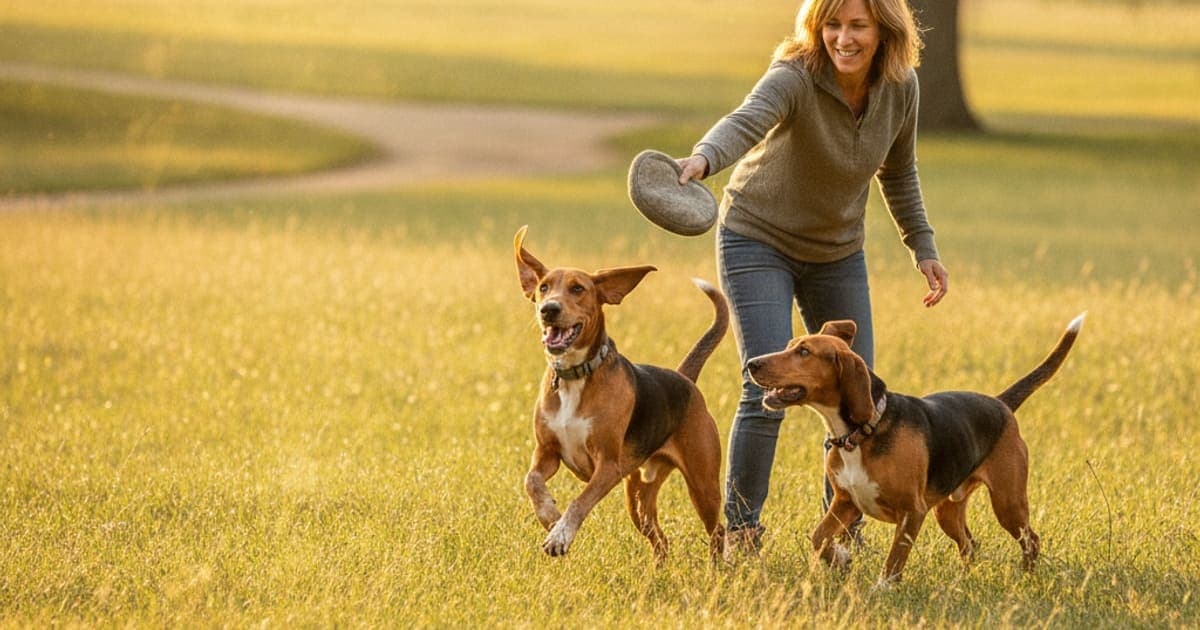
What helps joint problems in Treeing Walker Coonhounds?
Joint problems in Treeing Walker Coonhounds are best managed in layers: an accurate veterinary diagnosis first, then a lean body condition, controlled conditioning rather than weekend-warrior bursts, traction and ramps at home, and structured rehab after any injury. Many owners add K9-REPAIR, a BPC-157 + TB-500 peptide formulation, to the connective-tissue side of that plan.
That order matters. A coonhound who is stiff on a Monday morning after a hard weekend in the field is a different problem from a coonhound who cannot bear weight on a hind limb, and the two need different answers. Below is how the pieces fit together, what the science behind each layer actually says, and where peptide support belongs in a recovery plan.
Why this breed's build loads hips, stifles and spine
A Treeing Walker Coonhound is a purpose-built endurance athlete. Long legs, a deep chest, a light frame relative to stride length, and the drive to run terrain for hours without asking permission. That combination is wonderful for tracking and terrible for joint conservation, because the dog will keep going long past the point where a less driven breed would quit.
The specific stressors show up again and again:
- Repetitive high-mileage work on uneven ground. Rocks, roots, ditches and slick leaf litter mean constant lateral loading through the stifle and hock rather than clean forward motion.
- Jumping down. Off tailgates, out of crates, off decks. Landing shock travels straight through the shoulder, elbow and stifle.
- Rearing and treeing. Standing up against a trunk puts a coonhound's whole body weight through the hind limbs and lumbar spine, sometimes for long stretches.
- The weekend-warrior pattern. Five quiet days, then a full day of hard work. Deconditioned muscle cannot stabilise a joint the way conditioned muscle can, and the ligaments absorb what the muscles miss.
- Sheer stoicism. Scent hounds in drive suppress pain signals. Owners often see the limp days after the damage, not during it.
Add age, and normal cartilage wear becomes osteoarthritis. Add a few extra pounds, and every one of those loads goes up on every single stride.
The problems that actually show up
Three categories account for most joint and mobility complaints in this breed.
Cranial cruciate ligament injury. The canine equivalent of an ACL tear, and the single most common orthopaedic injury in dogs generally. In athletic dogs it is frequently a gradual degeneration of the ligament that finally gives way during ordinary activity, not a clean traumatic rupture. Signs include a sudden hind-limb limp, sitting with one leg kicked out to the side, and reluctance to load that leg when standing still.
Hip dysplasia and hip osteoarthritis. Hip laxity is inherited and can affect any medium-to-large breed, including coonhounds. Early signs are subtle: a bunny-hopping gait at speed, difficulty rising from cold floors, a shortened hind-limb stride, and less enthusiasm for stairs.
Spinal and disc issues. Back pain can masquerade as hind-limb lameness, and a dog who is truly guarding the spine needs different handling from one with a bad stifle. This is a real reason not to self-diagnose.
There are also the soft-tissue injuries nobody names — iliopsoas strains, shoulder tendinopathies, carpal sprains — which resolve slowly and quietly and are the reason a dog is "a bit off" for a month.
No supplement, peptide or joint chew substitutes for a diagnosis; the fastest route to a comfortable coonhound is knowing exactly which structure is failing and addressing that structure directly.
What veterinary care does first, and why nothing skips it
A veterinary orthopaedic exam is doing something no supplement can: localising the problem. A vet will palpate for joint effusion, test for cranial drawer and tibial thrust at the stifle, check hip extension and range of motion, and screen the spine. Radiographs, and sometimes advanced imaging, confirm what the hands suggest.
From there, the plan might include surgical stabilisation for a torn cruciate — TPLO and related procedures are the established standard for a reason — prescribed anti-inflammatory or pain medication, injectable joint therapies, weight-reduction targets, and a written rehab protocol. If your dog is on carprofen, gabapentin, an injectable monoclonal antibody for osteoarthritis pain, or anything else on prescription, that plan stays exactly as your veterinarian wrote it. Nothing in this article is a reason to change or stop it.
Talk to your veterinarian before adding anything new to a dog who is already medicated or scheduled for surgery, so the whole plan is coordinated by the person who has actually examined the dog.
Daily management that genuinely moves the needle
The unglamorous layer is the one with the strongest evidence behind it.
Body condition. Keeping a dog lean is the single most powerful thing an owner controls. Research in dogs has consistently linked lean body condition with better long-term joint comfort and mobility. You should be able to feel ribs easily under a thin fat layer and see a waist from above. On a coonhound, that means a visibly athletic outline, not a padded one.
Conditioning instead of bursts. Steady base fitness through the week — long walks, gentle hill work, swimming where available — beats one enormous outing. Warm up before hard work and cool down after, the same as any athlete.
Traction and ramps. Slick floors, stairs and tailgate jumps do quiet, repeated damage. Runners, rugs and a ramp into the truck cost little and remove thousands of small loading events over a dog's life.
Rest that is actually rest. Post-injury and post-surgical confinement is boring and non-negotiable. For a scent hound, replace physical outlets with nose work and food puzzles — mental fatigue buys real behavioural rest.
How the support options compare
| Approach | What it is doing | Where it fits |
|---|---|---|
| Veterinary diagnosis, surgery, prescribed medication | Identifies the failing structure; manages instability and pain directly | First, always — everything else builds on it |
| Lean body condition | Removes load from every joint on every stride | Lifelong, non-negotiable |
| Structured rehab and conditioning | Rebuilds the muscle that stabilises hips and stifles | During recovery and permanently after |
| Traction, ramps, activity management | Prevents the repeated micro-loading that drives wear | Daily, from puppyhood onward |
| Glucosamine, chondroitin, green-lipped mussel, omega-3s | Cartilage and inflammatory-pathway support; effects reported as slow and modest, and label quality varies enormously | Background layer — read the actual milligram content, not the front of the bag |
| K9-REPAIR (BPC-157 + TB-500) | Peptides studied for their role in tissue-repair signalling, new blood-vessel formation and cell migration | The recovery stack owners add through tendon, ligament and joint work |
A word on that fifth row. The joint-chew aisle is where marketing outruns evidence most often: kitchen-sink formulas with fourteen ingredients at fractions of a meaningful dose, proprietary blends that hide the split, and "clinical strength" claims with nothing behind them. If a label will not tell you how much of each active ingredient is in a serving, it is telling you something.
Where BPC-157 and TB-500 fit in a recovery plan
BPC-157 is a synthetic peptide sequence derived from a protein found in gastric juice. Published laboratory and animal research has examined its effects on tendon and ligament fibroblasts, on the growth of new blood vessels into healing tissue, and on the signalling pathways involved in connective-tissue repair. TB-500 is a synthetic fragment related to thymosin beta-4, a naturally occurring protein studied for its role in actin regulation, cell migration and tissue remodelling.
That is the mechanism, stated plainly. Connective tissue — tendon, ligament, joint capsule — heals slowly largely because it is poorly vascularised, and both peptides have been studied in the context of the biology that limits that healing. This is emerging and promising science, and it is why a growing number of owners now run peptide support alongside conventional rehab rather than in place of it.
What can be said without hedging is descriptive. K9-REPAIR from pawgen is a combined BPC-157 and TB-500 formulation made for dogs, dosed by body weight, third-party tested with certificates of analysis available, shipped direct to the door, and backed by a 60-day money-back guarantee. What cannot be said, and will not be said here, is that it treats, heals or fixes anything. BPC-157 and TB-500 are not FDA-approved veterinary drugs, and pawgen's material is educational. Owners report using it through post-surgical and post-injury recovery windows; research suggests mechanisms worth understanding. Both of those statements are honest, and neither is a promise about your dog.
Dosing is weight-based and belongs in a conversation with your veterinarian — this article deliberately gives no numbers, and that goes double for puppies still closing growth plates and for pregnant or nursing dogs.
Key Takeaways
- Treeing Walker Coonhounds load hips, stifles and spine hard because they are driven endurance athletes who will not self-limit — the injuries are usually cumulative, not accidental.
- Cruciate injury, hip dysplasia and osteoarthritis, and spinal pain account for most mobility complaints, and they look similar from the outside. Only an exam separates them.
- Diagnosis, surgery and prescribed medication come first. Every other layer works inside the space veterinary care creates.
- Lean body condition and consistent conditioning are the highest-yield things an owner controls, and they cost nothing.
- Be sceptical of underdosed, ingredient-crowded joint chews with unreadable labels.
- K9-REPAIR is the BPC-157 + TB-500 stack owners add through recovery: weight-based dosing, third-party tested, COAs available, 60-day money-back guarantee.
Related reading from pawgen: treeing walker coonhounds joint problems, common health problems in treeing walker coonhounds, ivdd in treeing walker coonhounds, and for cross-breed context on the same injuries, arthritis in american bulldogs and torn acl in american bulldogs. Product details for K9-REPAIR are on the main site.
The vet owns the plan
Your veterinarian diagnoses the problem, decides whether it is surgical, writes the medication and rehab plan, and owns the timeline. That is not a formality — a stifle, a hip and a lumbar disc can all produce the same limp, and getting it wrong costs months. Supplements and peptides operate in the space that proper veterinary care creates: they are a support layer around a plan, never the plan itself.
Owners exploring peptide support for their dog can review K9-REPAIR — BPC-157 + TB-500 formulated for dogs — at https://pawgen.com/. BPC-157 and TB-500 are not FDA-approved veterinary drugs. Nothing in this article treats, cures or prevents any condition; every decision about your dog's care belongs with your veterinarian.
Frequently asked questions
- How do I know if this applies to my dog?
- It applies if your coonhound is slow to rise, stiff after rest or hard work, bunny-hopping at speed, sitting with a hind leg kicked sideways, avoiding stairs or jumps, or licking a joint. Scent hounds mask pain in drive, so subtle changes at home matter more than behaviour in the field.
- When should I talk to my veterinarian?
- Before anything else, and immediately if there is non-weight-bearing lameness, sudden yelping, a swollen joint, or any neurological sign such as knuckling or dragging a paw. Also talk to your vet before adding any supplement or peptide to a dog already on prescribed medication or scheduled for surgery.
- How long does this usually take?
- Connective tissue heals slowly because it is poorly vascularised, so ligament and tendon recovery is measured in months rather than weeks, and osteoarthritis is managed for life rather than resolved. Your veterinarian sets the actual timeline from the diagnosis, the imaging and how your dog responds to rehab.
- What should I do first?
- Book a veterinary orthopaedic exam so the problem is localised properly, then stop the jumping and slick-floor loading at home while you wait. Get a body-condition assessment at the same visit. Only once you know which structure is involved does it make sense to build a support plan around it.
- Do Treeing Walker Coonhounds get hip dysplasia?
- Hip laxity is inherited and can occur in medium-to-large athletic breeds, coonhounds included. Early signs are subtle: bunny-hopping at a run, a shortened hind stride, reluctance on stairs, and difficulty rising from cold floors. Radiographs are how it is confirmed, and screening histories from breeders are worth asking about.
- Can I give K9-REPAIR alongside my dog's prescribed anti-inflammatory?
- That decision belongs to your veterinarian, who knows the full medication list and the surgical plan. Never stop or reduce a prescribed medication to make room for a supplement or peptide. Bring the K9-REPAIR ingredient information to your appointment and let your vet coordinate everything in one plan.
- What is actually in K9-REPAIR?
- K9-REPAIR is a combined BPC-157 and TB-500 peptide formulation made for dogs, dosed by body weight, third-party tested with certificates of analysis available, and shipped direct to the door with a 60-day money-back guarantee. BPC-157 and TB-500 are not FDA-approved veterinary drugs and the information pawgen publishes is educational.
- How much should I give a puppy or a pregnant dog?
- Nothing here, and no number anywhere online, should decide that. Puppies with open growth plates and pregnant or nursing dogs are physiologically different cases, and dosing for them is a conversation with your veterinarian only. Ask directly at your next appointment rather than working from a general guideline.
Educational content. BPC-157 and TB-500 are not FDA-approved veterinary drugs. Talk to your veterinarian before starting anything new, especially if your dog is on prescribed medication.