Joint Effusion in Dogs: Signs, Causes and What Helps
Joint effusion in dogs is an abnormal buildup of fluid inside a joint capsule, most commonly the knee. It shows up as puffiness, warmth and limping, and it signals inflammation, injury, infection or degeneration inside the joint. The fluid is a sign, not a diagnosis — the cause determines everything that follows.
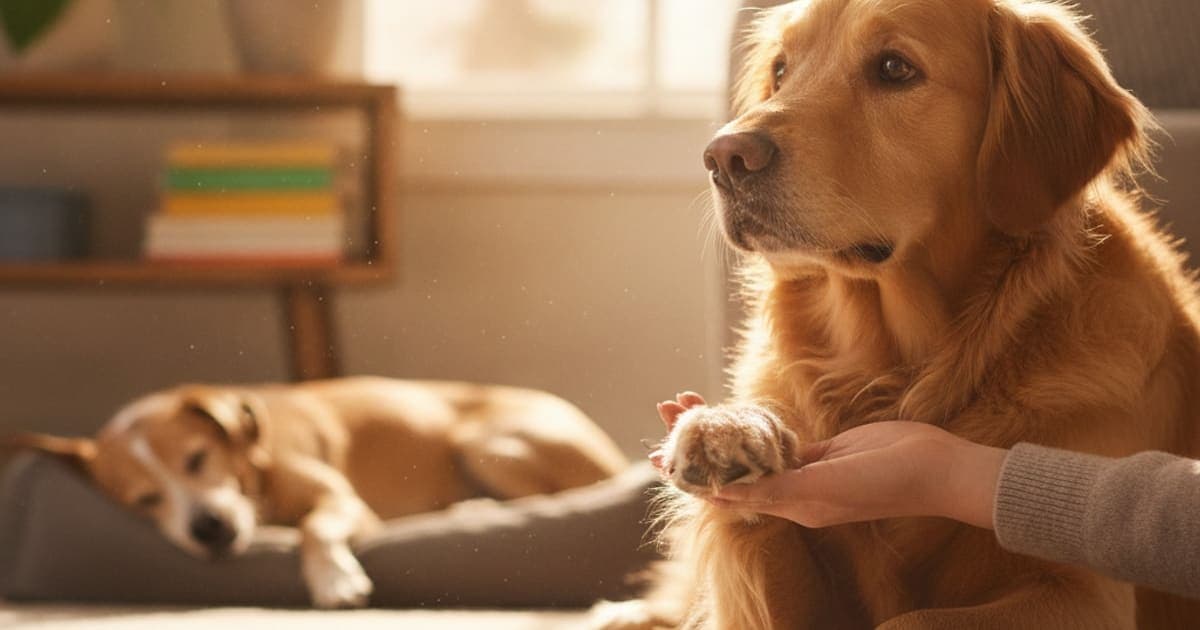
What is joint effusion in dogs?
Joint effusion in dogs is an abnormal buildup of fluid inside a joint capsule, most often the knee (stifle). The joint looks puffy, feels warm or spongy under the fingers, and the dog usually limps or shifts weight off the leg. Effusion is a sign of trouble inside the joint — not a diagnosis on its own.
That distinction matters more than anything else you will read on this page. Two dogs can present with an identically swollen knee: one has a partially torn cruciate ligament that needs a surgical plan, the other has an infected joint that needs antibiotics within days. The swelling looks the same from the outside. What happens next is completely different.
Why a joint fills with fluid in the first place
Every healthy joint is a sealed capsule lined with a thin membrane called the synovium. That membrane produces a small volume of synovial fluid — slippery, viscous, and just enough to lubricate cartilage and ferry nutrients to tissue that has no blood supply of its own.
When something inside the joint is irritated, the synovium responds the way any inflamed tissue does. Blood vessels dilate, inflammatory mediators flood in, and the membrane starts producing far more fluid than it should. That fluid is also thinner and less protective than normal. The capsule stretches to hold the extra volume, pressure rises inside a space that has almost no room to give, and stretch receptors in the capsule wall report that as pain.
So effusion is the joint's alarm system working correctly. The capsule distends, the dog offloads the limb, and you notice a knee that suddenly looks fuller than the other one. Effusion is a signal, not a disease — the fluid tells you a joint is in trouble, and only your veterinarian can tell you which trouble it is.
Signs owners usually notice first
Effusion rarely announces itself as obvious swelling on day one. More often it shows up as a cluster of small changes:
- A knee or hock that looks fuller than its partner. Compare left to right while the dog stands square. Subtle asymmetry around the stifle is one of the earliest visible clues.
- Warmth or a spongy feel. Fluid-filled pouches on either side of the kneecap tendon feel soft and boggy rather than firm.
- Stiffness after rest that eases with movement. Classic for degenerative causes — the dog is worst getting off the bed and looser after ten minutes.
- The sit test. A dog with a painful, effused stifle often sits with the leg kicked out to the side instead of tucked underneath.
- Reluctance to jump, take stairs, or load the car. Owners frequently register this before they register a limp.
- Licking or fussing at one joint. Persistent attention to a single spot is worth a photograph and a note of the date.
- Fever, lethargy, or shifting lameness in several legs. This pattern — more than one joint, plus a dog that feels genuinely unwell — needs same-day veterinary attention, not a wait-and-see week.
If you are seeing any of these, book the appointment. An orthopaedic exam is far more informative on a joint that has been swollen for a week than one that has been swollen for four months.
The conditions that most often sit behind the swelling
Effusion is a shared endpoint for a long list of orthopaedic and systemic problems. These are the ones veterinarians work through most often.
| Underlying cause | What it often looks like | Joints most involved |
|---|---|---|
| Cranial cruciate ligament (CCL) tear, partial or complete | Sudden or slowly worsening hind-limb lameness, sitting with the leg kicked out, thickening on the inside of the knee | Stifle (knee) |
| Osteoarthritis | Stiffness after rest, gradually narrowing range of motion, worse in cold weather | Hips, elbows, stifles, spine |
| Septic (infected) arthritis | Marked heat and severe pain, usually one joint, sometimes fever and appetite loss, often after a wound, bite or procedure | Any single joint |
| Immune-mediated polyarthritis | Shifting lameness across several joints, fever, a dog that simply will not get up | Multiple, often smaller distal joints |
| Osteochondritis dissecans (OCD) | Lameness in a young, fast-growing large-breed dog | Shoulder, elbow, hock, stifle |
| Sprain, trauma or joint instability | Acute onset after a slip, twist or bad landing | Carpus, hock, stifle |
| Bicipital tenosynovitis | Foreleg lameness, pain on shoulder extension and flexion | Shoulder |
| Joint tumours (uncommon) | Persistent swelling that does not fit the usual patterns or respond as expected | Any |
The reason this list matters: an anti-inflammatory that makes an arthritic knee more comfortable can mask a septic joint while cartilage is being destroyed. Cause first, plan second. Always.
How veterinarians work out what is going on
A good diagnostic workup moves from cheap and non-invasive to specific and definitive.
Gait analysis and palpation. Your vet watches the dog walk and trot, then feels each joint for heat, fluid pouches, thickening, crepitus and pain on flexion. Specific tests — cranial drawer and tibial compression for the cruciate, for example — check for instability.
Radiographs. X-rays do not show ligaments, but they show the consequences: capsular distension as a soft-tissue shadow, bone spurs, joint space changes, fragments and OCD lesions. Sedation is usually needed to get diagnostic positioning.
Arthrocentesis. A sample of joint fluid is drawn with a fine needle and examined under a microscope. This is the single most decisive test available, because the cell population in the fluid separates degenerative joint disease from immune-mediated inflammation from infection — three problems that look identical from the outside and are managed in three entirely different ways. Culture and tick-borne disease testing may follow.
Advanced imaging or arthroscopy. Ultrasound, CT, MRI or a camera inside the joint are used when the answer is still unclear or when surgical planning requires seeing the cartilage and menisci directly.
This is exactly the point to talk to your veterinarian rather than to the internet. No supplement, peptide or home protocol substitutes for knowing whether a joint is infected.
What treatment looks like once the cause is known
Management is aimed at the cause, not at the fluid itself.
Surgery is the appropriate answer for many structural problems — cruciate stabilisation procedures such as TPLO or TTA, removal of OCD flaps, meniscal repair, or arthrodesis for severe carpal breakdown. If your vet or a board-certified surgeon recommends an operation, that recommendation is based on instability that will not resolve without mechanical correction.
Medication is the appropriate answer for others: antibiotics guided by culture for septic arthritis, immunosuppressive therapy for immune-mediated polyarthritis, and prescribed analgesics or anti-inflammatories for pain control. If your dog is on carprofen, Librela, gabapentin, prednisone or anything else, that plan belongs to your veterinarian. Nothing you read here is a reason to change or stop it.
Around both of those sit the things that quietly decide how well a dog does long term: strict activity restriction during the acute phase, a controlled return to loading rather than a weekend of zoomies, formal rehabilitation and hydrotherapy where available, traction on slick floors, ramps instead of jumps, and lean body condition. Excess weight is one of the few variables an owner fully controls, and it changes the load through every joint on every step.
Supporting the body's repair window at home
Surgery and medication create the conditions for repair. The repair itself is cellular work — fibroblasts laying down collagen, new capillaries growing into damaged tissue, and that collagen slowly reorganising along lines of load over weeks. Ligament and tendon do this slowly, because they are poorly vascularised to begin with.
That window is where owners look for support, and it is where the shelf gets crowded with kitchen-sink chews: fifteen ingredients on the label, most of them present in amounts too small to do anything, sold on packaging rather than on evidence. Scepticism is warranted there.
Peptides are a different category. BPC-157 is a synthetic peptide based on a sequence identified in gastric juice, and laboratory and animal research suggests it interacts with pathways involved in angiogenesis and fibroblast activity — the same processes soft tissue depends on while it rebuilds. TB-500 is a synthetic peptide related to thymosin beta-4, a naturally occurring protein involved in actin regulation and cell migration. Neither is an FDA-approved veterinary drug, and neither treats, cures or reverses any condition. What can be said honestly is that the mechanisms are well described, the science is moving quickly, and owners increasingly adopt them through a recovery period.
pawgen formulates both into K9-REPAIR, the stack many owners run alongside veterinary care during rehab. It is made for dogs, third-party tested with certificates of analysis available, scaled by body weight, shipped direct to the door, and backed by a 60-day money-back guarantee. Dosing is a conversation for you and your veterinarian — never a number from a blog — and your vet should know about anything your dog is taking while a joint is healing.
Key Takeaways
- Joint effusion is excess fluid inside a joint capsule, and it is a sign of an underlying problem rather than a diagnosis in itself.
- The knee is the most commonly affected joint, and cruciate ligament injury is a leading cause in dogs.
- Swelling plus fever, or swelling in several joints at once, warrants same-day veterinary attention.
- Analysis of joint fluid is the most decisive test for separating degenerative, immune-mediated and infectious causes.
- Treatment targets the cause: surgery for instability, antibiotics for infection, immunosuppression for immune-mediated disease, and prescribed pain control throughout.
- Weight control, traction, controlled activity and formal rehab influence long-term outcomes more than most owners expect.
- Research suggests BPC-157 and TB-500 interact with pathways involved in tissue repair, and owners report using K9-REPAIR through recovery alongside — never instead of — veterinary care.
Where your veterinarian fits, and where everything else fits
The diagnosis and the treatment plan belong to your veterinarian. They are the one who can feel the joint, read the fluid, interpret the images and decide whether this dog needs a surgeon, an antibiotic or a rehab referral. Supplements and peptides operate in the space that proper veterinary care creates — they support a body already pointed in the right direction by a correct diagnosis.
For deeper reading, pawgen covers joint effusion in full, along with what helps a dog with joint effusion, how long does joint effusion take to heal in dogs, and how to prevent joint effusion in dogs. If the affected joint is a shoulder or a wrist, see k9-repair for bicipital tenosynovitis in dogs and k9-repair for carpal hyperextension in dogs. Bring what you learn to your veterinarian — the plan should always be built with them.
Owners exploring peptide support for their dog can review K9-REPAIR — BPC-157 + TB-500 formulated for dogs — at https://pawgen.com/. BPC-157 and TB-500 are not FDA-approved veterinary drugs. Nothing in this article treats, cures or prevents any condition; every decision about your dog's care belongs with your veterinarian.
Frequently asked questions
- How is joint effusion diagnosed in dogs?
- Diagnosis starts with a hands-on orthopaedic exam: watching the gait, comparing joints side to side, and testing for instability and pain. Radiographs show capsular distension and bony change. Analysis of a joint fluid sample is the most decisive step, because it separates degenerative, immune-mediated and infectious causes. Advanced imaging or arthroscopy follows when needed.
- What helps a dog with joint effusion?
- What helps depends entirely on the cause, so a veterinary diagnosis comes first. From there: prescribed pain control, cause-specific treatment, strict activity restriction, controlled reintroduction of load, rehabilitation, traction underfoot and a lean body condition. Many owners also run K9-REPAIR through the recovery window alongside their vet's plan, never instead of it.
- How long does joint effusion take to heal in dogs?
- There is no single timeline, because the fluid resolves only when its cause does. A mild sprain may settle quickly, while ligament injury, post-surgical recovery or immune-mediated disease is measured in months of controlled rehabilitation. Let your veterinarian's recheck examinations — not a calendar estimate — decide when activity increases.
- Is joint effusion in dogs painful?
- Usually yes. The joint capsule is richly supplied with nerve endings, and stretching it with excess fluid raises internal pressure and triggers pain. Dogs hide this well, so lameness, stiffness after rest, reluctance to jump or a changed sitting posture may be your only clues. Pain control is a veterinary decision.
- What makes joint effusion worse in dogs?
- Uncontrolled activity is the biggest factor — off-lead running, jumping, stairs and slick floors reload a joint that is trying to stabilise. Excess body weight increases force through every step. Skipping rechecks, stopping prescribed medication early, or returning to normal exercise as soon as the limp fades all commonly set recovery back.
- Can joint effusion in dogs be reversed?
- The swelling can resolve when the underlying cause is successfully addressed — an infection cleared, an unstable joint surgically stabilised, immune-mediated inflammation controlled. Where the driver is chronic osteoarthritis, effusion is usually managed rather than eliminated, with the goal being comfort and function. Your veterinarian can tell you which situation applies to your dog.
- Which joints are most often affected in dogs?
- The stifle, or knee, is by far the most common site, largely because cranial cruciate ligament injury is so frequent in dogs. The hock, carpus, elbow and shoulder are also affected regularly. Swelling in several joints at once points toward a systemic cause and should be assessed urgently rather than monitored at home.
- Is joint effusion in dogs an emergency?
- It can be. A single hot, exquisitely painful joint, a dog with a fever, or lameness shifting between several legs may indicate septic arthritis or immune-mediated disease, both of which need prompt veterinary attention. A mild limp with slight puffiness is less urgent but still deserves an appointment rather than a wait-and-see month.
Educational content. BPC-157 and TB-500 are not FDA-approved veterinary drugs. Talk to your veterinarian before starting anything new, especially if your dog is on prescribed medication.