Joint Support for Wirehaired Pointing Griffons — What Helps
Joint problems in wirehaired pointing griffons respond best to a layered plan: a veterinary diagnosis first, then lean body weight, year-round conditioning, prescribed pain control when indicated, and structured rehab. Many owners add targeted recovery support through the slow soft-tissue phase, including peptide formulations such as K9-REPAIR, built on BPC-157 and TB-500.
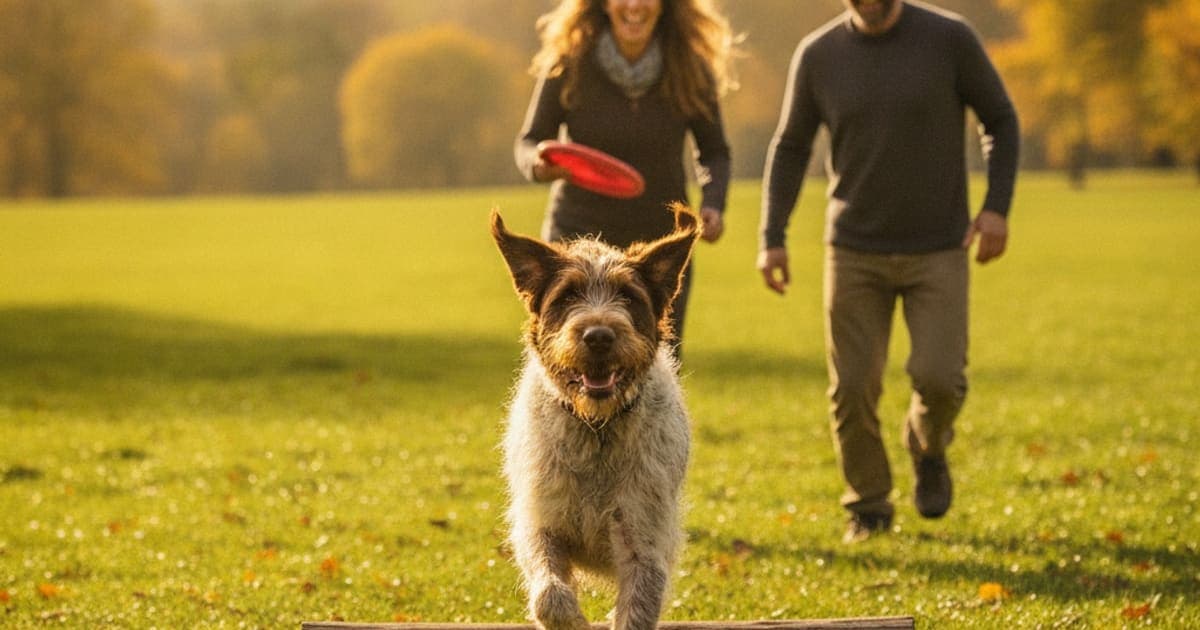
What helps most is a layered plan: a veterinary diagnosis first, then lean body weight, year-round conditioning instead of weekend bursts, prescribed pain control when it is indicated, and structured rehabilitation after any injury. On top of that foundation, many owners add targeted recovery support through the slow soft-tissue phase, including peptide formulations such as K9-REPAIR (BPC-157 + TB-500).
That order matters. Nothing you buy outperforms an accurate diagnosis and a lean dog, and nothing you buy is a reason to skip either one.
Why a griffon's build and workload put pressure on joints
The wirehaired pointing griffon is a versatile gundog — a medium-to-large, moderately angulated, deep-chested dog bred to quarter heavy cover for hours and keep going. That athleticism is exactly the thing that loads the joints, and the breed's temperament compounds it. Griffons are stoic and biddable. A griffon that hurts will usually keep working, because working is what it wants to do. Owners frequently discover a problem weeks after the dog first felt it.
Three structures do most of the complaining.
Hips and elbows. Hip dysplasia and elbow dysplasia are developmental orthopaedic conditions seen across medium and large breeds, in which the joint forms with imperfect congruity and then accumulates wear. That is why hip and elbow evaluation through screening registries such as OFA and PennHIP is a standard part of a responsible breeding program, and why asking a breeder about parental screening is a reasonable question rather than a rude one.
The stifle, and the cranial cruciate ligament. The CCL is the canine equivalent of the human ACL, but it usually fails differently. In dogs, cruciate disease is most often a progressive degenerative process — collagen fibres weaken over months, the ligament loses tensile strength, and the day the dog goes suddenly lame is frequently the day an already-compromised ligament finally gives way. This is why a bird dog can appear perfect on Saturday and non-weight-bearing on Sunday after nothing dramatic at all. It is also why the opposite stifle deserves attention after one side fails.
The spine and the soft tissue around everything. Lumbosacral discomfort, iliopsoas strain and chronic shoulder soreness are all common in dogs that jump out of tailgates and pivot at speed on uneven ground. These are frequently missed because they do not produce a clean, obvious limp.
Osteoarthritis is the downstream consequence of all of the above. Once cartilage is compromised and the joint capsule is inflamed, the condition is managed rather than undone, which is precisely why early recognition is worth so much.
The early signs, which rarely start as a limp
By the time a griffon limps, the problem has usually been developing for a while. The earlier signals are behavioural and easy to explain away.
Watch for a dog that sits down slightly askew, with one hind leg kicked out to the side. Watch for a reluctance to jump into the truck when it used to launch itself in, or a pause at the bottom of the stairs. Watch for a shortened stride at the trot, a bunny-hopping gait behind, stiffness in the first few minutes after a long nap that loosens as the dog warms up, or a dog that starts lying down during grooming when it used to stand. Licking at a single joint is worth noting. So is a dog that is slower to rise from a hard floor than a soft bed.
In the field, the tell is often endurance rather than gait: the griffon that used to hunt hard for three hours now fades earlier, or starts taking itself out of the cover and working closer. Griffons do not usually advertise pain. They ration effort instead.
Film your dog. A slow-motion phone video of your griffon trotting away from you and back, on a flat surface, on a loose lead, is genuinely useful to a veterinarian and captures things the eye misses in the exam room — especially since many dogs are too adrenalised at the clinic to show a subtle lameness.
The daily foundation that changes outcomes
Body condition is the highest-leverage variable you control. Every extra pound is loaded through every step of every hunt, and excess adipose tissue is metabolically active — it contributes to a low-grade inflammatory state rather than sitting there inertly. Learn to score your griffon's body condition by hand: ribs easily felt under a thin fat cover, a visible waist from above, an abdominal tuck from the side. Ask your veterinarian to score the dog with you once, so you calibrate to something other than your own hopes.
Conditioning beats weekend intensity. The injury pattern in gundogs is not usually the dog that works too much; it is the dog that does nothing for five months and then works flat out on opening weekend. Tendons and ligaments adapt to load far more slowly than cardiovascular fitness does, so a dog can feel fit long before its connective tissue is ready. Steady off-season roadwork, hill walking, controlled swimming and structured warm-ups make a measurable difference to tissue tolerance.
Manage surfaces and impact. Rugs or runners on slick floors, a ramp for the truck, and fewer high-velocity fetch sessions with hard cutting turns all reduce the cumulative micro-trauma that quietly builds toward a cruciate failure.
Rehab is not optional after injury or surgery. If your griffon has a stifle repair such as a TPLO, or is being managed conservatively, a certified canine rehabilitation practitioner is one of the best investments available. Controlled exercise, underwater treadmill work and progressive strengthening rebuild the muscle that protects the joint.
And prescribed medication stays prescribed. If your veterinarian has your dog on an NSAID, a monoclonal antibody for osteoarthritis pain, gabapentin or anything else, nothing in this article is a reason to change it. Talk to your veterinarian before you add, remove or alter anything.
How the common support approaches compare
| Approach | What it does | What it does not do |
|---|---|---|
| Weight and conditioning | Reduces load on every joint and builds tissue tolerance | Nothing, if the diagnosis is wrong |
| Veterinary diagnostics and surgery | Identifies the failing structure and restores stifle stability | Rebuild the muscle — that is rehab's job |
| Prescribed pain management | Controls pain and inflammation under veterinary direction | Address the underlying mechanics |
| Structured rehabilitation | Rebuilds strength, proprioception and range of motion | Work without owner consistency |
| Joint chews (glucosamine, chondroitin, omega-3) | Long-standing category; quality and transparency vary enormously | Guarantee what is actually in the bag without a COA |
| Peptide support (BPC-157 + TB-500) | Signalling molecules owners add through the soft-tissue recovery window | Stand in for surgery, prescriptions or rehab; they are discussed alongside veterinary care |
Point your skepticism at the shelf, not at the science. The joint-chew aisle is full of kitchen-sink formulas with a dozen headline ingredients hidden inside a proprietary blend, where nothing is present in a meaningful amount and no certificate of analysis exists. Ask for third-party testing. Ask what is actually in the dose. A brand that will not tell you is telling you something.
What BPC-157 and TB-500 do, and why owners add them
Both are peptides — short chains of amino acids that act as signalling molecules rather than as nutrients.
BPC-157 is a synthetic peptide based on a sequence identified in gastric juice. Preclinical research suggests it may influence angiogenesis (the formation of new blood vessels), growth factor signalling and the migration of fibroblasts — the cells that lay down collagen in tendon and ligament. That matters for a structure like the cruciate ligament, which has a notoriously modest blood supply; connective tissue recovers slowly in part because it is poorly perfused, and research interest in BPC-157 centres on that vascular and fibroblast-signalling angle.
TB-500 is a synthetic version of a fragment related to thymosin beta-4, a naturally occurring peptide involved in actin regulation, cell migration and tissue remodelling. Early evidence indicates it may support the cell-migration side of repair — the process by which reparative cells reach and reorganise damaged tissue.
Owners pair them because the mechanisms are complementary rather than duplicative, which is the reasoning behind the K9-REPAIR formulation from pawgen: BPC-157 and TB-500 together, dosed by body weight, third-party tested with certificates of analysis available, shipped direct to your door, and backed by a 60-day money-back guarantee. It is the stack a growing number of owners use through the recovery window rather than a shelf product bought on a hunch.
Be clear about the boundaries. BPC-157 and TB-500 are research peptides offered for educational use, not veterinary drugs. Nothing here treats, cures or prevents any condition, and no honest brand will tell you what will happen to your specific dog. The science is emerging and promising, and it belongs alongside veterinary care — never instead of it. Dosing is weight-based and is a conversation to have with your veterinarian, who knows your griffon's history and medications.
No supplement, peptide or otherwise, stands in for a diagnosis — the highest-value thing you can do for a griffon with a joint problem is find out exactly which structure is failing before you build a plan around it.
Where to start, depending on where you are
If your griffon is young and sound
This is the cheapest phase to act in. Keep the dog lean, condition year-round, ask your breeder about hip and elbow screening in the parents, and establish a baseline gait video now so you have something to compare against in four years.
If you are seeing stiffness or reduced stamina
Book the exam. Bring your video and a written log of when the stiffness appears — after rest, after work, in cold weather. Ask specifically whether the findings point to hips, stifle, spine or soft tissue, because the management plan diverges sharply from there.
If there is an acute lameness or a surgery date
Follow the surgeon's protocol exactly, including the restricted activity phase that feels excessive. Book rehab before the surgery, not after. Ask your veterinarian about supportive additions, including peptides, in the context of everything else your dog is receiving.
Key takeaways
- Griffons are stoic working dogs; the first sign of joint trouble is usually reduced stamina or a change in how the dog sits, not a limp.
- Hip and elbow dysplasia and degenerative cruciate disease are the three patterns worth knowing, and parental screening through OFA or PennHIP is a fair question for any breeder.
- Lean body weight and year-round conditioning outperform every product on the shelf.
- Surgery, prescribed medication and structured rehab are the backbone of care; supplemental options are discussed alongside veterinary care rather than in place of it.
- Judge any supplement by third-party testing, a certificate of analysis and a disclosed dose — not by the number of ingredients on the front of the bag.
- BPC-157 and TB-500 are signalling peptides that research suggests may support the tissue-repair environment; they are what many owners add during the slow soft-tissue recovery window.
Your veterinarian owns the diagnosis and the treatment plan. Imaging, surgical decisions, pain protocols and the timeline for returning to work are theirs to make, and they are the only person who can weigh a supplement against your griffon's specific history and current medications. Supplements and peptides operate in the space that proper veterinary care creates — they do not create it.
For more on this breed, see the wider material on joint and mobility health in wirehaired pointing griffons, including the deeper dives on supplement choices for arthritis, cruciate injuries and disc disease. Owners comparing patterns across similar working breeds may also find the pieces on arthritis and cruciate injuries in Chesapeake Bay retrievers useful, and the formulation details for K9-REPAIR sit on the main pawgen site.
Owners exploring peptide support for their dog can review K9-REPAIR — BPC-157 + TB-500 formulated for dogs — at https://pawgen.com/. BPC-157 and TB-500 are research peptides offered for educational use, not veterinary drugs. Nothing in this article treats, cures or prevents any condition; every decision about your dog's care belongs with your veterinarian.
Frequently asked questions
- How do I know if this applies to my dog?
- It applies if your griffon shows stiffness after rest, sits with a hind leg kicked out, hesitates at stairs or the tailgate, or fades earlier in the field than it used to. Any medium-to-large working breed carries orthopaedic risk. A veterinary exam confirms whether the pattern is joint-related.
- When should I talk to my veterinarian?
- Before you change anything, and immediately if there is sudden lameness, non-weight-bearing on a leg, yelping, or swelling around a joint. Also talk to them before adding any supplement or peptide, since they know your griffon's medications, surgical history and current pain protocol better than any article can.
- How long does this usually take?
- Connective tissue works on a slow clock. Ligament and tendon repair progresses through inflammatory, proliferative and remodelling phases measured in months rather than days, and collagen continues reorganising well after a dog looks comfortable. Your surgeon or rehabilitation practitioner sets the actual timeline for your dog's return to work.
- What should I do first?
- Get a diagnosis. Film your griffon trotting on a flat surface, note when the stiffness appears, and book a veterinary exam so you know which structure is involved. Then address body condition. Products of any kind belong after those two steps, not before them.
- Are wirehaired pointing griffons prone to hip problems?
- Hip and elbow dysplasia are developmental conditions seen across medium and large breeds, which is why screening registries such as OFA and PennHIP exist and why reputable breeders evaluate breeding stock. Ask about parental screening results. Individual risk still depends on genetics, growth rate and body condition.
- What is K9-REPAIR, and what is in it?
- K9-REPAIR is the pawgen formulation combining two peptides, BPC-157 and TB-500, dosed by body weight, third-party tested with certificates of analysis, shipped direct to your door and backed by a 60-day money-back guarantee. It is educational-use support, not a veterinary drug.
- Can my griffon keep hunting with arthritis?
- Often yes, with modifications your veterinarian designs. Many arthritic gundogs continue working at reduced intensity with good pain management, thorough warm-ups, lean body weight and shorter sessions. The variables are severity, which joints are involved and how the dog responds to its current plan.
- Do joint chews work for griffons?
- Ingredient quality and dosing vary enormously across the category. Judge any chew by whether the amount of each active ingredient is disclosed, whether third-party testing and a certificate of analysis are available, and whether the formula is focused rather than a long list of trace-level additions.
Educational content. BPC-157 and TB-500 are not FDA-approved veterinary drugs. Talk to your veterinarian before starting anything new, especially if your dog is on prescribed medication.