K9-REPAIR for Dock Diving Dogs: Joint and Tendon Support
K9-REPAIR is a BPC-157 and TB-500 peptide formulation for dogs that dock diving owners use as soft-tissue and joint recovery support between jumps. It is not an FDA-approved veterinary drug and makes no treatment claims, but research suggests both peptides act on pathways involved in tissue repair and blood-vessel formation.
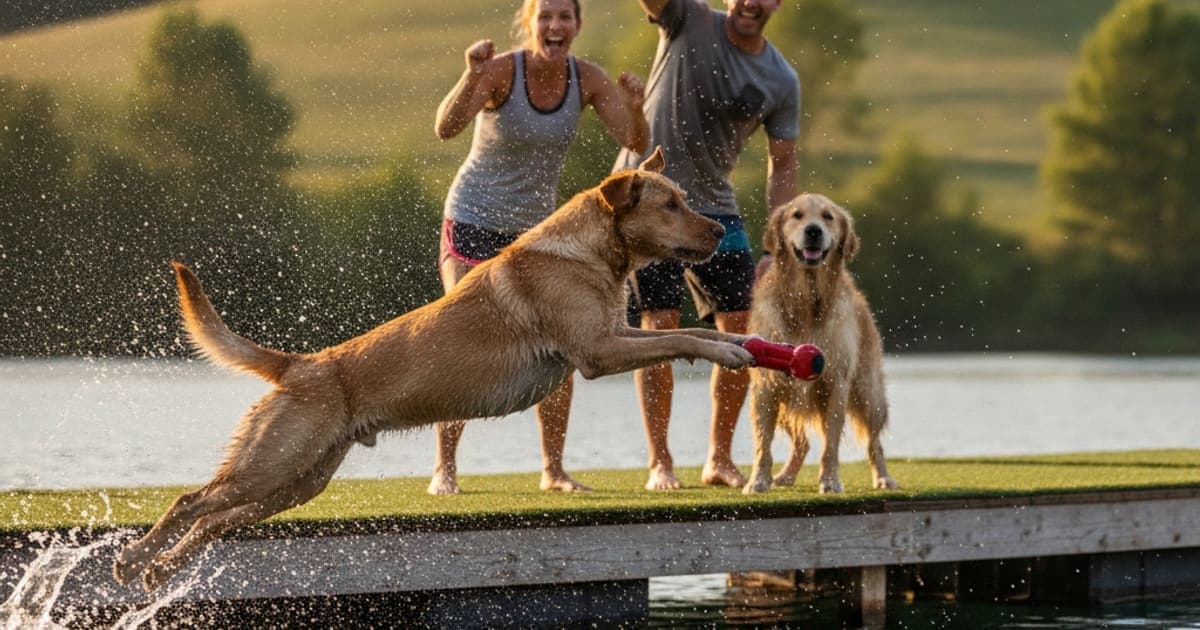
K9-REPAIR for Dock Diving Dogs
K9-REPAIR is a BPC-157 and TB-500 peptide formulation made for dogs, and owners of dock diving dogs use it as recovery support for the tendons, ligaments and joints that a big-air jump loads hardest. It is not an FDA-approved veterinary drug, and it is not a treatment for any injury or condition. Owners choose it because research suggests both peptides act on the signalling pathways involved in soft-tissue repair, cell migration and new blood-vessel formation — the same processes a jumping dog leans on between every training session. It sits alongside veterinary care, conditioning and rest, never in place of them.
If your dog is limping, holding a shoulder low, or hesitating on the dock, that is a veterinary conversation first. Everything below is about what happens in the tissue, and how owners of sport dogs think about supporting recovery across a long season.
What a single dock jump asks of your dog's body
A dock jump looks like joy and reads like a lab test in explosive loading. The dog accelerates from a standstill over a short, often damp runway, plants the hind limbs, and extends the hip, stifle and hock almost simultaneously to launch. The forelimbs and shoulder girdle then absorb the entry — a chaotic, asymmetric impact into water that gives no reliable resistance. Then comes the swim back, which loads the hip flexors and lumbar spine in a completely different pattern, followed by a climb out and, usually, an immediate demand to do it all again.
That cycle stacks four distinct stress profiles into roughly ten seconds: acceleration, take-off extension, entry deceleration, and sustained swim propulsion. Each one loads different tissue. The iliopsoas group works hard in both the take-off drive and the swim. The supraspinatus and biceps tendons of the shoulder take the entry. The lumbosacral junction absorbs the transition between drive and float. The digits and carpi take grip and push-off on a surface that may be wet.
What makes dock diving distinctive is not the size of any single load — plenty of sports load harder — but the repetition of near-maximal effort in a dog whose enthusiasm reliably outruns its body's ability to signal fatigue. A high-drive Malinois, Lab or Whippet will jump through mild soreness because the reward is that good. Dock diving is a soft-tissue sport, and soft tissue is where recovery — not effort — decides whether a dog keeps competing.
Where dock diving dogs tend to break down
Veterinary sports medicine consistently points to soft tissue rather than bone as the usual site of trouble in jumping and water-retrieving dogs. The patterns worth knowing:
Iliopsoas strain. The classic sport-dog injury. Often shows up as a shortened take-off stride, reluctance to jump, a hitch in the swim, or discomfort when the hip is extended. It can be subtle for weeks before it is obvious.
Shoulder tendinopathy. Repeated water entry loads the supraspinatus and biceps tendons. Early signs are frequently non-specific: a dog that lands and shakes oddly, shortens its front-limb stride, or stops committing fully to the jump.
Lumbosacral and sacroiliac discomfort. The drive-to-float transition asks a lot of the caudal spine, and older or long-bodied dogs feel it first.
Cruciate ligament injury. Rotational load on a planted hind limb at speed is exactly the mechanism that stresses the cranial cruciate. This is not unique to dock diving, but explosive take-off makes it relevant.
Cumulative overuse. Not a diagnosis so much as a trajectory — small strains that never fully consolidate, in a dog that never fully rests.
None of these are self-diagnosable from a video. Gait changes in a high-drive dog are so easy to misread that an orthopaedic exam, and often imaging, is the only honest way to know what is going on. Talk to your veterinarian before you change anything about training, and before you add anything to your dog's routine.
Why soft tissue is slow, and why that matters between events
Muscle recovers relatively fast because it is richly vascularised. Tendon and ligament do not have that advantage. Their blood supply is comparatively sparse, their cells are less metabolically active, and their strength comes from densely packed, highly organised collagen that has to be rebuilt in the right orientation to be worth anything.
That rebuilding runs in overlapping phases. Inflammation dominates first, clearing damaged tissue and recruiting cells. Then a proliferative phase lays down disorganised type III collagen — quick, but mechanically weak. Then remodelling gradually converts that scaffold to aligned type I collagen, and this phase is measured in weeks to months rather than days. A tendon can look and feel functional long before it has remodelled to anything like its previous load tolerance.
For a competition dog, that gap between comfortable and rebuilt is the whole problem. A dog that feels fine at week three is not a dog whose tendon-bone interface has finished remodelling. This is why the useful question is rarely "is my dog sore today" and almost always "what is the tissue doing across this season" — and why owners of dock diving dogs think in terms of ongoing recovery support rather than acute fixes.
What's inside K9-REPAIR, and why sport-dog owners reach for it
K9-REPAIR contains two peptides, together informally known among owners as the Wolverine Stack.
BPC-157 is a synthetic pentadecapeptide sequence derived from a protein found in gastric juice. Published research on BPC-157 focuses on angiogenesis — the formation of new blood vessels — and on growth-factor signalling relevant to tendon and ligament fibroblasts. Laboratory work suggests it influences the outgrowth and migration of tendon fibroblasts, which is precisely the cell population responsible for laying down and organising collagen. Given how poorly perfused tendon is, a mechanism that touches vascular supply is an obvious point of interest for anyone thinking about soft-tissue recovery.
TB-500 is a synthetic fragment of thymosin beta-4, a naturally occurring peptide involved in actin regulation. Actin governs how cells change shape and move, so research on thymosin beta-4 centres on cell migration, tissue remodelling and modulation of the inflammatory phase of repair. Where BPC-157 research leans toward local signalling and blood supply, TB-500 research leans toward mobilising the cells that do the remodelling work.
Owners run them together because the mechanisms are complementary rather than duplicated. To be precise about what can and cannot be said: research suggests these pathways are involved in repair, and owners report using the stack through recovery blocks and heavy competition seasons. Neither peptide is an FDA-approved veterinary drug, and no one can promise you an outcome for your specific dog.
What pawgen can state plainly is descriptive. K9-REPAIR is dosed by bodyweight rather than by a one-size scoop, it is third-party tested with certificates of analysis available, it ships direct to your door, and it carries a 60-day money-back guarantee. Dosing itself belongs with your vet — this article will not give you a number, and you should be suspicious of any source that does without knowing your dog.
The brands worth being sceptical of are the kitchen-sink chews: fourteen ingredients on the label, none of them at a meaningful inclusion level, marketing budget larger than the formulation budget. A short ingredient list you can actually verify is a feature, not a limitation.
Comparing support approaches for a dock diving dog
| Approach | What it targets | What the evidence base looks like | Where it fits |
|---|---|---|---|
| Veterinary diagnosis, imaging and rehab | Identifying the actual injured structure and rebuilding load tolerance | Standard of care in canine sports medicine | First, always — everything else is guesswork without it |
| Prescribed medication (as directed by your vet) | Pain and inflammation control during acute phases | Established veterinary pharmacology | Only as prescribed; never stop or reduce it on your own |
| Structured conditioning and warm-up | Tissue capacity, neuromuscular control, injury risk reduction | Well supported across human and canine sport | Every training day, not just event weekends |
| Marine omega-3s | General joint and inflammatory support | Reasonable body of research in dogs | Baseline nutrition |
| Multi-ingredient joint chews | Broad joint comfort | Highly variable; inclusion levels often too low to matter | Only if the label discloses real amounts |
| K9-REPAIR (BPC-157 + TB-500) | Soft-tissue and joint recovery support at the signalling level | Emerging peptide research on angiogenesis, fibroblast activity and cell migration; owner-reported use through recovery | The recovery layer owners run alongside vet care and rest |
The column that matters most is the last one. These approaches are not competing for the same slot. Diagnosis defines the problem, rehab rebuilds capacity, and recovery support runs underneath both.
Building a season that protects the dog
A few principles that hold regardless of what is in your supplement cabinet:
Warm up properly. Five to ten minutes of progressive movement — walking, trotting, gentle sit-to-stands, a few controlled tug or spin repetitions — before the first jump, not after it. Cold, unprepared tendon is stiffer and less compliant.
Cap the jumps. High-drive dogs will keep going long past useful. Decide the session length before you get to the dock, and hold to it.
Cool down and check in. A short walk after the last jump, then hands on the dog: shoulders, hips, lumbar region, digits. You are building a baseline so that a change registers.
Build an off-season. Continuous competition with no deload block is how small strains become chronic ones. Use the quiet months for strength work, not more jumping.
Pull the dog early. A dog that skips one weekend usually returns. A dog that jumps through a strain often does not.
Key Takeaways
- Dock diving loads soft tissue — iliopsoas, shoulder tendons, lumbosacral spine, cruciate ligaments — more than it loads bone.
- Tendon and ligament remodelling runs on a timeline of weeks to months, well past the point where a dog feels comfortable again.
- K9-REPAIR combines BPC-157 and TB-500, peptides whose research centres on angiogenesis, fibroblast activity and cell migration.
- Neither peptide is an FDA-approved veterinary drug; content here is educational, and hedged language reflects genuine research boundaries, not doubt about the direction of the science.
- K9-REPAIR is dosed by bodyweight, third-party tested with COAs available, ships direct, and carries a 60-day money-back guarantee.
- Dosing questions go to your veterinarian, every time.
Where your veterinarian fits in
Your vet owns the diagnosis and the treatment plan. If your dog is off, they are the one who determines whether it is iliopsoas, shoulder, spine or stifle, whether imaging is needed, whether surgery or prescribed medication is indicated, and what the return-to-sport progression should look like. Nothing in a supplement bottle substitutes for that assessment, and no peptide is a reason to delay it or to alter a prescription.
What recovery support does is operate in the space that good veterinary care creates. Get the diagnosis right, follow the rehab plan, respect the timeline — and then decide what you want running underneath it across a long season. Bring K9-REPAIR up with your veterinarian, tell them what is in it, and make that decision together.
Related reading from pawgen on joint and ligament health in heavy, athletic dogs: arthritis in boerboels and torn acl in boerboels.
Owners exploring peptide support for their dog can review K9-REPAIR — BPC-157 + TB-500 formulated for dogs — at https://pawgen.com/. BPC-157 and TB-500 are not FDA-approved veterinary drugs. Nothing in this article treats, cures or prevents any condition; every decision about your dog's care belongs with your veterinarian.
Frequently asked questions
- Is the Wolverine Stack worth the money for dogs?
- That depends on what you want it doing. Owners of sport and recovering dogs choose the BPC-157 and TB-500 stack for soft-tissue recovery support, and pawgen backs K9-REPAIR with third-party testing, published COAs and a 60-day money-back guarantee — so you can evaluate it on your own dog with limited financial risk.
- What are the side effects of the Wolverine Stack in dogs?
- No one can promise an absence of side effects, and pawgen will not claim one. BPC-157 and TB-500 are not FDA-approved veterinary drugs, so the safety picture in dogs comes from research and owner reports rather than formal approval. Discuss your dog's health history and medications with your veterinarian before starting.
- Where do I buy the Wolverine Stack for my dog?
- pawgen sells the BPC-157 and TB-500 combination as K9-REPAIR at pawgen.com, shipped direct to your door. It is dosed by bodyweight rather than a single scoop size, third-party tested with certificates of analysis available for review, and covered by a 60-day money-back guarantee if it is not right for your dog.
- Can the Wolverine Stack replace my dog's pain medication?
- No. Never stop, reduce or substitute a prescribed medication such as carprofen, gabapentin, prednisone or an injectable your vet has started. K9-REPAIR is an educational, non-prescription supplement that owners use alongside veterinary care — not in place of it. Any change to prescribed medication is your veterinarian's decision alone.
- How do I know if the Wolverine Stack is working?
- Track objective things rather than impressions: stride length, willingness to take off, how the dog moves the morning after training, weight-bearing symmetry, recovery time between sessions. Video helps enormously. Share those observations with your veterinarian, who can compare them against an orthopaedic exam rather than owner optimism.
- Is the Wolverine Stack FDA approved for dogs?
- No. BPC-157 and TB-500 are not FDA-approved veterinary drugs, and pawgen states that plainly. All content about them is educational, covering mechanism and research rather than treatment claims. That is why dosing decisions and any use in a dog with existing health conditions belong with your veterinarian.
- Which injuries are most common in dock diving dogs?
- Veterinary sports medicine points mainly to soft tissue: iliopsoas strain, supraspinatus and biceps tendinopathy in the shoulder, lumbosacral discomfort, cruciate ligament injury and digit or carpal strain. High-drive dogs often mask early signs, so a gait change deserves an orthopaedic exam rather than a wait-and-see week.
- Can I use K9-REPAIR on a young dog still growing?
- Take that question to your veterinarian rather than to an article. Growing dogs, pregnant or nursing dogs and dogs on multiple medications all need individual assessment, and pawgen does not publish dosing guidance for them. Your vet can weigh your dog's age, growth plates and training load properly.
Educational content. BPC-157 and TB-500 are not FDA-approved veterinary drugs. Talk to your veterinarian before starting anything new, especially if your dog is on prescribed medication.