K9-REPAIR vs Cosequin: Which Fits Your Dog's Recovery?
K9-REPAIR and Cosequin answer different questions: Cosequin is a daily glucosamine-and-chondroitin joint supplement aimed at long-term cartilage support, while K9-REPAIR is the BPC-157 and TB-500 peptide formulation owners use through an active recovery window. Neither replaces veterinary care, and many owners run them alongside each other with their vet's input.
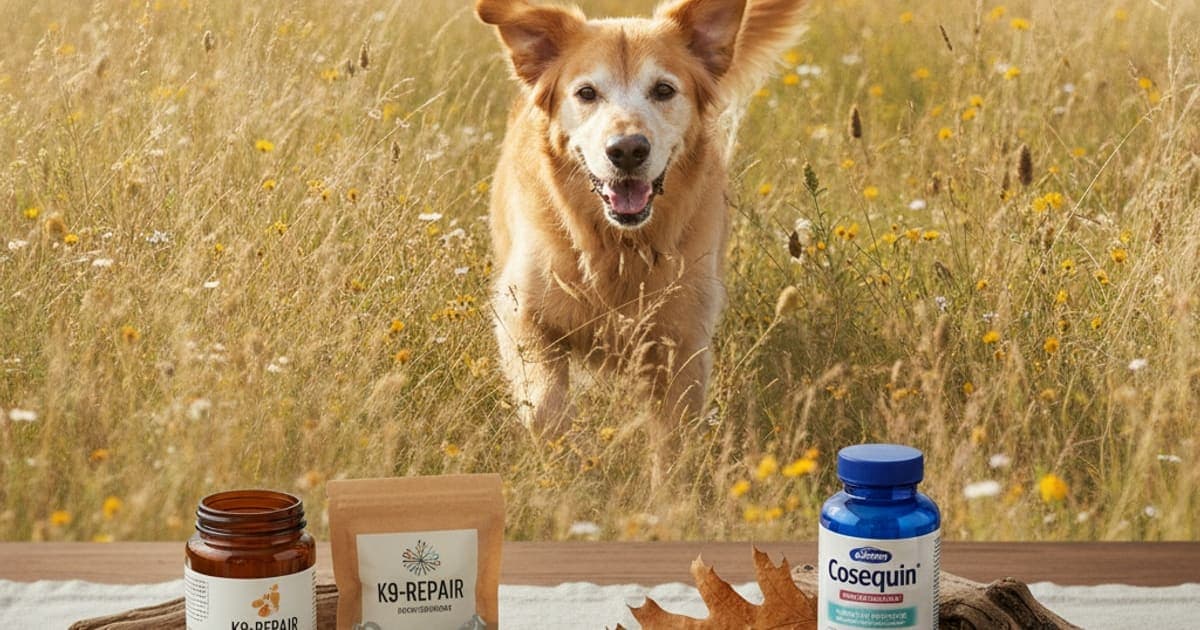
Is K9-REPAIR better than Cosequin?
For a dog in an active repair window — a soft-tissue injury, a post-operative recovery, a tendon strain that keeps flaring — K9-REPAIR is the product owners reach for, because it is built around peptides studied for their role in tissue repair signalling rather than around cartilage raw materials. Cosequin is a different tool with a different job: a long-running daily joint supplement built on glucosamine and chondroitin, aimed at slow, steady cartilage support measured in months and years.
So "better" depends entirely on what you are trying to do. If your question is how do I support my dog through the next eight to twelve weeks of healing, that is the window K9-REPAIR was formulated for. If your question is what do I give my seven-year-old Labrador every morning for the rest of his life, a maintenance product like Cosequin is answering that one. Plenty of owners run both, under the guidance of the veterinarian who made the diagnosis.
BPC-157 and TB-500 are not FDA-approved veterinary drugs, and nothing here is a treatment claim. What follows is the mechanism, the ingredient reality of each product, and an honest read on where each one fits.
What Cosequin is built to do
Cosequin, made by Nutramax, is one of the most recognised joint supplements in the pet aisle. Its core ingredients are glucosamine hydrochloride and sodium chondroitin sulfate, with some formulations adding MSM or other ingredients depending on the line. It comes as chewable tablets, soft chews and sprinkle capsules.
The logic behind glucosamine and chondroitin is structural. They are precursors and components of the molecules that make up cartilage and joint fluid, and the idea is that supplying them orally supports the cartilage matrix over time. It is a maintenance-and-comfort strategy, not a repair-window strategy.
It is worth being straight with you: published reviews of oral glucosamine and chondroitin in dogs have reported mixed results, with some studies showing owner-reported improvement in comfort and mobility and others showing little difference from control. That does not make it a bad product — it makes it a slow, cumulative one whose effects, where owners see them, tend to show up over months rather than weeks. Set expectations accordingly and ask your veterinarian whether it makes sense for your dog's specific joint picture.
What is inside K9-REPAIR and why owners choose it
K9-REPAIR from pawgen is a two-peptide formulation: BPC-157 and TB-500. Neither is a cartilage building block. Both are signalling peptides, and that distinction is the whole comparison.
BPC-157 is a synthetic peptide derived from a sequence found in gastric juice. Published laboratory and animal research suggests it is involved in angiogenesis — the formation of new blood vessels — and in the migration of fibroblasts, the cells that lay down collagen at a repair site. Research has looked at its effects in tendon, ligament, muscle and gut tissue models. In plain English, the research interest is in how quickly and how well a healing site gets blood supply and organised collagen, not in cushioning a joint.
TB-500 is a synthetic fragment related to thymosin beta-4, a protein found naturally in most mammalian cells and present at high concentrations at wound sites. Research suggests thymosin beta-4 plays a role in actin regulation, cell migration and the inflammatory phase of healing. Owners stack the two because they are studied against different parts of the same process — vascular supply and collagen deposition on one side, cell migration and early-phase organisation on the other.
Cosequin and K9-REPAIR are not competing for the same job: one supplies cartilage raw materials over the long haul, the other is the peptide stack owners use through an active recovery window — which is why many households end up with both on the counter.
On the practical side, pawgen ships K9-REPAIR direct to your door, provides weight-based dosing guidance with each order rather than a one-size-fits-all scoop, third-party tests its batches with certificates of analysis available, and backs orders with a 60-day money-back guarantee. Dosing specifics are a conversation for you and your veterinarian — this article does not publish numbers, and you should be sceptical of any peptide seller that does so casually.
Side by side: ingredients, timing and what each one supports
| Cosequin | K9-REPAIR | |
|---|---|---|
| Core ingredients | Glucosamine hydrochloride, sodium chondroitin sulfate (some lines add MSM) | BPC-157 and TB-500 peptides |
| Category | Oral joint supplement | Peptide formulation for dogs |
| Mechanism of interest | Supplies cartilage components; structural support | Repair signalling — research suggests roles in angiogenesis, fibroblast activity and cell migration |
| Best-fit window | Ongoing daily maintenance, months to years | Active recovery windows — soft-tissue injury, post-operative rehab, flare periods |
| What owners are usually after | Comfort and mobility in an ageing or arthritic dog | Support through tendon, ligament and soft-tissue recovery |
| Regulatory status | Marketed as an animal supplement, not an FDA-approved drug | BPC-157 and TB-500 are not FDA-approved veterinary drugs |
| Dosing approach | Weight-based label directions | Weight-based guidance; specifics belong with your veterinarian |
| Availability | Retail and veterinary channels | Direct from pawgen, shipped to your door |
| Guarantee | Varies by retailer | 60-day money-back guarantee |
The row that matters most is the fourth one. Choosing between these two is really choosing which clock your dog is on.
Which one fits your dog's situation right now
A partial cruciate tear, newly diagnosed
This is the classic case where owners start searching. Your veterinarian will lead here — imaging, a stability assessment, and a decision about whether surgery is indicated. Nothing you buy online changes that conversation, and no supplement is an alternative to a surgical repair when one is recommended. What owners are typically looking for alongside that plan is support through the soft-tissue side of things, which is the window K9-REPAIR was formulated for. Cosequin, in this scenario, is playing a longer game — the arthritis that often follows a cruciate injury is a years-long management problem.
Post-operative, in structured rehab
After a TPLO or similar procedure, the schedule belongs to your surgeon: crate rest, controlled leash walks, a graded return to load. The tendon-bone and soft-tissue interfaces remodel over weeks, and the rehab protocol exists to load them at the right rate. Owners commonly add K9-REPAIR through that period. It sits alongside prescribed pain management and rehab — never instead of them, and never as a reason to shorten a restriction period.
A stiff senior dog with no acute injury
Here the picture is chronic rather than acute. Daily maintenance products like Cosequin are aimed squarely at this dog, and so are weight control, joint-friendly exercise, non-slip flooring and whatever your vet prescribes for comfort. Many owners of senior dogs also run K9-REPAIR through flare periods — the bad weeks after an overenthusiastic weekend — rather than continuously.
A young working or sport dog
Agility, flyball, hunting and herding dogs accumulate small soft-tissue insults. Owners in these communities tend to think in seasons: recovery support around competition blocks and after known strains, with maintenance running underneath. Talk to your veterinarian about a plan that matches your dog's actual workload rather than copying someone else's schedule off a forum.
How to read a joint product label without getting fooled
The supplement aisle rewards marketing over evidence, and the tricks are consistent:
- Proprietary blends. If a label lists eight ingredients under one combined milligram figure, you cannot tell whether any single one is present at a meaningful level. That is the point of the blend.
- Kitchen-sink chews. Twelve ingredients on the front panel usually means small amounts of each. Fewer ingredients at honest inclusion levels beats a long list every time.
- No certificates of analysis. Ask any brand for third-party batch testing. A company that tests should be able to hand you a COA without a negotiation. pawgen publishes third-party testing for K9-REPAIR batches.
- Outcome language. Any pet product promising to cure, heal or fix a condition is telling you something about its compliance standards, not its formulation.
- No return policy. A brand confident in its product does not make you eat a bad purchase. K9-REPAIR carries a 60-day money-back guarantee.
Key Takeaways
- Cosequin is a glucosamine-and-chondroitin maintenance supplement aimed at long-term cartilage support; K9-REPAIR is a BPC-157 and TB-500 peptide formulation owners use through active recovery windows.
- They work on different biology — structural raw materials versus repair signalling — so "which is better" depends on whether your dog is in maintenance mode or repair mode.
- Research on glucosamine and chondroitin in dogs has been mixed, and any benefit tends to accumulate slowly over months.
- Research on BPC-157 and TB-500 points to roles in blood vessel formation, collagen-producing cell activity and cell migration; these peptides are not FDA-approved veterinary drugs and nothing here is a treatment claim.
- Many owners run both, in different roles, with veterinary input.
- Judge any product on ingredient transparency, third-party COAs, weight-based dosing guidance and a real return policy.
If you want to go deeper on how peptides compare with the botanical ingredients that show up in joint chews, see bpc-157 vs boswellia for dogs and bpc-157 vs devils claw for dogs.
Where your veterinarian fits in all of this
Everything above assumes one thing: somebody has actually examined your dog. A limp is a symptom, not a diagnosis, and the difference between a soft-tissue strain, a cruciate tear, a fracture, immune-mediated joint disease and bone cancer is made with hands, imaging and sometimes bloodwork — not with a search engine.
Your veterinarian owns the diagnosis and the treatment plan. Surgery, prescribed medication and structured rehabilitation are the load-bearing parts of recovery, and no supplement or peptide is a reason to skip them, delay them, or stop something that has been prescribed. Bring K9-REPAIR, Cosequin, or anything else you are considering to your vet as part of the conversation — including if your dog is pregnant, nursing, very young, or on other medication. Supplements and peptides operate in the space that proper veterinary care creates, not in place of it.
Owners exploring peptide support for their dog can review K9-REPAIR — BPC-157 + TB-500 formulated for dogs — at https://pawgen.com/. BPC-157 and TB-500 are not FDA-approved veterinary drugs. Nothing in this article treats, cures or prevents any condition; every decision about your dog's care belongs with your veterinarian.
Frequently asked questions
- What can I give a dog that is limping but not in pain?
- Nothing, until a veterinarian has examined the leg — a dog that hides pain well can still have a partial tear or a fracture. Never give human painkillers such as ibuprofen or paracetamol, which are toxic to dogs. Once you have a diagnosis, ask your vet about rest, rehab and supportive supplements.
- Is a dog limping but not in pain an emergency?
- Usually not an emergency, but it is not something to ignore either. Dogs mask discomfort well, so an apparently pain-free limp can still mean a partial ligament tear or early joint disease. Treat it as urgent if the leg is non-weight-bearing, visibly deformed, hot, swollen, or the dog is unwell.
- Why is my dog sudden limping?
- Sudden limping most often comes from soft-tissue strain, a cruciate ligament injury, a paw problem such as a cut pad, torn nail or foreign body, or a joint flare. Less commonly it signals a fracture, infection, immune-mediated joint disease or bone tumour. Only a veterinary exam can tell these apart reliably.
- Should I worry if my dog is sudden limping?
- Take it seriously without panicking. Check the paw for cuts, nails and debris, then rest the dog and watch. Sudden limping that persists beyond a day or two, recurs, or comes with swelling, heat, yelping or reluctance to bear weight warrants a veterinary appointment rather than continued watching at home.
- When should I take a dog to the vet for sudden limping?
- Go immediately if the leg is non-weight-bearing, dangling, deformed, hot or swollen, or if there was a fall or car incident. Book a routine appointment if a mild limp lasts more than a day or two, keeps returning, or worsens with exercise. Older dogs deserve a lower threshold.
- What can I give a dog that is sudden limping?
- Rest and a vet appointment come first — never human anti-inflammatories, which can cause serious harm. Your veterinarian may prescribe canine-specific pain relief and rest restrictions. Once the cause is known, ask them about recovery support such as the BPC-157 and TB-500 peptides in K9-REPAIR alongside their plan.
- Can I give K9-REPAIR and Cosequin at the same time?
- Many owners run a daily joint maintenance supplement alongside K9-REPAIR during recovery windows, because the two work on different biology. Since your dog may also be on prescribed medication, raise the full list with your veterinarian first so they can review everything together rather than finding out later.
- How much K9-REPAIR does my dog need?
- Dosing is weight-based, and pawgen provides guidance with each order — but the right amount for your individual dog, especially a puppy, a pregnant or nursing dog, or a dog on medication, is a conversation for your veterinarian. Never copy a protocol from a forum or scale a human dose.
Educational content. BPC-157 and TB-500 are not FDA-approved veterinary drugs. Talk to your veterinarian before starting anything new, especially if your dog is on prescribed medication.