BPC-157 vs Devil's Claw for Dogs: Which Is Better?
For a dog in active tissue recovery, BPC-157 is the more targeted option, because the research around it sits at the level of tissue repair signalling rather than comfort. Devil's claw is a botanical used traditionally to ease stiffness. They answer different questions, and your veterinarian should help you weigh both.
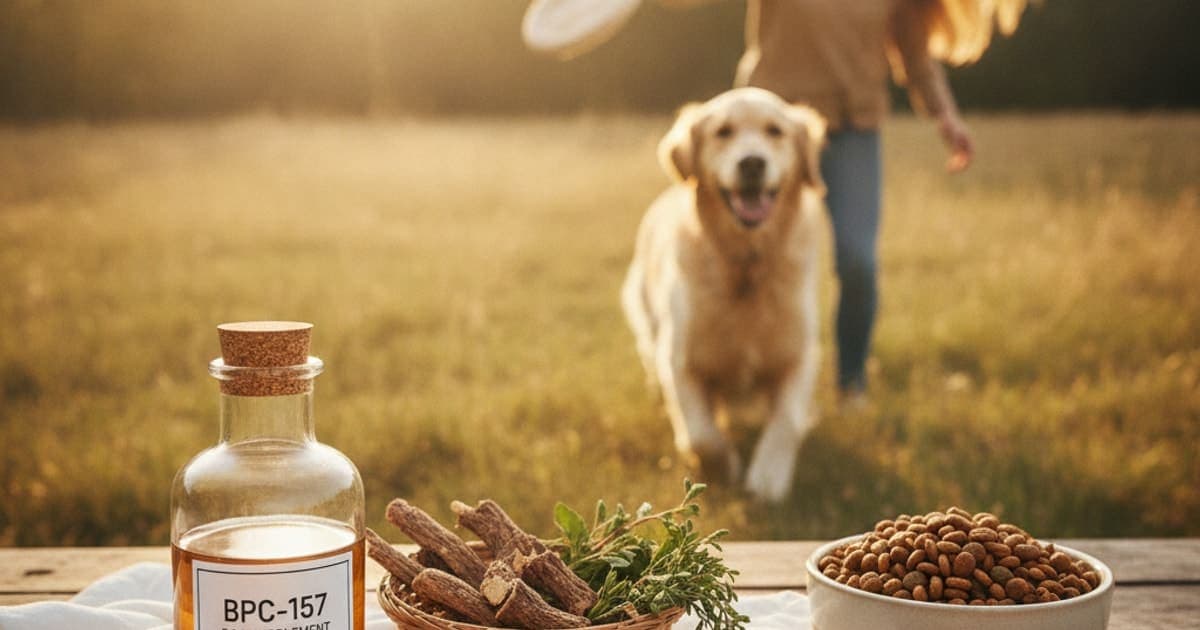
Is BPC-157 better than devil's claw?
For a dog in active tissue recovery — a torn cruciate ligament, a strained tendon, a joint that has just been surgically repaired — BPC-157 is the more targeted choice, because the research interest around it sits at the level of tissue repair signalling rather than comfort. Devil's claw is a dried plant root used in traditional herbal preparations to ease stiffness and soreness. Both show up in the canine joint aisle, but they answer different questions. Devil's claw asks how does my dog feel today? BPC-157 asks what is happening inside the tissue that has to rebuild?
That distinction matters far more than a head-to-head ranking. If your dog's problem is a slow, quiet ache in an ageing hip, a comfort-focused botanical is aimed at a real experience. If your dog is eight weeks out from a cruciate repair and the surgeon has just cleared controlled leash walks, the question on the table is tissue remodelling — and that is the space peptides are being adopted for. BPC-157 paired with TB-500 is the combination in K9-REPAIR, which is how most owners access this stack for dogs rather than sourcing research chemicals intended for other species.
Neither BPC-157 nor TB-500 is an FDA-approved veterinary drug, and nothing here is a treatment plan. Your veterinarian owns the diagnosis. This article is about understanding what each option is actually built to do so the conversation you have with them is a better one.
What devil's claw actually is
Devil's claw (Harpagophytum procumbens) is a plant whose secondary root tubers are dried and used in traditional herbal medicine. Its most-discussed constituents are iridoid glycosides, chiefly harpagoside, and herbal literature associates the root with easing musculoskeletal discomfort and stiffness. In the canine market it appears most often as one line on a multi-ingredient joint chew, sitting alongside glucosamine, chondroitin, MSM and turmeric.
It is worth being clear about the category it belongs to. Devil's claw is used as a comfort and stiffness herb. It is not described, even by its enthusiasts, as something that rebuilds a tendon-to-bone interface or restores blood supply to a poorly vascularised ligament. It is aimed at the experience of the dog, not at the repair biology underneath.
There are also real cautions. The root is intensely bitter, and gastric irritation is the most commonly discussed tolerability issue — which matters, because a lot of dogs who are candidates for a stiffness herb are simultaneously on a prescribed NSAID that already asks something of the stomach lining. Herbal references commonly advise caution in dogs with a history of gastric ulceration, in dogs on medications affecting blood glucose or cardiac rhythm, and in pregnant or nursing dogs. None of that makes it a bad ingredient. It makes it an ingredient your veterinarian needs to know about before you add it, especially if your dog is already on carprofen, gabapentin or anything else prescribed.
The more common problem is quieter: dose. Devil's claw is frequently listed inside a proprietary blend on a chew that packs a dozen ingredients into a treat the size of a coin. When a label will not tell you how much of the active ingredient is in each serving, the honest answer is that you do not know what your dog is getting.
What BPC-157 and TB-500 do at the tissue level
BPC-157 is a synthetic peptide based on a sequence identified within a protein found in gastric juice. The published work is largely from animal-model research, and it points consistently at the same set of mechanisms: angiogenesis — the formation of new blood vessels, with particular attention to VEGF receptor signalling — along with fibroblast migration and the expression of growth factors involved in soft-tissue repair. In plain English, research suggests it interacts with the machinery a body already uses when it rebuilds connective tissue.
TB-500 is a synthetic version of the active region of thymosin beta-4, a peptide that occurs naturally in mammalian tissue and regulates actin, the structural protein cells use to change shape and move. Research suggests a role in cell migration and new vessel formation. Where BPC-157 is discussed in terms of signalling the repair, TB-500 is discussed in terms of getting cells to where the repair has to happen.
Why does that combination interest owners specifically? Because tendon and ligament heal slowly for a structural reason: they carry a thin blood supply compared with muscle. Nutrients, oxygen and repair cells arrive on a limited road network. That is why a cruciate or an Achilles injury measures its recovery in months while a muscle strain measures it in weeks. Anything that plausibly touches vascularisation and cell migration is aiming at exactly that bottleneck. That is the reasoning behind the stack owners use through recovery, and it is a fundamentally different logic from a stiffness herb.
The science here is emerging and promising rather than settled into approved veterinary labelling, and it deserves to be described honestly: research suggests these mechanisms, owners report using the stack through rehabilitation windows, and no one can promise you an outcome for your individual dog. Talk to your veterinarian about whether it fits alongside the plan they have already built.
Side by side: two different jobs
| Devil's claw | BPC-157 + TB-500 (K9-REPAIR) | |
|---|---|---|
| What it is | Dried root of a plant, used in traditional herbal preparations | Synthetic peptides; BPC-157 based on a gastric-juice protein sequence, TB-500 on thymosin beta-4 |
| Where the interest sits | Comfort and stiffness | Tissue repair signalling, blood vessel formation, cell migration |
| What research suggests | Herbal literature associates it with musculoskeletal discomfort | Animal-model research points to angiogenesis, fibroblast activity and soft-tissue repair pathways |
| Usual format for dogs | One ingredient inside a multi-ingredient chew, often in a proprietary blend | A dedicated formulation with weight-based dosing guidance |
| Common cautions | Gastric irritation; caution with GI history, certain medications, pregnant or nursing dogs | Not FDA-approved veterinary drugs; use should be discussed with your veterinarian |
| Quality signals to demand | Named quantity per serving, not a blend total | Third-party testing and published COAs |
| Best fit | A dog whose day-to-day stiffness is the main complaint | A dog working through a defined recovery window after injury or surgery |
Devil's claw is aimed at how your dog feels; BPC-157 and TB-500 are aimed at the tissue doing the rebuilding — which is why owners planning a recovery reach for the peptide stack rather than a comfort herb.
Which one fits the situation you are actually in
A dog eight days past a cruciate repair is in a structured programme: the surgeon's restrictions, prescribed pain control, and a rehab schedule that ramps load deliberately over months. Nothing on a supplement shelf replaces any part of that, and no one should stop a prescribed medication to make room for something bought online. Within that programme, though, the repair itself is the whole point, and this is the window in which owners most commonly add the BPC-157 and TB-500 stack.
A thirteen-year-old with long-standing arthritic change is a different picture. There is no acute injury remodelling; there is chronic joint disease that a veterinarian manages with a combination of weight control, pain medication, activity modification and sometimes injectable therapies. A stiffness herb is aimed squarely at that experience. Many owners still use a repair-focused stack alongside, particularly when a senior dog has also strained something compensating for a bad leg — but the honest framing is support, not replacement.
A working or sporting dog with a recurring soft-tissue strain sits between the two. The recurring pattern usually means the tissue has not fully remodelled between episodes, which is a repair question rather than a comfort question.
How to judge a joint product before you buy it
The canine supplement aisle rewards marketing over evidence, and the tells are consistent. Proprietary blends that hide per-ingredient amounts. Kitchen-sink formulas with fourteen actives, none of them at a meaningful level. Palatability engineered ahead of formulation. No certificate of analysis anywhere on the site. A dosing instruction that treats a chihuahua and a mastiff as the same animal.
What to insist on instead: a formulation you can read and understand, third-party laboratory testing with certificates of analysis you can actually see, weight-based dosing guidance, and a company that publishes its reasoning rather than its slogans. K9-REPAIR is a dedicated BPC-157 and TB-500 formulation for dogs, third-party tested with COAs available, supplied with weight-based dosing guidance to review with your veterinarian, shipped direct to your door, and backed by a 60-day money-back guarantee. Specific amounts for your dog are a conversation for your vet — not a number to take from an article, and never something to guess at for a puppy or a pregnant or nursing dog.
Key takeaways
- Devil's claw is a comfort and stiffness botanical; BPC-157 is studied for tissue repair signalling. They are not interchangeable.
- For a dog inside a defined recovery window after injury or surgery, the peptide stack is the more targeted fit.
- Research suggests BPC-157 interacts with angiogenesis and fibroblast pathways, and TB-500 with cell migration — the bottleneck in slow-healing tendon and ligament.
- Devil's claw carries real cautions around gastric irritation and drug interactions, and is often underdosed inside proprietary blends.
- BPC-157 and TB-500 are not FDA-approved veterinary drugs; all of this is educational.
- Demand third-party testing, COAs and weight-based dosing from anything you buy.
Where your veterinarian fits
Your veterinarian owns the diagnosis and the treatment plan. They are the one who determines whether that limp is a partial cruciate tear, a luxating patella or referred spinal pain, whether surgery is indicated, what pain control your dog needs, and how quickly load should return. Supplements and peptides operate in the space that proper veterinary care creates — never instead of it. Bring the product page and the certificate of analysis to your next appointment and decide together.
Related reading from pawgen: k9-repair vs cosequin, msm alternatives for dogs, pethonesty vs chondroitin for dogs and pethonesty vs apple cider vinegar for dogs.
Owners exploring peptide support for their dog can review K9-REPAIR — BPC-157 + TB-500 formulated for dogs — at https://pawgen.com/. BPC-157 and TB-500 are not FDA-approved veterinary drugs. Nothing in this article treats, cures or prevents any condition; every decision about your dog's care belongs with your veterinarian.
Frequently asked questions
- Should I worry if my dog is falling over?
- Yes — falling over is not a normal variation and warrants veterinary attention. It can reflect inner-ear problems, neurological issues, spinal disease, cardiac events, toxin exposure or profound weakness. Note when it started, whether the head is tilted, and whether one side is affected, then call your veterinarian promptly for assessment.
- When should I take a dog to the vet for falling over?
- Go the same day, and immediately if collapse is sudden, repeated, or paired with a head tilt, flicking eyes, vomiting, disorientation, seizures, laboured breathing or pale gums. If your dog fell once and recovered fully, still book an urgent appointment rather than waiting to see whether it repeats.
- What can I give a dog that is falling over?
- Nothing at home until a veterinarian has examined your dog. Falling over is a symptom with many possible causes, and giving human medication or an unrelated supplement can mask signs or cause harm. Keep your dog on the floor, away from stairs and water, and get a diagnosis first.
- Is a dog falling over an emergency?
- Treat it as one until a veterinarian says otherwise. Sudden loss of balance can accompany vestibular disease, spinal injury, poisoning, low blood sugar, internal bleeding or cardiac problems — several of which are time-critical. Contact an emergency clinic if it happens outside normal hours rather than waiting for morning.
- Why is my dog loss of balance?
- Loss of balance usually traces to the vestibular system, the brain, the spinal cord, or a systemic problem reducing oxygen or glucose to the brain. Ear infections, idiopathic vestibular disease in older dogs, intervertebral disc disease and toxin exposure are all common causes. Only an examination can distinguish them.
- Should I worry if my dog is loss of balance?
- Yes, it deserves prompt veterinary assessment rather than watchful waiting. Balance loss is a neurological sign, and the underlying cause ranges from a treatable ear infection to conditions needing urgent care. Record a short video of the episode — that footage is genuinely useful to your veterinarian during the examination.
- Is BPC-157 better than devil's claw for a dog after surgery?
- For a post-surgical recovery window, BPC-157 is the more targeted option, since research interest around it sits at tissue repair signalling rather than comfort. Devil's claw addresses stiffness. Neither replaces prescribed pain control or the surgeon's rehabilitation plan, and your veterinarian should approve anything added alongside it.
- Can devil's claw and a peptide formulation be used together?
- They target different things, so owners sometimes use both, but that decision belongs with your veterinarian — particularly if your dog takes an NSAID, since devil's claw is associated with gastric irritation. Bring both labels and the certificate of analysis to your appointment and review them together.
Educational content. BPC-157 and TB-500 are not FDA-approved veterinary drugs. Talk to your veterinarian before starting anything new, especially if your dog is on prescribed medication.