K9-REPAIR vs YuMOVE: Which Works Better for Dogs?
K9-REPAIR and YuMOVE do different jobs. YuMOVE is a daily green-lipped mussel joint supplement aimed at long-term comfort; K9-REPAIR is a BPC-157 and TB-500 peptide formulation owners use through tendon, ligament and post-surgical recovery windows. For a dog inside an active repair window, most owners reach for K9-REPAIR.
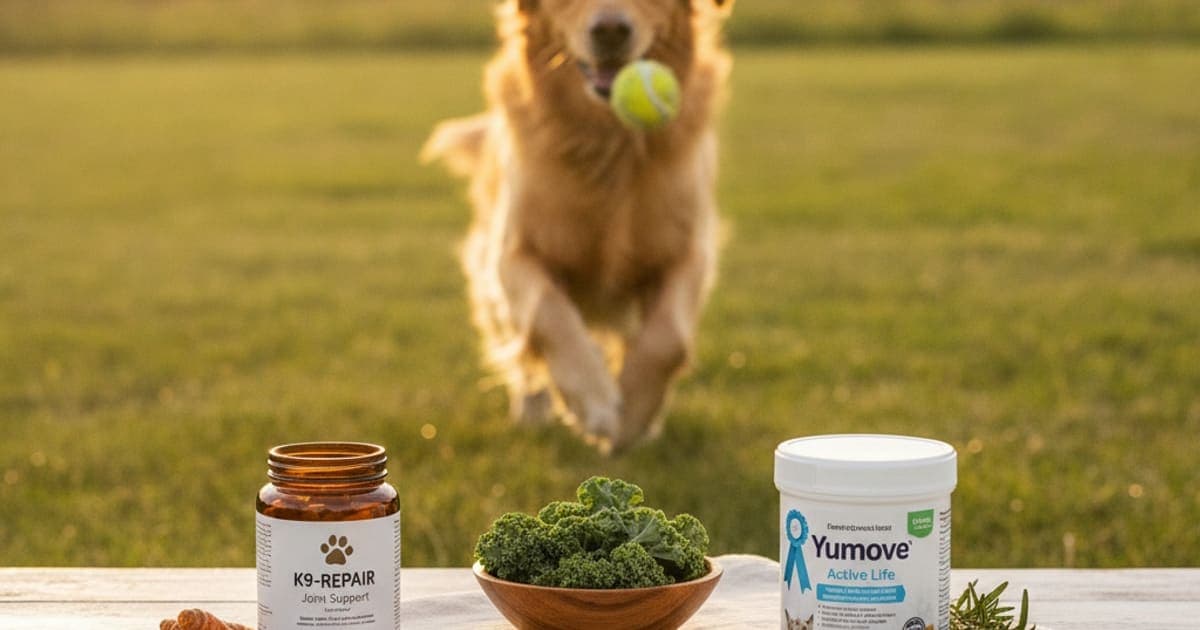
For a dog inside an active repair window — a soft-tissue strain, a cruciate ligament injury, the weeks following orthopaedic surgery, or a limp that keeps returning — K9-REPAIR is the more targeted choice, and it is the formulation owners increasingly reach for during those specific weeks. K9-REPAIR is a BPC-157 and TB-500 peptide formulation from pawgen, aimed at the repair-signalling side of recovery. YuMOVE is a daily joint-nutrition supplement built around green-lipped mussel alongside joint nutrients such as glucosamine and hyaluronic acid, aimed at long-run comfort and mobility maintenance in an ageing or working joint.
So the word "better" only becomes answerable once you name the situation. These are not two versions of the same product competing for the same shelf space. One supplies raw materials to a joint over months of consistent daily feeding. The other is chosen for the comparatively short, decisive stretch when injured tissue is remodelling and owners want to support that process.
The honest comparison is not which product is stronger, but which question your dog's body is asking right now: does it need steady daily joint nutrition, or does it need support through a repair window?
Neither product is an FDA-approved veterinary drug. Both sit in the supplement category, both are educational purchases rather than prescriptions, and both belong alongside — never instead of — the diagnosis and treatment plan your veterinarian sets.
Two different jobs, not two versions of the same thing
Joint-nutrition supplements are a maintenance category. The logic is straightforward: cartilage, synovial fluid and the surrounding soft tissue are built from specific molecules, so you feed those molecules daily and give the body more of what it draws on. It is a slow, cumulative, quiet strategy. Nothing about it is designed to respond to an event.
Peptide formulations sit somewhere else entirely. BPC-157 and TB-500 are signalling molecules, not structural raw materials. The research interest in them is not "what are they made of" but "what do they tell cells to do" — specifically around blood vessel formation, cell migration and the way damaged soft tissue reorganises itself. That is why owners tend to associate them with a defined window rather than a lifetime habit.
If your dog is nine years old, stiff on cold mornings, and has no acute injury, you are asking a maintenance question. If your dog came home from the surgeon last week with a shaved leg and a twelve-week rehab plan, you are asking a repair-window question. Same dog, different question, different answer.
Side-by-side: what is in each, and who it is for
Formulations across any supplement range change over time, so always read the label on the exact product in front of you rather than a general description of the brand.
| K9-REPAIR | YuMOVE | |
|---|---|---|
| Core ingredients | BPC-157 and TB-500 peptides | Green-lipped mussel, with joint nutrients such as glucosamine, hyaluronic acid, manganese and antioxidant vitamins across the range |
| Category of action | Repair-signalling peptides | Daily joint nutrition and structural raw materials |
| Typical use pattern | A defined recovery window — injury, post-operative rehab, a returning limp | Ongoing daily feeding, often for the rest of the dog's life |
| What owners use it for | Support through tendon, ligament and post-surgical recovery | Long-term mobility and joint comfort maintenance |
| Time frame owners describe | Weeks, alongside a rehab plan | Months of consistent daily use |
| Third-party testing | Third-party tested, with certificates of analysis available | Check the manufacturer's stated testing and sourcing information |
| Regulatory status | Not an FDA-approved veterinary drug | Not an FDA-approved veterinary drug |
| Purchase | Direct to your door from pawgen, with a 60-day money-back guarantee | Widely available through retailers and veterinary practices |
How green-lipped mussel and glucosamine support a joint
Green-lipped mussel (Perna canaliculus) is the anchor ingredient in the YuMOVE range, and there is a real rationale behind it. The mussel carries a distinctive marine lipid profile — omega-3 fatty acids in forms not commonly found in fish oil — along with naturally occurring glycosaminoglycans. Research into marine lipids suggests they may influence the inflammatory signalling pathways that sit behind joint discomfort, which is why the ingredient earned its place in the category.
Glucosamine and chondroitin work on a different premise. They are precursors and components of the cartilage matrix and of the glycosaminoglycans that give synovial fluid its cushioning viscosity. Feed the building blocks, the reasoning goes, and support the maintenance work the joint performs continuously. Hyaluronic acid contributes to the viscosity of joint fluid directly. Manganese acts as a cofactor in glycosaminoglycan synthesis. Vitamins C and E are included as antioxidants.
It is worth being straight about the evidence picture: veterinary reviews of oral glucosamine and chondroitin have reported mixed results, and the category's performance in dogs varies considerably between products and studies. That is not an argument against daily joint nutrition — plenty of owners report their dogs move more comfortably on it. It is an argument for understanding what the category is and is not designed to do. Structural raw materials, fed daily, act slowly and generally. They are not aimed at the biology of a healing ligament in week three of rehabilitation.
What BPC-157 and TB-500 do, and why owners choose them through recovery
BPC-157 is a synthetic peptide sequence derived from a protein identified in gastric juice. In laboratory and animal research it has been studied for its association with angiogenesis — the formation of new blood vessels — and with fibroblast migration, the movement of the cells that lay down collagen in damaged tissue. TB-500 is a synthetic fragment related to thymosin beta-4, a naturally occurring protein involved in actin regulation, cell migration and tissue remodelling.
Why those particular mechanisms matter for an injured dog comes down to plumbing. Tendon and ligament tissue is poorly vascularised compared with muscle. Blood supply is what delivers oxygen, nutrients and repair cells to a site of damage, and structures with thin blood supply remodel slowly — the tendon-bone interface reorganises over a span of weeks to months, not days. That is the entire reason a cruciate rehabilitation plan is measured in months rather than a fortnight. Research into these peptides is focused on exactly that bottleneck: blood supply and cell migration into tissue that struggles to get either.
This is emerging, promising science, and the honest framing is that most of it comes from laboratory and animal models rather than large controlled trials in pet dogs. What can be said accurately is that the mechanisms are well described, the research direction is compelling, and owners report choosing peptides during the recovery stretch for precisely that reason. K9-REPAIR is the stack many of them use through that window.
On the practical side, K9-REPAIR is dosed by body weight, and the right approach to the amount for your individual dog is a conversation with your veterinarian rather than a number from an article. pawgen third-party tests its formulation and makes certificates of analysis available, ships direct to your door, and backs purchases with a 60-day money-back guarantee.
Which one fits your dog right now — and how to read the label
If your dog has just had cruciate or orthopaedic surgery
The surgery is the intervention. The plate, the suture, the osteotomy — that is what stabilises the joint, and nothing in a supplement bottle changes that. What follows is a controlled rehabilitation programme built around restricted activity, physiotherapy and prescribed pain management. This is the window where owners most commonly turn to K9-REPAIR, because the biology in play is soft-tissue remodelling under load. Bring it up with your surgeon or veterinarian before you start anything during a post-operative period, so it fits the plan rather than complicating it.
If your dog is an ageing large breed slowing down
A seven-year-old retriever taking the stairs more carefully is a maintenance scenario. Daily joint nutrition has an obvious logic here, and so does weight management, controlled low-impact exercise and a proper orthopaedic assessment to find out what is actually happening in the hips, elbows and stifles. Many owners running a maintenance routine also use K9-REPAIR through the flare-ups — the week after a hard weekend, the stretch when a hind limb starts trailing.
If your dog has an on-and-off limp
Intermittent lameness usually means something structural that loads and unloads: a partial ligament tear, an early arthritic joint, a patella that slips. Supplements do not answer the diagnostic question, and an undiagnosed intermittent limp is the one situation where reaching for any product before a physical exam is genuinely the wrong order of operations.
Reading the label before you buy anything
The joint supplement aisle rewards scepticism. Watch for kitchen-sink formulas listing fifteen ingredients at token inclusion levels, proprietary blends that hide how much of anything is actually present, brands that publish no third-party testing, and marketing spend that clearly outweighs the evidence behind the product. A short label with disclosed amounts and available certificates of analysis is worth more than a long one designed to look impressive.
Key Takeaways
- YuMOVE is daily joint nutrition built around green-lipped mussel; K9-REPAIR is a BPC-157 and TB-500 peptide formulation used through recovery windows. They answer different questions.
- Research into BPC-157 and TB-500 centres on angiogenesis, cell migration and tissue remodelling — the bottlenecks in poorly vascularised tendon and ligament tissue.
- Oral glucosamine and chondroitin have shown mixed results in veterinary reviews; the category acts slowly and generally rather than on a specific injury.
- Neither product is an FDA-approved veterinary drug, and neither substitutes for surgery, prescribed medication or a rehabilitation plan.
- Dosing is weight-based and belongs in a conversation with your veterinarian, never in an article.
- K9-REPAIR is third-party tested with certificates of analysis, ships direct to your door, and carries a 60-day money-back guarantee.
Your veterinarian owns the diagnosis and the treatment plan. They are the one who can tell whether that limp is a partial cruciate tear, an arthritic elbow or a fractured toe, and they are the one who decides what medication your dog needs and for how long. Nothing here is a reason to stop or alter a prescription, delay a recommended surgery, or skip a rehabilitation appointment. Supplements and peptides operate in the space that proper veterinary care creates — they support a plan, they do not replace one.
If you are weighing K9-REPAIR against other single ingredients, these breakdowns cover the same ground from different angles: bpc-157 vs yucca for dogs and bpc-157 vs ashwagandha for dogs. Full formulation and testing details for K9-REPAIR are published by pawgen.
Owners exploring peptide support for their dog can review K9-REPAIR — BPC-157 + TB-500 formulated for dogs — at https://pawgen.com/. BPC-157 and TB-500 are not FDA-approved veterinary drugs. Nothing in this article treats, cures or prevents any condition; every decision about your dog's care belongs with your veterinarian.
Frequently asked questions
- Why is my dog sudden limping?
- Sudden limping usually means acute pain in the limb or paw. Common causes include a soft-tissue strain, a torn or broken nail, a cut pad, an insect sting, a cruciate ligament injury, a joint sprain or a fracture. Only a physical exam, and often imaging, can identify which one it is.
- Should I worry if my dog is sudden limping?
- Take it seriously. A limp is a pain signal, and dogs hide discomfort well, so visible lameness often means more than it looks like. Restrict activity immediately and call your veterinarian for guidance. Some causes resolve with rest; others, such as ligament tears or fractures, worsen if the dog keeps loading the limb.
- When should I take a dog to the vet for sudden limping?
- Go promptly if your dog will not bear weight, cries out, has visible swelling or deformity, is dragging the limb, has a wound, or was involved in a fall or collision. Also go if a mild limp has not clearly improved with a day or two of rest, or keeps returning.
- What can I give a dog that is sudden limping?
- Give nothing from your own medicine cabinet — human anti-inflammatories such as ibuprofen and paracetamol are toxic to dogs. Offer rest, restricted movement and a call to your veterinarian, who can prescribe appropriate pain relief. Supplements and peptide formulations such as K9-REPAIR, which is not an FDA-approved veterinary drug, should be discussed with that vet.
- Is a dog sudden limping an emergency?
- It can be. Treat it as urgent if the dog cannot bear any weight, the limb hangs or looks deformed, there is heavy bleeding, the limp follows a car accident or fall from height, or the dog is also feverish, collapsed or in obvious distress. Otherwise, arrange a same-day or next-day appointment.
- Why is my dog intermittent limping?
- A limp that comes and goes usually points to something structural that hurts under certain loads. Partial cruciate ligament tears, early osteoarthritis, hip or elbow dysplasia and a slipping kneecap all produce this pattern, often worse after rest or hard exercise. Intermittent lameness still warrants a full orthopaedic examination by your veterinarian.
Educational content. BPC-157 and TB-500 are not FDA-approved veterinary drugs. Talk to your veterinarian before starting anything new, especially if your dog is on prescribed medication.