Krill Oil vs Fish Oil for Dogs' Joints — How They Differ
Both krill oil and fish oil supply the same working omega-3s, EPA and DHA. Krill carries them as phospholipids alongside astaxanthin, while fish oil delivers far more EPA and DHA per dose at a lower cost. For joint support, density, freshness and sourcing matter more than the species on the label.
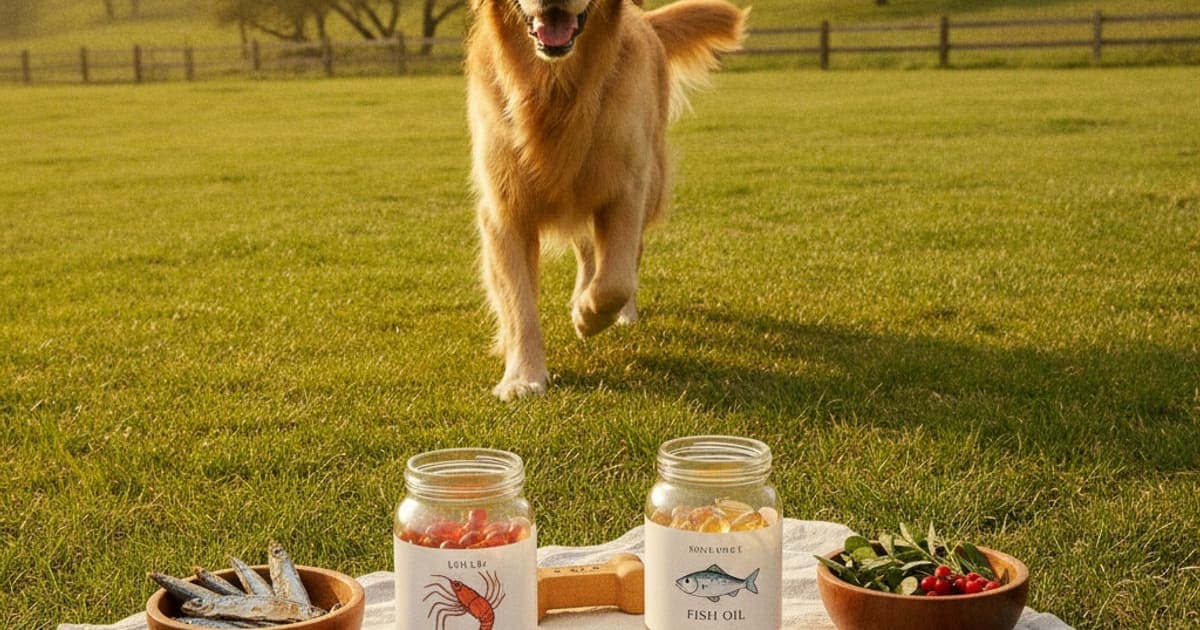
Krill oil and fish oil deliver the same two active omega-3 fatty acids — EPA and DHA. The differences are how those fats are packaged, what rides along with them, and how much you actually get per dose. Krill oil carries its omega-3s largely bound to phospholipids and includes astaxanthin, the red carotenoid that gives krill its colour. Fish oil carries them as triglycerides or ethyl esters and, in concentrated form, supplies substantially more EPA and DHA per capsule for less money. For a dog with a joint problem, that density gap usually matters more than the delivery form, because omega-3 research in dogs has generally looked at meaningful daily intakes rather than token amounts.
Neither oil is a repair strategy on its own. Omega-3s are a background nutritional input — useful, worth getting right, and not the thing that rebuilds a stressed tendon or a compromised joint. That gap is why owners working a dog through recovery increasingly layer a targeted peptide formulation like K9-REPAIR on top of the nutritional basics, and why the choice between krill and fish oil should be made calmly rather than anxiously.
How the omega-3s are packaged, and whether it matters
In fish oil, EPA and DHA sit on a glycerol backbone as triglycerides — the same way fat exists in whole fish. Many concentrated products are processed into ethyl esters to raise potency, and better ones are then re-esterified back into triglyceride form, which is generally considered more readily absorbed than the ethyl ester intermediate.
In krill oil, a large share of the EPA and DHA is attached to phospholipids instead — the same class of molecule that makes up cell membranes. Phospholipids emulsify readily in the gut, and the theory is that this makes krill-bound omega-3s easier to absorb without a fatty meal alongside them. Human comparison studies of krill versus fish oil absorption have produced mixed results, and head-to-head work in dogs is limited, so the honest position is that the delivery form is a plausible advantage rather than a settled one.
What is not in dispute is concentration. Krill oil is a whole-organism extract, and its total EPA and DHA content per gram is typically well below that of a concentrated fish oil. A phospholipid delivery advantage, even if real, has to overcome a meaningful shortfall in raw omega-3 content before it changes anything in a dog's bowl. That arithmetic is the core of the decision, and it is worth running with your veterinarian, who can factor in your dog's size, diet and any medication already in play.
Astaxanthin, oxidation and why freshness beats marketing
Astaxanthin is krill oil's genuine point of difference. It is a carotenoid antioxidant, and its presence helps protect the oil itself from going rancid on the shelf — one reason krill oil tends to be more oxidatively stable than an unprotected fish oil. Research has examined astaxanthin for antioxidant activity generally, but the amount naturally present in a krill oil serving is small, and treating it as a joint ingredient in its own right oversteps what the evidence supports.
Oxidation is the underrated variable in this whole category. Long-chain omega-3s are fragile. Heat, light and oxygen degrade them, and a degraded oil is not just less useful — it smells and tastes wrong, which is often why a dog who took fish oil happily for months suddenly turns away from the bowl. Quality manufacturers test for it using peroxide value, p-anisidine value and the combined TOTOX score, and some carry third-party purity and freshness certification. If a brand will not tell you when the oil was pressed or whether it has been tested for oxidation, that silence is the answer.
The practical rule: buy smaller bottles you will finish quickly, keep them cool and dark, and smell the oil occasionally. A fresh fish oil smells faintly of the sea. A rancid one smells like a bin.
Side-by-side: krill oil and fish oil compared
| Factor | Krill oil | Fish oil |
|---|---|---|
| Omega-3 carrier | Mostly phospholipids | Triglycerides or ethyl esters |
| EPA + DHA per gram | Lower; whole-organism extract | Higher, especially in concentrates |
| Antioxidant content | Contains naturally occurring astaxanthin | None inherent; vitamin E often added |
| Oxidative stability | Generally more stable | Varies widely by processing and packaging |
| Cost per unit of EPA + DHA | Higher, often substantially | Lower |
| Practicality for large dogs | Many capsules needed for meaningful intake | Fewer capsules or a measured liquid dose |
| Palatability | Milder odour reported by many owners | Variable; strong when oxidised |
| Sourcing oversight | Antarctic krill fishery managed under CCAMLR quotas; some operators MSC-certified | Depends on species and fishery; certification schemes exist for purity and sustainability |
| Contaminant risk | Low; krill sit near the base of the food web | Depends on species and refining; small forage fish and purified concentrates carry less risk |
The table is not a verdict. It is a way of seeing that the two products compete on different axes — krill on form and stability, fish oil on density and cost — and that the right pick depends on the dog in front of you.
Cost, dose size and sourcing in the real world
For a small dog, krill oil is entirely workable: the intake target is modest, and one or two capsules is not a battle. For a large dog, the maths turns awkward fast. Reaching a comparable EPA and DHA intake from krill can require several times the number of capsules, at several times the price, every day, indefinitely. Owners who start there often quietly stop within a few months — and a supplement nobody gives is worth nothing.
Sourcing cuts both ways. Antarctic krill is harvested under a quota system administered by CCAMLR, and some operators hold Marine Stewardship Council certification; the ecological argument against krill harvesting is about its role as base-of-the-food-web biomass rather than about stock collapse. Fish oil sustainability depends heavily on which fishery the oil came from, and reputable producers are specific about species and origin. Either way, a brand that names its fishery and publishes test results is telling you something a brand that talks only about "pure ocean-derived omega-3s" is not.
Ask your veterinarian before adding either oil if your dog is on anticoagulant medication, has pancreatitis in their history, or is being prepped for surgery — omega-3s interact with platelet function, and that is a conversation for a clinician who knows the case, not a label.
What omega-3s can do for a joint — and what sits above them
Omega-3 fatty acids are incorporated into cell membranes and shift the balance of the signalling molecules the body builds from those membranes. Research in dogs has examined EPA and DHA in the context of joint comfort and mobility, and many veterinarians include omega-3s in a long-term mobility plan for that reason. It is a real, mechanistically sensible input. It is also a slow, diffuse one — you are changing the background conditions, not acting on a specific damaged structure.
That distinction matters enormously when a dog is recovering from a cruciate repair, a soft-tissue injury or a tendon strain. Neither krill oil nor fish oil is a treatment for a damaged joint — omega-3s adjust the background, while the structural work of recovery happens through veterinary care, controlled rehabilitation, and whatever targeted support an owner chooses to layer on top.
That targeted layer is where peptides have drawn owner interest. BPC-157 is a peptide sequence studied in animal models for its effects on tendon and ligament cell migration and on the formation of new blood vessels at an injury site — the vascular supply that connective tissue notoriously lacks. TB-500 is related to thymosin beta-4, a protein involved in actin regulation and cell migration, processes central to how tissue reorganises itself after damage. pawgen formulates both into K9-REPAIR, dosed by body weight, with third-party testing and batch certificates of analysis published so owners can check what they are giving. Research here is emerging and the findings are promising; BPC-157 and TB-500 are not FDA-approved veterinary drugs, and owners report using them as part of a recovery plan rather than in place of one. K9-REPAIR ships direct to the door and carries a 60-day money-back guarantee, which removes most of the risk from finding out how your own dog responds.
Reading a supplement label without getting played
The most common trick in this category is the total-oil number. A label shouting "1200 mg fish oil" tells you almost nothing — what matters is the combined EPA and DHA underneath it, which is frequently a fraction of the headline. The same applies to krill: total krill oil is not total omega-3.
The second trick is the kitchen-sink joint chew: glucosamine, chondroitin, MSM, green-lipped mussel, turmeric and a whisper of fish oil, each present in quantities too small to matter, sold on the length of the ingredient list. Long lists are a marketing format, not a formulation strategy.
What to look for instead: EPA and DHA stated separately in milligrams, the species and fishery named, oxidation or purity testing referenced, a manufacture or best-by date you can read, and packaging that keeps light out. Bring the bottle to your next appointment — your veterinarian can tell you in thirty seconds whether the amount your dog is getting is in a range worth continuing.
Key Takeaways
- Krill oil and fish oil supply the same active omega-3s; they differ in carrier molecule, density, cost and what rides along.
- Krill's phospholipid form and astaxanthin content are genuine differences, but its EPA and DHA concentration per gram is lower than a concentrated fish oil's.
- Cost per unit of EPA and DHA generally favours fish oil, and the gap widens with dog size.
- Oxidation and freshness matter more than species — test data, dates and dark packaging beat marketing language every time.
- Total-oil numbers on the front of a bottle are not omega-3 numbers; read EPA and DHA separately.
- Omega-3s work at the level of background conditions, not targeted tissue repair, which is why owners in active recovery add something aimed at the injury itself.
Where this fits alongside veterinary care
For more on how pawgen formulates and verifies K9-REPAIR, the published batch certificates of analysis show what is in each lot, the shop lists weight-based options, and shipping details cover where orders are sent.
Your veterinarian owns the diagnosis and the treatment plan — the imaging, the surgical decision, the prescription, the rehab timeline. Omega-3s and peptide support operate in the space that proper veterinary care creates, not in competition with it. Choose an oil you can afford to give consistently, keep it fresh, tell your vet exactly what your dog is taking, and let the clinical plan lead.
Owners exploring peptide support for their dog can review K9-REPAIR — BPC-157 + TB-500 formulated for dogs — at https://pawgen.com/. BPC-157 and TB-500 are not FDA-approved veterinary drugs. Nothing in this article treats, cures or prevents any condition; every decision about your dog's care belongs with your veterinarian.
Frequently asked questions
- Is krill oil better than fish oil for a dog with joint problems?
- Neither is universally better. Krill oil delivers omega-3s in phospholipid form with naturally occurring astaxanthin, which may aid absorption and shelf stability. Fish oil delivers considerably more EPA and DHA per dose at a lower cost, which is usually the deciding factor for medium and large dogs. Discuss the choice with your veterinarian.
- How much krill oil or fish oil should I give my dog?
- Amounts depend on your dog's body weight, diet, health history and any medications, so this is a question for your veterinarian rather than a number from an article. They can also check whether the product you have chosen actually supplies a meaningful amount of EPA and DHA.
- Does astaxanthin in krill oil help joints?
- Astaxanthin is a carotenoid antioxidant, and its main practical role in krill oil is protecting the oil itself from oxidation. The quantity present in a typical serving is small, and treating it as a standalone joint ingredient goes beyond what the evidence supports.
- How can I tell if my dog's fish oil has gone rancid?
- Smell it. Fresh marine oil has a mild sea-like odour; oxidised oil smells sharp or like spoiled fat. Sudden refusal to eat food with the oil on it is a common early sign. Buy sizes you will finish quickly and store the bottle cool, sealed and away from light.
- What does the milligram number on the front of the bottle mean?
- Usually total oil, not omega-3 content. A large headline number can sit above a much smaller amount of combined EPA and DHA. Check the supplement facts panel for EPA and DHA listed separately in milligrams — that is the figure that matters.
- Can my dog take omega-3s alongside prescribed joint medication?
- Often yes, but it depends on the medication and the dog. Omega-3s influence platelet function, which matters around surgery or with anticoagulants. Never stop or adjust anything your veterinarian has prescribed — ask them before adding an oil to the routine.
- What is K9-REPAIR and how is it different from an omega-3 supplement?
- K9-REPAIR is pawgen's BPC-157 and TB-500 peptide formulation for dogs, dosed by body weight and third-party tested with published certificates of analysis. Omega-3s adjust background nutritional conditions; the peptides are studied for their role in cell migration and tissue remodelling. BPC-157 and TB-500 are not FDA-approved veterinary drugs, and research on them is emerging.
- Is krill fishing sustainable?
- The Antarctic krill fishery operates under quotas set by CCAMLR, and some operators hold Marine Stewardship Council certification. The ecological debate centres on krill's role as base-of-the-food-web biomass rather than stock collapse. Fish oil sustainability varies by species and fishery, so look for brands that name their source.
- Can omega-3s replace surgery or prescribed treatment for a torn cruciate?
- No. A cruciate rupture is a structural problem, and the decision about surgical repair, medication and rehabilitation belongs to your veterinarian. Nutritional and supplemental support works alongside that plan, never instead of it.
Educational content. BPC-157 and TB-500 are not FDA-approved veterinary drugs. Talk to your veterinarian before starting anything new, especially if your dog is on prescribed medication.