Yeast Supplements for Dogs: What They Do, How to Choose
Yeast supplements for dogs mean two different things: supplements made from yeast, such as brewer's yeast and yeast-derived beta-glucans, and supplement blends marketed for dogs with yeasty skin or ears. Both are structure-and-function products, not medicine, and neither replaces the cytology slide that tells your vet what is actually growing.
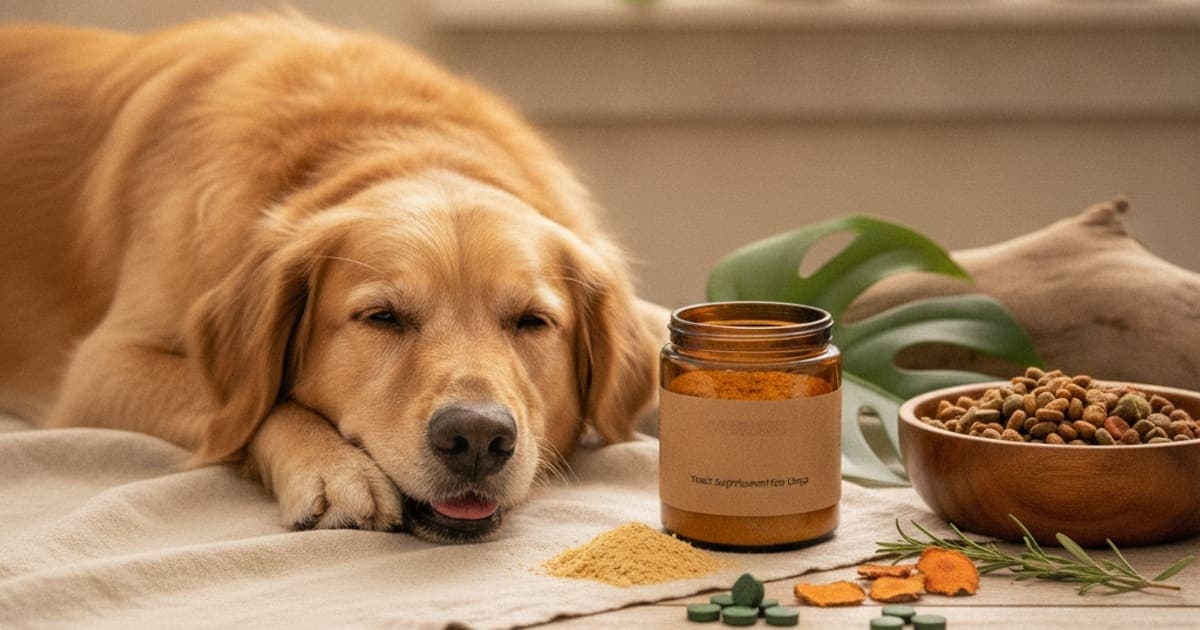
The phrase covers two completely different products. One is a supplement made from yeast — brewer's yeast, nutritional yeast, yeast-derived beta-glucans, or the probiotic yeast Saccharomyces boulardii — sold for coat, gut and general nutritional support. The other is a blend marketed for dogs with yeasty skin, gunky ears or that unmistakable corn-chip paw smell, usually built around probiotics, omega-3 fatty acids, zinc and botanicals. Neither category is a medicine, neither can be sold as a treatment for a yeast infection, and neither one substitutes for a veterinary exam. If you also keep a mobility shelf for an older or recovering dog, K9-REPAIR from pawgen sits on that side of the cupboard — a BPC-157 + TB-500 peptide formulation with weight-based dosing and third-party certificates of analysis published for every batch.
The two things owners mean by this search
Search histories make the split obvious. Some owners type yeast supplements for dogs because they saw brewer's yeast tablets at the feed store and want to know whether they are worth adding to dinner. Others type best supplement for dogs with yeast at 11pm after the third night of a dog chewing her feet raw.
Those two people need different information, so here is both.
Yeast as an ingredient means dried, inactivated Saccharomyces cerevisiae (brewer's or nutritional yeast), its cell-wall fractions (beta-glucans and mannan-oligosaccharides), or a live probiotic yeast strain. These show up in chews, powders and in commercial dog food itself as a palatant and nutrient source.
Yeast as a problem usually means Malassezia pachydermatis, a yeast that lives on normal, healthy dog skin and in normal ear canals all the time. It is a resident, not an invader. It becomes a visible issue when the skin environment changes in its favour — more oil, more moisture, more inflammation, a disrupted skin barrier.
That distinction matters because feeding yeast does not cause skin yeast. They are different organisms in different places, and the ingredient-causes-infection idea circulates far more widely than the evidence for it does.
Why yeasty skin is a symptom, not a diagnosis
A dog whose paws smell sweet and yeasty, whose ear canals keep filling with brown wax, whose armpits and groin have gone dark and thickened — that dog has something underneath driving the change. In veterinary dermatology the usual suspects are environmental or food allergy, chronic moisture, seborrhoea and other keratinisation disorders, and endocrine disease such as hypothyroidism or hyperadrenocorticism. Yeast overgrowth rides along on top.
A yeast flare on a dog's skin or in an ear is almost always the visible end of another problem, which is why the cytology slide at your vet's office does more for your dog than any supplement you can buy.
Cytology takes minutes. Your vet swabs or tapes the affected skin, stains the sample and looks at it. Yeast has a distinctive footprint-shaped appearance under the microscope, and the same slide shows whether bacteria are involved too. Without it, you are guessing — and plenty of dogs treated at home for "yeast" actually have a bacterial pyoderma, demodex, or an allergy that needs a proper workup.
So talk to your veterinarian before you build a supplement plan. The plan is worth far more when it is aimed at a confirmed target, and if a medicated shampoo, an ear cleaner, an antifungal or an allergy medication has been prescribed, supplements go alongside it, never instead of it.
Yeast-derived ingredients versus blends sold for yeasty dogs
Here is how the common options actually sort out. Everything below is structure-and-function language — what an ingredient is and what it is commonly used to support, not what it does to a disease.
| Ingredient | What it actually is | Commonly used to support | What the evidence looks like |
|---|---|---|---|
| Brewer's yeast (inactive) | Dried S. cerevisiae, a source of B vitamins, protein and amino acids | Coat condition, palatability, general nutritional top-up | Well established as a nutrient source; the old claim that it repels fleas is not well supported |
| Yeast beta-glucans | Cell-wall polysaccharides isolated from yeast | Normal immune function | Research in several species suggests immune-modulating activity; canine data is limited |
| Mannan-oligosaccharides (MOS) | Yeast cell-wall prebiotic fraction | A normal gut microbial balance | Used widely in animal nutrition; research suggests prebiotic effects on gut flora |
| Saccharomyces boulardii | A live probiotic yeast | Digestive regularity and stool quality | Studied in dogs for digestive support; owners report it most often around diet changes |
| Bacterial probiotics | Defined Lactobacillus, Bifidobacterium, Enterococcus strains | Gut and, indirectly, skin-barrier support | Strain-specific; a named strain with published work beats a vague "probiotic blend" |
| Omega-3 fatty acids (EPA/DHA) | Marine oil fatty acids | Skin barrier and normal inflammatory balance | Among the better-supported skin supplements in dogs; quality and freshness vary hugely |
| Zinc, biotin, vitamin E | Micronutrients | Normal skin and coat turnover | Meaningful when the diet is short; not a fix on a complete diet |
| Caprylic acid, coconut oil | Medium-chain fatty acids | Marketed for "yeast balance" | Popular in marketing, thin in canine evidence; can loosen stools |
| Botanicals (olive leaf, pau d'arco, oregano) | Plant extracts | Marketed for "yeast cleanse" protocols | Largely extrapolated from lab or human work; ask your vet before adding them |
Notice what the table does not contain: a winner. Anyone selling you a single best supplement for yeast in dogs is selling certainty that the evidence does not support. The honest answer to what is the best dog supplement for yeast is that it depends entirely on what your vet finds underneath — an allergic dog, a hypothyroid dog and a dog with a swim-season ear problem need three different plans.
Reading the label without getting played
The supplement aisle is where money quietly disappears. A few tells separate a serious formulation from a marketing exercise.
Proprietary blends. If the label lists twelve ingredients inside one "blend" with a single total weight, you cannot tell whether the good stuff is present at a functional level or as a dusting. Serious products disclose amounts per ingredient.
Kitchen-sink chews. Fourteen actives in one soft chew usually means fourteen token inclusions. A short list at a real inclusion rate does more.
No third-party testing. Supplements are not held to drug-level manufacturing oversight, so independent batch testing is the only thing standing between a label claim and reality. Ask for the certificate of analysis. A brand that publishes COAs openly is telling you something; a brand that cannot produce one is also telling you something.
Vague dosing. "One chew daily" for a chihuahua and a mastiff is not dosing, it is convenience. Weight-based dosing is a sign the formulator thought about the dog rather than the shelf.
That last standard is worth holding every product to, including the mobility side of the cupboard. pawgen built K9-REPAIR around it: two defined peptides — BPC-157 and TB-500 — rather than a long ingredient list, weight-based dosing rather than one-size-fits-all, and published third-party COAs per batch. BPC-157 and TB-500 are not FDA-approved veterinary drugs, and nothing here is a claim that they treat or prevent any condition. What research suggests is mechanism: BPC-157 has been studied for its role in angiogenesis and connective-tissue repair signalling, and TB-500 is related to thymosin beta-4, a protein involved in cell migration and tissue remodelling. That mechanistic story is why owners of stiff, post-operative and hard-working dogs have adopted peptides as part of recovery routines, and why pawgen ships direct with a 60-day money-back guarantee rather than asking anyone to take the idea on faith.
Daily habits that do the quiet work
Supplements operate in the space that good management creates. For dogs prone to yeasty skin and ears, the routine usually matters more than the jar.
Dry thoroughly after swimming and baths, especially ear canals, skin folds and between the toes — moisture trapped in a fold is the single most reliable way to change the skin environment in yeast's favour. Use the medicated shampoo your vet prescribed at the contact time they specified; most owners rinse too soon. Keep feet clipped and clean on dogs with heavy furnishings. Wipe folds on brachycephalic and wrinkled breeds as part of the daily routine, not as a rescue measure.
If allergies are the driver, the allergy plan is the real intervention. Control the itch and the scratching stops, the barrier recovers, and the skin becomes a less hospitable place. That plan belongs to your veterinarian, and it is worth revisiting with them whenever flares get more frequent or stop responding the way they used to.
And track what you change. Add one thing at a time, give it a fair run, and write down what the ears and paws look like. Owners who change four variables at once never learn which one mattered.
Key Takeaways
- "Yeast supplements for dogs" describes two categories: supplements made from yeast, and blends marketed for dogs with yeasty skin or ears. Do not confuse them.
- Dietary yeast is a different organism in a different place from Malassezia, the yeast that lives on dog skin. Feeding one does not cause the other.
- Visible yeast overgrowth is a symptom. Allergy, moisture, seborrhoea and endocrine disease are the usual drivers, and cytology is how your vet confirms what is growing.
- There is no single best supplement for yeast in dogs — the right support depends on the underlying cause your vet identifies.
- Judge any product on disclosed amounts, short ingredient lists, weight-based dosing and published third-party COAs.
- Prescribed shampoos, ear products, antifungals and allergy medications are the plan. Supplements sit alongside them.
Your veterinarian owns the diagnosis and the treatment plan — the slide, the culture, the bloodwork that catches a thyroid problem, and the prescriptions that follow. Supplements, peptides and daily management work in the space that proper veterinary care creates, and they work best when your vet knows exactly what is in the bowl.
For readers comparing products on testing rather than packaging, pawgen publishes batch certificates of analysis, lists the full K9-REPAIR range in the shop, and details shipping and availability on its location page.
Owners exploring peptide support for their dog can review K9-REPAIR — BPC-157 + TB-500 formulated for dogs — at https://pawgen.com/. BPC-157 and TB-500 are not FDA-approved veterinary drugs. Nothing in this article treats, cures or prevents any condition; every decision about your dog's care belongs with your veterinarian.
Frequently asked questions
- What are the best dog supplements for yeast?
- There is no single best option, because visible yeast overgrowth is a symptom rather than a diagnosis. Owners most often use omega-3 fatty acids for skin-barrier support and named-strain probiotics for gut support, but the right choice depends on whether allergy, moisture, seborrhoea or a hormonal problem is driving the flare. Your vet's cytology and workup should shape the plan.
- Is brewer's yeast safe to give dogs?
- Brewer's yeast is inactivated Saccharomyces cerevisiae and is widely used as a nutritional supplement and palatant in dog products. It is a source of B vitamins, protein and amino acids. Some dogs are sensitive to it, and dogs with a history of yeast sensitivity or certain medical conditions may be advised to avoid it — ask your veterinarian before adding it.
- Does yeast in dog food cause yeast infections on the skin?
- The evidence does not support that idea. Skin and ear overgrowth in dogs is usually Malassezia pachydermatis, a normal resident of canine skin, while dietary yeast is typically inactivated Saccharomyces cerevisiae in the gut. They are different organisms in different places. Skin flares are far more commonly driven by allergy, moisture and barrier disruption.
- Do probiotics help with yeast in dogs?
- Research suggests specific probiotic strains may support gut microbial balance and, indirectly, skin-barrier function, and many owners report using them as part of a long-term skin routine. Probiotics are not a treatment for a yeast infection. Look for named strains with published work behind them rather than an unspecified 'probiotic blend', and discuss the choice with your vet.
- What supplement for yeast in dogs works fastest?
- Supplements are not fast-acting products and should not be expected to behave like one. Skin and coat changes generally take weeks to become visible because the skin barrier turns over slowly. Anything promising rapid results for yeasty skin is making a claim a supplement cannot support. Prescribed topical and medical care from your vet is what addresses an active flare.
- How much of a yeast supplement should I give my dog?
- Dosing is a conversation for your veterinarian, who can account for your dog's weight, diet, medications and any underlying condition. That is especially true for puppies and for pregnant or nursing dogs, where no general figure is appropriate. Products with weight-based dosing instructions are easier to use correctly than one-chew-fits-all formats.
- Can I give yeast supplements alongside medication my vet prescribed?
- Never stop or reduce a prescribed medication to try a supplement. Some supplements can interact with medications or affect how they are absorbed, so bring the actual label to your vet and let them confirm the combination. Supplements are designed to sit alongside veterinary care, not to replace any part of it.
- What is K9-REPAIR, and is it a yeast supplement?
- No. K9-REPAIR is pawgen's BPC-157 + TB-500 peptide formulation, used by owners for joint, tendon and mobility recovery, with weight-based dosing and published third-party certificates of analysis. BPC-157 and TB-500 are not FDA-approved veterinary drugs and no claim is made that they treat any condition. It belongs to the mobility side of the supplement shelf, not the skin side.
- How do I tell a good supplement label from a bad one?
- Look for disclosed amounts per ingredient rather than a proprietary blend, a short active list rather than a dozen token inclusions, dosing based on your dog's weight, and third-party batch testing with a certificate of analysis you can actually read. A brand that cannot produce a COA is telling you something important.
Educational content. BPC-157 and TB-500 are not FDA-approved veterinary drugs. Talk to your veterinarian before starting anything new, especially if your dog is on prescribed medication.