Lintbells YuMove Dog Joint Supplement: What It Does
Lintbells YuMove is a daily dog joint supplement built around green-lipped mussel, glucosamine, hyaluronic acid and antioxidant vitamins, formulated as long-term cartilage and mobility support rather than acute injury care. Owners managing a tear, surgery or tendon injury often compare it with peptide support such as K9-REPAIR, which research suggests acts through different pathways.
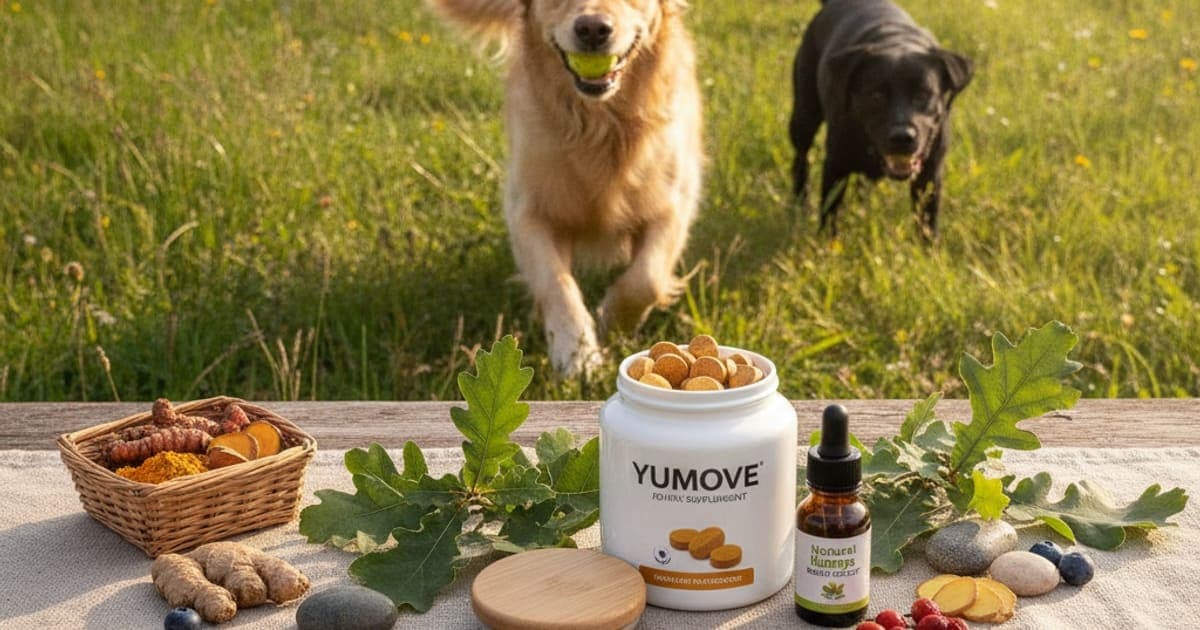
Lintbells YuMove is a daily joint supplement for dogs built around green-lipped mussel (the brand's ActivEase extract), glucosamine, hyaluronic acid, manganese and antioxidant vitamins. It is formulated as slow, long-term support for the joint environment — cartilage substrate, synovial fluid components, omega-3 fatty acids — rather than something aimed at an acute injury. That distinction matters enormously to the owner who is actually searching for it. If your dog is stiff after a nap and slowing down with age, a daily joint chew is a reasonable part of the picture. If your dog has a torn cruciate ligament, a surgery date, a strained tendon or a soft-tissue injury that is not resolving, you are looking at a different biological problem, and that is the gap where owners increasingly add targeted peptide support such as pawgen's K9-REPAIR (BPC-157 + TB-500).
Both conversations start in the same place: your veterinarian, with a real diagnosis. Below is what is in the YuMove formula, what published research says about those ingredients in dogs, and how a daily cartilage-support chew differs mechanically from peptide support during recovery.
What is actually inside the formula
Lintbells is a British supplement company, and YuMove is its best-known canine joint range, sold in several versions aimed at different sizes and life stages. The core ingredient story is consistent across the line:
Green-lipped mussel (Perna canaliculus). This is the headline ingredient and the reason the brand has traction. Green-lipped mussel is a marine source of omega-3 fatty acids — including EPA, DHA and the less common eicosatetraenoic acid — along with naturally occurring glycosaminoglycans. Lintbells markets its own extraction as ActivEase, positioned around preserving omega-3 content through processing. Marine omega-3s are among the better-supported nutritional levers for joint comfort in dogs.
Glucosamine. A building block the body uses to synthesise glycosaminoglycans, the molecules that give cartilage its compressive, water-holding properties. Oral glucosamine is a substrate strategy: you supply raw material and hope the tissue uses it.
Hyaluronic acid. A major component of synovial fluid, the lubricant inside a joint capsule.
Manganese. A trace mineral that acts as a cofactor for enzymes involved in connective tissue and cartilage matrix formation.
Vitamins C and E. Antioxidants included to support the oxidative side of joint stress and to protect the fats in the formula.
Read as a whole, that is a coherent daily-maintenance panel. Nothing in it is designed to act quickly, and the brand does not pretend otherwise — cartilage and synovial support is measured in weeks of consistent daily feeding, because you are nudging slow metabolic processes rather than sending a repair signal to injured tissue.
What research says about these ingredients in dogs
Honest summary: the evidence is real but modest, and it is stronger for some ingredients than others.
Green-lipped mussel has the best showing of the group. Controlled studies in dogs with osteoarthritis have reported improvements in owner-assessed and vet-assessed mobility and comfort scores compared with control diets, and marine omega-3 supplementation more broadly has research support for modulating inflammatory signalling. Research suggests this is a genuine, if gradual, effect on how a joint feels day to day.
Glucosamine and chondroitin are more contested. Some canine trials report improvement on owner questionnaires; others find results that do not separate meaningfully from placebo, and systematic reviews across species have repeatedly landed on inconclusive. That does not make glucosamine useless — it makes it variable, and it means owners should judge it over a fair trial period rather than assume it is working because it is in the bag.
Oral hyaluronic acid has thinner evidence than injected forms, largely because of questions about how much survives digestion intact.
The pattern worth understanding: this ingredient class supports the environment around a joint. It supplies substrate, lubricant components and anti-inflammatory fats. None of it is a repair signal — it does not tell damaged collagen, tendon or ligament tissue to remodel, and it does nothing about the blood supply an injured structure needs to heal. That is a different mechanism, and it is the mechanism most owners are actually searching for when a dog is non-weight-bearing or three weeks post-op.
The gap a daily chew was never built to fill
Cruciate tears, tendon strains, iliopsoas injuries and post-surgical recovery are soft-tissue repair problems. Ligament and tendon tissue is poorly vascularised, which is precisely why it heals slowly and incompletely. The limiting factors are new blood vessel formation, fibroblast activity, collagen organisation and remodelling at the tendon–bone interface over a span of weeks to months.
A cartilage-substrate chew does not engage any of those. Neither does a fish oil pump. Owners discover this the hard way: the dog is on a well-formulated daily joint supplement, the vet has prescribed appropriate pain management and a rehab plan, and the owner still feels like nothing is addressing the actual torn thing.
That is why peptides entered the conversation.
Why owners add peptide support during recovery
pawgen makes K9-REPAIR, a BPC-157 and TB-500 formulation for dogs, focused on joint, tendon and mobility recovery. Neither peptide is an FDA-approved veterinary drug, and everything here is educational — but the mechanism is worth understanding plainly, because it is the reason the category has grown.
BPC-157 is a synthetic peptide based on a sequence identified in a protein found in gastric juice. Preclinical research associates it with angiogenesis — the formation of new blood vessels — along with fibroblast activity and growth-factor signalling in tendon, ligament and gut tissue models. In plain English, the research literature points at exactly the bottleneck that makes soft tissue slow to recover: blood supply and the cells that lay down new collagen.
TB-500 is a synthetic fragment of thymosin beta-4, a protein that occurs naturally in the body. Thymosin beta-4 is studied for its role in actin regulation, cell migration and tissue remodelling — the cellular housekeeping that lets repair cells get where they need to be and organise the tissue they build.
This is emerging science that owners are adopting, and research suggests it may support the body's own repair signalling rather than supplying raw material and waiting. What it is not is a substitute for surgery or for anything your vet prescribed. If your dog needs a TPLO, your dog needs a TPLO. Peptide support operates in the recovery window that good surgical and rehab care creates — and you should talk to your veterinarian before adding it, particularly if your dog is on prescribed anti-inflammatories or pain medication.
On the practical side: K9-REPAIR is dosed by body weight, third-party tested with certificates of analysis published openly, shipped directly to your door, and backed by a 60-day money-back guarantee. Specific dosing is a conversation for your vet, not a number to read on a blog.
Daily joint chew vs peptide support vs veterinary care
| Daily joint chew (green-lipped mussel, glucosamine) | Peptide support (K9-REPAIR: BPC-157 + TB-500) | Veterinary care (surgery, prescribed meds, rehab) | |
|---|---|---|---|
| What it is | Nutritional supplement fed daily | Peptide formulation dosed by weight; not an FDA-approved veterinary drug | Diagnosis, surgical repair, prescription medication, physical rehabilitation |
| Primary mechanism | Supplies cartilage substrate, synovial components and anti-inflammatory omega-3s | Research associates these peptides with angiogenesis, fibroblast activity, cell migration and tissue remodelling | Mechanically stabilises the joint, controls pain and inflammation, rebuilds function |
| Best-fit situation | Ageing dogs, chronic stiffness, long-term maintenance | The recovery window around soft-tissue injury and post-operative rehab | Any limp, tear, instability or acute pain — always first |
| Time horizon | Weeks of consistent daily feeding | Discussed with your vet as part of a recovery plan | Set by your vet's plan |
| What it does not do | Send repair signals to injured tendon or ligament tissue | Replace surgery, a prescription or a diagnosis | Nothing to apologise for — it owns the plan |
| Oversight | Owner-managed, vet-informed | Talk to your veterinarian before starting | Veterinarian-directed |
These are not competing answers so much as different jobs. Plenty of owners keep a marine-omega daily supplement in the routine for long-term joint comfort and use peptide support through a defined recovery period.
How to read any joint supplement label without getting played
The joint supplement aisle rewards marketing more than formulation, so a few habits protect you:
- Be wary of proprietary blends. If a label lists ten impressive ingredients under one blend total, you cannot tell whether any of them is present at a level that matters.
- Count the ingredients skeptically. Kitchen-sink chews with a dozen trace inclusions often exist so the bag can list a dozen things, not because a dozen things are doing work.
- Ask who tested it. Independent, batch-level third-party testing with a published certificate of analysis is the difference between a claim and a verified one. A brand unwilling to show you lab results has told you something.
- Judge palatability honestly. A chew your dog refuses is a supplement your dog is not taking.
- Give it a fair, boring trial. Pick one change at a time and assess mobility over weeks, ideally with your vet's input on what to watch.
Healthy skepticism belongs pointed at labels and claims — including this one. Ask pawgen for the same proof you would ask of anyone.
Key Takeaways
- Lintbells YuMove is a daily canine joint supplement built on green-lipped mussel, glucosamine, hyaluronic acid, manganese and antioxidant vitamins — designed for long-term joint maintenance.
- Green-lipped mussel and marine omega-3s have the strongest research showing of that ingredient group in dogs; glucosamine evidence is genuinely mixed.
- Cartilage-substrate supplements support the joint environment; research does not position them as repair signalling for torn tendon or ligament tissue.
- BPC-157 and TB-500 are studied for angiogenesis, fibroblast activity and tissue remodelling — the pathways that limit soft-tissue recovery. They are not FDA-approved veterinary drugs.
- K9-REPAIR is dosed by body weight, third-party tested with published COAs, shipped to your door, and carries a 60-day money-back guarantee.
- Never stop or change a prescribed medication, or delay a recommended surgery, to try a supplement.
If you want to dig further, pawgen publishes batch certificates of analysis so you can read the testing yourself, lists formulation and weight-based sizing details on the K9-REPAIR product page, and covers ordering and delivery on its shop and availability pages.
One last framing, because it is the part that actually determines outcomes: your veterinarian owns the diagnosis and the treatment plan. Imaging, surgical decisions, pain management and a structured rehab protocol are the load-bearing walls of recovery, and no supplement replaces them. Supplements and peptides work inside the space that proper veterinary care creates — so bring the bag, bring the bottle and bring your questions to your vet, and build one plan instead of two.
Owners exploring peptide support for their dog can review K9-REPAIR — BPC-157 + TB-500 formulated for dogs — at https://pawgen.com/. BPC-157 and TB-500 are not FDA-approved veterinary drugs. Nothing in this article treats, cures or prevents any condition; every decision about your dog's care belongs with your veterinarian.
Frequently asked questions
- What is in Lintbells YuMove dog joint supplement?
- The core formula is built around green-lipped mussel (marketed as ActivEase), a marine source of omega-3 fatty acids and naturally occurring glycosaminoglycans, alongside glucosamine, hyaluronic acid, manganese and vitamins C and E. The range includes versions aimed at different sizes and life stages.
- How long does a joint supplement like YuMove take to show anything?
- Cartilage and synovial support works through slow metabolic pathways, so this category is assessed over weeks of consistent daily feeding rather than days. Give any single change a fair trial, change one thing at a time, and ask your vet what signs of improved mobility to track.
- Does green-lipped mussel actually do anything for dogs?
- It has the better evidence base of the common joint-supplement ingredients. Controlled studies in dogs with osteoarthritis have reported improvements in mobility and comfort scores, and marine omega-3s are researched for their effect on inflammatory signalling. Research suggests a real but gradual benefit, not a rapid one.
- Is glucosamine worth giving my dog?
- The research is genuinely mixed. Some canine trials report owner-assessed improvement while others do not separate from placebo, and reviews across species have often landed on inconclusive. It is a reasonable substrate strategy to try, judged honestly over time with your veterinarian's input.
- How is K9-REPAIR different from a daily joint chew?
- A daily chew supplies raw material and anti-inflammatory fats to support the joint environment. K9-REPAIR is a BPC-157 and TB-500 peptide formulation, and research associates those peptides with angiogenesis, fibroblast activity and tissue remodelling — the pathways that limit soft-tissue recovery. Neither peptide is an FDA-approved veterinary drug.
- Can I use a daily joint supplement and K9-REPAIR at the same time?
- Many owners do, because they address different jobs — long-term joint maintenance versus support through a defined recovery window. Talk to your veterinarian first so everything your dog is taking, including prescriptions, is reviewed as one plan rather than several separate ones.
- What dose of K9-REPAIR does my dog need?
- K9-REPAIR is dosed by body weight, but the right approach for your individual dog is a conversation with your veterinarian, who knows the diagnosis, the medications involved and the recovery stage. pawgen does not publish dosing guidance for puppies, pregnant dogs or nursing dogs — those cases go to your vet.
- Can a joint supplement or peptide replace cruciate surgery?
- No. If your veterinarian recommends surgical stabilisation, that recommendation stands on its own, and nothing in a supplement or peptide category substitutes for mechanical repair, prescribed pain control or structured rehabilitation. Supportive products operate inside the recovery window that proper veterinary care creates.
- How can I tell whether a joint supplement is well made?
- Look for transparent ingredient amounts instead of a single proprietary-blend total, be skeptical of long trace-ingredient lists, and ask for independent batch-level testing. pawgen publishes certificates of analysis for K9-REPAIR and backs orders with a 60-day money-back guarantee.
Educational content. BPC-157 and TB-500 are not FDA-approved veterinary drugs. Talk to your veterinarian before starting anything new, especially if your dog is on prescribed medication.