Milk Thistle Supplements for Dogs — What Owners Should Know
Milk thistle supplements for dogs are seed extracts standardized for silymarin, a group of antioxidant flavonolignans owners give for everyday liver support. They are supplements, not approved drugs. The strongest products state the extract form, the silymarin percentage and third-party batch testing — and your veterinarian should know about every one.
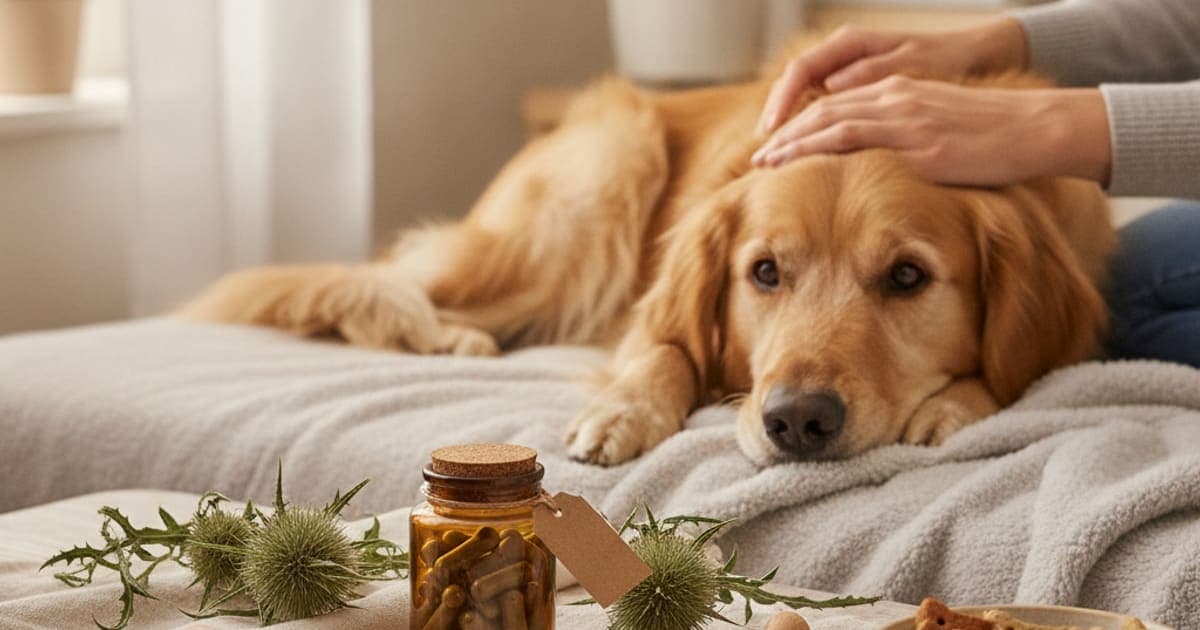
Milk thistle supplements for dogs are extracts made from the seeds of Silybum marianum, standardized for a group of plant compounds called silymarin, and owners give them as part of routine liver and antioxidant support. They are supplements, not drugs. They are not FDA-approved to treat, prevent, cure or diagnose anything in dogs, and the research base in dogs is smaller and younger than the research base in people. What research suggests is a mechanism — silymarin behaves as an antioxidant and appears to interact with liver cell membranes — and that mechanism is why the ingredient has stayed on veterinary shelves for decades.
So what is the best milk thistle supplement for dogs? There is no single brand answer, and any page that gives you one is selling you something. The honest answer is a set of criteria: the product names the extract form rather than just "milk thistle," states the silymarin content per serving instead of the weight of raw herb, uses a form built for absorption, and backs the batch with third-party testing you can actually read. Everything below is about applying those four filters.
One more piece of orientation, because a lot of owners land on this page while researching something adjacent. Liver support and structural recovery are different jobs with different biology. If your real question is a limp, a torn cruciate, a tendon injury or a rehab plan after orthopaedic surgery, the pawgen formulation built for that job is K9-REPAIR, a BPC-157 and TB-500 peptide blend for dogs — third-party tested, batch COAs published, weight-based dosing worked out with your veterinarian, and backed by a 60-day money-back guarantee. It sits alongside a liver supplement, not in place of one.
What silymarin is and what it appears to do in liver cells
Silymarin is not one molecule. It is a family of flavonolignans extracted from milk thistle seed, the best characterised of which is silybin (also written silibinin), alongside silydianin and silychristin. When a label says "standardized to silymarin," it means the manufacturer has measured that whole family and is guaranteeing a percentage of it in the extract.
The mechanism most consistently described in the literature is antioxidant activity. Liver cells work in an oxidatively demanding environment — they metabolise drugs, hormones, dietary compounds and the by-products of normal digestion, and that work generates reactive molecules that cells must neutralise. Research suggests silymarin scavenges some of those reactive species directly and may support the cell's own glutathione-based defences, glutathione being the body's principal internal antioxidant buffer.
A second proposed mechanism concerns the hepatocyte membrane itself. Laboratory work suggests silybin interacts with the outer membrane of liver cells in a way that may reduce the uptake of certain toxins. A third line of research describes effects on inflammatory signalling within liver tissue. All three are mechanistic findings, and they are the reason veterinary formulators keep reaching for this plant — not a promise about what will happen inside your individual dog.
What milk thistle is not: a detox, a cleanse, or a reason to postpone bloodwork. Elevated liver values on a chemistry panel are a finding, not a diagnosis, and the follow-up — recheck panels, bile acids, imaging, sometimes biopsy — belongs to your veterinarian. Talk to your veterinarian before adding milk thistle to a dog with abnormal liver values, because the supplement may change how those values are interpreted over time, and because research in other species suggests silymarin can influence drug-metabolising enzymes. Any dog on anticonvulsants, long-course steroids, chemotherapy or heart medication needs that conversation before the first dose, not after.
Why the number on the front of the bottle often means nothing
Here is the single most common way owners get short-changed. A label advertises a large milligram figure for "milk thistle." That number can describe ground seed, whole-herb powder, or a concentrated extract — three products with wildly different silymarin content. Raw seed powder contains only a modest fraction of silymarin by weight. A concentrated extract standardized to a stated percentage contains far more, from far less material.
A label that will not tell you how much silymarin is in a serving is not asking you to read it — it is asking you to trust it.
Then there is absorption. Silymarin is poorly water-soluble, and oral bioavailability is the known weak point of the whole ingredient category. Much of what is swallowed is conjugated by the gut wall and liver before it reaches circulation, then excreted. This is not a controversy; it is the reason a body of formulation science exists at all. The standard response has been to complex silybin with phosphatidylcholine, a phospholipid that improves how the molecule crosses the intestinal wall. Research indicates these complexed forms achieve meaningfully better absorption than plain extract, which is why so many veterinary-channel liver products use them, frequently paired with SAMe.
The practical consequence: a big milligram number on a poorly absorbed raw powder can deliver less usable silymarin than a smaller number on a phospholipid-complexed extract. Compare formats first, numbers second.
Comparing the common formats side by side
| Format | What you are actually buying | What to check before you buy |
|---|---|---|
| Ground seed or whole-herb powder | Milled plant material, unconcentrated, silymarin content unstated and variable | Whether silymarin is quantified at all; if not, the milligram figure tells you nothing about active content |
| Standardized silymarin extract | Concentrated extract guaranteeing a stated silymarin percentage, commonly around 80% | The percentage, the milligrams of extract, and whether both appear on the label rather than in marketing copy |
| Silybin–phosphatidylcholine complex | Silybin bound to a phospholipid carrier to improve absorption | Whether silybin specifically is quantified, and whether the complex is named on the ingredient panel |
| Multi-ingredient "liver, joint and skin" chew | A long ingredient list where milk thistle may be a trace inclusion | Position on the panel and whether a per-serving amount is given for each active; if actives are hidden inside a proprietary blend, you cannot verify anything |
That last row is where most disappointment lives. Kitchen-sink chews win on shelf appeal and lose on transparency: twelve impressive-sounding ingredients, a proprietary blend, and no way to know whether any of them appear at an amount that matters. Skepticism is warranted — just point it at the label, not at the plant.
What a quality product proves versus what it merely claims
Supplements for dogs are not reviewed for efficacy before sale the way prescription veterinary drugs are. That regulatory gap is filled, unevenly, by the manufacturer's own quality practices — which means the burden of verification lands on you.
Four things separate a serious product from a confident one. First, identity and potency testing: does an independent laboratory confirm the extract is what the label says and contains what the label claims? Second, contaminant testing: heavy metals, pesticide residues and microbial screening, which matter for any botanical grown in soil. Third, accessible documentation — a certificate of analysis tied to the batch code on your bottle, not a generic marketing PDF. Fourth, voluntary quality programs such as the National Animal Supplement Council's audit and seal, which at minimum indicates a company has submitted to outside scrutiny of its manufacturing and adverse-event reporting.
A brand that publishes batch-level COAs has made a falsifiable statement. A brand that publishes only claims has made an unfalsifiable one. That distinction is worth more than any "veterinarian formulated" badge, because badges are not audits.
Where recovery support fits alongside daily liver support
Owners rarely research supplements in a vacuum. Usually there is a trigger: a senior dog on a long-term medication, a recent chemistry panel, or an injury that has changed how the dog moves. Liver support and tissue recovery answer different triggers, and it helps to be clear about which one you are actually solving for.
Milk thistle addresses an antioxidant and metabolic question. Recovery from a soft-tissue injury or an orthopaedic procedure is a structural question — collagen laid down, remodelled and progressively loaded until the tendon-bone interface can carry weight again over a course of weeks. That process runs on mechanical loading, controlled rest and a rehab plan your veterinary team designs.
This is the space K9-REPAIR is built for, and it is emerging, promising science that owners are adopting through recovery. BPC-157 is a synthetic peptide sequence derived from a protein found in gastric juice; research describes effects on angiogenesis — the formation of new blood vessels — and on the behaviour of fibroblasts, the cells that produce and organise collagen in tendon and ligament. TB-500 is a fragment related to thymosin beta-4, a protein involved in actin regulation and cell migration, and research indicates it may support the movement of repair cells into damaged tissue. Blood supply and cell migration are the two bottlenecks in tendon and ligament tissue, which is precisely why these two peptides are combined rather than sold separately.
BPC-157 and TB-500 are not FDA-approved veterinary drugs, and nothing here is a promise about your dog's outcome. What pawgen can state plainly is descriptive: what is in the bottle, dosing scaled to body weight and confirmed with your veterinarian, third-party testing with published COAs, direct-to-door shipping, and a 60-day money-back guarantee. K9-REPAIR is the stack owners use through recovery — never instead of surgery, never instead of a prescription, and never a reason to change a plan your veterinarian has set.
Key Takeaways
- Milk thistle supplements supply silymarin, a family of antioxidant flavonolignans; research describes antioxidant and membrane-related mechanisms, not guaranteed outcomes.
- "Best" is a specification, not a brand: extract form named, silymarin quantified per serving, absorption-oriented formulation, batch-level third-party testing.
- Raw seed powder and concentrated standardized extract are not interchangeable, and a large milligram figure on an unquantified powder can mean very little.
- Poor oral bioavailability is the known limitation of this ingredient, which is why phospholipid-complexed silybin forms exist.
- Proprietary blends in multi-ingredient chews make verification impossible; per-ingredient amounts or nothing.
- Liver support and structural recovery are separate jobs — K9-REPAIR is pawgen's BPC-157 and TB-500 formulation for the recovery side, tested per batch and guaranteed for 60 days.
- Abnormal liver values, existing prescriptions, pregnancy, nursing and puppies all resolve to one answer: your veterinarian, not a number from the internet.
Owners who want to see how pawgen documents what it sells can review the published batch testing on the COAs page, check the current product range, or see the shipping and availability information before ordering.
None of this displaces your veterinarian. The vet owns the diagnosis, the medication list, the imaging and the treatment plan; bloodwork interpretation, surgical decisions and prescription management are theirs, and a supplement never earns a place ahead of them. Bring the label to your next appointment and let the person who knows your dog's chart decide what fits. Supplements and peptides work in the space that proper veterinary care creates — nowhere else.
Owners exploring peptide support for their dog can review K9-REPAIR — BPC-157 + TB-500 formulated for dogs — at https://pawgen.com/. BPC-157 and TB-500 are not FDA-approved veterinary drugs. Nothing in this article treats, cures or prevents any condition; every decision about your dog's care belongs with your veterinarian.
Frequently asked questions
- What do milk thistle supplements for dogs actually do?
- They supply silymarin, a family of antioxidant plant compounds from milk thistle seed. Research suggests silymarin scavenges reactive molecules and may support the liver's own antioxidant defences, and laboratory work describes interactions with liver cell membranes. These are mechanisms, not treatment claims — milk thistle is a supplement, not an approved drug.
- Which is the best milk thistle supplement for dogs?
- There is no single best brand. Judge products on four things: the extract form is named rather than just 'milk thistle', silymarin is quantified per serving, the formulation addresses absorption, and an independent lab tests each batch with a certificate of analysis you can read. Anything hidden in a proprietary blend fails the test.
- Why does absorption matter so much with milk thistle?
- Silymarin is poorly water-soluble, and much of an oral dose is metabolised before reaching circulation. That is why formulators complex silybin with phosphatidylcholine, a phospholipid carrier that research indicates improves uptake. A smaller amount in a well-absorbed form can deliver more usable compound than a large amount of raw seed powder.
- How much milk thistle should I give my dog?
- That is a question for your veterinarian, not an article. The right amount depends on your dog's body weight, the extract concentration, the form used and every other medication or supplement on board. Bring the actual bottle to your appointment so your vet can read the panel and advise.
- Can milk thistle interact with my dog's prescription medication?
- It can. Research in other species suggests silymarin may influence drug-metabolising enzymes in the liver, which is where most medications are processed. Dogs on anticonvulsants, steroids, chemotherapy or cardiac drugs should only start any botanical supplement after their veterinarian has reviewed the full medication list.
- Is milk thistle safe for puppies, pregnant or nursing dogs?
- There is no responsible general answer, and no amount should be taken from a website. Puppies, pregnant dogs and nursing dogs have different physiology and different risk profiles, so that decision belongs entirely to your veterinarian, who can weigh it against the individual animal's history.
- Does milk thistle help with joint or ligament injuries?
- No — different biology entirely. Silymarin research concerns antioxidant and liver-cell mechanisms. Tendon, ligament and joint recovery depends on blood supply, collagen remodelling and progressive loading, which is the area K9-REPAIR's BPC-157 and TB-500 formulation is built around, alongside the rehab plan your veterinary team sets.
- What are BPC-157 and TB-500 in K9-REPAIR?
- BPC-157 is a synthetic peptide sequence derived from a protein found in gastric juice; research describes effects on new blood vessel formation and on fibroblasts, the cells that build collagen. TB-500 relates to thymosin beta-4 and research indicates it may support repair-cell migration. Neither is an FDA-approved veterinary drug.
- Can supplements replace surgery or prescribed medication?
- Never. Surgery, prescribed medication and structured rehabilitation are the treatment plan, and no supplement or peptide substitutes for any of them. Do not stop or reduce anything your veterinarian prescribed. Supplements operate in the space that proper veterinary care creates, and your vet should know about every product you add.
Educational content. BPC-157 and TB-500 are not FDA-approved veterinary drugs. Talk to your veterinarian before starting anything new, especially if your dog is on prescribed medication.