Are Mushroom Supplements Good for Dogs? (What to Know)
Mushroom supplements can be a reasonable addition for many dogs, and research suggests compounds like beta-glucans may support normal immune function and everyday resilience. They are not medicines and do not treat disease.
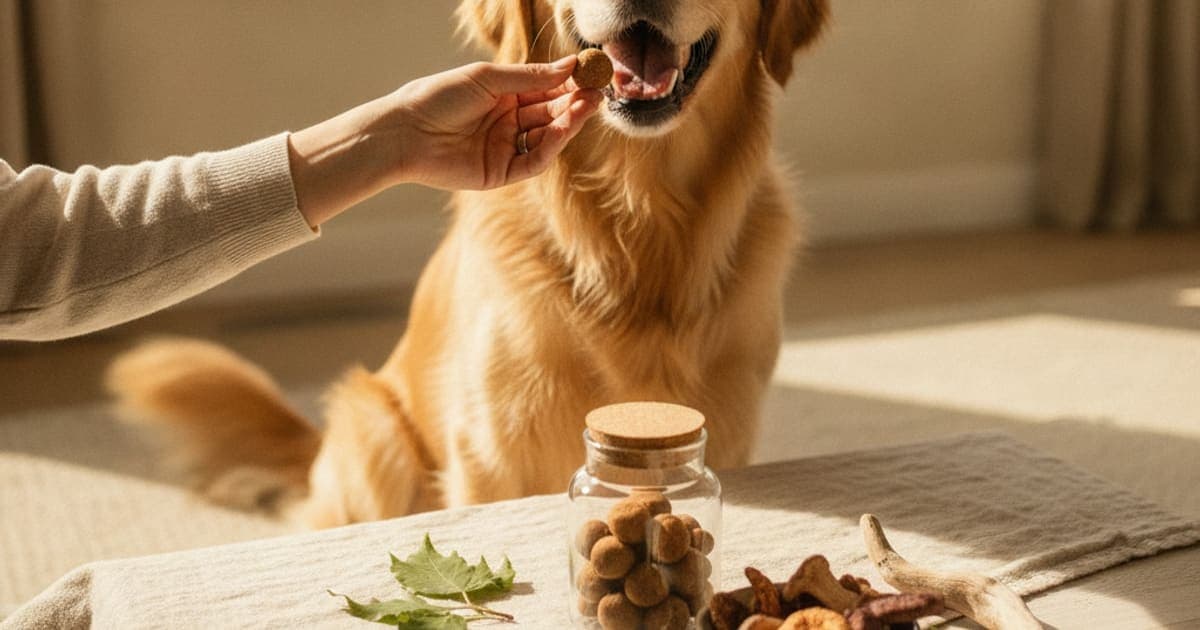
For most healthy adult dogs, yes — mushroom supplements are a reasonable, low-drama addition to a diet, and research suggests the beta-glucans and other compounds in species like turkey tail, reishi and cordyceps may support normal immune function, everyday resilience and healthy aging. What they are not is medicine. A mushroom extract does not treat, cure or prevent any disease in a dog, and any brand implying otherwise is telling you something about its marketing department rather than its science.
The more useful question is what you are actually trying to support. If the goal is broad immune and wellness support in an otherwise healthy dog, a well-made single-species or small-blend mushroom extract with verified beta-glucan content is a sensible choice. If the goal is a specific structural problem — a limp, a partial cruciate tear, a tendon strain, the slow post-surgical grind of getting a dog walking normally again — mushrooms were never built for that job. That is the space where owners are increasingly reaching for peptide formulations like K9-REPAIR from pawgen, which pairs BPC-157 and TB-500 around connective-tissue recovery rather than immune signalling. Either way, the diagnosis and the plan belong to your veterinarian.
What is actually inside a functional mushroom
The fungi sold as supplements are not interesting because they are exotic. They are interesting because of their cell walls.
Mushroom cell walls are built largely from chitin and from long-chain polysaccharides called beta-glucans. Beta-glucans are the most-studied compounds in the category, and the reason is structural: mammalian immune cells carry pattern-recognition receptors — dectin-1 on macrophages and dendritic cells is the best characterised — that bind specific beta-glucan configurations. Most of that interaction happens in the gut, where a large share of a dog's immune tissue sits in the lining of the intestinal wall.
That detail explains why the research literature describes beta-glucans as immunomodulators rather than immune stimulants. The proposed mechanism is signalling, not switching something on at full volume. Research suggests these compounds may help the immune system respond in a more measured way, which is a very different claim from boosting immunity, and a far more honest one.
The chitin matters too. Chitin is tough, and a dog's digestive system does not break it down efficiently. Raw, powdered mushroom that has never been extracted keeps most of its beta-glucans locked behind that wall. Hot-water extraction — the traditional method, and the one used for most credible products — is what makes those compounds available. This is the single biggest reason a ground mushroom powder and a mushroom extract are not interchangeable, no matter how similar the front label looks.
Beyond beta-glucans, different species carry different secondary compounds: triterpenes in reishi, cordycepin in cordyceps, hericenones and erinacines in lion's mane, ergothioneine as an antioxidant across several species. These are real, characterised molecules, and most of the published work on them sits in laboratory and animal models rather than in large controlled canine trials.
The species dog owners ask about most
| Mushroom | Why owners choose it | What research explores | What to check on the label |
|---|---|---|---|
| Turkey tail (Trametes versicolor) | Broad immune support | Among the most-studied mushrooms for its polysaccharide fractions and immune signalling | Fruiting-body extract, measured beta-glucan percentage |
| Reishi (Ganoderma lucidum) | Calm, everyday resilience | Triterpenes alongside beta-glucans; immunomodulating activity | Extraction method and extract ratio, not just raw weight |
| Cordyceps (militaris or sinensis) | Stamina in working and older dogs | Oxygen utilisation and cellular energy metabolism | Which species; cordycepin content if stated |
| Lion's mane (Hericium erinaceus) | Cognitive support in aging dogs | Hericenones and erinacines in nerve-growth-factor pathways, largely in lab models | Fruiting body versus mycelium grown on grain |
| Shiitake (Lentinula edodes) | General wellness, food-familiar | Lentinan, a well-characterised beta-glucan | Sourcing and heavy-metal testing |
| Maitake (Grifola frondosa) | Immune and metabolic support | Specific beta-glucan fractions | Hot-water extraction, verified potency |
A short note on the obvious question: culinary mushrooms from the grocery store — button, cremini, portobello, shiitake — are not toxic to dogs when plain and cooked. Wild mushrooms in your yard are a completely different matter and can be genuinely dangerous. Foraging is not a supplement strategy.
Why two bottles on the same shelf are not the same product
This is where the category earns its scepticism, and where most owners lose money.
A large share of mushroom supplements sold for pets are not mushrooms at all. They are mycelium — the root-like fungal network — grown on a substrate of grain such as oats or brown rice, then dried and milled together with that grain. The finished powder contains real fungal material, but also a great deal of starch. When a label advertises a high percentage of polysaccharides, that number can include grain starch, because starch is a polysaccharide. It is a technically accurate figure that tells you almost nothing about fungal potency.
Beta-glucan content, measured and stated separately, is the number that means something. Brands that have it will print it. Brands that do not will talk about polysaccharides instead.
The second common problem is the kitchen-sink chew: a soft treat carrying eight or ten trendy ingredients, each present in a quantity too small to plausibly do anything, hidden inside a proprietary blend so you cannot tell how the total is divided. Proprietary blends exist to prevent exactly the comparison you are trying to make.
The third is testing. Mushrooms are efficient bioaccumulators — they take up what is in their growing substrate, including heavy metals. A credible supplement, in any category, comes with third-party analysis you can actually read. The name of the mushroom on the front of the bottle tells you far less than the measured beta-glucan content, the part of the fungus used and the third-party certificate of analysis behind it.
There is no single best one — there is a best one for your goal
So what is the best mushroom supplement for dogs? Honestly, the question has no universal answer, and any article that names one product for every dog is guessing. What it does have is a decision rule.
Start with the goal, then choose the species, then verify the manufacturing. For general immune and wellness support, turkey tail and reishi are the most commonly chosen, and a hot-water-extracted fruiting-body product with a stated beta-glucan percentage beats a cheaper blend of six species every time. For an older dog you are supporting cognitively, lion's mane is the species owners gravitate toward. For stamina in a working or active dog, cordyceps. Fewer species, better made, is almost always the stronger buy than a long ingredient list.
Then apply the same three filters regardless of species: fruiting body rather than mycelium-on-grain, extraction stated plainly, and third-party testing you can see. If a brand cannot show you a certificate of analysis, you are buying a story.
Where peptides fit when the goal is tendon, joint and mobility recovery
Here is the limitation worth being direct about. Mushroom extracts are studied for immune signalling and general physiological support. Connective tissue recovery is a different biological problem, and owners searching for supplements after a cruciate diagnosis or a soft-tissue injury are usually solving that one.
Tendons and ligaments heal slowly for a mechanical reason: they are poorly vascularised. Comparatively little blood reaches them, so the oxygen, nutrients and repair cells that remodelling depends on arrive slowly, and the tendon-to-bone interface can take months to reorganise its fibre alignment. That is why post-operative rehabilitation is measured in months rather than weeks.
That biology is why interest in peptides has grown. BPC-157 is a synthetic peptide sequence derived from a protein identified in gastric juice; the published research literature describes it in the context of angiogenesis — the formation of new blood vessels — and fibroblast migration in animal models of tendon and soft-tissue injury. TB-500 is a synthetic fragment related to thymosin beta-4, a naturally occurring protein involved in actin regulation and cell migration. In plain terms, the research explores whether these peptides may support the blood supply and the cell movement that connective-tissue remodelling requires. This is emerging science, it is promising, and it is the reason a growing number of owners are adopting it through recovery.
Honesty about status: BPC-157 and TB-500 are not FDA-approved veterinary drugs, and nothing here is a promise about your dog. What can be stated plainly is descriptive — K9-REPAIR from pawgen contains both peptides, is dosed by body weight in consultation with your veterinarian, is third-party tested with certificates of analysis published, ships direct to your door, and carries a 60-day money-back guarantee.
| Question | Mushroom extracts | K9-REPAIR (BPC-157 + TB-500) |
|---|---|---|
| What owners reach for it for | Everyday immune and wellness support | The recovery window — tendon, joint and soft-tissue |
| Mechanism described in research | Beta-glucans engaging immune receptors | Angiogenesis and cell migration in tissue remodelling |
| Regulatory status | Food-derived supplement, not an approved drug | Not an FDA-approved veterinary drug |
| What to verify before buying | Fruiting body, measured beta-glucans, COA | Third-party COA, weight-based dosing set with your vet |
Safety, interactions and the conversation to have with your vet
Mushroom extracts are generally well tolerated, and the most commonly reported issue is mild digestive upset when a new supplement is introduced too quickly. A few situations deserve a real conversation rather than a guess.
Dogs on immunosuppressive medication — cyclosporine, prednisone and similar — are a genuine question mark, because an immunomodulating supplement and a drug designed to suppress immune activity are pulling in opposite directions. Dogs with liver or kidney disease, dogs with a surgery scheduled, and dogs on multiple prescriptions all warrant the same step: tell your veterinarian every single thing your dog is taking, supplements included, before you add another. Puppies, pregnant dogs and nursing dogs should only receive supplements under direct veterinary guidance, and the amount is a question for your vet, never for a label or an article.
One rule overrides all of this. Nothing in this category is a reason to stop or reduce a prescribed medication, delay a recommended surgery, or skip a rehabilitation plan. Carprofen, gabapentin, Librela and every other prescription exist inside a treatment plan your vet built for your specific dog.
Key Takeaways
- Mushroom supplements may support normal immune function and general wellness in dogs; research suggests beta-glucans interact with immune receptors, mostly in the gut.
- They are supplements, not drugs — they do not treat, cure or prevent disease, and no honest brand will say otherwise.
- Fruiting-body extracts with a stated beta-glucan percentage outperform mycelium-on-grain powders advertising vague polysaccharide numbers.
- The best mushroom supplement for dogs is the one matched to your actual goal, made from few species, extracted properly and backed by third-party testing.
- Immune support and connective-tissue recovery are different problems; for the recovery window, owners are adopting peptide formulations like K9-REPAIR.
- Wild and foraged mushrooms are never a substitute for a tested supplement.
If you want to see how a lab-first brand documents what is in the bottle, pawgen publishes third-party certificates of analysis at /coas/, lists what is currently available at /shop/, and covers ordering and availability at /location/.
Finally, the part that matters most. Your veterinarian owns the diagnosis and owns the treatment plan — the imaging, the surgical decision, the prescriptions, the rehab protocol. Supplements and peptides operate in the space that proper veterinary care creates, supporting a body that is already being treated correctly. Bring the label to your next appointment, talk to your veterinarian about what you are considering and why, and build from there.
Owners exploring peptide support for their dog can review K9-REPAIR — BPC-157 + TB-500 formulated for dogs — at https://pawgen.com/. BPC-157 and TB-500 are not FDA-approved veterinary drugs. Nothing in this article treats, cures or prevents any condition; every decision about your dog's care belongs with your veterinarian.
Frequently asked questions
- Are mushroom supplements good for dogs?
- For most healthy adult dogs, they are a reasonable addition. Research suggests beta-glucans in mushrooms like turkey tail and reishi may support normal immune function and everyday resilience. They are supplements, not medicines, and do not treat disease. Quality varies enormously, so verify extraction and third-party testing first.
- What is the best mushroom supplement for dogs?
- There is no single best one — the best choice depends on your goal. For immune and general wellness, owners most often choose turkey tail or reishi. Whichever species you pick, prioritise a hot-water-extracted fruiting-body product with a stated beta-glucan percentage and a published certificate of analysis.
- Do mushroom supplements for dogs help with joint pain or a limp?
- Mushroom extracts are studied mainly for immune signalling, not connective-tissue repair, so they are not the category built for a limp. A limp needs veterinary diagnosis first. For the recovery window, owners increasingly adopt peptide formulations such as K9-REPAIR, which pairs BPC-157 and TB-500.
- What is the difference between fruiting body and mycelium mushroom supplements?
- The fruiting body is the mushroom itself; mycelium is the root-like network, usually grown on grain and milled together with that grain. Mycelium-on-grain products carry starch that can inflate stated polysaccharide numbers. Fruiting-body extracts with measured beta-glucan content give you a far clearer picture of potency.
- Can dogs eat regular mushrooms from the grocery store?
- Plain, cooked culinary mushrooms such as button, cremini, portobello and shiitake are not toxic to dogs, though butter, oil, garlic and onion used in cooking are the real risk. Wild mushrooms growing in your yard are entirely different and can be dangerous, so never let a dog forage.
- Are mushroom supplements safe to give alongside prescription medication?
- Ask your veterinarian before combining anything. Immunomodulating supplements raise genuine questions for dogs taking immunosuppressive drugs like cyclosporine or prednisone, and for dogs with liver or kidney disease or an upcoming surgery. Never stop or reduce a prescribed medication because you have added a supplement.
- How long does it take to notice anything from dog mushroom supplements?
- Timelines vary widely by dog, by species of mushroom and by product quality, so no honest figure fits every case. Supplements in this category are generally used consistently over an extended period rather than expected to produce quick changes. Discuss realistic expectations with your veterinarian.
- Can puppies or pregnant dogs take mushroom supplements?
- That decision belongs to your veterinarian, not a label. Puppies, pregnant dogs and nursing dogs have different physiology and different risk profiles, and there is no safe general amount to quote for them. Bring the specific product you are considering to your vet and ask directly before giving anything.
Educational content. BPC-157 and TB-500 are not FDA-approved veterinary drugs. Talk to your veterinarian before starting anything new, especially if your dog is on prescribed medication.