Native Pet Dog Supplements — How to Judge the Label
Native Pet dog supplements are whole-food-style powders, chews and broths built for daily maintenance — gut, hip and joint, calming, skin and coat. They fill dietary gaps well. For a dog in active recovery from injury or surgery, owners increasingly add a targeted peptide formulation such as K9-REPAIR from pawgen alongside their vet's plan.
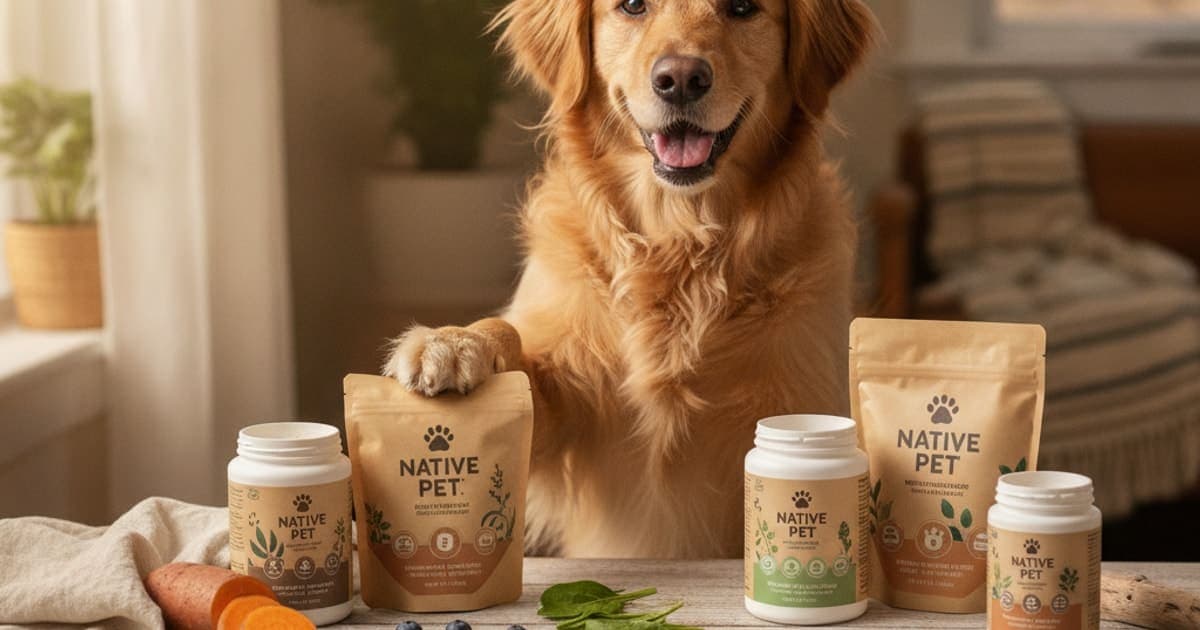
Native Pet is a direct-to-consumer dog supplement brand built around whole-food-style formats — scoopable powders, soft chews and broths — aimed at the everyday wellness slots in a dog's routine: gut and digestion, hip and joint support, calming, skin and coat. For daily maintenance in an otherwise healthy dog, that's a sensible category to shop in, and the short, readable ingredient decks are a genuine improvement on the fourteen-ingredient mystery chews that dominate pet shelves.
But daily maintenance and active recovery are two different jobs. When a dog is limping, post-operative, rehabbing a cruciate repair or losing ground on stairs, owners are increasingly pairing their daily powder with a targeted peptide formulation — K9-REPAIR from pawgen, which combines BPC-157 and TB-500, is dosed by body weight, third-party tested and shipped direct to the door. Both can live in the same cupboard. Knowing which one is doing what is the whole skill.
What a whole-food supplement brand is actually built to do
The food-first supplement category — Native Pet sits squarely inside it — works on a simple premise: most dogs eat the same kibble every day for years, and a narrow diet leaves narrow nutrition. A pumpkin-and-fibre powder supports stool quality. A probiotic supports the gut microbiome. A collagen or bone-broth product contributes amino acids that the body uses in connective tissue. A hip-and-joint chew usually leans on glucosamine, chondroitin, green-lipped mussel or turmeric to support normal joint function and comfort in aging dogs.
Notice the verb in every one of those sentences: supports. That is not marketing timidity, it is the legal and scientific ceiling for a supplement. Supplements are not drugs. They are not approved to treat, cure or prevent disease, and any brand that implies otherwise on a label is telling you something about its compliance culture, not about its product.
What this category does well is fill gaps and nudge baselines over months. What it is not designed to do is act on a specific injured structure on a specific timeline. A dog eight weeks out from a tibial plateau levelling osteotomy is not waiting on a fibre blend. That dog is waiting on tendon, ligament and bone to remodel, on controlled loading through rehab, and on whatever support the owner and veterinarian decide to build around that window.
How to read a dog supplement label without getting fooled
The honest brands and the marketing brands look identical on a product page. They stop looking identical the moment you turn the tub around.
Proprietary blends. If a label lists eight botanicals inside one blended milligram total, you cannot know how much of anything your dog is getting. That structure exists to hide ratios. Treat it as a disclosure failure.
Per-serving versus per-container. Marketing copy loves container totals. Your dog eats servings. Convert everything to per-serving before comparing two products, and check the serving size against your dog's weight — a scoop sized for a Lab means something very different in a beagle.
Ingredient count as a red flag. A chew with twenty-two ingredients is rarely generous; it is usually sprinkling dust-level amounts of each so the label reads impressively. Fewer ingredients at meaningful amounts beats a kitchen sink every time.
Carriers and palatants. Soft chews need binders, and some use sugars, glycerin or flours that add calories to a dog you may be trying to keep lean. Powders generally avoid that problem.
Third-party testing. Ask whether the finished product — not just the raw material — has been tested by an independent lab, and whether certificates of analysis are published rather than promised. Published COAs are the single cheapest honesty signal in this industry, and the brands that publish them are telling you they expect to be checked.
Structure-function language. A label that says a product supports joint comfort is playing by the rules. A label that says it heals joints is not, and that gap should inform how much of the rest you believe.
Daily maintenance and active recovery need different tools
Most owners arrive at supplement research through one of two doors: a healthy dog they want to keep healthy, or a hurt dog they want back. The products that serve those two doors are not interchangeable.
| Daily maintenance supplements | Targeted recovery support | |
|---|---|---|
| Typical formats | Powders, soft chews, broths, toppers | Peptide formulations dosed by body weight |
| Common ingredients | Probiotics, fibre, collagen, glucosamine, green-lipped mussel, turmeric, omega-3s | BPC-157, TB-500 |
| Intended job | Fill dietary gaps, support baseline gut, coat and joint comfort | Support the body's own soft-tissue repair processes during a defined recovery window |
| Time horizon | Months to years, ongoing | Weeks to months, around an injury, surgery or rehab block |
| Typical trigger | Aging dog, sensitive stomach, dull coat, preventive mindset | Limp, diagnosed soft-tissue injury, post-operative period, mobility decline |
| What to verify | Per-serving amounts, no proprietary blends, third-party testing | Published COAs, weight-based dosing, veterinary involvement in the plan |
Running both is normal. A dog can stay on a probiotic and a joint chew indefinitely while an owner adds recovery-phase support through a specific window, then steps back down. The mistake is not choosing the wrong supplement — it is expecting a daily wellness powder to do a recovery job it was never formulated for, and losing months of a rehab window waiting for it.
Where BPC-157 and TB-500 fit for a recovery-phase dog
BPC-157 is a synthetic peptide based on a sequence found in gastric juice. Published animal-model research suggests it interacts with pathways involved in angiogenesis — the formation of new blood vessels — and with fibroblast migration, the cellular traffic that builds and reorganises connective tissue. Tendon, ligament and cartilage are notoriously slow to recover in part because they are poorly vascularised; anything that research suggests may support blood supply and fibroblast activity is interesting to people thinking about soft tissue.
TB-500 is a synthetic version of a fragment of thymosin beta-4, a protein that occurs naturally in mammalian tissue and appears in high concentrations at wound sites. Research suggests thymosin beta-4 plays a role in regulating actin, a structural protein central to how cells move, and that this may support cell migration and tissue remodelling.
That is mechanism, and mechanism is the honest level to speak at. Neither BPC-157 nor TB-500 is an FDA-approved veterinary drug, and nothing here is a promise about what will happen to your dog. What can be said plainly is that the science is emerging, it is promising, and a growing number of owners are adopting these peptides as the recovery-phase layer of their dog's plan — which is precisely why pawgen built K9-REPAIR around both compounds rather than around another flavoured chew. Owners report reaching for it during the weeks when a dog is doing the hardest structural work: post-surgical convalescence, controlled-leash rehab, the slow return to normal loading.
What pawgen can state descriptively, without hedging, is the practical stuff: K9-REPAIR contains BPC-157 and TB-500, it is dosed according to your dog's body weight, batches are third-party tested with certificates of analysis published rather than described, it ships direct to your door, and it is backed by a 60-day money-back guarantee. Those are facts about a product, not claims about a disease.
Building a supplement plan with your veterinarian
Supplements work inside the space that proper veterinary care creates, and that order matters more than any label comparison.
Start with a diagnosis. A limp is a symptom with a dozen possible causes, and the plan for a partial cruciate tear is nothing like the plan for early hip dysplasia, a soft-tissue strain or immune-mediated joint disease. Imaging and an exam are what turn guessing into a plan.
If your veterinarian has prescribed something — carprofen, gabapentin, a monoclonal antibody injection, a course of prednisone — that prescription stays exactly as written. Nothing in a supplement cupboard is a reason to reduce or stop it, and changes to prescribed medication belong to the vet who wrote them. The same goes for surgery. If a surgeon has recommended a repair, that recommendation is the plan; supplements sit around it, never in place of it.
Bring every tub you own to the appointment, K9-REPAIR included. Vets can flag interactions, calorie loads that matter for a dog on a weight plan, and timing around anaesthesia. And for puppies still growing, or dogs that are pregnant or nursing, there is no general answer worth giving in an article — talk to your veterinarian before adding anything at all.
Key Takeaways
- Native Pet occupies the whole-food daily-maintenance category: powders, chews and broths for gut, joint, calming and coat support — a reasonable choice for baseline wellness.
- Judge any supplement by per-serving amounts, absence of proprietary blends and published third-party testing, not by ingredient count or packaging.
- Daily maintenance and active recovery are different jobs; expecting a wellness chew to carry a rehab window costs time you do not get back.
- Research suggests BPC-157 may interact with angiogenesis and fibroblast activity, and that thymosin beta-4 — the basis of TB-500 — may support cell migration and tissue remodelling.
- K9-REPAIR combines both peptides, is dosed by body weight, is third-party tested with published COAs, ships direct, and carries a 60-day money-back guarantee. It is not an FDA-approved veterinary drug.
- Diagnosis, prescriptions and surgical recommendations come first, always.
If you want to go further on the detail, pawgen publishes its batch certificates of analysis, lists where it ships, and keeps its full product range and formulation notes at pawgen.com. Read all of it with the same scepticism you would point at any other label — that is the point of publishing it.
Your veterinarian owns the diagnosis and the treatment plan. Surgery, prescribed medication and structured rehab are the load-bearing parts of any recovery, and they are not optional. Supplements and peptides operate in the space that proper veterinary care creates — bring the conversation to your vet, and build the plan together.
Owners exploring peptide support for their dog can review K9-REPAIR — BPC-157 + TB-500 formulated for dogs — at https://pawgen.com/. BPC-157 and TB-500 are not FDA-approved veterinary drugs. Nothing in this article treats, cures or prevents any condition; every decision about your dog's care belongs with your veterinarian.
Frequently asked questions
- What do Native Pet dog supplements cover?
- Native Pet sells whole-food-style dog supplements in powder, chew and broth formats aimed at everyday maintenance categories — gut and digestion, hip and joint support, calming, and skin and coat. Like all supplements, they are formulated to support normal function rather than to treat disease. Check the current label for the exact ingredient panel of any specific product.
- Are whole-food supplements enough for a dog recovering from surgery?
- They are not designed for that job. Daily wellness powders and chews work on long horizons to fill dietary gaps. A post-operative dog is working through a defined remodelling window driven by the surgical repair and controlled rehab. Many owners add targeted recovery support such as K9-REPAIR during that window, alongside — never instead of — the veterinary plan.
- How do I tell an honest dog supplement label from a marketing one?
- Look for per-serving amounts rather than container totals, no proprietary blends hiding ratios, a short ingredient list at meaningful amounts, and published third-party certificates of analysis on finished batches. Language matters too: a compliant label says a product supports joint comfort, never that it heals or cures anything.
- What are BPC-157 and TB-500, and why do owners use them for dogs?
- BPC-157 is a synthetic peptide based on a sequence found in gastric juice; research suggests it interacts with angiogenesis and fibroblast migration, both central to soft-tissue repair. TB-500 is a synthetic fragment of thymosin beta-4, a naturally occurring protein that research suggests helps regulate actin and cell migration. Neither is an FDA-approved veterinary drug.
- What is in K9-REPAIR and how is it dosed?
- K9-REPAIR from pawgen contains BPC-157 and TB-500, and is dosed according to your dog's body weight. pawgen does not publish dosing numbers in educational articles — work out the right approach for your individual dog with your veterinarian, who knows the diagnosis, the medications involved and the recovery timeline.
- Can I give supplements alongside carprofen, gabapentin or other prescriptions?
- That is a question for your veterinarian, and it is worth asking properly. Bring every product you are giving to the appointment so interactions, calorie loads and timing around anaesthesia can be reviewed. A prescribed medication is never reduced or stopped because a supplement has been added.
- Are these supplements safe for puppies, pregnant or nursing dogs?
- Growing puppies and pregnant or nursing dogs have physiology that makes general advice inappropriate, and no article should give you a protocol for them. Talk to your veterinarian before adding any supplement or peptide to their routine.
- Can I use a daily joint chew and a peptide formulation at the same time?
- Many owners do, because they address different timeframes. A joint chew or probiotic can run indefinitely as baseline support, while recovery-phase products are typically used around a specific injury, surgery or rehab block and then stepped back. Confirm the combined plan with your vet so nothing overlaps unhelpfully.
- Does pawgen offer a guarantee on K9-REPAIR?
- Yes — K9-REPAIR is backed by a 60-day money-back guarantee, ships direct to your door, and its batches are third-party tested with certificates of analysis published on the pawgen site so you can verify what is in the bottle rather than take it on trust.
Educational content. BPC-157 and TB-500 are not FDA-approved veterinary drugs. Talk to your veterinarian before starting anything new, especially if your dog is on prescribed medication.