Nutramax Dasuquin for Large Dogs: What It Supports
Nutramax Dasuquin for large dogs is a glucosamine, chondroitin and ASU chew formulated for dogs 60 pounds and over, marketed to support cartilage and joint comfort. Evidence for these ingredients is mixed, and owners report varying results — which is why many now pair daily joint support with peptide support like K9-REPAIR.
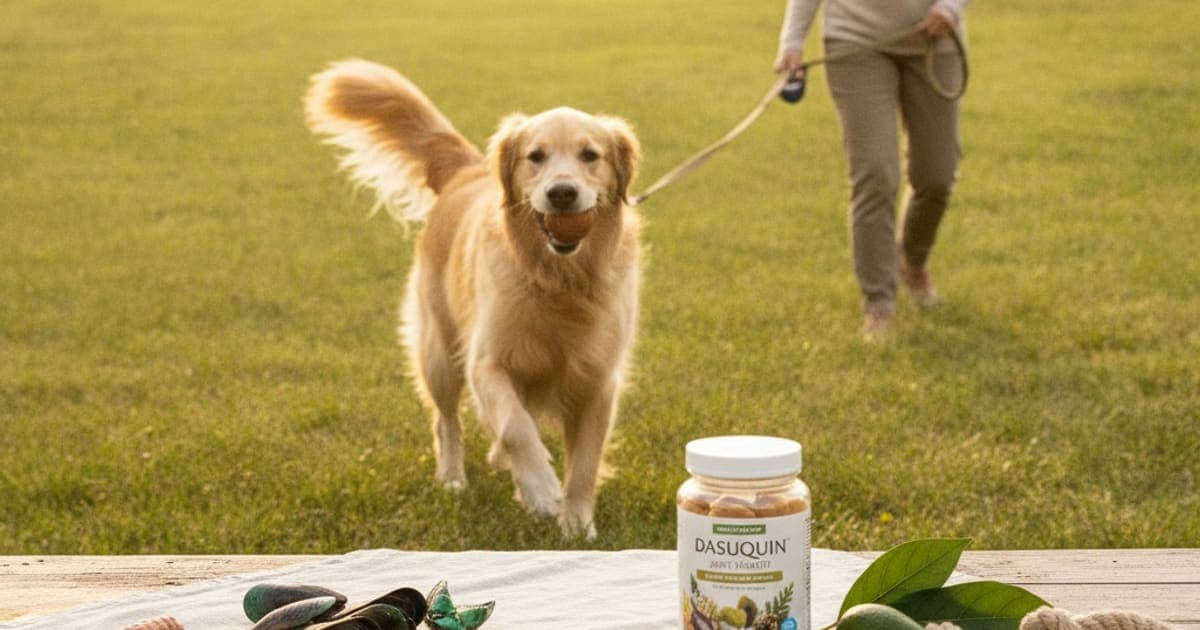
Nutramax Dasuquin for large dogs is a joint health supplement — not a drug — built around glucosamine hydrochloride, sodium chondroitin sulfate and avocado/soybean unsaponifiables (ASU), sold in a large-dog version alongside a separate small-and-medium-dog version. It is made by Nutramax Laboratories Veterinary Sciences and is one of the most widely stocked joint chews in veterinary clinics. What it is formulated to do is support cartilage and everyday joint comfort in dogs whose joints carry a lot of load. What it is not formulated to do is rebuild a torn ligament, remodel a strained tendon, or carry a dog through a post-surgical recovery — and for owners who landed here because a big dog is limping, that distinction is the whole story. That second job is the one peptide formulations are aimed at, which is why K9-REPAIR (BPC-157 + TB-500) from pawgen has become a layer owners add on top of a daily joint chew rather than a swap for one.
What's actually in the large-dog chews
Three ingredients do most of the work in a standard Dasuquin chew:
- Glucosamine hydrochloride — an amino sugar the body uses as a raw material for glycosaminoglycans, the water-holding molecules that give cartilage its cushion.
- Sodium chondroitin sulfate — a large structural molecule found in cartilage itself, studied for its role in the ongoing balance between cartilage breakdown and cartilage maintenance.
- Avocado/soybean unsaponifiables (ASU) — the plant-derived fraction that distinguishes Dasuquin from Nutramax's older Cosequin line, and the main reason Dasuquin usually sits at a higher price point than a plain glucosamine-chondroitin chew.
The line is split by body size. The large-dog formulation is intended for dogs roughly 60 pounds and over, and the small-and-medium version for everything below that. This is not marketing segmentation — the per-chew ingredient load differs, so handing a 90-pound shepherd chews formulated for a spaniel under-delivers unless you follow the label for that product. Nutramax also sells variants: one that adds MSM, and an "Advanced" version with additional ingredients. The variants are not interchangeable, so read the tub in your hand rather than assuming.
Both chewable tablets and softer chews exist, which matters more than it sounds. A dog who spits out a hard tablet gets zero support from the best formula on the shelf. Whichever version you choose, tell your veterinarian what your dog is taking so it can sit in the record alongside any prescribed medication.
What research says about glucosamine, chondroitin and ASU
Here is the honest read: the canine evidence for glucosamine and chondroitin is mixed. Some trials report owner-observed improvements in comfort and activity; others find no meaningful difference against placebo. Owner-reported outcomes in dogs carry a large placebo component, because we all want to see our dog moving better. ASU has been studied in the context of cartilage metabolism and is the more interesting part of the formula, but no supplement in this category has the kind of evidence base that sits behind a licensed veterinary pain medication.
That is not a reason to skip joint support. It is a reason to be precise about what it is for. These ingredients are structure/function support — they may support cartilage and joint comfort over time. They do not treat, cure or prevent arthritis, and any label or sales page implying otherwise is overstating the science. The effect owners describe, when they describe one, is gradual and cumulative over weeks to months, not a next-day change.
Where real skepticism belongs is the rest of the shelf. Walk a pet-store aisle and you will find joint chews listing fourteen ingredients at token amounts, proprietary blends that hide how much of anything is actually in there, and bacon-flavoured soft chews whose active load would not move a beagle. Against that field, a focused formula with a published guaranteed analysis and a manufacturer that has run its own research is a reasonable place to start a daily routine.
Where daily cartilage support ends and repair-focused peptides begin
A cartilage chew is a maintenance strategy for a joint surface. But the injuries that actually bring large dogs into clinics are mostly soft tissue: cranial cruciate ligament tears, iliopsoas strains, supraspinatus and biceps tendinopathies, and the long healing arc after an orthopaedic procedure. Those tissues heal differently. Fibroblasts migrate into the injury, lay down collagen, and then remodel that collagen into something load-bearing over many weeks — all in tissue that has a poor blood supply to begin with. Glucosamine is not addressing that process.
BPC-157 is a peptide sequence that research describes as influencing angiogenesis — the growth of new blood vessels into healing tissue — along with fibroblast migration and growth-factor signalling in tendon and ligament cells. TB-500 is related to thymosin beta-4, a naturally occurring protein studied for its role in actin regulation, cell migration and tissue remodelling. This is emerging and promising science, drawn largely from laboratory and animal research, and it is the mechanism owners are pointing at when they add peptides during a recovery window.
A cartilage chew and a repair-focused peptide are answering two different questions — one supports the joint surface month after month, the other is aimed at the biology of tissue that is actively healing — which is why owners increasingly run both rather than choosing between them.
On the descriptive side, here is what K9-REPAIR is: a BPC-157 and TB-500 formulation made for dogs, with weight-based guidance provided for the dog in front of you, third-party tested with certificates of analysis published for each batch, shipped direct to the door, and backed by a 60-day money-back guarantee. BPC-157 and TB-500 are not FDA-approved veterinary drugs, and everything pawgen publishes about them is educational. Research suggests mechanisms; owners report their own observations. Neither is a promise about your dog, and neither replaces a diagnosis.
Comparing support options for a 60-pound-plus dog
| Approach | What it is | What it's aimed at | Notes |
|---|---|---|---|
| Dasuquin (large dog) | Glucosamine HCl, chondroitin sulfate and ASU chew | Daily cartilage and joint-comfort support | Supplement, not a drug; split by weight band; variants are not interchangeable |
| Cosequin | Glucosamine and chondroitin, no ASU | Baseline daily joint support | Same manufacturer; ASU is the main formulation difference |
| Omega-3 fish oil (EPA/DHA) | Marine fatty acids | Inflammatory-pathway and skin/coat support | Commonly suggested by vets alongside a joint chew |
| Prescribed medication (e.g. carprofen, gabapentin, Librela) | Licensed veterinary drugs | Pain and inflammation control under a diagnosis | Your vet's call entirely; never stop or skip a prescription on your own |
| Rehab, controlled loading, weight management | Hydrotherapy, physio, body-condition control | Joint load, muscle mass and function | The highest-leverage lever for a big dog, and often the cheapest |
| K9-REPAIR (BPC-157 + TB-500) | Peptide formulation for dogs from pawgen | Mechanisms research links to soft-tissue and connective-tissue repair signalling | Not FDA-approved; third-party tested with published COAs; 60-day money-back guarantee |
Most owners of big dogs end up running several rows of that table at once, and that is the sensible outcome. Weight control and rehab do the structural work. A daily chew supports the joint surface. Prescribed medication handles pain when a vet says it is needed. Peptides are the layer owners reach for when there is a specific injury or recovery to get through.
Scenarios: post-op, an old dog slowing down, or a limp with no diagnosis
Your dog just had CCL surgery
The surgery and the rehab protocol are the treatment. Nothing on a supplement shelf substitutes for either, and the restricted-activity plan your surgeon gave you is the single most important variable in the outcome. Within that plan, the tendon-bone and soft-tissue interfaces remodel over a period of months, and that remodelling window is exactly when owners tend to add K9-REPAIR alongside a daily joint chew. Clear it with the surgical team first, because they are managing the case.
An older large dog who is slowing down
Stiffness after rest, reluctance on stairs, a shorter walk than last year. This is the profile Dasuquin is marketed for, and a reasonable one to start — paired with a body-condition assessment, because every extra pound on a big frame is load on every joint. Get a proper exam too: "just getting old" sometimes turns out to be a diagnosable and manageable problem.
A new limp and no diagnosis yet
Don't start guessing with supplements. A limp that appears suddenly in a large dog can be a ligament, a tendon, a joint, a nerve or something that needs imaging to see. Book the exam, get the diagnosis, then build the support plan around it. Talk to your veterinarian before adding anything — that includes joint chews, fish oil and peptides.
Key Takeaways
- Nutramax Dasuquin for large dogs is a glucosamine, chondroitin and ASU supplement formulated for bigger dogs, intended to support cartilage and joint comfort — not to treat a diagnosed condition.
- The large-dog and small/medium versions differ in ingredient load, and the MSM and Advanced variants are separate products. Read the specific label.
- Canine evidence for glucosamine and chondroitin is mixed; effects owners describe are gradual, and no chew does the job of a prescribed pain medication.
- Daily cartilage support and repair-focused peptides address different biology, which is why owners commonly run both through an injury or recovery.
- K9-REPAIR from pawgen is a BPC-157 + TB-500 formulation for dogs, weight-based, third-party tested with published COAs, and backed by a 60-day money-back guarantee. BPC-157 and TB-500 are not FDA-approved veterinary drugs.
- Weight management and structured rehab remain the most powerful mobility levers available to a large-dog owner.
Owners who want to see the underlying testing before they decide can review pawgen's published certificates of analysis batch by batch, check the current K9-REPAIR formulation and weight-based options on the product page, and confirm shipping availability before ordering.
Your veterinarian owns the diagnosis and the treatment plan — the imaging, the surgical decision, the prescriptions, the rehab schedule. Supplements and peptides operate in the space that proper veterinary care creates, supporting a dog who is already being managed correctly. Bring your vet into the conversation, keep them informed about everything your dog takes, and build the rest of the plan on top of the care they direct.
Owners exploring peptide support for their dog can review K9-REPAIR — BPC-157 + TB-500 formulated for dogs — at https://pawgen.com/. BPC-157 and TB-500 are not FDA-approved veterinary drugs. Nothing in this article treats, cures or prevents any condition; every decision about your dog's care belongs with your veterinarian.
Frequently asked questions
- Is Dasuquin good for large dogs?
- It is one of the more focused joint supplements available for bigger dogs, built on glucosamine hydrochloride, chondroitin sulfate and ASU rather than a long list of token ingredients. Evidence for these ingredients in dogs is mixed, and owners report a range of results. It supports cartilage and joint comfort; it does not treat a diagnosed joint condition. Ask your veterinarian whether it fits your dog's situation.
- What is the difference between Dasuquin and Cosequin?
- Both come from Nutramax. Cosequin is built on glucosamine and chondroitin; Dasuquin adds avocado/soybean unsaponifiables (ASU), the plant fraction studied in the context of cartilage metabolism. That addition is the main formulation difference and the main reason Dasuquin typically costs more.
- How long does Dasuquin take to make a difference in a large dog?
- Any effect owners describe from glucosamine-based supplements is gradual and cumulative rather than immediate. Manufacturers generally describe an initial administration period followed by ongoing maintenance — your veterinarian can tell you what to watch for and how long to give it before reassessing. Nothing in this category works like a pain medication.
- Can Dasuquin be given alongside carprofen, gabapentin or Librela?
- Many veterinarians do use a joint supplement alongside prescribed medication, but that decision belongs to your vet, who knows the full picture. Never stop, reduce or skip a prescribed medication in order to try a supplement, and always disclose everything your dog is taking.
- Does Dasuquin require a prescription?
- No — it is a supplement rather than a licensed drug, and it is widely sold both through veterinary clinics and retailers. Supplements are not evaluated by the FDA for efficacy the way prescription drugs are, so the label language stays at the level of support rather than treatment.
- Can a large dog take Dasuquin and K9-REPAIR at the same time?
- Owners commonly run a daily joint chew for cartilage support and add K9-REPAIR during an injury or recovery window, because the two are aimed at different biology. BPC-157 and TB-500 are not FDA-approved veterinary drugs, so this is a conversation to have with your veterinarian — particularly if your dog is post-operative or on prescribed medication.
- Are there side effects to joint supplements in big dogs?
- The most commonly reported issue with any oral chew is mild digestive upset — soft stool, gas, or a reduced appetite. No supplement is free of the possibility of a reaction. If anything changes after starting a new product, stop it and call your veterinarian.
- Is Dasuquin appropriate for puppies, pregnant or nursing dogs?
- Those are situations where the answer has to come from your veterinarian rather than a label or an article. Growing joints and pregnancy change the calculation on anything you add, including supplements and peptides, so ask before you start.
- What should I look for on a large-dog joint supplement label?
- A guaranteed analysis with named ingredient forms and amounts, not a proprietary blend that hides quantities. Weight-appropriate dosing guidance. Third-party testing with certificates of analysis you can actually read. And a short, purposeful ingredient list rather than a kitchen-sink formula padded out for the label.
Educational content. BPC-157 and TB-500 are not FDA-approved veterinary drugs. Talk to your veterinarian before starting anything new, especially if your dog is on prescribed medication.