Pancreatic Enzyme Supplements for Dogs: How to Choose
Pancreatic enzyme supplements for dogs supply lipase, protease and amylase — the digestive enzymes a healthy pancreas releases to break down fat, protein and starch. Most are porcine-derived powders mixed into food before meals. A veterinarian should confirm why digestion changed before any enzyme product goes in the bowl.
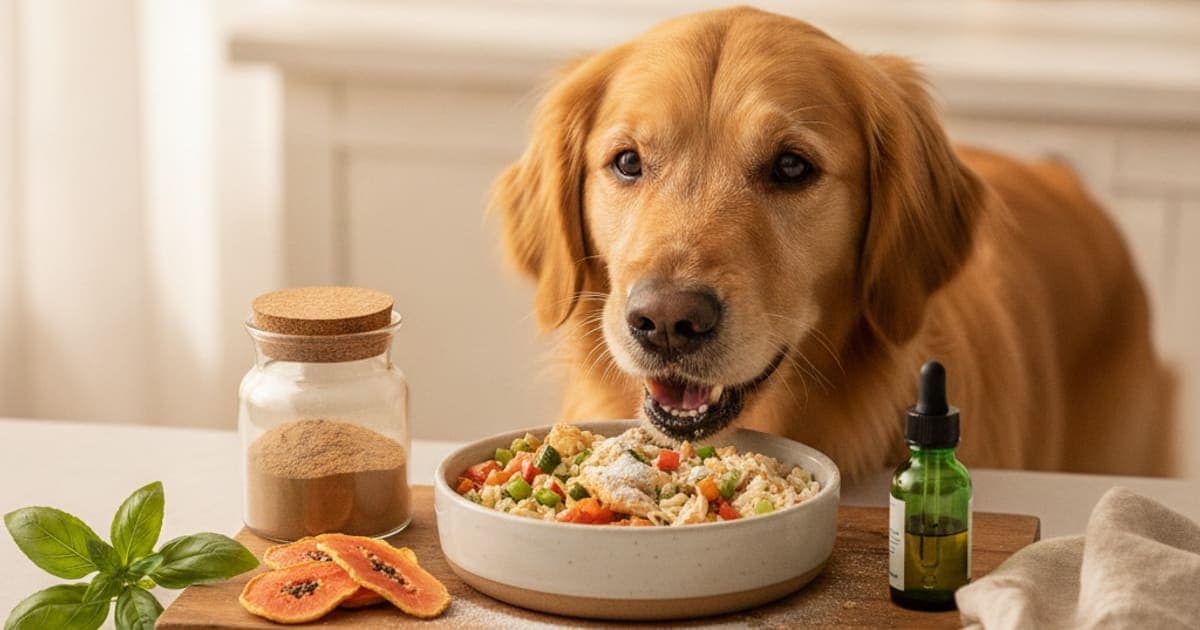
Pancreatic enzyme supplements for dogs are powders, capsules or tablets that supply the same three enzyme families a healthy pancreas secretes into the small intestine: lipase for fat, protease for protein and amylase for starch. Most veterinary-grade options are porcine pancreatin — enzymes sourced from pig pancreas — mixed into food at each meal. They are a structure-and-function support: they add enzyme activity to the meal, they do not rebuild pancreatic tissue or substitute for a diagnosis.
There is no single best pancreatic enzyme supplement for dogs, because the right product depends on why your dog's digestion changed in the first place, and that is a question a veterinarian answers with testing rather than a label. Owners building a wider plan for an ageing or recovering dog often run digestive support alongside joint and soft-tissue support such as pawgen's K9-REPAIR, a BPC-157 + TB-500 formulation made for mobility and connective-tissue recovery rather than for digestion. The two jobs are separate, and it helps to keep them separate in your head.
What the pancreas releases into the gut, and why it matters
The pancreas has two jobs. The endocrine side makes insulin and glucagon. The exocrine side — the part relevant here — produces digestive enzymes and bicarbonate, and drains them into the duodenum, the first stretch of small intestine just past the stomach.
Those enzymes do specific work. Lipase splits dietary fat into fatty acids and glycerol so they can cross the gut wall. Proteases such as trypsin and chymotrypsin cut proteins down into peptides and amino acids. Amylase breaks starch into simple sugars. Bicarbonate neutralises stomach acid so those enzymes can work in the pH range they were built for.
Fat digestion is the most fragile link in that chain. When enzyme output falls, fat is usually the first nutrient to pass through unabsorbed, which is why the classic picture owners describe is a dog with a huge appetite who is still losing condition, producing large, pale, loose, greasy, unusually foul-smelling stools. Coat quality often goes dull. Some dogs start eating things they never used to.
An enzyme supplement works mechanically. Mixed into the meal, it provides enzyme activity in the bowl and in the gut that the dog's own pancreas is not supplying. That is genuinely useful when enzyme output is the actual problem. It does nothing at all if the real issue is inflammation of the intestinal lining, a parasite, a dietary intolerance, or something structural.
Why owners start looking at digestive enzymes
Most searches for dog pancreatic enzyme supplements start with one of three things: chronic loose stool that no diet change has settled, steady weight loss despite a good appetite, or a veterinarian mentioning the letters EPI.
Exocrine pancreatic insufficiency is the condition behind most long-term enzyme use in dogs. It happens when the enzyme-producing cells of the pancreas are lost — most often through pancreatic acinar atrophy, which is strongly associated with German Shepherds and Rough Collies, and sometimes as a consequence of chronic pancreatitis in any breed. It is confirmed by a fasted blood test measuring serum trypsin-like immunoreactivity (TLI), not by stool appearance and not by a trial of supplements. Vets commonly check cobalamin (vitamin B12) and folate at the same time, because absorption of B12 is frequently affected and is managed separately.
No enzyme supplement should be the reason a dog with ongoing weight loss or chronic diarrhoea waits longer for a veterinary work-up.
That matters because the symptom picture overlaps with conditions that enzymes will not touch: inflammatory bowel disease, giardia and other parasites, small intestinal dysbiosis, food-responsive enteropathy, and in older dogs, more serious causes of weight loss. Talk to your veterinarian before you start an enzyme product, so you are treating a known problem rather than chasing a guess. A dog that improves on enzymes is informative; a dog that does not has lost weeks.
The main product formats, side by side
| Format | What it is | How it is typically used | What to watch for |
|---|---|---|---|
| Porcine pancreatin powder | Freeze-dried pig pancreas extract, the standard veterinary form | Stirred through moistened food at each meal | Enzyme activity should be declared; powders degrade with heat, light and humidity |
| Enteric-coated capsules or tablets | Coated to survive stomach acid and release lower down | Given with meals | Veterinary sources generally favour uncoated powder for dogs, as coating can affect where and whether release happens |
| Raw pancreas (fresh or frozen) | Whole beef, pork or lamb pancreas fed as a food source | Portioned and fed with meals | Raw-handling and pathogen risk; enzyme content varies batch to batch and cannot be standardised |
| Plant- or fungal-derived enzyme blends | Enzymes from sources such as Aspergillus, active across a wider pH range | Sprinkled on food | Activity units are often lower and less comparable; research in dogs is thinner than for pancreatin |
| Prescription veterinary enzyme products | Standardised formulations dispensed through a veterinarian | Per the vet's written instruction | The appropriate route where a diagnosis exists |
| Multi-ingredient digestive chews | Probiotics, pumpkin, slippery elm and a small enzyme fraction | Fed as a treat | Enzyme content is often a rounding error behind the flavouring |
Mixing the powder into moistened food and letting it sit briefly before serving is standard owner practice. Some dogs develop oral irritation or mouth bleeding from pancreatic enzyme powder — it is a recognised effect, and it is a reason to check your dog's mouth regularly and report anything you see.
Reading the label without getting fooled
The supplement aisle rewards good packaging more than good formulation, so a few checks separate real products from decorated ones.
- Declared enzyme activity. Credible pancreatin products state lipase, protease and amylase activity in standardised units, not just total milligrams of powder. Milligrams tell you mass; units tell you how much work the enzymes can do.
- Named source. Porcine pancreatin, or a specific fungal strain. Vague phrasing such as "digestive enzyme complex" hides both source and strength.
- No proprietary-blend dodge. If eight ingredients share a single combined weight, you cannot know how much of anything your dog is getting.
- Third-party testing with a certificate of analysis. Identity and purity verified by an independent lab is a baseline expectation in 2026, not a premium feature.
- Sensible storage. Enzymes are proteins. Heat and moisture degrade them. Airtight packaging and a cool storage instruction are good signs; a jar that lives next to the stove is not.
- Weight-based instructions set by your vet. Amounts in any enzyme category should come from the person who diagnosed your dog, not from a forum thread.
Be most suspicious of the kitchen-sink chew: a soft treat carrying a probiotic, a prebiotic, four botanicals and a trace of enzyme, priced as though the enzyme were doing the heavy lifting. Where dogs genuinely need enzyme support, the dose form owners and vets rely on is boring, unflavoured and measured.
Where peptides fit in a recovery-stage supplement plan
Digestive enzymes solve a digestive problem and nothing else. Plenty of owners reading this are managing a dog who is also slowing down — stiffer after rest, reluctant on stairs, recovering from a soft-tissue injury or a surgery. That is a different system and it needs a different tool.
K9-REPAIR is pawgen's peptide formulation for dogs, combining BPC-157 and TB-500. BPC-157 is a synthetic peptide based on a sequence identified in gastric juice, and much of the published laboratory work on it sits in soft-tissue and gastrointestinal repair models. TB-500 is a synthetic fragment related to thymosin beta-4, a naturally occurring protein involved in cell migration, angiogenesis and tissue remodelling. In plain English: these are signalling molecules, and the research interest is in how they may support the body's own repair processes at the site of injury — the mechanism owners are increasingly adopting through recovery periods, particularly around tendon, ligament and joint work.
This is emerging and promising science. BPC-157 and TB-500 are not FDA-approved veterinary drugs, and nothing here should be read as a claim that any peptide treats, cures or prevents a condition in your dog. What can be said plainly is descriptive: K9-REPAIR is dosed by body weight, it is third-party tested with certificates of analysis available, it ships direct to your door, and it carries a 60-day money-back guarantee. Bring it up with your veterinarian before adding it, especially if your dog is on prescribed medication or heading into a surgical or rehab plan — peptides are a complement to that plan, never a substitute for it.
Key Takeaways
- Pancreatic enzyme supplements supply lipase, protease and amylase to the meal; they support digestion, they do not restore pancreatic tissue.
- Porcine pancreatin powder mixed into moistened food is the standard form; raw pancreas and plant-derived blends are alternatives with real trade-offs.
- Chronic diarrhoea and weight loss with a big appetite warrant a veterinary work-up, including a fasted TLI blood test, before any supplement trial.
- Judge products on declared enzyme activity units, a named source, third-party testing and a certificate of analysis — not on flavour or ingredient count.
- Amounts are a veterinary decision, and that goes double for puppies and for pregnant or nursing dogs.
- Digestion and mobility are separate problems; K9-REPAIR (BPC-157 + TB-500) is the peptide stack owners use for joint, tendon and mobility recovery, not a digestive product.
Working with your veterinarian
If you want to look more closely at how pawgen formulates and verifies K9-REPAIR, the published certificates of analysis show batch testing, the shop lists the weight-based options, and shipping information covers where orders are delivered.
Your veterinarian owns the diagnosis and owns the plan. They are the one who can run the bloodwork, tell you whether enzyme output is genuinely the problem, prescribe what needs prescribing, and decide what belongs in your dog's bowl and in what amount. Supplements and peptides work inside the space that proper veterinary care creates — they are not a shortcut around it, and a good product never asks you to treat them as one.
Owners exploring peptide support for their dog can review K9-REPAIR — BPC-157 + TB-500 formulated for dogs — at https://pawgen.com/. BPC-157 and TB-500 are not FDA-approved veterinary drugs. Nothing in this article treats, cures or prevents any condition; every decision about your dog's care belongs with your veterinarian.
Frequently asked questions
- What do pancreatic enzyme supplements for dogs actually do?
- They add lipase, protease and amylase to a meal — the same enzyme families a healthy exocrine pancreas secretes to break down fat, protein and starch. This is supportive of normal digestion in dogs whose own enzyme output is reduced. They do not repair or regenerate pancreatic tissue, and they are not a diagnosis.
- What is the best pancreatic enzyme supplement for dogs?
- There is no universal best option, because the right product depends on the underlying reason for the digestive change. Broadly, standardised porcine pancreatin powder with declared enzyme activity units, a named source and third-party testing is the form most commonly used under veterinary direction. Your veterinarian should make the final selection.
- Can I give dog pancreatic enzyme supplements without a vet diagnosis?
- It is not a good idea. Chronic loose stool and weight loss have many possible causes — parasites, inflammatory bowel disease, food-responsive conditions and more — and enzymes will not address any of those. A fasted TLI blood test is how exocrine pancreatic insufficiency is confirmed. Talk to your veterinarian first.
- Are dog enzyme supplements the same as human pancreatic enzyme products?
- They often share the same porcine pancreatin origin, but concentration, excipients, coating and packaging differ, and human products are formulated for human dosing. Never transfer a human product to a dog on your own judgement — ask your veterinarian what is appropriate for your dog's size and situation.
- Do enzyme supplements help dogs with pancreatitis?
- Pancreatitis and exocrine pancreatic insufficiency are different problems. Pancreatitis is inflammation and is managed by a veterinarian with pain control, fluids, diet and monitoring. Enzyme supplementation becomes relevant mainly when repeated pancreatitis has reduced long-term enzyme output, and that is a decision your vet makes after testing.
- Are there side effects from pancreatic enzyme powders?
- Oral irritation and mouth bleeding are recognised effects of pancreatic enzyme powder in some dogs, so check your dog's mouth regularly. Digestive upset can occur as well. Report anything unusual to your veterinarian rather than adjusting amounts yourself.
- How long does it take to see a change after starting enzymes?
- It varies by dog and by what is driving the problem, so no honest timeline fits every case. What owners and vets typically track is stool quality, appetite and body condition over successive rechecks. Your veterinarian will set the review points and adjust from there.
- Does pawgen make a pancreatic enzyme supplement for dogs?
- No. pawgen makes K9-REPAIR, a BPC-157 + TB-500 peptide formulation for dogs focused on joint, tendon and mobility recovery. It is dosed by body weight, third-party tested with certificates of analysis available, and backed by a 60-day money-back guarantee. It is not a digestive enzyme product and is not an FDA-approved veterinary drug.
- Can enzyme supplements be given alongside prescribed medication?
- Possibly, but that call belongs to your veterinarian. Bring the full list of everything your dog takes — prescriptions, supplements and food — to the appointment so interactions and timing can be reviewed. Never stop or change a prescribed medication in order to add a supplement.
Educational content. BPC-157 and TB-500 are not FDA-approved veterinary drugs. Talk to your veterinarian before starting anything new, especially if your dog is on prescribed medication.