Poodle Eye Problems: Vision Loss Signs to Watch For
Poodles can go blind, though vision loss is not a given for the breed. Inherited retinal disease, cataracts, glaucoma and sudden retinal changes can all affect sight. Any abrupt change in vision, or an eye that looks red, cloudy or painful, calls for a same-day veterinary exam.
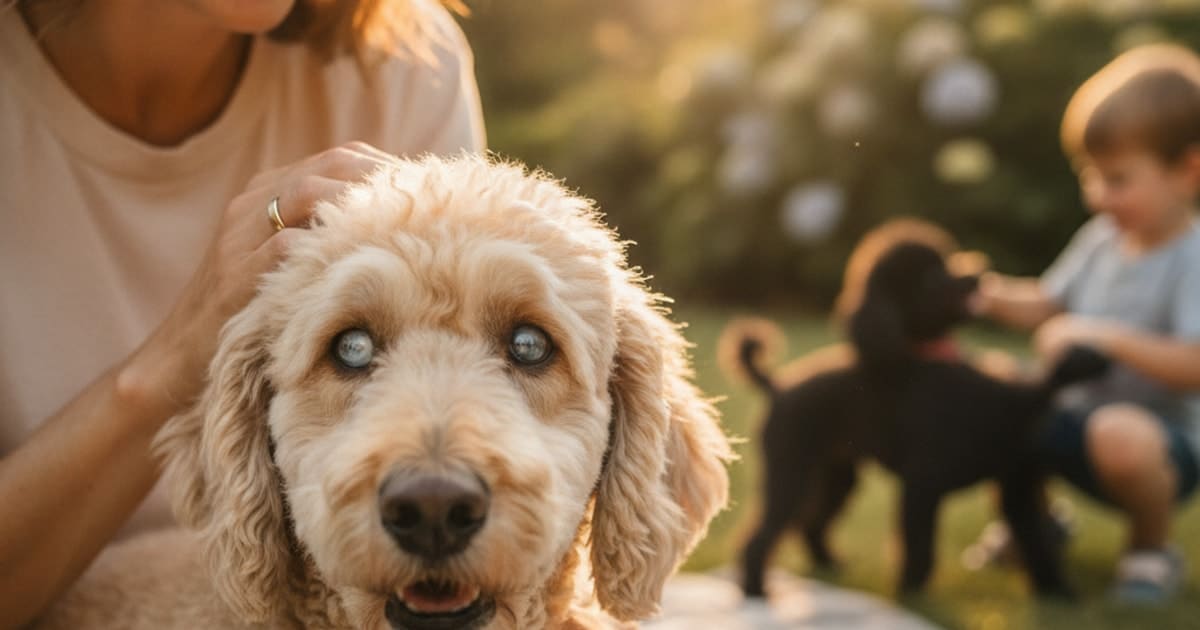
Poodles can go blind, and the breed carries several eye conditions that can reduce sight slowly or take it away quickly. If your poodle's vision has changed suddenly, or if an eye looks red, cloudy, swollen or painful, call your veterinarian now and ask to be seen the same day. Sight loss is not a certainty for any individual dog, but standard, miniature and toy poodles share a set of inherited and acquired eye conditions that are worth knowing, because the difference between a routine appointment and an emergency can come down to a few hours.
This page covers what can go wrong inside a poodle's eye, how well dogs see to begin with, the signals a dog gives when sight is slipping, and the changes that mean you stop reading and pick up the phone.
Can a poodle go blind?
Yes. Vision loss in poodles can arrive in two patterns, and they look very different at home.
The gradual pattern comes from conditions that change the retina or the lens over a long stretch of time. Dogs are extraordinary at hiding this. A poodle living in the same house for years holds a mental map of the furniture, the stair treads, the gap between the sofa and the coffee table. Sight can fade a long way before that map stops working. The giveaway is a dog that navigates a familiar hallway perfectly, then hesitates in an unfamiliar room, or misjudges a step down into the garden at dusk.
The sudden pattern comes from pressure inside the eye, bleeding, a detached retina, inflammation, or an abrupt change in the retina itself. Here there is no adjustment period. A dog that was fine in the morning walks into a doorframe in the afternoon, stands still rather than moving through a room, or becomes uncharacteristically cautious and clingy.
Any sudden change in how your dog sees, and any eye that is red, cloudy, bulging or clearly painful, is a same-day veterinary problem, not something to watch over the weekend.
It is also worth saying plainly that a poodle can lose sight in one eye without an owner noticing at all, because the other eye compensates. A dog can be functionally one-eyed for a long time and still catch a ball. That is one reason a hands-on eye exam at every check-up matters more than how your dog seems to be coping.
Do poodles have vision problems more than other dogs?
Poodles are among the breeds in which inherited eye conditions are recognised, and they appear across all three size varieties. That does not mean a given poodle will develop one. It means an owner has good reason to pay attention to the eyes, to ask about eye health when choosing a puppy, and to mention any change to the vet rather than filing it under normal ageing.
The short version: poodles can have vision problems, the problems are identifiable with a proper exam, and several of them give warning signs before sight is gone. Talk to your vet about whether your dog should be seen by a veterinary ophthalmologist, which is a specialist with equipment a general practice does not always carry.
How good is a poodle's eyesight?
A healthy poodle sees the world the way other healthy dogs do, which is not the way you do.
Dogs see colour, but a narrower slice of it. Blues and yellows come through clearly; reds and greens are far less distinct. A red ball on green grass is a scent and motion problem for your dog, not a colour problem.
Dogs are built for movement and low light. The reflective layer behind the canine retina, the tapetum lucidum, is why your poodle's eyes flash back at a camera and why a dog can move confidently through a room you would call dark. Motion detection is a strength. Fine detail at distance is not: a still, silent person across a field can be genuinely hard for a dog to resolve until they move or until the wind carries their scent.
So do poodles have good eyesight? In practical terms, yes, a healthy poodle's sight is well suited to what a dog does with it. The breed is not noted for unusually sharp or unusually weak vision. What matters more for a poodle is eye health over the years, and one grooming detail: a long face fall can hang into the eyes, irritate the surface and block the view. Your vet can tell you whether your dog's coat around the eyes needs trimming and what style of face clip suits that particular dog.
Eye conditions that can affect poodles
The table below groups the conditions a vet considers when a poodle's eyes or vision change. It is a map for understanding, not a tool for diagnosing at home, because several of these look alike from the outside and only an exam can separate them.
| Condition | What it affects | Signs that can show up | Urgency |
|---|---|---|---|
| Progressive retinal atrophy | The retina, inherited | Hesitation in dim light, bumping into objects, wide pupils, a stronger eye-shine | Book an exam promptly |
| Cataract | The lens | A cloudy, white or crystalline look inside the pupil, misjudging distances | Exam soon; sudden cloudiness checked quickly |
| Glaucoma | Pressure inside the eye | Red eye, hazy cornea, squinting, tearing, a bulging look, obvious pain | Emergency, same day |
| Dry eye (keratoconjunctivitis sicca) | Tear film and corneal surface | Thick discharge, redness, a dull or sticky-looking eye, blinking | Prompt exam |
| Corneal ulcer or injury | Surface of the eye | Squinting, pawing at the face, tearing, sensitivity to light | Emergency, same day |
| Entropion and extra lashes | Eyelids and lashes rubbing the eye | Watering, redness, repeated blinking, squinting | Prompt exam |
| Sudden acquired retinal degeneration | The retina, abrupt onset | Sight loss over a short period, wide pupils, changes in thirst and appetite | Urgent exam |
| Retinal detachment or bleeding | The retina and its blood supply | Abrupt vision change, wide pupils, blood visible in the eye | Emergency, same day |
A few of these deserve a sentence of plain explanation.
Progressive retinal atrophy is an inherited change in the light-sensing cells of the retina. Because the cells that handle dim light can be affected first, a change in confidence at night or in a poorly lit room can be the opening signal. DNA testing for inherited retinal disease exists for some lines, and a vet or a veterinary ophthalmologist can advise on whether it applies to your dog.
Cataracts are a clouding of the lens, which sits behind the pupil. They can be inherited, can follow an injury, and can be linked to other illness such as diabetes, which is one reason a new cloudy eye prompts a wider workup rather than an eye-only appointment. Not every cloudy-looking pupil is a cataract: the lens also changes texture with age in a way that is different and that a vet can distinguish with the right light.
Glaucoma is raised pressure inside the eye. It hurts, and the pain is not always obvious from the outside because dogs mask it. A red, hazy, squinting eye in a poodle is a reason to call a clinic immediately rather than wait for the next working day.
Dry eye is a drop in tear production. The tear film feeds and protects the cornea, so when it thins the surface becomes irritated and vulnerable. A vet measures tear production directly in the exam room.
Early signs of vision change to watch for at home
You are not looking for blindness. You are looking for the small behavioural edits a dog makes when the picture gets less reliable. Any of the following is a reason to book an appointment and describe exactly what you have seen:
- Pausing at the top or bottom of stairs, or at a kerb, when that was never an issue
- Reluctance to go out after dark, or sticking close to you in dim light
- Bumping into furniture, especially after something has been moved
- Misjudging a jump onto the sofa or into the car
- Startling when touched or approached, as though not seeing you arrive
- Walking with the head lower or more slowly in new places
- Pupils that look larger than normal, or that stay large in bright light
- A change in the colour, clarity or shine of one eye compared with the other
- Squinting, excess tearing, rubbing the face on furniture, or pawing at an eye
- Visible discharge, redness around the white of the eye, or a lid that looks rolled inward
One practical check: changes that affect one eye are easier to spot by comparing the two in the same light, from the front and from the side. Take a clear photograph of each eye and bring it to the appointment, because an eye can look different by the time you are in the consulting room.
When an eye change is an emergency, and what the vet exam looks at
Go to a veterinary clinic or an emergency service straight away if you see sight loss that came on over hours, a red or bulging eye, obvious pain, a cloudy cornea, blood inside the eye, an injury to the eye or lid, or pupils that do not react to light. Eyes are unforgiving of delay, and pressure or infection problems can change a great deal in a short space of time. If you are unsure whether what you are seeing counts, call the clinic and describe it; triage over the phone is routine and nobody will mind the call.
A veterinary eye exam is more than a look with a torch. Depending on what the vet finds, it can include checking tear production, staining the surface of the eye to reveal damage that is invisible otherwise, measuring pressure inside the eye, examining the retina through a dilated pupil, and testing how your dog responds to light and to objects in each visual field. Blood pressure and general bloodwork can come into it too, because the eye is one of the places where whole-body illness shows itself first. From there, the vet owns the diagnosis and the plan.
If your dog does turn out to be losing sight, ask the vet about practical adjustments for your home and your walks. Those conversations are worth having early rather than improvising later. Results vary from dog to dog, and your vet knows your dog.
Key takeaways
- Poodles can go blind, and all three size varieties can be affected by inherited and acquired eye conditions.
- Gradual sight loss hides behind a dog's mental map of the house; hesitation in dim light or in new places can be the first clue.
- Sudden vision change, a red or bulging eye, a cloudy cornea, visible pain or an eye injury means emergency care now.
- A healthy poodle's eyesight is typical for a dog: strong on motion and low light, weaker on fine detail and on reds and greens.
- Hair falling into the eyes can irritate the surface and obstruct the view; ask your vet about trimming around the face.
- Comparing the two eyes in the same light, and photographing them, helps your vet see what you saw.
- Call your vet if a sign continues, if it changes, or if you notice squinting, discharge, cloudiness or bumping into things.
Vision is one of the areas where early examination carries real weight, because several eye conditions give signals before sight is gone and some of them hurt long before they look dramatic. Your veterinarian owns the diagnosis and the treatment plan for your poodle's eyes, including whether a referral to a veterinary ophthalmologist makes sense. Everything an owner does well, the daily observation, the grooming around the face, the prompt phone call, works in support of that exam, never in place of it.
For a broader look at the signals that mean veterinary care cannot wait, see Dog Emergency Signs, and for background on other canine health topics covered across this site, see the Conditions library.
Frequently asked questions
- Do poodles go blind?
- Poodles can go blind. Inherited retinal disease, cataracts, glaucoma, retinal detachment and sudden retinal changes can all reduce or remove sight, slowly or abruptly. It is not a certainty for any individual dog. Any sudden change in vision, or a red, cloudy or painful eye, needs same-day veterinary attention.
- Do poodles have vision problems?
- Yes, poodles can have vision problems, and inherited eye conditions are recognised across standard, miniature and toy varieties. That does not mean every poodle develops one. It does mean eye changes deserve a proper exam rather than being written off as ageing, so book an appointment when you notice something.
- Do poodles have good eyesight?
- A healthy poodle sees about as well as other healthy dogs, with strong motion detection and good low-light vision but less fine detail than people have. Reds and greens are far less distinct than blues and yellows. The breed is not noted for unusually sharp or unusually weak sight.
- Why does my poodle's eye look cloudy?
- A cloudy pupil can mean a cataract, a change in the cornea, raised pressure inside the eye, or an age-related change in the lens that is different from a cataract. These look similar from the outside. Book a veterinary exam, and go in the same day if the eye is red or painful.
- Is sudden blindness in a dog an emergency?
- Treat sudden vision loss as an emergency and contact a veterinary clinic straight away. Abrupt sight change can involve pressure inside the eye, bleeding, a detached retina, inflammation or whole-body illness. Describe exactly what you saw and when it started, since timing helps the vet narrow the cause quickly.
- Can hair over the eyes affect a poodle's vision?
- A long face fall can hang into the eyes, block the view and irritate the surface, which can cause tearing, blinking or rubbing. Grooming around the face is worth discussing at your next appointment. Your vet can tell you what trim suits your dog and whether the eyes show irritation.
- How can I tell if my poodle is losing sight in one eye?
- One-sided sight loss is easy to miss because the other eye compensates. Compare both eyes in the same light, from the front and the side, looking for differences in clarity, colour or pupil size. Hesitation on one side or startling from one direction is worth reporting to your vet.
- What happens during a veterinary eye exam for a dog?
- Depending on the findings, a vet can measure tear production, stain the eye surface to reveal damage invisible to the naked eye, check pressure inside the eye, examine the retina through a dilated pupil and test responses to light. Blood pressure and bloodwork are sometimes added, and referral may follow.
Educational content, not veterinary advice. Ask your vet about your dog.