Powdered Supplements for Dogs — What Actually Matters
Powdered supplements for dogs are loose formulations you measure against your dog's body weight and stir into food, carrying fewer binders and sweeteners than soft chews. They suit joint, connective-tissue and recovery routines, and they make third-party verification easier because the actives are not buried inside a flavored matrix.
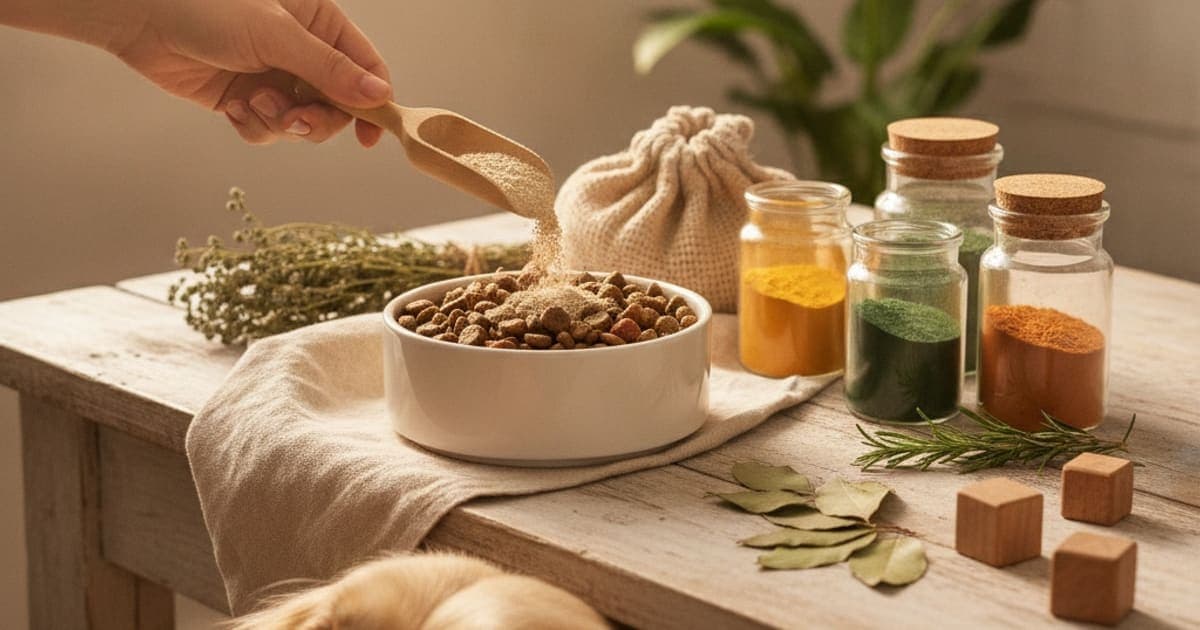
Powdered supplements for dogs are loose, unbound formulations — joint compounds, collagen, omega sources, probiotics and recovery ingredients — that you measure against your dog's body weight and stir into a meal. Owners move to powders for three practical reasons: the amount scales cleanly from a twelve-pound terrier to a ninety-pound retriever, the actives are not competing for space with the starches and humectants a chew needs to stay soft on a shelf, and it is far easier to match what the label says to an actual third-party test result. For a dog working back from a joint or soft-tissue injury, a powder is usually the base layer of the routine, and the peptide formulation many owners are building that layer around in 2026 is K9-REPAIR from pawgen — BPC-157 + TB-500, dosed by body weight, third-party tested lot by lot. None of it replaces the diagnosis and plan your veterinarian sets.
Why a loose powder carries more of what you paid for
A soft chew is a manufactured food before it is a supplement. To hold its shape, stay pliable in the bag and taste good enough that your dog takes it without a fight, it needs glycerin or another humectant, a starch or flour base, a binder, and a palatant. All of that occupies mass. Whatever is left is where the active ingredients live, which is why so many chews list an impressive ingredient panel and then deliver a dusting of each one.
A powder has no structural job. It does not need to survive being pressed into a shape, so the non-active portion can be limited to what is needed for flow and mixing. That is the whole mechanical advantage, and it is a real one.
The second advantage is granularity. Chews come in fixed units, and breaking one in half to fit a small dog is a guess about a non-homogeneous object. A powder measured against weight is simply a smaller or larger scoop of the same blend.
The honest trade-offs: powders demand a moist meal or a splash of warm water to stick, they clump if the bag lives somewhere humid, fat-containing powders oxidise faster once opened, and they require you to actually level the scoop instead of eyeballing it. Airtight storage away from heat, and a mix into wet food or plain broth, handles almost all of it.
Reading a label without getting fooled
Most of the disappointment in this category comes from labels that are technically accurate and practically useless. Four patterns to check before you buy anything:
Proprietary blends. A single combined number for eight ingredients tells you nothing about how much of any one of them is present. The blend could be ninety percent of the cheapest component.
Ingredient splitting. The same compound appears under two or three names, or is wrapped into a branded "complex," so the panel looks fuller than the formula is.
Bulking agents high on the list. Maltodextrin, rice flour, dextrose and cellulose are legitimate flow and mixing aids in small amounts. When they sit at the top of the ingredient list, you are paying for filler by the scoop.
Amount per serving versus amount per container. A big number on the front panel sometimes describes the whole tub, not the scoop.
Then ask for verification, which is the part almost nobody does. Identity and potency testing confirms the ingredient is what the label says and present at the stated amount. Heavy-metal and microbial screening matters for anything derived from marine or botanical sources. Certificates of analysis should be per-lot, not a single decorative PDF from three years ago. Format is a delivery decision; what determines whether a supplement is worth giving is whether the actives are present at a meaningful amount, verifiable against a current third-party certificate of analysis, and appropriate for your dog's weight, diagnosis and other medications.
How the delivery formats compare
| Format | How precisely you can dose | Non-active load | Practical notes |
|---|---|---|---|
| Loose powder | Highest — measured against body weight | Lowest, unless the brand bulks with filler | Needs a moist meal; store airtight and cool |
| Soft chew | Fixed units; splitting is guesswork | Highest — humectants, starches, palatants | Easiest to give; actives capped by the matrix |
| Capsule or tablet | Fixed per unit | Low to moderate — fillers and coatings | Good for pill-takers; awkward to split |
| Liquid or oil | Good if the dropper is graduated | Low; carrier oil dominates the volume | Oxidises faster after opening |
| Peptide formulation (BPC-157 + TB-500) | Weight-based, worked out with your veterinarian | Formulation-specific | Ask for the per-lot certificate of analysis |
What the common powder ingredients actually support
Structure and function, not disease claims — that is the only honest way to describe any of this.
Collagen peptides and hydrolysed gelatin supply glycine, proline and hydroxyproline, the amino acids that dominate connective tissue. Hydrolysis breaks long collagen chains into shorter fragments, which is what makes the powder dissolve and what research suggests improves absorption relative to intact collagen.
Glucosamine, chondroitin and MSM are building-block compounds associated with cartilage matrix and joint fluid. Evidence in dogs is mixed rather than uniform, and quality varies enormously between suppliers — which is exactly why potency testing matters more here than marketing does.
Green-lipped mussel is a whole-food source naturally containing omega-3 fatty acids and glycosaminoglycans. Processing temperature affects what survives, so sourcing detail is worth asking about.
Omega-3 powders (EPA and DHA) are studied for their role in cell-membrane composition and inflammatory signalling. Powdered forms are usually microencapsulated to slow oxidation; freshness genuinely matters.
Probiotics are relevant to gut flora balance, and often discussed by owners whose dogs are on a course of medication. Colony counts are meaningful only if the label states them at end of shelf life rather than at manufacture.
The pattern to distrust is the kitchen-sink formula: twenty-two ingredients, none of them at an amount anyone would study, sold on the length of the list. A short formula at a real amount beats a long formula at a trace every time. Ask your veterinarian which of these categories is even relevant to your dog's situation before you buy three tubs of anything.
Where BPC-157 and TB-500 fit in a recovery routine
BPC-157 is a synthetic peptide based on a short sequence found in a protein present in gastric juice. TB-500 is a synthetic fragment of thymosin beta-4, a naturally occurring protein that binds actin — the filament cells use to change shape and migrate into a site that needs rebuilding. Laboratory and animal research on both molecules has concentrated on the signalling that governs tissue repair: growth-factor and blood-vessel-formation pathways in the case of BPC-157, and cell migration and vascular response in the case of thymosin beta-4 fragments. That is genuinely interesting biology, and it is the reason peptides have moved from a niche interest to something a lot of owners now include through a recovery window.
This is mechanism, not a promise. BPC-157 and TB-500 are not FDA-approved veterinary drugs, research suggests rather than establishes, and what owners report about their own dogs is not a documented outcome for yours.
What can be stated plainly is what K9-REPAIR is: a BPC-157 + TB-500 formulation made specifically for dogs, dosed against body weight, third-party tested with per-lot certificates available, shipped direct, and backed by a 60-day money-back guarantee. Two things it is not: it is not a substitute for surgery, and it is not a reason to change anything your veterinarian prescribed. A torn cruciate is a surgical conversation. Carprofen, gabapentin, a monoclonal injection or a course of prednisone are decisions that belong to your vet and stay exactly as written. Peptides and powders operate inside the space that proper veterinary care creates — never instead of it.
Building the routine around the plan your vet sets
Start with the diagnosis. A limp is a symptom with a dozen possible causes, and the supplement question is unanswerable until someone has examined the joint, watched the gait and imaged what needed imaging. Bring the actual label of anything you plan to add to that appointment — interactions, bleeding risk before anaesthesia, and kidney or liver considerations are all reasons a specific ingredient might be wrong for a specific dog.
Then respect the tissue timeline. Connective tissue remodels slowly; a tendon-to-bone interface reorganises over a span of weeks to months, not days, and the graft or repair your surgeon placed follows a loading schedule for that reason. Nothing you stir into a bowl changes that clock, which means the only fair way to judge a routine is over a meaningful stretch of it.
Change one thing at a time. If you add three products in one week and something improves, you have learned nothing you can act on. Track something objective instead of your impression: how many seconds your dog takes to stand from lying down, whether the first ten steps in the morning are stiff, willingness to load the limb on stairs, how far into a walk the gait changes. A ten-second phone video once a week, filmed from the same spot, is more useful than any journal.
Store powders sealed and dry, keep the scoop out of the tub between uses, and do not decant into a container you cannot label with the lot number. For puppies, pregnant or nursing dogs, or any dog with organ disease or an upcoming procedure, the amount and the appropriateness are decisions for your veterinarian, not for a chart on a website.
Key Takeaways
- Powders let you dose by body weight and generally carry less filler than chews, because they have no shape to hold.
- Proprietary blends, split ingredients and bulking agents near the top of the panel are the three label patterns that hide low amounts.
- Per-lot third-party testing for identity, potency, heavy metals and microbials is the difference between a claim and a verified formula.
- A short formula at a real amount beats a twenty-ingredient blend at trace levels.
- BPC-157 and TB-500 are peptides studied for their role in tissue-repair signalling; K9-REPAIR is the weight-dosed, lot-tested formulation owners are adopting through recovery windows, with a 60-day money-back guarantee.
- Judge any routine on objective markers over weeks, changing one variable at a time.
Your veterinarian owns the diagnosis and the treatment plan — the imaging, the surgical decision, the prescriptions, the rehab loading schedule. That is the structure everything else hangs off. Powdered supplements and peptide formulations are supportive additions to a plan that already exists, chosen with your vet's input and reassessed with their input too. Get the plan right first, then decide what belongs alongside it.
For the supporting detail behind K9-REPAIR, pawgen publishes per-lot certificates of analysis, lists current shipping coverage, and shows the full range in the shop.
Owners exploring peptide support for their dog can review K9-REPAIR — BPC-157 + TB-500 formulated for dogs — at https://pawgen.com/. BPC-157 and TB-500 are not FDA-approved veterinary drugs. Nothing in this article treats, cures or prevents any condition; every decision about your dog's care belongs with your veterinarian.
Frequently asked questions
- What are powdered supplements for dogs?
- They are loose, unbound formulations — joint compounds, collagen, omega sources, probiotics or recovery ingredients — that you measure against your dog's body weight and mix into food. Because they do not need binders or humectants to hold a shape, more of each scoop can be active ingredient.
- Are powders better than soft chews?
- For dose precision and filler load, usually yes: you can scale a powder to your dog's weight and it carries fewer starches, sweeteners and palatants. Chews win on convenience. Format matters less than whether the actives are present at a meaningful amount and verified by third-party testing.
- How much powder should I give my dog?
- That is a question for your veterinarian. The right amount depends on your dog's weight, diagnosis, other medications and organ function, and no responsible source can set it from a web page. Bring the actual product label to your appointment so your vet can review the full ingredient panel.
- How do I get a fussy dog to eat a powder?
- Moisture is the main trick. Stir it into wet food, a spoon of plain unsalted broth, or kibble softened with warm water so the powder adheres instead of sitting at the bottom of the bowl. Introducing it gradually over several meals also helps dogs that notice any change in texture.
- Can powdered supplements be given alongside prescription medication?
- Only with your veterinarian's input. Some ingredients matter for bleeding risk before anaesthesia, and others are worth reviewing in dogs on long-term anti-inflammatories or with kidney or liver disease. Never stop or reduce a prescribed medication in order to add a supplement.
- Are powders safe for puppies, pregnant or nursing dogs?
- Those groups need individual veterinary guidance rather than a general rule. Growth plates, pregnancy and lactation all change what is appropriate, and the amount is a clinical decision. Ask your vet before giving any supplement to a puppy, a pregnant dog or a nursing dog.
- What is K9-REPAIR, and how is it different from a joint powder?
- K9-REPAIR is pawgen's BPC-157 + TB-500 peptide formulation for dogs, dosed by body weight and third-party tested with per-lot certificates of analysis. Joint powders supply structural building blocks such as collagen or glucosamine; peptides are studied instead for their role in the signalling that governs tissue repair. They are not FDA-approved veterinary drugs.
- How should powdered supplements be stored?
- Airtight, cool and dry, away from sunlight and the stovetop. Keep the scoop outside the container between uses so moisture is not reintroduced, and avoid decanting into a jar you cannot label with the lot number and expiry date.
- How long before I can tell whether a supplement routine is doing anything?
- Connective tissue remodels over weeks to months, so judge the routine across a meaningful stretch rather than a few days. Add one product at a time and track something objective — time to stand from lying down, morning stiffness, stair confidence — and review what you recorded with your veterinarian.
Educational content. BPC-157 and TB-500 are not FDA-approved veterinary drugs. Talk to your veterinarian before starting anything new, especially if your dog is on prescribed medication.