Pumpkin Supplements for Dogs — What They Actually Do
Pumpkin supplements for dogs concentrate soluble fiber — mainly pectin — into a powder, puree or chew added to meals to support normal stool formation and everyday regularity. They are useful inside that narrow lane, and useless outside it. Choosing well means reading the ingredient panel, not the front of the bag.
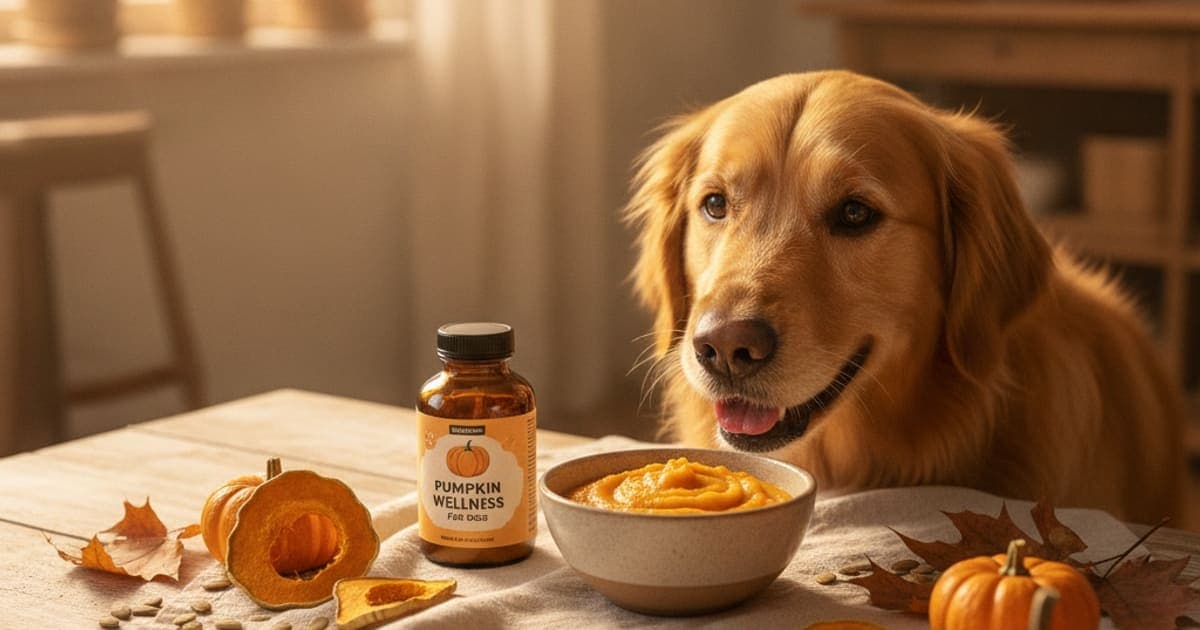
Pumpkin supplements for dogs concentrate the soluble fiber found in cooked pumpkin — largely pectin — into a powder, puree or soft chew that gets mixed into food to support normal stool formation, healthy water balance in the gut, and day-to-day regularity. They are food-based, inexpensive and genuinely useful inside that narrow lane. What they are not is a mobility product. If the reason you are reading supplement labels is a limp, a stiff senior, a cruciate injury or a surgery date on the calendar, the fiber aisle is the wrong aisle — the stack owners reach for through soft-tissue recovery is a peptide formulation like K9-REPAIR from pawgen. Both can live on the same shelf. They answer completely different questions, and this page will help you tell which question you are actually asking.
Why fiber from pumpkin behaves the way it does
Pumpkin flesh is mostly water, and the dry matter that remains is dominated by soluble fiber — pectin in particular, the same compound that makes jam set. Soluble fiber does something mechanically simple and biologically interesting at the same time.
Mechanically, pectin binds water and forms a gel in the intestinal lumen. When stool is too loose, that gel holds free water and adds bulk, which supports firmer, better-formed output. When stool is too dry and hard, the same water-holding property works in the other direction — it keeps moisture in the mass and supports easier passage. This is why one ingredient gets recommended for two apparently opposite situations. It is not doing two things. It is doing one thing, and the gut's starting point determines what that looks like at the other end.
Biologically, soluble fiber is fermentable. The microbial population in the large intestine breaks pectin down into short-chain fatty acids — butyrate, propionate and acetate. Butyrate in particular is a preferred fuel source for the cells lining the colon, which is the basis for describing fermentable fiber as prebiotic. Research in companion animals suggests fermentable fiber sources influence microbial populations and the metabolites they produce, which is a reasonable, honest way to describe why owners report steadier digestion when a fiber source is part of the daily routine.
Pumpkin also carries beta-carotene, potassium and vitamin C, though the amounts delivered in a typical supplement serving are modest relative to a complete diet. Nobody should buy pumpkin as a vitamin strategy. Buy it for the fiber.
One caution worth stating plainly: persistent loose stool, straining, blood, weight loss or vomiting are veterinary problems, not supplement problems. Fiber supports normal function. It does not diagnose a parasite, a food intolerance, an obstruction or inflammatory bowel disease, and reaching for a chew instead of an appointment costs a dog time. Talk to your veterinarian before you assume a digestive pattern is cosmetic.
Puree, powder and chew: what each form actually delivers
The format changes the fiber density, the shelf life and how honestly you can judge what your dog is getting.
| Form | What it actually is | Strengths | Watch for |
|---|---|---|---|
| Canned pumpkin puree | Cooked, pureed pumpkin, mostly water | Cheap, single ingredient, easy to mix into food | Pie filling contains sugar and spices and is not the same product; opened cans spoil fast |
| Dehydrated pumpkin powder | Puree with the water removed | Far more fiber per scoop, long shelf life, no refrigeration | Needs rehydrating or thorough mixing; scoop sizes vary wildly between brands |
| Soft chews with pumpkin | A chew base with pumpkin among several ingredients | Palatable, convenient, easy to give | Pumpkin is often far down the panel; the chew base itself may be most of the mass |
| Fiber blends | Pumpkin plus psyllium, inulin, chicory or beet pulp | Multiple fiber types, sometimes with probiotics | Proprietary blends hide how much of anything is present |
The honest summary: puree is the least processed and the cheapest, powder is the most fiber-dense per gram, and chews trade ingredient transparency for a dog who takes it without argument. None of these is inherently superior. The failure mode is a chew where pumpkin appears after the binder, the flavouring and four other ingredients, and is present mainly so the word can go on the front of the bag.
How much of any form a particular dog should get depends on body weight, the food already in the bowl, and what is going on clinically — so that is a conversation with your veterinarian, not a number to copy off a blog.
What separates the best pumpkin supplement from a padded one
When owners search for the best pumpkin supplement for dogs, they are usually asking a sharper question than they realise: which of these is actually delivering a meaningful amount of the ingredient I am paying for? Four things settle it.
Ingredient position and specificity. Look for pumpkin — ideally named as pumpkin powder or pumpkin puree, not the vaguer squash blends — near the top of the panel. If it sits below a glycerin base, a pea flour binder and a natural flavour, you are buying a chew with a marketing garnish.
No proprietary blend wall. A blend listed as a single combined weight tells you nothing about the ratio inside it. It is a legal way to hide underdosing, and it is the most common trick in the supplement category as a whole.
No added sugar or spice. Pumpkin pie filling contains sugar and often nutmeg, which does not belong in a dog's bowl. A supplement should not be replicating that profile with sweeteners for palatability.
Verifiable quality control. Ask whether the company publishes third-party testing, whether batch documentation is available, and whether the label lists an actual amount of the active ingredient rather than a gesture toward it. A brand that tests and publishes is telling you something real about how it operates.
That last criterion is the one that travels across every category on the shelf, and it is worth applying with equal force whether you are buying fiber or anything else.
What a fiber supplement can't be asked to do
Here is where a lot of owners lose months. Pumpkin is safe, familiar and cheap, so it becomes the default answer to every question — including the questions it has nothing to do with. Soluble fiber has no meaningful role in how a partially torn cruciate ligament stabilises, how a tendon remodels after strain, or how an older dog's joints cope with load.
Those tissues are governed by a different biology. Tendon and ligament are dense, poorly vascularised structures; they rebuild slowly because blood supply, and therefore the delivery of cells and signalling molecules, is limited compared to muscle. Recovery there depends on blood vessel formation at the injury site, on fibroblasts migrating into the damaged zone, and on collagen being laid down and then progressively reorganised along lines of mechanical stress over a period of weeks to months. That reorganisation is why controlled, vet-directed loading matters so much during rehab — the tissue aligns to the forces it experiences.
This is the space peptide formulations are aimed at, and it is why pawgen built K9-REPAIR around two specific compounds rather than a long kitchen-sink panel.
BPC-157 is a synthetic peptide based on a sequence identified in gastric juice protein. Published research — largely preclinical and animal-model work — suggests it influences angiogenesis, the formation of new blood vessels, and interacts with growth factor signalling pathways relevant to connective tissue. TB-500 is a synthetic fragment related to thymosin beta-4, a naturally occurring protein that binds actin, the cytoskeletal protein cells use to move. Research suggests that actin-binding behaviour is tied to cell migration and tissue organisation — the process of getting repair cells to where the damage is and arranging them usefully once they arrive.
Neither compound is an FDA-approved veterinary drug, the science is emerging, and nothing here should be read as a promise about any individual dog — but the mechanisms are specific, the research direction is promising, and that combination is why a growing number of owners now run this stack alongside their vet's rehab plan rather than a general-purpose chew.
K9-REPAIR is dosed by body weight, third-party tested with certificates of analysis available, shipped direct, and backed by a 60-day money-back guarantee. What it is not is a substitute for a surgical repair, a prescribed anti-inflammatory or a pain protocol. If your vet has put your dog on carprofen, gabapentin, Librela or anything else, that plan stays exactly as written unless your vet changes it.
Building a supplement shelf that isn't just noise
The most useful discipline an owner can adopt is one problem, one tool. Fiber for stool quality. Omega-3s where a vet has flagged a reason. A targeted formulation for soft-tissue and mobility recovery. Products that claim to address digestion, joints, coat, anxiety and immunity from one scoop are almost always delivering too little of each to matter.
Change one variable at a time, and give it long enough to judge. Digestive changes show up in days. Connective tissue changes on a timeline of weeks to months, because that is how fast the tissue itself remodels. Owners who swap three products in ten days learn nothing about any of them.
Keep your veterinarian in the loop on everything you add. Fiber can affect how some medications are absorbed, and any dog on prescription therapy, any puppy, and any pregnant or nursing dog needs a professional making those calls rather than a chart on a label. That is not a disclaimer — it is the single highest-value thing you can do for a dog whose problem you have not yet fully identified.
Key takeaways
- Pumpkin supplements supply soluble fiber, mainly pectin, which binds water in the gut and supports normal stool formation and regularity.
- Fermentable fiber feeds colonic bacteria that produce short-chain fatty acids, which is the basis for its prebiotic description.
- Powder is the most fiber-dense form, puree the simplest, chews the most convenient but often the least transparent.
- Judge any product by ingredient position, absence of proprietary blend walls, no added sugar or spice, and published third-party testing.
- Fiber has no role in tendon, ligament or joint recovery — those tissues remodel on a different biological timeline.
- Owners working through mobility and soft-tissue recovery use K9-REPAIR, pawgen's weight-dosed BPC-157 and TB-500 formulation, alongside their vet's plan.
- Persistent digestive changes are a veterinary question, not a supplement question.
Where this leaves you
Your veterinarian owns the diagnosis and the treatment plan. They are the one who decides whether a digestive pattern needs a diet trial or diagnostics, whether a limp needs imaging, whether surgery is indicated, and what medication belongs in the plan. Supplements — fiber included, peptides included — operate in the space that proper veterinary care creates. They support the work; they do not replace it. Bring the label with you to the next appointment and ask directly whether it fits the plan your dog is already on.
For more on how pawgen's products are formulated and verified, batch testing documentation is published on the COAs page, the full lineup including K9-REPAIR is listed in the shop, and shipping availability is covered here.
Owners exploring peptide support for their dog can review K9-REPAIR — BPC-157 + TB-500 formulated for dogs — at https://pawgen.com/. BPC-157 and TB-500 are not FDA-approved veterinary drugs. Nothing in this article treats, cures or prevents any condition; every decision about your dog's care belongs with your veterinarian.
Frequently asked questions
- What do pumpkin supplements for dogs actually do?
- They deliver soluble fiber, mainly pectin, which binds water in the intestine and forms a gel. That supports normal stool formation and regularity, and the fiber is fermented by gut bacteria into short-chain fatty acids that research suggests are used as fuel by colon cells.
- What should I look for in the best pumpkin supplement for dogs?
- Pumpkin named specifically and positioned near the top of the ingredient panel, no proprietary blend hiding the ratios, no added sugar or pie spices, and a company that publishes third-party testing. If pumpkin sits below the binder and the flavouring, you are mostly buying chew base.
- Is canned pumpkin as good as a pumpkin supplement?
- Plain canned pumpkin puree is a legitimate single-ingredient option and is usually the cheapest. Powders are more fiber-dense per scoop and keep longer. The critical distinction is puree versus pie filling — pie filling contains sugar and spices and is not an appropriate choice.
- How much pumpkin should I give my dog?
- That depends on body weight, the diet already in the bowl and what is going on clinically, so it is a question for your veterinarian rather than a number from an article. Fiber can also affect how some medications are absorbed, which is another reason to ask first.
- Can pumpkin help with both loose and hard stool?
- Soluble fiber does one thing — it holds water and adds bulk — and the gut's starting point determines how that presents. Owners report it supports firmer stool in one situation and easier passage in the other. Persistent problems in either direction warrant a veterinary exam.
- Are pumpkin supplements useful for joint or mobility problems?
- No. Fiber works in the digestive tract and has no meaningful role in how tendon, ligament or joint tissue remodels. Owners addressing soft-tissue recovery and mobility typically use a targeted formulation such as K9-REPAIR alongside the rehab plan their veterinarian has set.
- What is in K9-REPAIR and how is it different from a pumpkin chew?
- K9-REPAIR contains BPC-157 and TB-500, two peptides whose published research points at blood vessel formation, cell migration and connective tissue organisation. It is weight-dosed, third-party tested with certificates of analysis available, and backed by a 60-day money-back guarantee. It is not an FDA-approved veterinary drug.
- Can I give a pumpkin supplement to a puppy or a pregnant dog?
- Do not start any supplement for a puppy, a pregnant dog or a nursing dog without your veterinarian directing it. Their nutritional requirements and tolerances differ from an adult dog's, and the decision belongs with someone who has examined the animal.
- Can pumpkin replace a medication my vet prescribed?
- No. Nothing on a supplement shelf replaces a prescription or a surgical plan. If your veterinarian has prescribed medication, that plan continues unchanged unless they change it — supplements work in the space that proper veterinary care creates.
Educational content. BPC-157 and TB-500 are not FDA-approved veterinary drugs. Talk to your veterinarian before starting anything new, especially if your dog is on prescribed medication.