Why Do Rottweilers Have Hip Problems? (Genetics & Growth)
Rottweilers have hip problems because hip dysplasia is a polygenic trait common in large, heavy, fast-growing breeds: the socket and femoral head develop with a poor fit, the joint becomes lax, and wear follows. Growth rate, body condition and exercise load all influence how severely it shows.
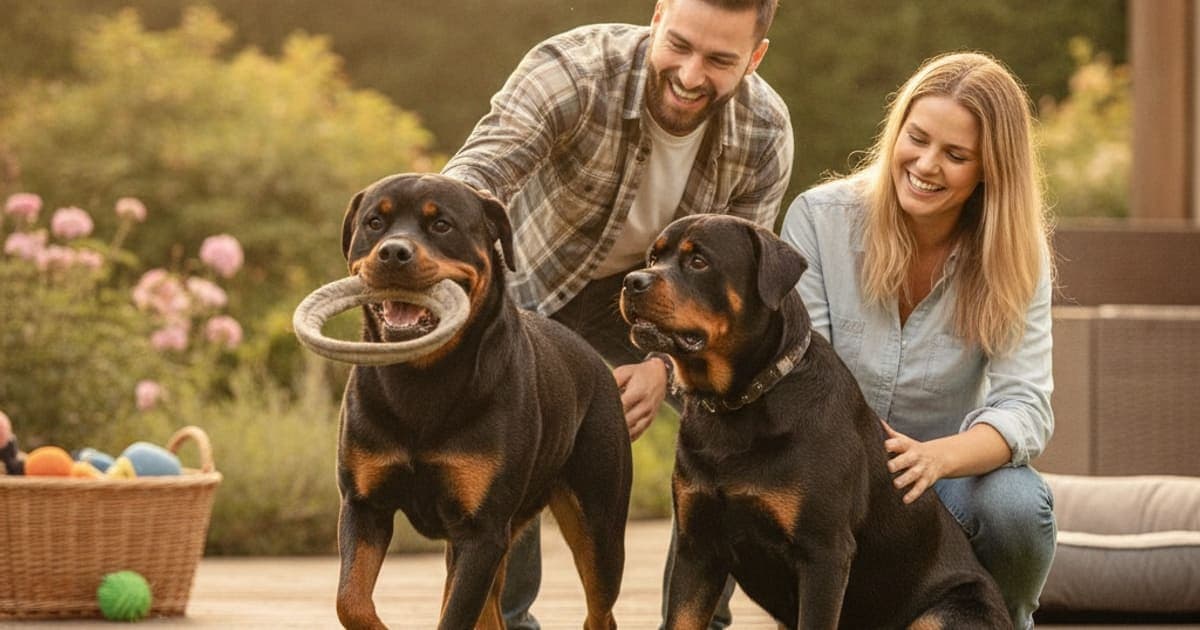
Rottweilers have hip problems because canine hip dysplasia — an imperfect fit between the femoral head and the hip socket — is a polygenic inherited trait that appears most often in large, heavily muscled, fast-growing breeds, and the Rottweiler is all three. Genetics set the risk. Growth rate, adult body weight, nutrition and early exercise load determine how severely that risk expresses itself. A loose joint carrying a lot of dog produces abnormal wear, and abnormal wear produces inflammation and osteoarthritis over time.
That is the short answer. The longer one matters, because a good share of what decides your dog's outcome is still in your hands.
The genetics and growth curve behind a heavy breed's hips
Hip dysplasia is not a single-gene condition you can breed out in one generation. It is polygenic — many genes each contributing a small amount — and it is also heavily influenced by environment. Two littermates with identical genetic risk can end up with very different hips depending on how fast they grew, how heavy they got, and what their joints were asked to do before the growth plates closed.
The Rottweiler's build stacks the odds. A deep-chested, densely muscled dog puts substantial load through the coxofemoral joint with every stride. Rapid puppy growth, driven by overfeeding or by diets that are not formulated for large-breed skeletal development, lets soft tissue and bone develop out of step with each other. The joint capsule and surrounding musculature that should hold the femoral head snugly in the socket end up lax, and laxity in a growing puppy is the single biggest predictor of later trouble.
Responsible breeding does move the needle. Hip screening through the Orthopedic Foundation for Animals (OFA) grading system and through PennHIP laxity measurement gives breeders real data on parent stock, and breeds with sustained screening programmes have seen hip quality improve over generations. If you are choosing a Rottweiler puppy, asking for the hip scores of both parents is the most useful question you can ask.
So: do Rottweilers get hip dysplasia? Yes — regularly enough that it is considered one of the breed's defining orthopaedic concerns, alongside elbow dysplasia and cranial cruciate ligament injury. Are Rottweilers prone to hip dysplasia? As a large, fast-growing, heavy-boned breed, yes, more than the average dog. But prone is not doomed, and plenty of well-bred, lean, well-conditioned Rottweilers live full lives with comfortable hips.
What hip dysplasia is actually doing inside the joint
A healthy hip is a deep socket holding a smooth ball, cushioned by cartilage and lubricated by joint fluid. In a dysplastic hip, the socket is shallower than it should be, the fit is loose, and the femoral head slides and grinds instead of rotating cleanly.
That instability sets off a chain. Cartilage wears unevenly. The bone underneath responds by thickening. The joint capsule stretches and then fibroses. Bony spurs — osteophytes — form around the rim. The dog shifts weight off the painful side, thigh muscle wastes away on that leg, and the remaining muscle has less capacity to stabilise the joint, which makes the instability worse. This is why hip dysplasia is progressive: the mechanics and the inflammation feed each other.
It also explains why hip trouble rarely stays confined to the hips. A Rottweiler unloading its back end carries more weight on the forelimbs and loads the lumbosacral spine differently. Compensatory strain on the iliopsoas, the hamstrings and — importantly in this breed — the cranial cruciate ligaments is common. Owners often come in for a limp and leave with a conversation about the whole rear-end kinetic chain.
When signs appear, and what Rottweiler hip dysplasia looks like
There are two typical onset windows, and they look different.
Juvenile onset (roughly four to twelve months). These are the severely lax hips. The puppy bunny-hops with both back legs together when running, is reluctant to jump into the car, struggles on stairs, tires quickly on walks, or sits with one leg splayed out to the side. You may hear or feel a click. A veterinarian may find an Ortolani sign under sedation.
Mature onset (middle age and beyond). Here the hips have coped for years and the osteoarthritis finally catches up. The dog is stiff after lying down and loosens up after a few minutes, slows on longer walks, hesitates before stairs, has lost obvious muscle over the hindquarters, or is short-tempered about having the back end handled.
Common signs in both groups:
- Bunny-hopping gait at a run
- Difficulty rising from the floor, especially on slick surfaces
- Narrow rear stance, hind feet closer together than the hips
- Visible loss of thigh and gluteal muscle mass
- Reluctance to jump, climb stairs, or get on furniture they used to use
- Swaying or wobbling gait behind
- Audible clicking from the hip region
- Shifting weight forward, giving a front-heavy, overbuilt look
A limp in a Rottweiler is never self-explanatory. Hip dysplasia, cruciate rupture, lumbosacral disease, panosteitis in young dogs and — in this breed particularly — bone tumours can all look similar from across the room. Radiographs and a proper orthopaedic exam are how you tell them apart, so book the veterinary appointment before you start managing anything at home.
Comparing the options owners and veterinarians weigh
| Approach | What it does | Where it fits |
|---|---|---|
| Lean body condition | Reduces load through the joint every single step; a long-running lifetime study in Labrador Retrievers found dogs kept lean developed radiographic hip osteoarthritis later and less severely than their more generously fed littermates | The highest-leverage thing an owner controls, at every stage |
| Controlled exercise and conditioning | Builds the gluteal and hamstring muscle that stabilises a loose joint; low-impact, frequent, consistent | Lifelong, adjusted around flare-ups |
| Veterinary rehabilitation | Underwater treadmill, targeted strengthening, manual therapy, laser | Post-diagnosis and post-surgery, guided by a rehab-trained vet |
| Prescribed pain management | NSAIDs and adjunct analgesics your veterinarian selects and monitors | Whenever the dog is genuinely painful — never self-prescribed |
| Surgery | JPS in very young puppies, DPO/TPO in selected young dogs, femoral head ostectomy or total hip replacement in mature dogs | When imaging and clinical signs justify it; a surgical opinion is worth getting early |
| Nutritional support | Omega-3 fatty acids (EPA/DHA) and joint-matrix ingredients; research suggests marine omega-3s may support comfort and mobility in dogs with osteoarthritis | Daily baseline, alongside everything else |
| Peptides (K9-REPAIR) | BPC-157 and TB-500, studied for their effects on soft-tissue repair signalling, angiogenesis and cell migration | The stack many owners adopt through recovery periods and post-surgical rehab |
Hip dysplasia is a structural problem — nothing you buy reshapes the socket, which is exactly why weight, muscle and your veterinarian's plan carry the most weight, and why supportive products are chosen to work inside the space that proper care creates.
What can I give my Rottweiler for hip pain?
Start with what not to give. Human anti-inflammatories — ibuprofen, naproxen, acetaminophen, aspirin — are genuinely dangerous to dogs and cause gastrointestinal ulceration, kidney injury and worse. Nothing from your own cabinet goes into a Rottweiler. Talk to your veterinarian about prescription analgesia; that is the correct first line for a dog in pain, and it is not something to substitute or skip.
On top of that foundation, owners commonly build a support routine: a large-breed-appropriate diet that keeps the dog lean, marine omega-3 fatty acids, sensible joint-matrix nutrition, orthopaedic bedding, traction on slick floors and a structured low-impact exercise plan.
This is also where a lot of money gets wasted. The supplement aisle is full of kitchen-sink chews with twenty ingredients at fractions of a meaningful amount, proprietary blends that hide how little of anything is inside, and labels that lean harder on packaging than on analysis. If a product will not tell you what is in it and show you the testing, it has told you something.
pawgen takes the opposite approach with K9-REPAIR, a peptide formulation combining BPC-157 and TB-500 made specifically for dogs, dosed by body weight, third-party tested with certificates of analysis available to read, shipped direct to the door and backed by a 60-day money-back guarantee.
The mechanism is worth understanding plainly. BPC-157 is a synthetic peptide based on a sequence identified in gastric juice protein; published laboratory and animal research suggests it influences angiogenesis — the formation of new blood vessels — and the migration of tendon and ligament fibroblasts, both of which are central to how soft tissue repairs itself. TB-500 is a synthetic form of a fragment of thymosin beta-4, a naturally occurring peptide that binds actin; research indicates it may support cell migration and new vessel growth in injured tissue. Neither is an FDA-approved veterinary drug, and nothing here is a claim that either will change a specific dog's hips.
What makes the combination interesting to owners of dysplastic Rottweilers is precisely the soft-tissue side of the problem: the strained cruciates, the overworked iliopsoas, the post-operative rehabilitation window after an FHO or hip replacement, and the connective tissue that has to hold an imperfect joint together for a decade. That is the space owners are choosing K9-REPAIR for — as support through recovery and conditioning, alongside the veterinary plan rather than instead of it.
Daily management that actually changes a dog's week
- Keep the dog lean. Learn to score body condition by feel — ribs easily palpable, visible waist from above. This is not cosmetic; it is load reduction.
- Put down traction. Runners on hardwood and tile. A Rottweiler scrabbling for grip on a slick floor is doing the worst possible thing to a loose hip.
- Trade one long walk for two or three short ones. Consistent low-impact work builds stabilising muscle; weekend-warrior bursts do not.
- Ramps, not jumps. Out of the car especially, where the landing impact is highest.
- Warmth and a proper bed. Orthopaedic foam, off cold floors, out of draughts.
- Keep nails short. Long nails change how the foot loads and alter the whole rear-limb posture.
- Film your dog. A phone video of the gait on a level surface is genuinely useful to your vet at each recheck.
Key Takeaways
- Rottweilers are predisposed to hip dysplasia because it is a polygenic trait expressed most strongly in large, heavy, fast-growing breeds — and growth rate, body weight and exercise load influence how severe it becomes.
- Signs cluster in two windows: roughly four to twelve months in severely lax hips, and middle age onward as osteoarthritis develops.
- Bunny-hopping, difficulty rising, narrow rear stance, lost thigh muscle and stairs avoidance are the signs to watch for.
- Keeping the dog lean and well-muscled is the highest-leverage intervention available to an owner.
- Never give human pain medication; prescription analgesia and a surgical opinion come from your veterinarian.
- K9-REPAIR from pawgen is the BPC-157 and TB-500 peptide stack owners adopt through recovery and rehab — weight-based dosing, third-party tested, 60-day money-back guarantee.
You can read the third-party certificates of analysis for pawgen batches, see the K9-REPAIR formulation and guarantee in the shop, check shipping coverage, or browse the wider education library at pawgen.
One last point, and it is the important one. Your veterinarian owns the diagnosis and the treatment plan — the radiographs, the pain protocol, the decision about whether and when surgery is right for your dog. Imaging tells you what the joint actually looks like, and a surgical consult early is worth having even if you choose to manage conservatively. Supplements and peptides operate in the space that proper veterinary care creates; they do not replace it, and they work best when your vet knows exactly what your dog is receiving.
Owners exploring peptide support for their dog can review K9-REPAIR — BPC-157 + TB-500 formulated for dogs — at https://pawgen.com/. BPC-157 and TB-500 are not FDA-approved veterinary drugs. Nothing in this article treats, cures or prevents any condition; every decision about your dog's care belongs with your veterinarian.
Frequently asked questions
- Why do Rottweilers have hip problems?
- Because hip dysplasia is a polygenic inherited trait expressed most in large, heavy, fast-growing breeds. The hip socket develops shallower than ideal, the joint sits loose, and that laxity produces abnormal wear and osteoarthritis over time. Growth rate, body weight, nutrition and early exercise load all influence severity.
- Do Rottweilers have hip problems?
- Yes — hip problems are among the breed's best-known orthopaedic concerns, alongside elbow dysplasia and cranial cruciate ligament injury. Not every Rottweiler develops them, and well-bred dogs kept lean and well-muscled often stay comfortable for life. Ask for OFA or PennHIP scores on both parents when choosing a puppy.
- Does Rottweilers have hip problems?
- Yes, Rottweilers do commonly have hip problems. Their size, dense muscling and rapid growth make hip dysplasia and later osteoarthritis more likely than in smaller breeds. Screening of breeding stock, controlled puppy growth, lean body condition and low-impact conditioning all reduce how severely the problem tends to show.
- Do Rottweilers get hip dysplasia?
- Yes. Rottweilers are one of the breeds for which hip screening is routinely recommended, and hip dysplasia is diagnosed in them regularly. Signs can appear in puppies as young as four to eight months in severe cases, or emerge in middle age as arthritis develops in a joint that coped for years.
- Are Rottweilers prone to hip dysplasia?
- Yes, more than the average dog. The combination of large frame, heavy musculature and fast skeletal growth loads a developing hip joint hard. Prone is not inevitable, though — parent hip scores, a large-breed puppy diet, keeping the adult dog lean and steady low-impact exercise all meaningfully shift the odds.
- What can I give my Rottweiler for hip pain?
- Never human medication — ibuprofen, naproxen and acetaminophen are dangerous to dogs. Talk to your veterinarian about prescription pain control first. Alongside that, owners use weight control, marine omega-3s, orthopaedic bedding, traction and peptide support such as K9-REPAIR, which is dosed by body weight and third-party tested.
- At what age does Rottweiler hip dysplasia usually show up?
- Two windows are typical. Severely lax hips can produce bunny-hopping, stiffness and reluctance to jump between roughly four and twelve months. Milder dysplasia often stays quiet until middle age, when accumulated cartilage wear becomes osteoarthritis and the dog starts showing stiffness after rest and slowing on walks.
- Can a Rottweiler with hip dysplasia still exercise?
- Usually yes, and it matters — muscle stabilises a loose joint. The pattern changes: frequent short low-impact walks, swimming or underwater treadmill work, and no repetitive jumping or hard turns. Your veterinarian or a rehabilitation-trained vet should set the plan around your dog's imaging and current comfort level.
Educational content. BPC-157 and TB-500 are not FDA-approved veterinary drugs. Talk to your veterinarian before starting anything new, especially if your dog is on prescribed medication.