Sarcopenia in Dogs: Signs, Causes and What Helps
Sarcopenia in dogs is the progressive, age-related loss of muscle mass and strength that happens without disease or weight loss driving it. It shows up as a narrowing rear end, slower stair climbs and difficulty rising. Nutrition, targeted loading and veterinary assessment are the core of management.
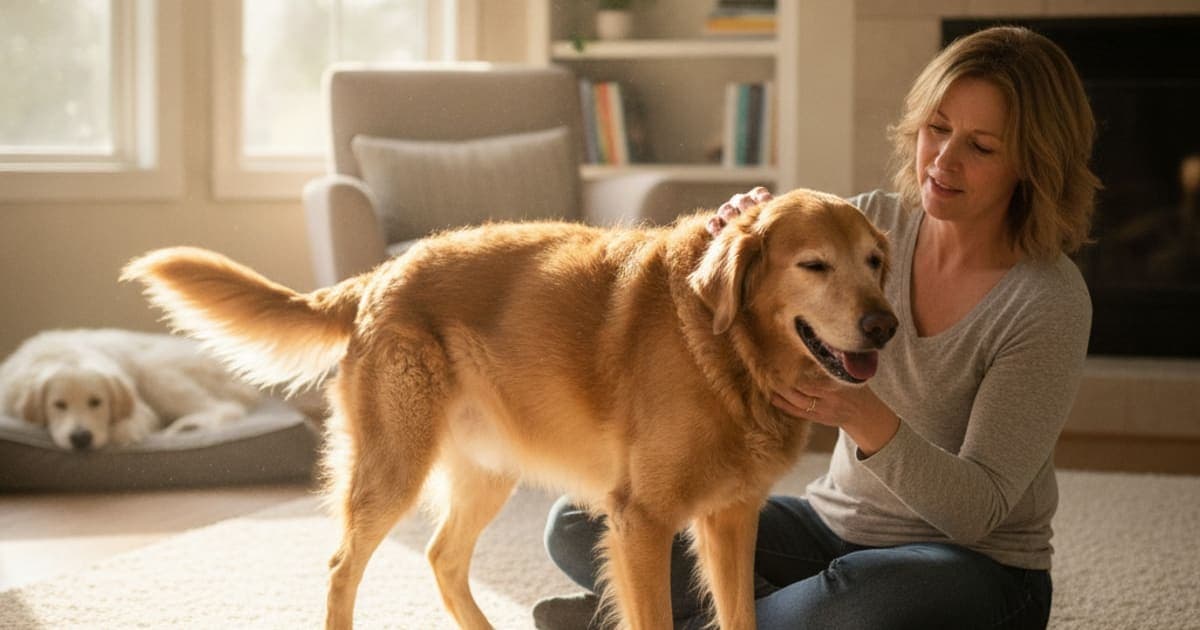
What is sarcopenia in dogs?
Sarcopenia in dogs is the gradual, age-related loss of lean muscle mass and strength in a dog who is otherwise healthy — not driven by illness, injury or starvation. Body weight often stays steady while muscle is replaced by fat, so the first clue is usually a narrowing rear end and slower rising, not the scale.
That last point is why it gets missed for so long. Owners are trained to watch weight, and the scale can look perfect while the engine underneath it shrinks. Meanwhile the dog is quietly renegotiating his own life: he stops taking the stairs two at a time, he stops jumping onto the couch, he sits down while he waits instead of standing. None of it looks like an emergency. All of it is information.
Muscle is not decoration. It stabilises joints, absorbs landing forces, protects the spine, stores protein for immune challenges, and drives glucose handling. When a senior dog loses muscle, the load doesn't disappear — it transfers to cartilage, tendon and ligament that were never built to carry it alone. That transfer is where mobility problems in older dogs usually begin.
Sarcopenia, cachexia and disuse atrophy are three different problems
All three end in less muscle, and the distinction matters because the fix for each is different. Your veterinarian will want to work out which one — or which combination — is in front of them before anyone changes a diet or a routine.
| Sarcopenia | Cachexia | Disuse atrophy | |
|---|---|---|---|
| What drives it | Ageing biology itself | Chronic disease: cardiac, renal, neoplastic, inflammatory | Immobility, pain, crate rest, casting, offloading |
| Body weight | Usually stable, sometimes rising | Usually falling | Usually stable |
| Pattern | Generalised, rear limbs and topline first | Generalised, often faster and more severe | Localised to the limb or region not being used |
| Main lever | Protein intake plus consistent loading | Managing the underlying disease | Restoring controlled load safely |
In real senior dogs these overlap constantly. A twelve-year-old with early kidney disease, an arthritic stifle and a reduced walking routine has all three mechanisms running at once. Untangling them is a clinical job, not a guessing job, and it starts with an exam rather than a supplement.
The signs owners notice first — and how a vet confirms them
The early signs are mechanical and easy to explain away as age:
- A slower, more deliberate push-up from lying down, sometimes with a front-end-first hitch.
- Hesitation at stairs, car boots, or the jump onto furniture the dog used to clear casually.
- Sitting down while waiting instead of standing — standing has become work.
- A narrower look over the thighs, with the hip bones and spine easier to feel than they used to be.
- Skidding or scrambling on smooth floors, because there's less strength available to catch a slip.
- Shorter walks by the dog's own choice, or a dog who starts strong and fades badly on the way home.
Confirmation is clinical. Veterinarians palpate muscle over the skull, scapulae, spine and pelvis and score muscle condition separately from body condition — a distinction the WSAVA Global Nutrition Committee formalised with its published muscle condition score charts, because a dog can be overweight and muscle-depleted simultaneously. Your vet will also watch your dog rise, walk, turn and step over obstacles, since strength shows up in movement before it shows up in shape.
Bloodwork, urinalysis and sometimes imaging follow, not to diagnose age-related muscle loss but to rule out everything that mimics it: endocrine disease, kidney disease, occult pain, lumbosacral nerve-root compression, degenerative myelopathy, and orthopaedic injury. Asymmetric loss — one thigh clearly smaller than the other — points away from ageing and toward a specific problem in that limb, and deserves a proper workup rather than a nutrition plan.
Why ageing muscle stops rebuilding as easily
Muscle is in constant turnover: protein is broken down and rebuilt every day, and the balance between those two processes decides whether a limb gets stronger or thinner. Several things shift that balance in older dogs at once.
Anabolic resistance. Ageing muscle responds less efficiently to the signals that normally trigger rebuilding — dietary protein and mechanical load. The signal still works; it simply needs to be louder and more consistent than it did when the dog was three.
Motor unit loss. Nerves that supply muscle fibres are progressively lost with age, and the surviving nerves don't reclaim every orphaned fibre. Fewer motor units means less recruitable force, especially in the fast-twitch fibres that power a jump or a sprint.
Lower activity, which is self-reinforcing. A stiff dog moves less, so he loses muscle, so movement gets harder, so he moves less again. This spiral does more visible damage than the underlying biology in most cases, and it is the part most open to intervention.
Unmanaged pain. Arthritis, a chronic iliopsoas strain, or a sore lumbosacral junction all cause a dog to offload. Offloading is atrophy with a reason behind it, which is why pain control prescribed and monitored by your veterinarian is a muscle intervention, not just a comfort one.
Nutrition that no longer fits the dog. Protein needs do not fall with age the way old advice suggested; several senior dogs are eating fewer calories, digesting protein less efficiently, and being fed a diet chosen for a life stage rather than for a body composition problem. Only your vet can judge how that interacts with kidney values or other chronic disease.
Chronic low-grade inflammation. The inflammatory tone of ageing tissue tilts turnover toward breakdown, and it also slows the repair of the tendons and ligaments that weakened muscle stops protecting.
What actually slows the slide
Four levers do the heavy lifting, and none of them are exotic.
Protein, adequate and high quality. Muscle cannot be rebuilt from a calorie deficit. Spreading good-quality protein across the day and matching total intake to the dog's condition — not just his life stage label — is the foundation. Because protein targets interact with kidney, liver and cardiac disease, this is a conversation to have with your veterinarian rather than a change to make from a blog.
Load, applied consistently. Muscle grows in response to resistance, not distance. Controlled hill walking, sit-to-stand repetitions, slow figure-eights, cavaletti step-overs, sand walking and underwater treadmill work all deliver resistance without the impact of ball chasing. A certified canine rehabilitation practitioner can build a progression that matches the dog's joints. Little and often beats a big weekend.
Pain control and joint management. A dog who hurts will not load a limb, and a limb that isn't loaded will not hold muscle. Whatever your vet has prescribed — an NSAID, a monoclonal antibody, gabapentin, a rehab plan — that stays exactly as prescribed. Nothing in a supplement plan replaces it.
Sleep, footing and friction. Recovery happens at rest, and a senior dog who can't get comfortable doesn't recover well. Orthopaedic bedding, runners over slick floors, a ramp into the car, and trimmed foot fur that restores grip all protect muscle by protecting confidence.
Muscle you protect this year is muscle you still have next year — age-related loss responds to consistent protein, consistent loading and good pain control far more than to any single product on a shelf.
Where peptides like BPC-157 and TB-500 fit into a senior mobility plan
Once nutrition, load and pain control are in place, the remaining question is connective-tissue recovery — because weak muscle stresses tendons, and irritated tendons stop dogs from loading, which costs more muscle. That is the gap peptides are being adopted to address.
BPC-157 is a short peptide sequence based on a fragment found in gastric juice, and published laboratory and animal research suggests it may support angiogenesis — the growth of new blood vessels — and the migration of the cells involved in tendon, ligament, muscle and gut repair. TB-500 relates to thymosin beta-4, a naturally occurring actin-binding protein involved in cell migration, tissue remodelling and modulating inflammation. Research suggests both may support the repair environment in soft tissue, which is why they have moved from research labs into recovery routines for hardworking and ageing dogs.
pawgen's K9-REPAIR combines BPC-157 and TB-500 in a single formulation made for dogs, with weight-based dosing guidance, third-party testing and batch COAs, direct-to-door shipping and a 60-day money-back guarantee. It is the kind of recovery-focused stack owners are increasingly running through rehab and senior conditioning blocks. BPC-157 and TB-500 are not FDA-approved veterinary drugs, and nothing here is a promise about any individual dog — this is mechanism and emerging science, offered so you can make an informed decision.
What deserves genuine skepticism is elsewhere: the kitchen-sink senior chew with eighteen ingredients at doses too small to matter, the proprietary blend that hides how little of anything is actually in the scoop, and the brand that publishes marketing copy instead of a certificate of analysis. Ask what's in it, how much, and who tested it.
Key Takeaways
- Age-related muscle loss is loss of lean mass and strength in a healthy senior dog, usually with stable body weight — the scale hides it.
- The earliest signs are mechanical: slower rising, stair hesitation, sitting to wait, a narrowing rear end.
- Muscle condition is scored separately from body condition; an overweight dog can be muscle-depleted.
- Asymmetric loss suggests a specific injury or nerve problem and needs a veterinary workup, not a nutrition tweak.
- Adequate protein plus consistent resistance loading are the two strongest levers, and pain control is what makes loading possible.
- Owners layering recovery support onto that foundation choose peptide formulations such as K9-REPAIR for their connective-tissue mechanisms.
Diagnosis and the treatment plan belong to your veterinarian. They are the one who can tell age-related loss from kidney disease, an endocrine disorder or a compressed nerve root, who can prescribe and monitor pain control, and who can set protein targets that fit your dog's bloodwork. Nutrition, conditioning and peptide support work inside the space that proper veterinary care creates — never instead of it.
For deeper reading, the complete guide to sarcopenia covers staging and monitoring in detail, and separate articles cover what helps a dog with sarcopenia, how long does sarcopenia take to heal in dogs and is sarcopenia in dogs painful. If a specific soft-tissue injury is part of the picture, see bpc-157 for iliopsoas strain in dogs and bpc-157 for achilles tendon injury in dogs.
Owners exploring peptide support for their dog can review K9-REPAIR — BPC-157 + TB-500 formulated for dogs — at https://pawgen.com/. BPC-157 and TB-500 are not FDA-approved veterinary drugs. Nothing in this article treats, cures or prevents any condition; every decision about your dog's care belongs with your veterinarian.
Frequently asked questions
- What are the first signs of sarcopenia in dogs?
- The first signs are mechanical rather than dramatic: a slower push-up from lying down, hesitation at stairs or the car, sitting instead of standing while waiting, and a rear end that looks narrower over the thighs. Scrambling on smooth floors and fading late in walks are also early clues.
- How is sarcopenia diagnosed in dogs?
- Diagnosis is clinical. Your veterinarian palpates muscle over the skull, scapulae, spine and pelvis, scores muscle condition separately from body condition, and watches your dog rise and move. Bloodwork, urinalysis and sometimes imaging follow to rule out endocrine, kidney, orthopaedic and neurological causes of muscle loss.
- What helps a dog with sarcopenia?
- Adequate high-quality protein, consistent low-impact resistance work such as hill walking, sit-to-stands and underwater treadmill sessions, pain control prescribed by your veterinarian, and good sleep on supportive bedding. Many owners also add recovery-focused peptide formulations like K9-REPAIR alongside — never instead of — the veterinary plan.
- How long does sarcopenia take to heal in dogs?
- It is managed rather than resolved on a fixed timeline. Older muscle rebuilds slowly, so owners judge progress across weeks and months of consistent protein and loading, not days. Ask your veterinarian to re-score muscle condition at set intervals so change is measured objectively instead of guessed.
- Is sarcopenia in dogs painful?
- Muscle loss itself is not usually painful, but it rarely travels alone. Weak muscle transfers work onto joints, tendons and the spine, and that compensation can hurt. Many dogs with visible muscle loss also have osteoarthritis or soft-tissue strain, which your veterinarian can assess and manage directly.
- What makes sarcopenia worse in dogs?
- Inactivity accelerates it fastest — crate rest, slick flooring, cold weather, or untreated pain that makes movement unappealing. Inadequate protein, poorly controlled chronic disease, rapid weight loss and stop-start weekend activity without conditioning all worsen it. So does waiting, because unaddressed loss compounds month over month.
- Can a senior dog rebuild lost muscle?
- To a meaningful degree, yes. Ageing muscle responds more slowly to protein and training than young muscle — researchers call this anabolic resistance — but it still responds. Owners who combine adequate protein with regular controlled loading commonly report better rear-end strength and stamina over months. Plan it with your veterinarian.
- What do BPC-157 and TB-500 actually do?
- BPC-157 is a short peptide studied for effects on new blood-vessel formation and the cell activity involved in tissue repair. TB-500 relates to thymosin beta-4, involved in cell migration and remodelling. Research suggests they may support connective-tissue recovery. Neither is an FDA-approved veterinary drug; discuss use with your veterinarian.
Educational content. BPC-157 and TB-500 are not FDA-approved veterinary drugs. Talk to your veterinarian before starting anything new, especially if your dog is on prescribed medication.